lights KIA RIO HATCHBACK 2007 Owner's Manual
[x] Cancel search | Manufacturer: KIA, Model Year: 2007, Model line: RIO HATCHBACK, Model: KIA RIO HATCHBACK 2007Pages: 221, PDF Size: 2.65 MB
Page 163 of 221
67
In case of an emergency
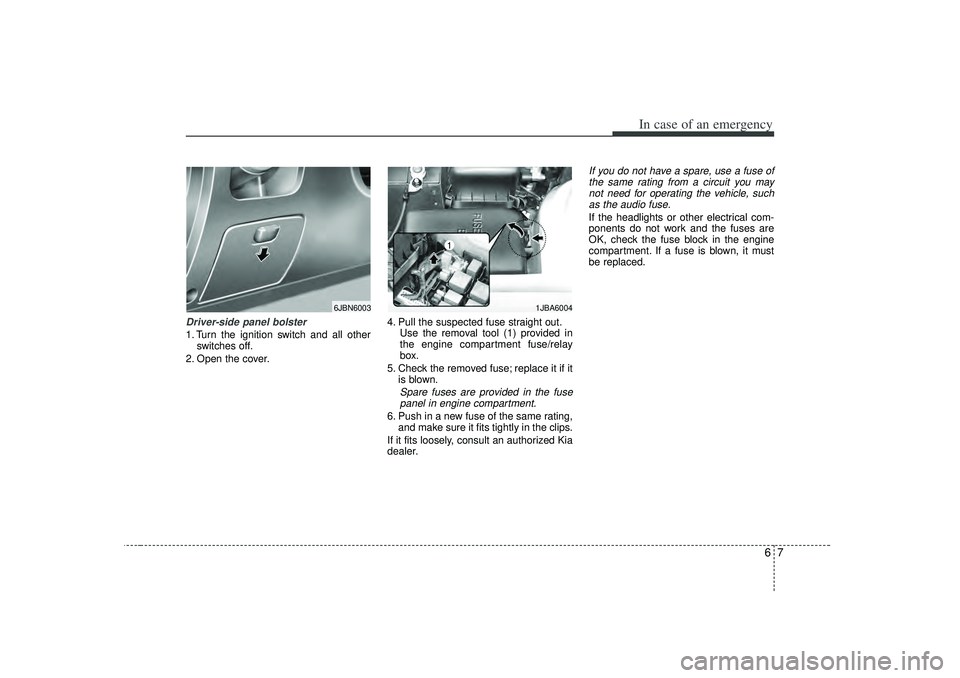
Driver-side panel bolster1. Turn the ignition switch and all otherswitches off.
2. Open the cover. 4. Pull the suspected fuse straight out.
Use the removal tool (1) provided in
the engine compartment fuse/relay
box.
5. Check the removed fuse; replace it if it is blown.
Spare fuses are provided in the fusepanel in engine compartment.
6. Push in a new fuse of the same rating, and make sure it fits tightly in the clips.
If it fits loosely, consult an authorized Kia
dealer.
If you do not have a spare, use a fuse of the same rating from a circuit you maynot need for operating the vehicle, such as the audio fuse.If the headlights or other electrical com-
ponents do not work and the fuses are
OK, check the fuse block in the engine
compartment. If a fuse is blown, it must
be replaced.
1JBA6004
1
6JBN6003
Page 168 of 221
In case of an emergency12
6Memory fuseYour vehicle is equipped with a memory
fuse to prevent battery discharge if your
vehicle is parked without being operated
for prolonged periods. Use the following
procedures before parking the vehicle for
prolonged period.
1. Turn off the engine.
2. Turn off the headlights and tail lights.
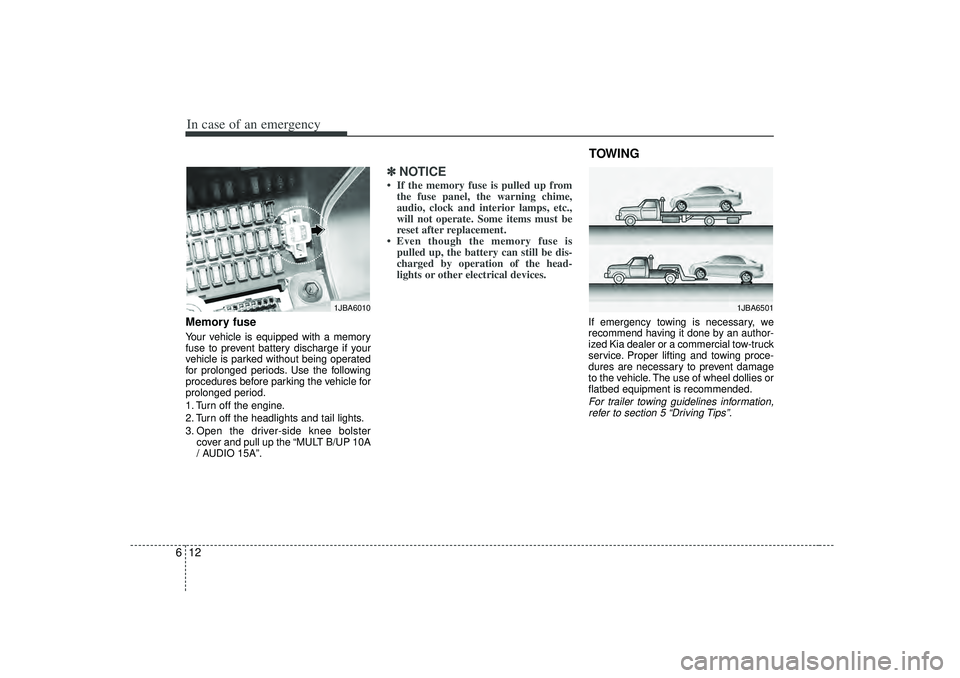
3. Open the driver-side knee bolster
cover and pull up the “MULT B/UP 10A
/ AUDIO 15A”.
✽ ✽NOTICE• If the memory fuse is pulled up from
the fuse panel, the warning chime,
audio, clock and interior lamps, etc.,
will not operate. Some items must be
reset after replacement.
• Even though the memory fuse is pulled up, the battery can still be dis-
charged by operation of the head-
lights or other electrical devices.
If emergency towing is necessary, we
recommend having it done by an author-
ized Kia dealer or a commercial tow-truck
service. Proper lifting and towing proce-
dures are necessary to prevent damage
to the vehicle. The use of wheel dollies or
flatbed equipment is recommended.For trailer towing guidelines information,
refer to section 5 “Driving Tips”.
1JBA6010
TOWING
1JBA6501
Page 185 of 221
77
Maintenance
OWNER MAINTENANCE Owner maintenance schedule The following lists are vehicle checks and
inspections that should be performed by
the owner or an authorized Kia dealer at
the frequencies indicated to help ensure
safe, dependable operation of your vehi-
cle.
Any adverse conditions should be
brought to the attention of your dealer as
soon as possible.
These Owner Maintenance Checks are
generally not covered by warranties and
you may be charged for labor, parts and
lubricants used.When you stop for fuel: Check the engine oil level.
Check coolant level in coolant reser-voir.
Check the windshield washer fluid level.
Look for low or under-inflated tires.
While operating your vehicle: Note any changes in the sound of the exhaust or any smell of exhaust fumes
in the vehicle.
Check for vibrations in the steering wheel. Notice any increased steering
effort or looseness in the steering
wheel, or change in its straight-ahead
position.
Notice if your vehicle constantly turns slightly or “pulls” to one side when trav-
eling on smooth, level road.
When stopping, listen and check for strange sounds, pulling to one side,
increased brake pedal travel or “hard-
to-push” brake pedal.
If any slipping or changes in the oper- ation of your transaxle occurs, check
the transaxle fluid level.
Check automatic transaxle P (Park) function.
Check parking brake.
Check for fluid leaks under your vehicle (water dripping from the air condition-
ing system during or after use is nor-
mal).
At least monthly: Check coolant level in the coolantrecovery reservoir.
Check the operation of all exterior lights, including the stoplights, turn sig-
nals and hazard warning flashers.
Check the inflation pressures of all tires including the spare.At least twice a year (i.e., every Spring and Fall) : Check radiator, heater and air condi- tioning hoses for leaks or damage.
Check windshield washer spray and wiper operation. Clean wiper blades
with clean cloth dampened with wash-
er fluid.
Check headlight alignment.
Check muffler, exhaust pipes, shields and clamps.
Check the lap/shoulder belts for wear and function.
Check for worn tires and loose wheel lug nuts.
WARNING
Be careful when checking your
engine coolant level when the
engine is hot. Scalding hot coolant
and steam may blow out under
pressure. This could cause burns or
other serious injury.
Page 200 of 221
Maintenance22
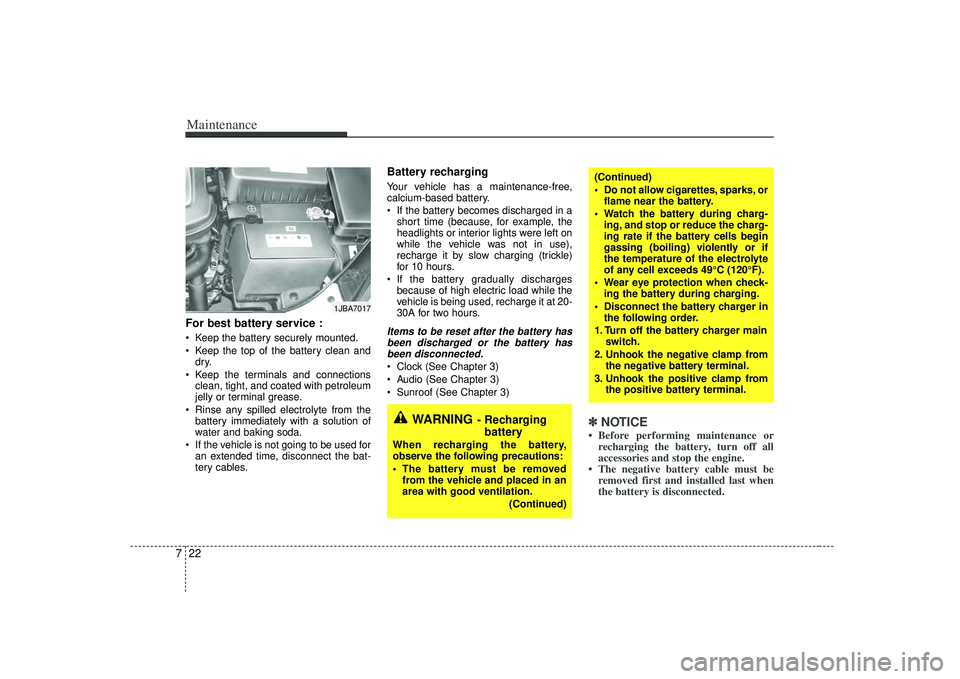
7For best battery service : Keep the battery securely mounted.
Keep the top of the battery clean and
dry.
Keep the terminals and connections clean, tight, and coated with petroleum
jelly or terminal grease.
Rinse any spilled electrolyte from the battery immediately with a solution of
water and baking soda.
If the vehicle is not going to be used for an extended time, disconnect the bat-
tery cables.
Battery recharging Your vehicle has a maintenance-free,
calcium-based battery.
If the battery becomes discharged in ashort time (because, for example, the
headlights or interior lights were left on
while the vehicle was not in use),
recharge it by slow charging (trickle)
for 10 hours.
If the battery gradually discharges because of high electric load while the
vehicle is being used, recharge it at 20-
30A for two hours.Items to be reset after the battery hasbeen discharged or the battery hasbeen disconnected. Clock (See Chapter 3)
Audio (See Chapter 3)
Sunroof (See Chapter 3)
✽ ✽ NOTICE• Before performing maintenance or
recharging the battery, turn off all
accessories and stop the engine.
• The negative battery cable must be removed first and installed last when
the battery is disconnected.
1JBA7017
WARNING
- Recharging
battery
When recharging the battery,
observe the following precautions:
The battery must be removed
from the vehicle and placed in an
area with good ventilation.
(Continued)
(Continued)
Do not allow cigarettes, sparks, orflame near the battery.
Watch the battery during charg- ing, and stop or reduce the charg-
ing rate if the battery cells begin
gassing (boiling) violently or if
the temperature of the electrolyte
of any cell exceeds 49°C (120°F).
Wear eye protection when check- ing the battery during charging.
Disconnect the battery charger in the following order.
1. Turn off the battery charger main switch.
2. Unhook the negative clamp from the negative battery terminal.
3. Unhook the positive clamp from the positive battery terminal.
Page 218 of 221
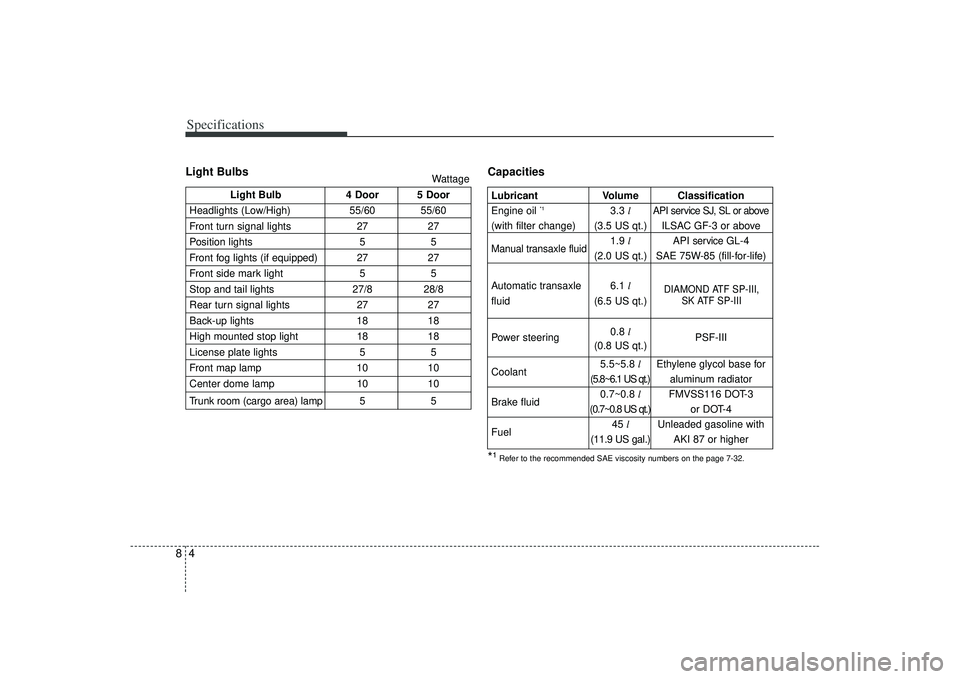
Specifications48Light BulbsCapacities
Light Bulb4 Door 5 Door
Headlights (Low/High) 55/60 55/60
Front turn signal lights 2727
Position lights 55
Front fog lights (if equipped) 27 27
Front side mark light 55
Stop and tail lights 27/8 28/8
Rear turn signal lights 2727
Back-up lights 1818
High mounted stop light 1818
License plate lights 55
Front map lamp 1010
Center dome lamp 1010
Trunk room (cargo area) lamp 5 5
Wattage
LubricantVolume Classification
Engine oil
*1
3.3 l
API service SJ, SL or above
(with filter change) (3.5 US qt.) ILSAC GF-3 or aboveManual transaxle fluid
1.9 l API
service
GL-4
(2.0 US qt.) SAE 75W-85 (fill-for-life)
Automatic transaxle 6.1 l
fluid (6.5 US qt.)
Power steering 0.8
l
PSF-III
(0.8 US qt.)
Coolant 5.5~5.8
lEthylene glycol base for
(5.8~6.1 US qt.) aluminum radiator
Brake fluid 0.7~0.8
lFMVSS116 DOT-3
(0.7~0.8 US qt.) o r D OT- 4
Fuel 45
l Unleaded gasoline with
(11.9 US gal.) AKI 87 or higher
*¹Refer to the recommended SAE viscosity numbers on the page 7-32.
DIAMOND ATF SP-III,
SK ATF SP-III
Page 220 of 221

Index29Air bags-supplemental restraint system··················\
·······3-47
Air cleaner ··················\
··················\
··················\
···············7-17
Antenna ··················\
··················\
··················\
··················\
··3-80
Audio system ··················\
··················\
··················\
···········3-81
Automatic transaxle··················\
··················\
············4-6, 7-15
Battery··················\
··················\
··················\
··················\
····7-21
Before driving ··················\
··················\
··················\
············5-4
Brake fluid ··················\
··················\
··················\
···············7-13
Brake system··················\
··················\
··················\
··············4-9
Climate control air filter ··················\
··················\
············7-18
Climate control system ··················\
··················\
··············4-30
Defroster ··················\
··················\
··················\
··················\
4-29
Door locks··················\
··················\
··················\
··················\
3-9
Drive belts··················\
··················\
··················\
················7-14
Electrical circuit protection ··················\
··················\
·········6-6
Emergency starting ··················\
··················\
··················\
····6-3
Emission control system ··················\
··················\
··············5-2Engine compartment ··················\
··················\
············2-4, 7-9
Engine cooling system ··················\
··················\
···············7-11
Engine oil ··················\
··················\
··················\
·················7-10\
Exterior care··················\
··················\
··················\
·············7-33
Fuel filler lid ··················\
··················\
··················\
············3-65
Fuel requirements ··················\
··················\
··················\
······5-2
Gauges ··················\
··················\
··················\
··················\
···4-17
Hazard warning flasher··················\
··················\
··············4-29
Hood··················\
··················\
··················\
··················\
·······3-64
How to use this manual ··················\
··················\
···············1-2
If you have a flat tire ··················\
··················\
·················6-17\
Ignition switch ··················\
··················\
··················\
···········4-2
Immobilizer system ··················\
··················\
··················\
···3-7
Instrument cluster ··················\
··················\
··················\
····4-16
Instrument panel overview ··················\
··················\
··········2-3
Interior care··················\
··················\
··················\
··············7-35
Interior features··················\
··················\
··················\
········3-73
Interior lights ··················\
··················\
··················\
···········3-71
Interior overview ··················\
··················\
··················\
·······2-2ABCED
FGHI