parking brake KIA RIO HATCHBACK 2007 Owner's Manual
[x] Cancel search | Manufacturer: KIA, Model Year: 2007, Model line: RIO HATCHBACK, Model: KIA RIO HATCHBACK 2007Pages: 221, PDF Size: 2.65 MB
Page 169 of 221
613
In case of an emergency
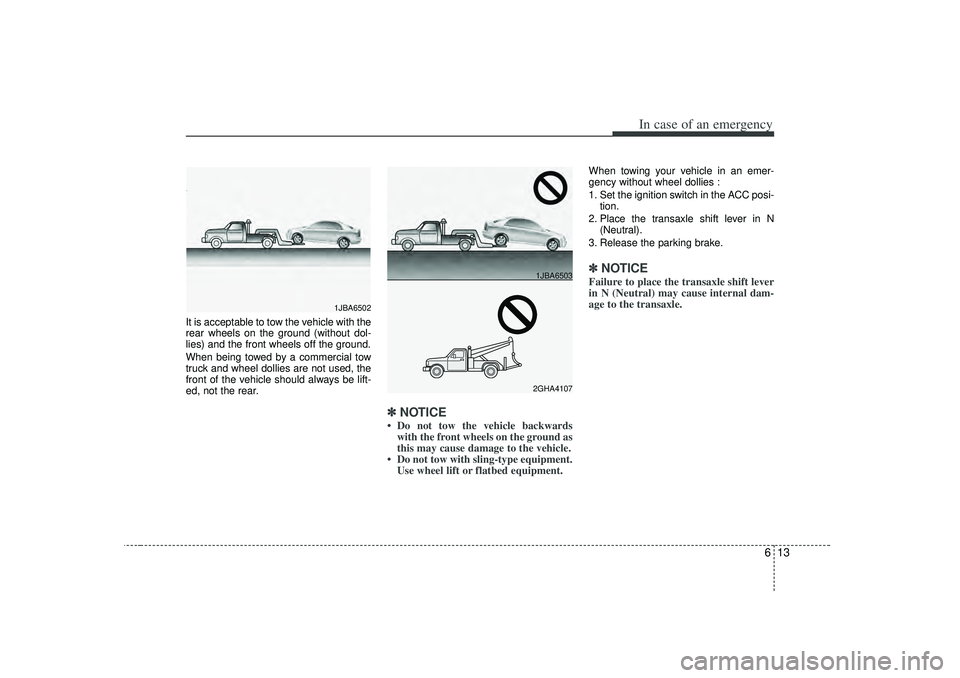
It is acceptable to tow the vehicle with the
rear wheels on the ground (without dol-
lies) and the front wheels off the ground.
When being towed by a commercial tow
truck and wheel dollies are not used, the
front of the vehicle should always be lift-
ed, not the rear.
✽ ✽NOTICE• Do not tow the vehicle backwards
with the front wheels on the ground as
this may cause damage to the vehicle.
• Do not tow with sling-type equipment. Use wheel lift or flatbed equipment.
When towing your vehicle in an emer-
gency without wheel dollies :
1. Set the ignition switch in the ACC posi-
tion.
2. Place the transaxle shift lever in N (Neutral).
3. Release the parking brake.✽ ✽ NOTICEFailure to place the transaxle shift lever
in N (Neutral) may cause internal dam-
age to the transaxle.
2GHA41071JBA6503
1JBA6502
Page 172 of 221
In case of an emergency16
6 Before emergency towing, check that
the hook is not broken or damaged.
Fasten the towing cable or chain securely to the hook.
Do not jerk the hook. Apply steady and even force.
To avoid damaging the hook, do not pull from the side or at a vertical angle.
Always pull straight ahead.
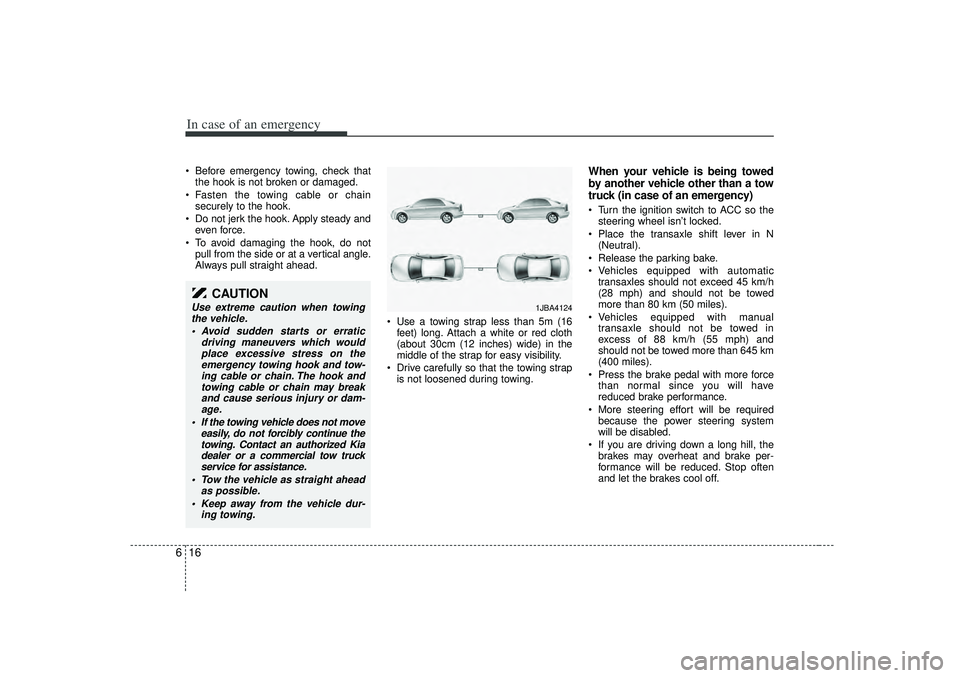
Use a towing strap less than 5m (16feet) long. Attach a white or red cloth
(about 30cm (12 inches) wide) in the
middle of the strap for easy visibility.
Drive carefully so that the towing strap is not loosened during towing.
When your vehicle is being towed
by another vehicle other than a tow
truck (in case of an emergency) Turn the ignition switch to ACC so thesteering wheel isn’t locked.
Place the transaxle shift lever in N (Neutral).
Release the parking bake.
Vehicles equipped with automatic transaxles should not exceed 45 km/h
(28 mph) and should not be towed
more than 80 km (50 miles).
Vehicles equipped with manual transaxle should not be towed in
excess of 88 km/h (55 mph) and
should not be towed more than 645 km
(400 miles).
Press the brake pedal with more force than normal since you will have
reduced brake performance.
More steering effort will be required because the power steering system
will be disabled.
If you are driving down a long hill, the brakes may overheat and brake per-
formance will be reduced. Stop often
and let the brakes cool off.
CAUTION
Use extreme caution when towingthe vehicle.
Avoid sudden starts or erratic driving maneuvers which wouldplace excessive stress on theemergency towing hook and tow- ing cable or chain. The hook andtowing cable or chain may breakand cause serious injury or dam- age.
If the towing vehicle does not move easily, do not forcibly continue thetowing. Contact an authorized Kiadealer or a commercial tow truckservice for assistance.
Tow the vehicle as straight ahead as possible.
Keep away from the vehicle dur- ing towing.
1JBA4124
Page 175 of 221
619
In case of an emergency
Changing tires Jacking instructions The jack is provided for emergency tire
changing only.
Follow jacking instructions to reduce the
possibility of personal injury.
Tire replacement 1. Park on a level surface and apply theparking brake firmly.
2. Shift the shift lever into R (Reverse) with manual transaxle or P (Park) with
automatic transaxle.
3. Activate the hazard warning flasher.
WARNING
- Changing tires
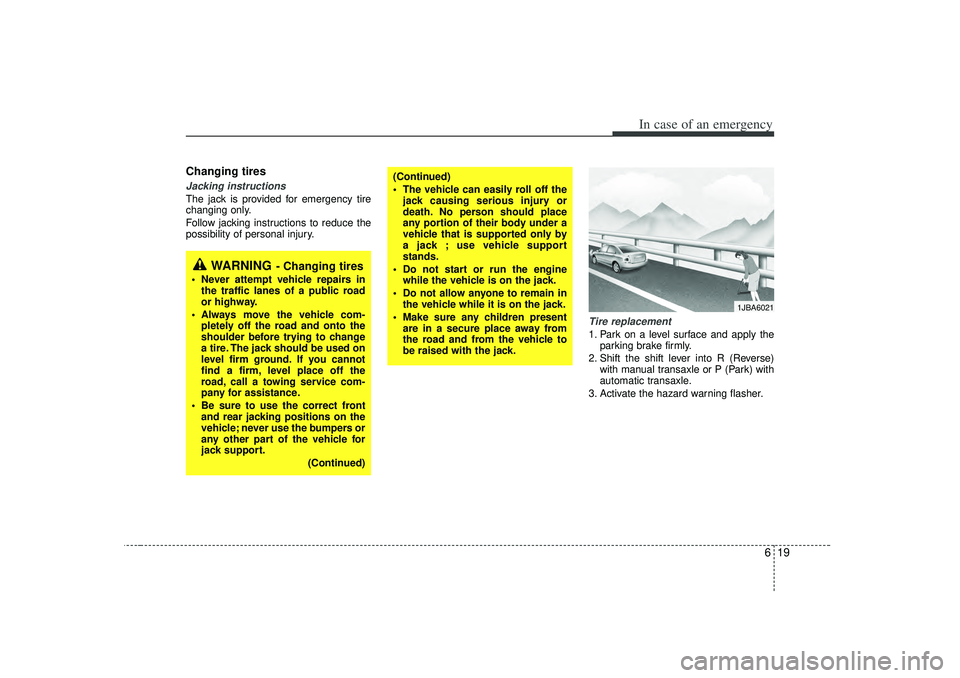
Never attempt vehicle repairs in the traffic lanes of a public road
or highway.
Always move the vehicle com- pletely off the road and onto the
shoulder before trying to change
a tire. The jack should be used on
level firm ground. If you cannot
find a firm, level place off the
road, call a towing service com-
pany for assistance.
Be sure to use the correct front and rear jacking positions on the
vehicle; never use the bumpers or
any other part of the vehicle for
jack support.
(Continued)
(Continued)
The vehicle can easily roll off thejack causing serious injury or
death. No person should place
any portion of their body under a
vehicle that is supported only by
a jack ; use vehicle support
stands.
Do not start or run the engine while the vehicle is on the jack.
Do not allow anyone to remain in the vehicle while it is on the jack.
Make sure any children present are in a secure place away from
the road and from the vehicle to
be raised with the jack.
1JBA6021
Page 176 of 221
In case of an emergency20
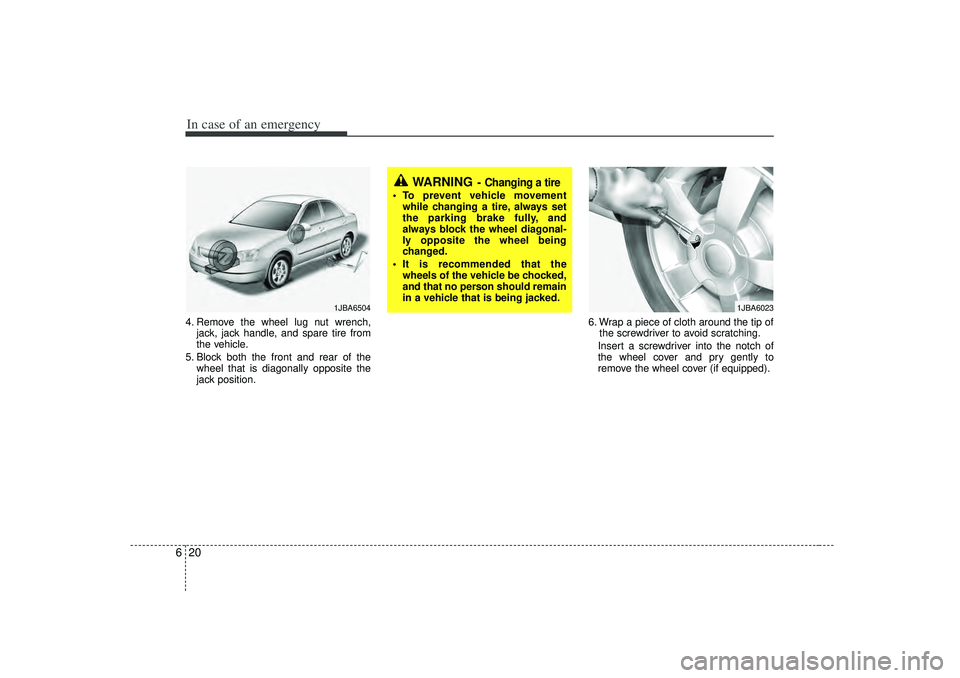
64. Remove the wheel lug nut wrench,
jack, jack handle, and spare tire from
the vehicle.
5. Block both the front and rear of the wheel that is diagonally opposite the
jack position. 6. Wrap a piece of cloth around the tip of
the screwdriver to avoid scratching.
Insert a screwdriver into the notch of
the wheel cover and pry gently to
remove the wheel cover (if equipped).
WARNING
- Changing a tire
To prevent vehicle movement while changing a tire, always set
the parking brake fully, and
always block the wheel diagonal-
ly opposite the wheel being
changed.
It is recommended that the wheels of the vehicle be chocked,
and that no person should remain
in a vehicle that is being jacked.
1JBA6504
1JBA6023
Page 182 of 221
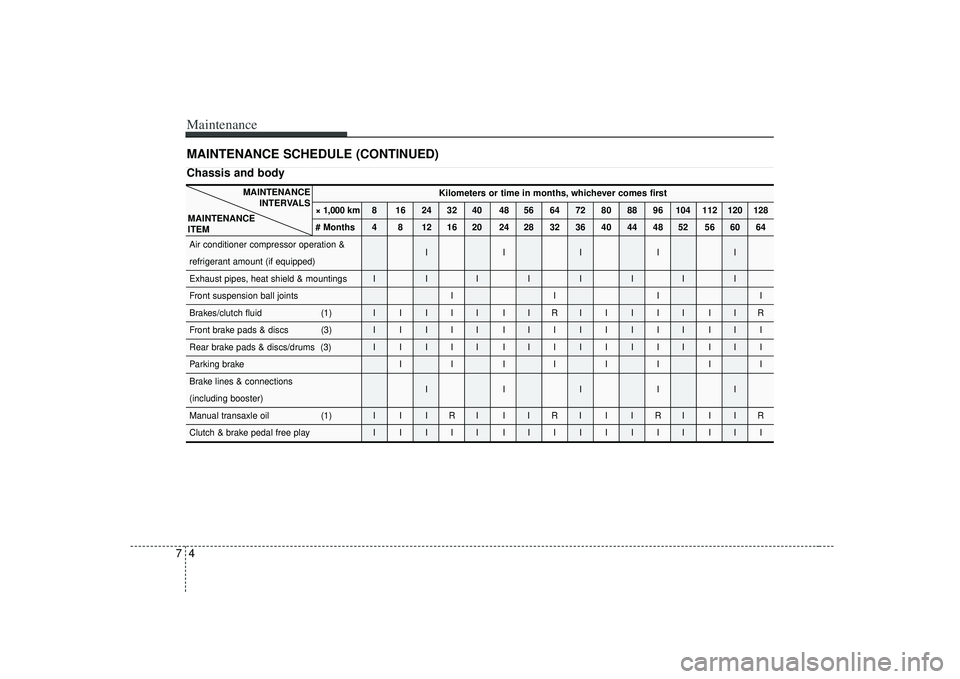
Maintenance47MAINTENANCE SCHEDULE (CONTINUED)Chassis and body
Kilometers or time in months, whichever comes first
× 1,000 km 8 16 24 32 40 48 56 64 72 80 88 96 104 112 120 128
# Months 4 8 12 16 20 24 28 32 36 40 44 48 52 56 60 64
Air conditioner compressor operation & IIIII
refrigerant amount (if equipped)
Exhaust pipes, heat shield & mountings I I IIIIII
Front suspension ball joints I I I I
Brakes/clutch fluid (1) I I I I I I I R IIIII IIR
Front brake pads & discs (3) I I I I I I IIIIIII III
Rear brake pads & discs/drums (3) I I I I I I IIIIIII III
Parking brake I I I IIIII
Brake lines & connections IIIII
(including booster)
Manual transaxle oil (1) I I I R I I I R I I I R I I I R
Clutch & brake pedal free play I I I I I I IIIIIII III
MAINTENANCE
INTERVALS
MAINTENANCE
ITEM
Page 185 of 221
77
Maintenance
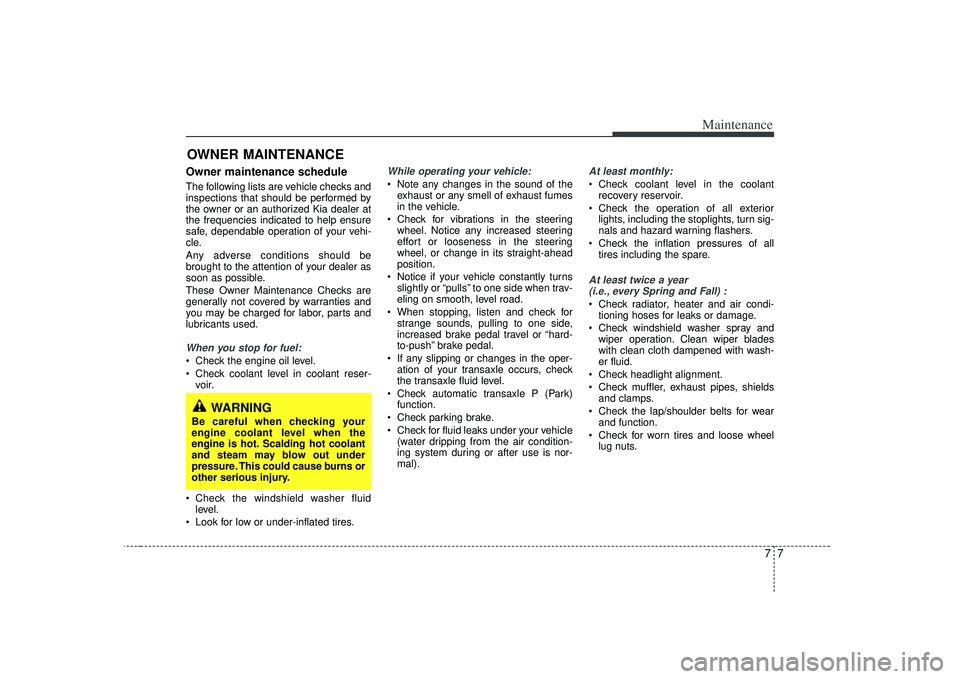
OWNER MAINTENANCE Owner maintenance schedule The following lists are vehicle checks and
inspections that should be performed by
the owner or an authorized Kia dealer at
the frequencies indicated to help ensure
safe, dependable operation of your vehi-
cle.
Any adverse conditions should be
brought to the attention of your dealer as
soon as possible.
These Owner Maintenance Checks are
generally not covered by warranties and
you may be charged for labor, parts and
lubricants used.When you stop for fuel: Check the engine oil level.
Check coolant level in coolant reser-voir.
Check the windshield washer fluid level.
Look for low or under-inflated tires.
While operating your vehicle: Note any changes in the sound of the exhaust or any smell of exhaust fumes
in the vehicle.
Check for vibrations in the steering wheel. Notice any increased steering
effort or looseness in the steering
wheel, or change in its straight-ahead
position.
Notice if your vehicle constantly turns slightly or “pulls” to one side when trav-
eling on smooth, level road.
When stopping, listen and check for strange sounds, pulling to one side,
increased brake pedal travel or “hard-
to-push” brake pedal.
If any slipping or changes in the oper- ation of your transaxle occurs, check
the transaxle fluid level.
Check automatic transaxle P (Park) function.
Check parking brake.
Check for fluid leaks under your vehicle (water dripping from the air condition-
ing system during or after use is nor-
mal).
At least monthly: Check coolant level in the coolantrecovery reservoir.
Check the operation of all exterior lights, including the stoplights, turn sig-
nals and hazard warning flashers.
Check the inflation pressures of all tires including the spare.At least twice a year (i.e., every Spring and Fall) : Check radiator, heater and air condi- tioning hoses for leaks or damage.
Check windshield washer spray and wiper operation. Clean wiper blades
with clean cloth dampened with wash-
er fluid.
Check headlight alignment.
Check muffler, exhaust pipes, shields and clamps.
Check the lap/shoulder belts for wear and function.
Check for worn tires and loose wheel lug nuts.
WARNING
Be careful when checking your
engine coolant level when the
engine is hot. Scalding hot coolant
and steam may blow out under
pressure. This could cause burns or
other serious injury.
Page 193 of 221
715
Maintenance
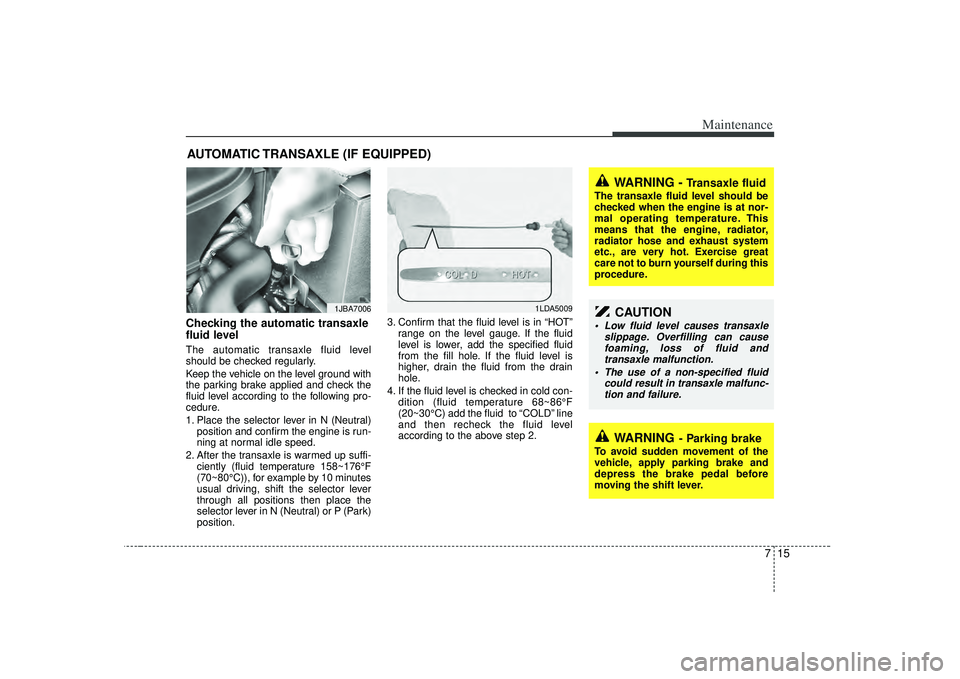
AUTOMATIC TRANSAXLE (IF EQUIPPED)Checking the automatic transaxle
fluid level The automatic transaxle fluid level
should be checked regularly.
Keep the vehicle on the level ground with
the parking brake applied and check the
fluid level according to the following pro-
cedure.
1. Place the selector lever in N (Neutral)position and confirm the engine is run-
ning at normal idle speed.
2. After the transaxle is warmed up suffi- ciently (fluid temperature 158~176°F
(70~80°C)), for example by 10 minutes
usual driving, shift the selector lever
through all positions then place the
selector lever in N (Neutral) or P (Park)
position. 3. Confirm that the fluid level is in “HOT”
range on the level gauge. If the fluid
level is lower, add the specified fluid
from the fill hole. If the fluid level is
higher, drain the fluid from the drain
hole.
4. If the fluid level is checked in cold con- dition (fluid temperature 68~86°F
(20~30°C) add the fluid to “COLD” line
and then recheck the fluid level
according to the above step 2.
1JBA7006
1LDA5009
WARNING -
Transaxle fluid
The transaxle fluid level should be
checked when the engine is at nor-
mal operating temperature. This
means that the engine, radiator,
radiator hose and exhaust system
etc., are very hot. Exercise great
care not to burn yourself during this
procedure.
WARNING
- Parking brake
To avoid sudden movement of the
vehicle, apply parking brake and
depress the brake pedal before
moving the shift lever.
CAUTION
Low fluid level causes transaxle slippage. Overfilling can causefoaming, loss of fluid andtransaxle malfunction.
The use of a non-specified fluid could result in transaxle malfunc-tion and failure.