service KIA RIO HATCHBACK 2007 Owner's Manual
[x] Cancel search | Manufacturer: KIA, Model Year: 2007, Model line: RIO HATCHBACK, Model: KIA RIO HATCHBACK 2007Pages: 221, PDF Size: 2.65 MB
Page 180 of 221
Maintenance27MAINTENANCE SERVICESYou should exercise the utmost care to
prevent damage to your vehicle and
injury to yourself whenever performing
any maintenance or inspection proce-
dures.
Should you have any doubts concerning
the inspection or servicing of your vehi-
cle, we strongly recommend that you
have an authorized Kia dealer perform
this work.
An authorized Kia dealer has factory-
trained technicians and genuine Kia
parts to service your vehicle properly. For
expert advice and quality service, see an
authorized Kia dealer.
Inadequate, incomplete or insufficient
servicing may result in operational prob-
lems with your vehicle that could lead to
vehicle damage, an accident, or person-
al injury.
Owner’s responsibility Maintenance Service and Record
Retention are the owner's responsibil-
ity.
You should retain documents that show
proper maintenance has been performed
on your vehicle in accordance with the
scheduled maintenance service charts
shown on the following pages. You need
this information to establish your compli-
ance with the servicing and maintenance
requirements of your Kia warranties.
Detailed warranty information is provided
in your Warranty & Consumer Information
manual.
Repairs and adjustments required as a
result of improper maintenance or a lack
of required maintenance are not covered.
We strongly recommend that all vehicle
maintenance be performed by an author-
ized Kia dealer using genuine Kia parts.
Page 186 of 221
Maintenance87At least once a year : Clean body and door drain holes.
Lubricate door hinges and checks, andhood hinges.
Lubricate door and hood locks and latches.
Lubricate door rubber weatherstrips.
Check the air conditioning system before the warm weather season.
Check the power steering fluid level.
Inspect and lubricate automatic transaxle linkage and controls.
Clean battery and terminals.
Check the brake fluid level.
Owner maintenance precautions Improper or incomplete service may
result in problems. This section gives
instructions only for the maintenance
items that are easy to perform.
As explained earlier in this section, sev-
eral procedures can be done only by an
authorized Kia dealer with special tools.
Improper owner maintenance during
the warranty period may affect war-
ranty coverage. For details, read the
separate Kia Warranty & Consumer
Information Manual provided with the
vehicle. If you're unsure about any
servicing or maintenance procedure,
have it done by an Authorized Kia
Dealer.
WARNING
- Maintenance work
Performing maintenance work on
a vehicle can be dangerous. You
can be seriously injured while per-
forming some maintenance pro-
cedures. If you lack sufficient
knowledge and experience or the
proper tools and equipment to do
the work, have it done by an
Authorized Kia Dealer.
Working under the hood with the engine running is dangerous. It
becomes even more dangerous
when you wear jewelry or loose
clothing. These can become
entangled in moving parts and
result in injury. Always remove all
loose or hanging clothing and all
jewelry before working on the
engine.
Page 200 of 221
Maintenance22
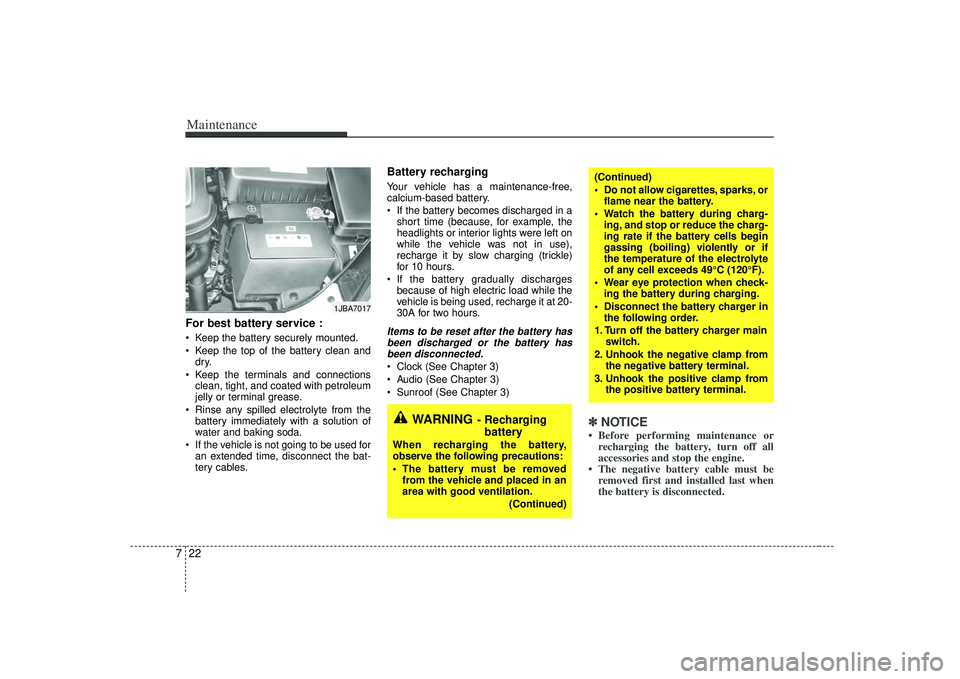
7For best battery service : Keep the battery securely mounted.
Keep the top of the battery clean and
dry.
Keep the terminals and connections clean, tight, and coated with petroleum
jelly or terminal grease.
Rinse any spilled electrolyte from the battery immediately with a solution of
water and baking soda.
If the vehicle is not going to be used for an extended time, disconnect the bat-
tery cables.
Battery recharging Your vehicle has a maintenance-free,
calcium-based battery.
If the battery becomes discharged in ashort time (because, for example, the
headlights or interior lights were left on
while the vehicle was not in use),
recharge it by slow charging (trickle)
for 10 hours.
If the battery gradually discharges because of high electric load while the
vehicle is being used, recharge it at 20-
30A for two hours.Items to be reset after the battery hasbeen discharged or the battery hasbeen disconnected. Clock (See Chapter 3)
Audio (See Chapter 3)
Sunroof (See Chapter 3)
✽ ✽ NOTICE• Before performing maintenance or
recharging the battery, turn off all
accessories and stop the engine.
• The negative battery cable must be removed first and installed last when
the battery is disconnected.
1JBA7017
WARNING
- Recharging
battery
When recharging the battery,
observe the following precautions:
The battery must be removed
from the vehicle and placed in an
area with good ventilation.
(Continued)
(Continued)
Do not allow cigarettes, sparks, orflame near the battery.
Watch the battery during charg- ing, and stop or reduce the charg-
ing rate if the battery cells begin
gassing (boiling) violently or if
the temperature of the electrolyte
of any cell exceeds 49°C (120°F).
Wear eye protection when check- ing the battery during charging.
Disconnect the battery charger in the following order.
1. Turn off the battery charger main switch.
2. Unhook the negative clamp from the negative battery terminal.
3. Unhook the positive clamp from the positive battery terminal.
Page 208 of 221
Maintenance30
74. Tire ply composition and mate-
rialThe number of layers or plies of rub-
ber-coated fabric in the tire. Tire
manufacturers also must indicate the
materials in the tire, which include
steel, nylon, polyester, and others.
The letter "R" means radial ply con-
struction; the letter "D" means diago-
nal or bias ply construction; and the
letter "B" means belted-bias ply con-
struction.
5. Maximum permissible inflationpressureThis number is the greatest amount
of air pressure that should be put in
the tire. Do not exceed the maximum
permissible inflation pressure. Refer
to the Tire and Loading Information
label for recommended inflation
pressure.6. Maximum load ratingThis number indicates the maximum
load in kilograms and pounds that
can be carried by the tire. When
replacing the tires on the vehicle,
always use a tire that has the same
load rating as the factory installed
tire.7. Uniform tire quality grading The following information relates to
the tire grading system developed by
the Canadian Motor Vehicle Safety
Standard (CMVSS) for grading tires
by tread wear, traction and tempera-
ture performance. Tread wear
The tread wear grade is a compara-
tive rating based on the wear rate of
the tire when tested under controlled
conditions on a specified govern-
ment test course. For example, a tire
graded 150 would wear one-and-a-
half times as well on the government
course as a tire graded 100.
The relative performance of tires
depends upon the actual conditions
of their use. However, performance
may differ from the norm because of
variations in driving habits, service
practices and differences in road
characteristics and climate.
These grades are molded on the
side-walls of passenger vehicle tires.
The tires available as standard or
optional equipment on Kia vehicles
may vary with respect to grade.
WARNING
Tires degrade over time, even
when they are not being used.
Regardless of the remaining
tread, it is recommended that
tires generally be replaced after
six (6) years of normal service.
Heat caused by hot climates or
frequent high loading condi-
tions can accelerate the aging
process. Failure to follow this
warning can result in sudden
tire failure, which could lead to a
loss of control and an accident
involving serious injury or
death.
Page 210 of 221
Maintenance32
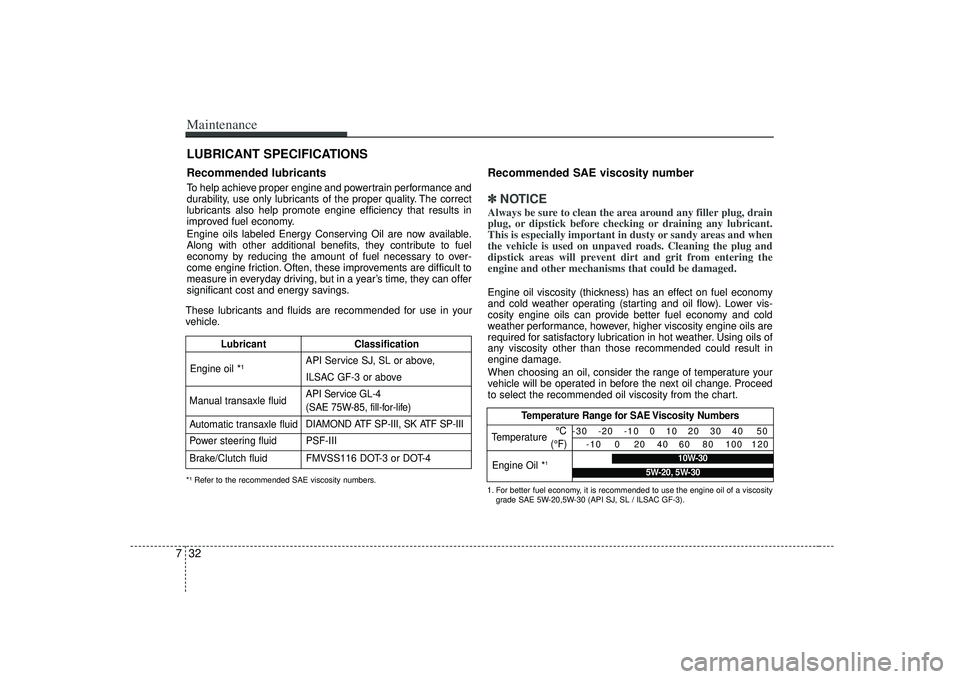
7LUBRICANT SPECIFICATIONSRecommended lubricants To help achieve proper engine and powertrain performance and
durability, use only lubricants of the proper quality. The correct
lubricants also help promote engine efficiency that results in
improved fuel economy.
Engine oils labeled Energy Conserving Oil are now available.
Along with other additional benefits, they contribute to fuel
economy by reducing the amount of fuel necessary to over-
come engine friction. Often, these improvements are difficult to
measure in everyday driving, but in a year’s time, they can offer
significant cost and energy savings.
Recommended SAE viscosity number ✽ ✽
NOTICEAlways be sure to clean the area around any filler plug, drain
plug, or dipstick before checking or draining any lubricant.
This is especially important in dusty or sandy areas and when
the vehicle is used on unpaved roads. Cleaning the plug and
dipstick areas will prevent dirt and grit from entering the
engine and other mechanisms that could be damaged. Engine oil viscosity (thickness) has an effect on fuel economy
and cold weather operating (starting and oil flow). Lower vis-
cosity engine oils can provide better fuel economy and cold
weather performance, however, higher viscosity engine oils are
required for satisfactory lubrication in hot weather. Using oils of
any viscosity other than those recommended could result in
engine damage.
When choosing an oil, consider the range of temperature your
vehicle will be operated in before the next oil change. Proceed
to select the recommended oil viscosity from the chart.
*¹ Refer to the recommended SAE viscosity numbers.These lubricants and fluids are recommended for use in your
vehicle.
Lubricant Classification
API Service SJ, SL or above,
ILSAC GF-3 or above
Manual transaxle fluid API Service GL-4
(SAE 75W-85, fill-for-life)
DIAMOND ATF SP-III, SK ATF SP-III
Power steering fluid PSF-III
Brake/Clutch fluid FMVSS116 DOT-3 or DOT-4
Engine oil
*¹
Automatic transaxle fluid
Temperature Range for SAE Viscosity Numbers
Temperature
Engine Oil *
1°C
(°F)
-30 -20 -10 0 10 20 30 40 50
-10 0 20 40 60 80 100 120
1. For better fuel economy, it is recommended to use the engine oil of a viscositygrade SAE 5W-20,5W-30 (API SJ, SL / ILSAC GF-3).
10W-30
5W-20, 5W-30
Page 218 of 221
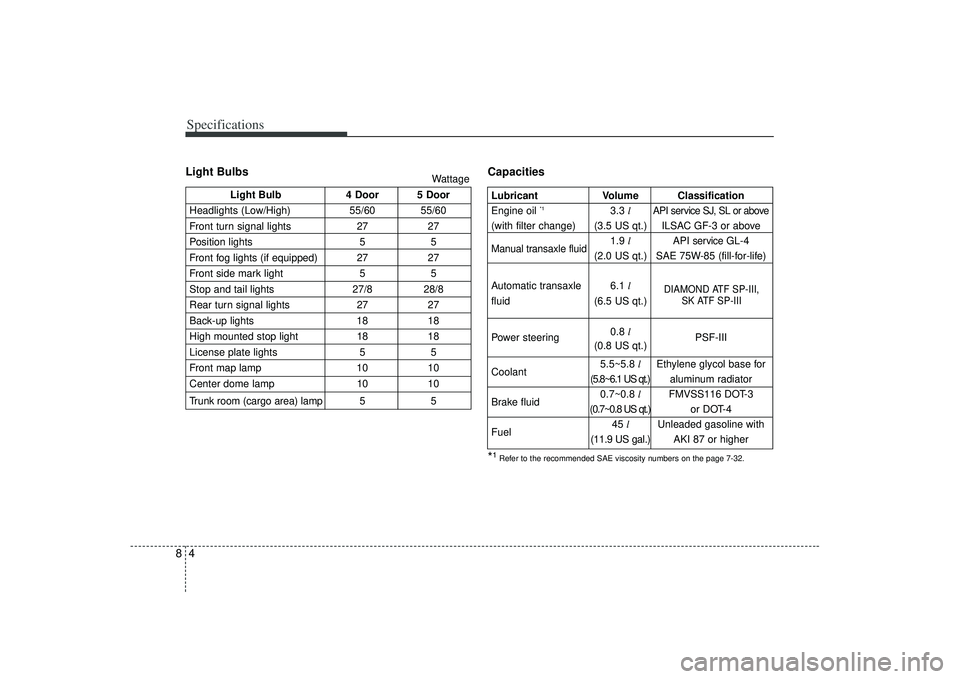
Specifications48Light BulbsCapacities
Light Bulb4 Door 5 Door
Headlights (Low/High) 55/60 55/60
Front turn signal lights 2727
Position lights 55
Front fog lights (if equipped) 27 27
Front side mark light 55
Stop and tail lights 27/8 28/8
Rear turn signal lights 2727
Back-up lights 1818
High mounted stop light 1818
License plate lights 55
Front map lamp 1010
Center dome lamp 1010
Trunk room (cargo area) lamp 5 5
Wattage
LubricantVolume Classification
Engine oil
*1
3.3 l
API service SJ, SL or above
(with filter change) (3.5 US qt.) ILSAC GF-3 or aboveManual transaxle fluid
1.9 l API
service
GL-4
(2.0 US qt.) SAE 75W-85 (fill-for-life)
Automatic transaxle 6.1 l
fluid (6.5 US qt.)
Power steering 0.8
l
PSF-III
(0.8 US qt.)
Coolant 5.5~5.8
lEthylene glycol base for
(5.8~6.1 US qt.) aluminum radiator
Brake fluid 0.7~0.8
lFMVSS116 DOT-3
(0.7~0.8 US qt.) o r D OT- 4
Fuel 45
l Unleaded gasoline with
(11.9 US gal.) AKI 87 or higher
*¹Refer to the recommended SAE viscosity numbers on the page 7-32.
DIAMOND ATF SP-III,
SK ATF SP-III
Page 221 of 221

93
Index
Keys ··················\
··················\
··················\
··················\
·········3-2
Label information ··················\
··················\
··················\
····5-10
Lighting··················\
··················\
··················\
··················\
··4-23
Lubricant specifications ··················\
··················\
·············7-32
Lubricants and fluids ··················\
··················\
·················7-16\
Luggage net ··················\
··················\
··················\
·············3-79
Maintenance schedule··················\
··················\
··················\
7-3
Maintenance services ··················\
··················\
··················\
·7-2
Manual transaxle··················\
··················\
··················\
········4-4
Mirrors ··················\
··················\
··················\
··················\
···3-68
Overheating··················\
··················\
··················\
················6-2
Overloading ··················\
··················\
··················\
···············5-9
Owner maintenance ··················\
··················\
··················\
···7-7
Power steering ··················\
··················\
··················\
·········7-14
Remote keyless entry ··················\
··················\
··················\
·3-3
Road warning ··················\
··················\
··················\
·············6-2Safety belts··················\
··················\
··················\
···············3-27
Seat··················\
··················\
··················\
··················\
·········3-17
Special driving conditions ··················\
··················\
···········5-6
Specifications ··················\
··················\
··················\
·············8-2
Starting the engine ··················\
··················\
··················\
·····4-3
Steering wheel···············\
··················\
··················\
·············4-14
Storage compartment ··················\
··················\
·················3-72\
Suggestions for economical operation··················\
···········5-5
Sunroof··················\
··················\
··················\
··················\
···3-77
Theft-alarm system ··················\
··················\
··················\
····3-5
Tires and wheels ··················\
··················\
··················\
······7-23
Towing ··················\
··················\
··················\
··················\
···6-12
Trailer towing ··················\
··················\
··················\
············5-9
Trunk ··················\
··················\
··················\
··················\
······3-62
Vehicle break-in process ··················\
··················\
··············1-2
Warnings and indicators ··················\
··················\
············4-19
Windows ··················\
··················\
··················\
··················\
3-14
Windshield defrosting and defogging··················\
··········4-37
Wiper blades ··················\
··················\
··················\
············7-19
Wipers and washers ··················\
··················\
··················\
·4-26KLMOPR
SWTV