air condition KIA RIO HATCHBACK 2012 Service Manual
[x] Cancel search | Manufacturer: KIA, Model Year: 2012, Model line: RIO HATCHBACK, Model: KIA RIO HATCHBACK 2012Pages: 385, PDF Size: 9.68 MB
Page 324 of 385
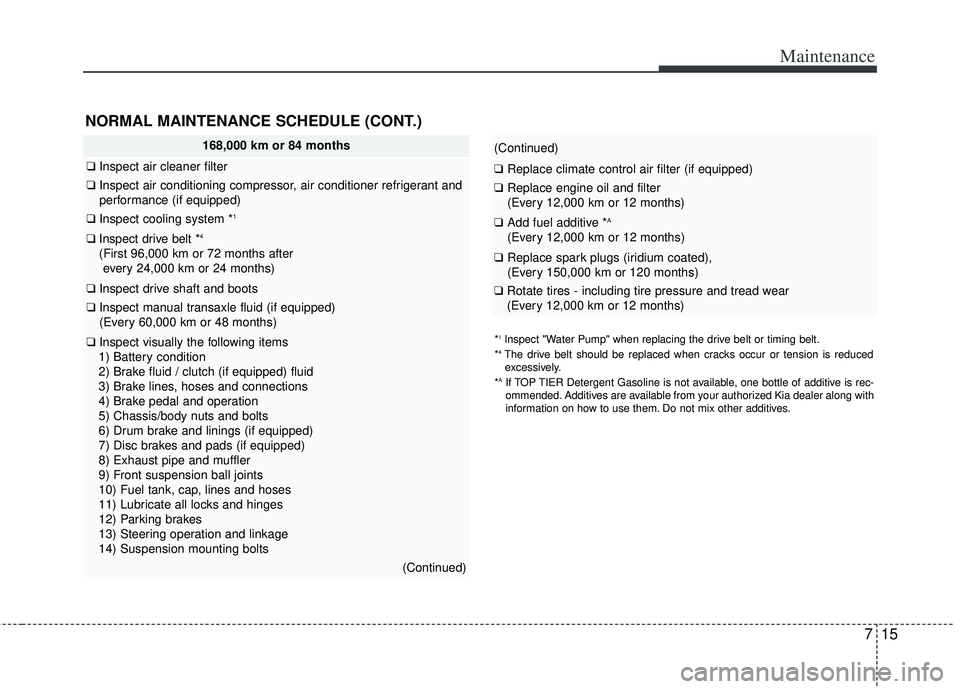
715
Maintenance
(Continued)
❑Replace climate control air filter (if equipped)
❑Replace engine oil and filter
(Every 12,000 km or 12 months)
❑Add fuel additive *A
(Every 12,000 km or 12 months)
❑Replace spark plugs (iridium coated),
(Every 150,000 km or 120 months)
❑Rotate tires - including tire pressure and tread wear
(Every 12,000 km or 12 months)
*1lnspect "Water Pump" when replacing the drive belt or timing belt.
*4The drive belt should be replaced when cracks occur or tension is reduced excessively.
*
AIf TOP TIER Detergent Gasoline is not available, one bottle of additive is rec-
ommended. Additives are available from your authorized Kia dealer along with
information on how to use them. Do not mix other additives.
NORMAL MAINTENANCE SCHEDULE (CONT.)
168,000 km or 84 months
❑ Inspect air cleaner filter
❑Inspect air conditioning compressor, air conditioner refrigerant and
performance (if equipped)
❑ Inspect cooling system *1
❑Inspect drive belt *4
(First 96,000 km or 72 months after
every 24,000 km or 24 months)
❑ Inspect drive shaft and boots
❑Inspect manual transaxle fluid (if equipped)
(Every 60,000 km or 48 months)
❑ Inspect visually the following items
1) Battery condition
2) Brake fluid / clutch (if equipped) fluid
3) Brake lines, hoses and connections
4) Brake pedal and operation
5) Chassis/body nuts and bolts
6) Drum brake and linings (if equipped)
7) Disc brakes and pads (if equipped)
8) Exhaust pipe and muffler
9) Front suspension ball joints
10) Fuel tank, cap, lines and hoses
11) Lubricate all locks and hinges
12) Parking brakes
13) Steering operation and linkage
14) Suspension mounting bolts
(Continued)
Page 325 of 385
Maintenance
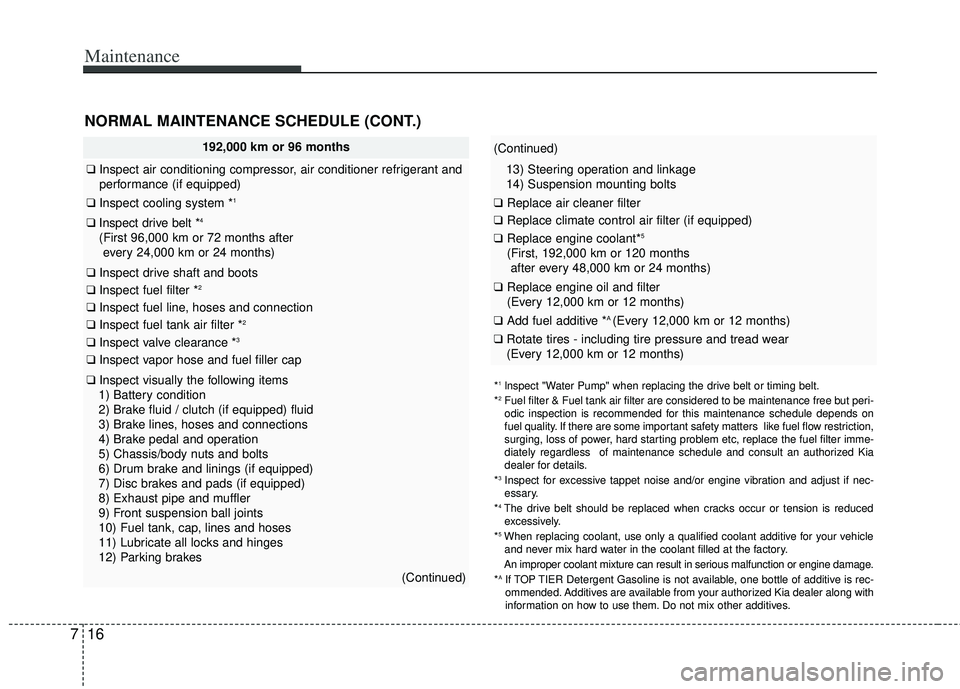
16
7
NORMAL MAINTENANCE SCHEDULE (CONT.)
192,000 km or 96 months
❑ Inspect air conditioning compressor, air conditioner refrigerant and
performance (if equipped)
❑ Inspect cooling system *1
❑Inspect drive belt *4
(First 96,000 km or 72 months after
every 24,000 km or 24 months)
❑ Inspect drive shaft and boots
❑ Inspect fuel filter *2
❑Inspect fuel line, hoses and connection
❑Inspect fuel tank air filter *2
❑Inspect valve clearance *3
❑Inspect vapor hose and fuel filler cap
❑Inspect visually the following items
1) Battery condition
2) Brake fluid / clutch (if equipped) fluid
3) Brake lines, hoses and connections
4) Brake pedal and operation
5) Chassis/body nuts and bolts
6) Drum brake and linings (if equipped)
7) Disc brakes and pads (if equipped)
8) Exhaust pipe and muffler
9) Front suspension ball joints
10) Fuel tank, cap, lines and hoses
11) Lubricate all locks and hinges
12) Parking brakes
(Continued)
(Continued)
13) Steering operation and linkage
14) Suspension mounting bolts
❑ Replace air cleaner filter
❑Replace climate control air filter (if equipped)
❑Replace engine coolant*5
(First, 192,000 km or 120 months
after every 48,000 km or 24 months)
❑ Replace engine oil and filter
(Every 12,000 km or 12 months)
❑ Add fuel additive *A (Every 12,000 km or 12 months)
❑Rotate tires - including tire pressure and tread wear
(Every 12,000 km or 12 months)
*1lnspect "Water Pump" when replacing the drive belt or timing belt.
*2Fuel filter & Fuel tank air filter are considered to be maintenance free\
but peri-
odic inspection is recommended for this maintenance schedule depends on
fuel quality. If there are some important safety matters like fuel flow restriction,
surging, loss of power, hard starting problem etc, replace the fuel filter imme-
diately regardless of maintenance schedule and consult an authorized Kia
dealer for details.
*
3Inspect for excessive tappet noise and/or engine vibration and adjust if nec-
essary.
*
4The drive belt should be replaced when cracks occur or tension is reduced excessively.
*
5When replacing coolant, use only a qualified coolant additive for your vehicle and never mix hard water in the coolant filled at the factory.
An improper coolant mixture can result in serious malfunction or engine damage.
*
AIf TOP TIER Detergent Gasoline is not available, one bottle of additive is rec-
ommended. Additives are available from your authorized Kia dealer along with
information on how to use them. Do not mix other additives.
Page 326 of 385
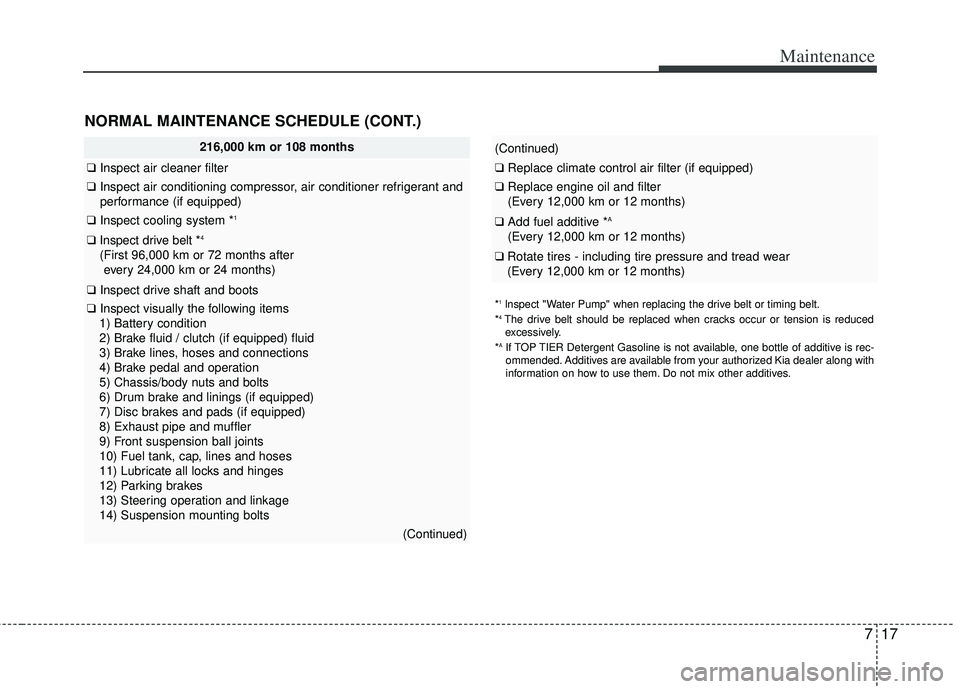
717
Maintenance
NORMAL MAINTENANCE SCHEDULE (CONT.)
216,000 km or 108 months
❑Inspect air cleaner filter
❑Inspect air conditioning compressor, air conditioner refrigerant and
performance (if equipped)
❑ Inspect cooling system *1
❑Inspect drive belt *4
(First 96,000 km or 72 months after
every 24,000 km or 24 months)
❑ Inspect drive shaft and boots
❑ Inspect visually the following items
1) Battery condition
2) Brake fluid / clutch (if equipped) fluid
3) Brake lines, hoses and connections
4) Brake pedal and operation
5) Chassis/body nuts and bolts
6) Drum brake and linings (if equipped)
7) Disc brakes and pads (if equipped)
8) Exhaust pipe and muffler
9) Front suspension ball joints
10) Fuel tank, cap, lines and hoses
11) Lubricate all locks and hinges
12) Parking brakes
13) Steering operation and linkage
14) Suspension mounting bolts
(Continued)
(Continued)
❑ Replace climate control air filter (if equipped)
❑Replace engine oil and filter
(Every 12,000 km or 12 months)
❑Add fuel additive *A
(Every 12,000 km or 12 months)
❑Rotate tires - including tire pressure and tread wear
(Every 12,000 km or 12 months)
*1lnspect "Water Pump" when replacing the drive belt or timing belt.
*4The drive belt should be replaced when cracks occur or tension is reduced excessively.
*
AIf TOP TIER Detergent Gasoline is not available, one bottle of additive is rec-
ommended. Additives are available from your authorized Kia dealer along with
information on how to use them. Do not mix other additives.
Page 327 of 385
Maintenance
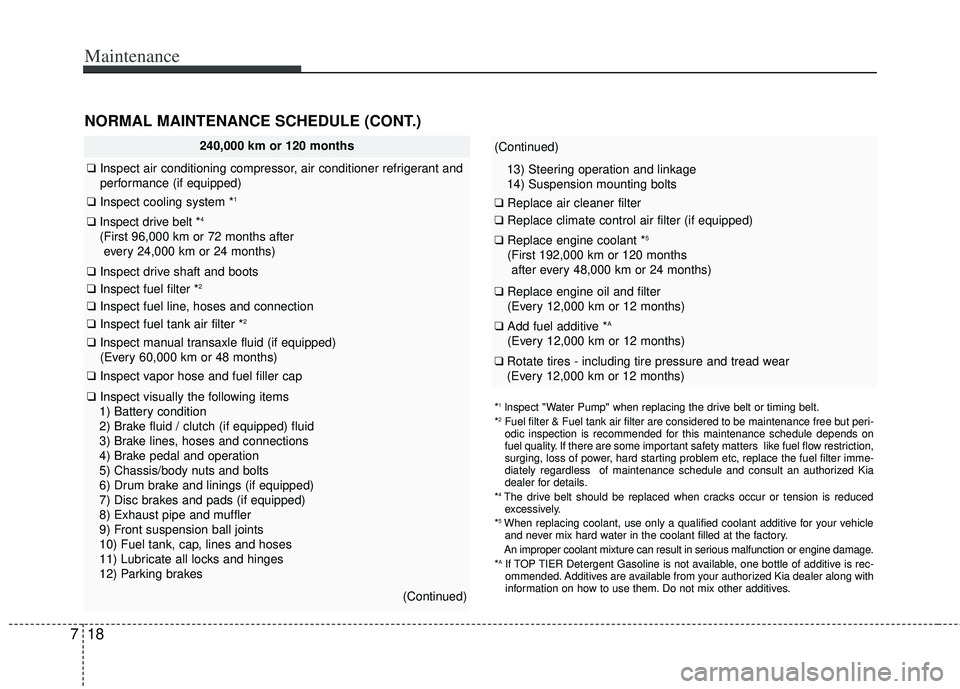
18
7
240,000 km or 120 months
❑ Inspect air conditioning compressor, air conditioner refrigerant and
performance (if equipped)
❑ Inspect cooling system *1
❑Inspect drive belt *4
(First 96,000 km or 72 months after
every 24,000 km or 24 months)
❑ Inspect drive shaft and boots
❑ Inspect fuel filter *2
❑Inspect fuel line, hoses and connection
❑Inspect fuel tank air filter *2
❑Inspect manual transaxle fluid (if equipped)
(Every 60,000 km or 48 months)
❑ Inspect vapor hose and fuel filler cap
❑Inspect visually the following items
1) Battery condition
2) Brake fluid / clutch (if equipped) fluid
3) Brake lines, hoses and connections
4) Brake pedal and operation
5) Chassis/body nuts and bolts
6) Drum brake and linings (if equipped)
7) Disc brakes and pads (if equipped)
8) Exhaust pipe and muffler
9) Front suspension ball joints
10) Fuel tank, cap, lines and hoses
11) Lubricate all locks and hinges
12) Parking brakes
(Continued)
(Continued)
13) Steering operation and linkage
14) Suspension mounting bolts
❑ Replace air cleaner filter
❑Replace climate control air filter (if equipped)
❑Replace engine coolant *5
(First 192,000 km or 120 months
after every 48,000 km or 24 months)
❑ Replace engine oil and filter
(Every 12,000 km or 12 months)
❑Add fuel additive *A
(Every 12,000 km or 12 months)
❑Rotate tires - including tire pressure and tread wear
(Every 12,000 km or 12 months)
NORMAL MAINTENANCE SCHEDULE (CONT.)
*1lnspect "Water Pump" when replacing the drive belt or timing belt.
*2Fuel filter & Fuel tank air filter are considered to be maintenance free\
but peri-
odic inspection is recommended for this maintenance schedule depends on
fuel quality. If there are some important safety matters like fuel flow restriction,
surging, loss of power, hard starting problem etc, replace the fuel filter imme-
diately regardless of maintenance schedule and consult an authorized Kia
dealer for details.
*
4The drive belt should be replaced when cracks occur or tension is reduced excessively.
*
5When replacing coolant, use only a qualified coolant additive for your vehicle and never mix hard water in the coolant filled at the factory.
An improper coolant mixture can result in serious malfunction or engine damage.
*
AIf TOP TIER Detergent Gasoline is not available, one bottle of additive is rec-
ommended. Additives are available from your authorized Kia dealer along with
information on how to use them. Do not mix other additives.
Page 329 of 385
Maintenance
20
7
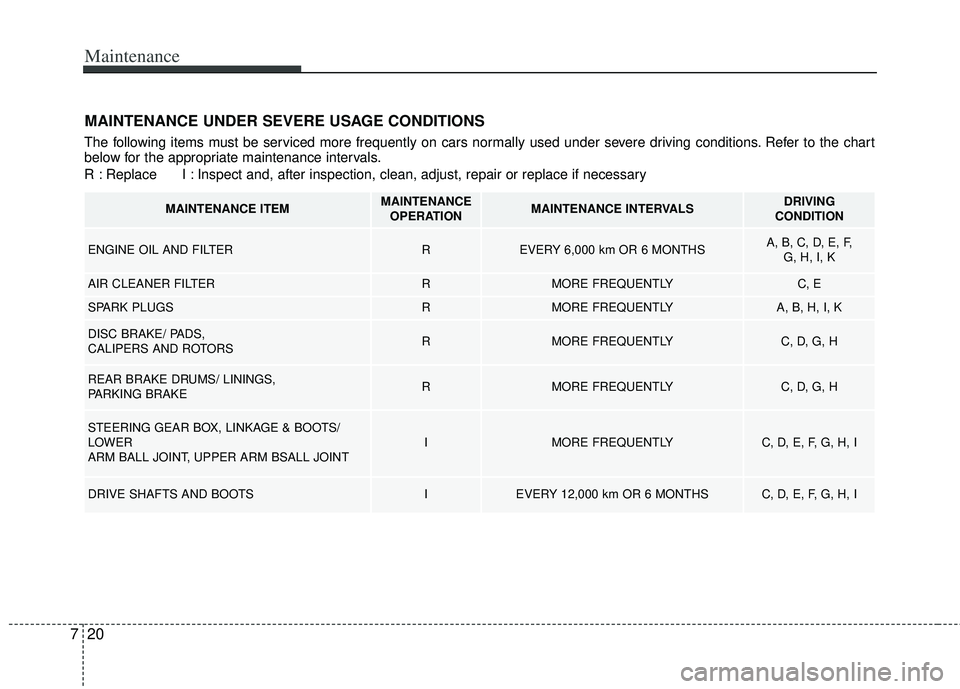
MAINTENANCE UNDER SEVERE USAGE CONDITIONS
The following items must be serviced more frequently on cars normally used under severe driving conditions. Refer to the chart
below for the appropriate maintenance intervals.
R : Replace I : Inspect and, after inspection, clean, adjust, repair or replace if neces\
sary
MAINTENANCE ITEMMAINTENANCE
OPERATIONMAINTENANCE INTERVALSDRIVING
CONDITION
ENGINE OIL AND FILTERREVERY 6,000 km OR 6 MONTHSA, B, C, D, E, F, G, H, I, K
AIR CLEANER FILTERRMORE FREQUENTLYC, E
SPARK PLUGSRMORE FREQUENTLYA, B, H, I, K
DISC BRAKE/ PADS,
CALIPERS AND ROTORSRMORE FREQUENTLYC, D, G, H
REAR BRAKE DRUMS/ LININGS,
PARKING BRAKERMORE FREQUENTLYC, D, G, H
STEERING GEAR BOX, LINKAGE & BOOTS/
LOWER
ARM BALL JOINT, UPPER ARM BSALL JOINTIMORE FREQUENTLYC, D, E, F, G, H, I
DRIVE SHAFTS AND BOOTSIEVERY 12,000 km OR 6 MONTHSC, D, E, F, G, H, I
Page 330 of 385
721
Maintenance
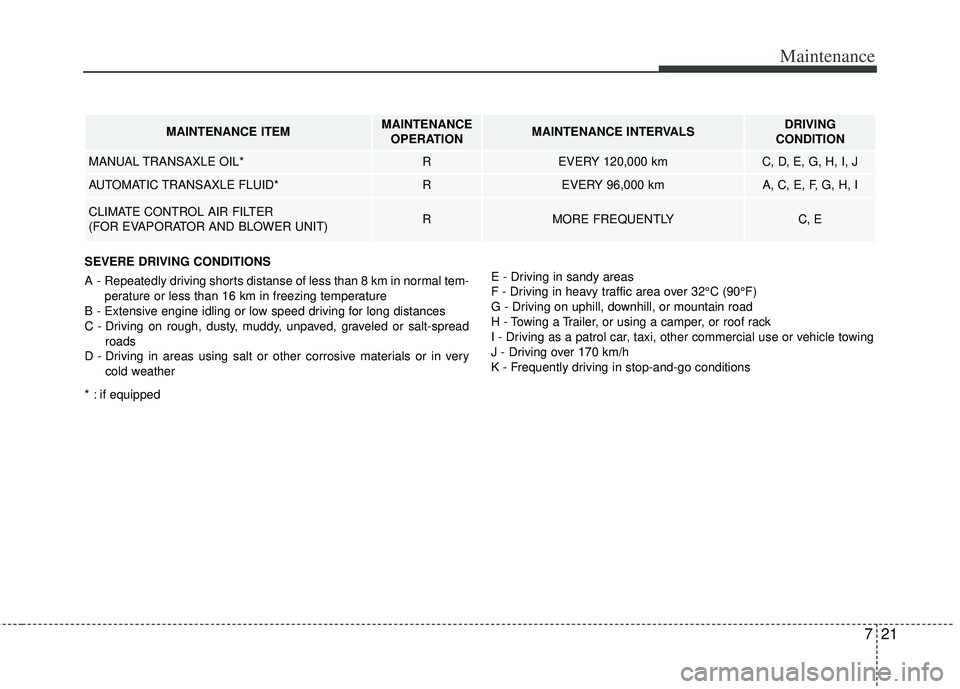
MAINTENANCE ITEMMAINTENANCEOPERATIONMAINTENANCE INTERVALSDRIVING
CONDITION
MANUAL TRANSAXLE OIL*REVERY 120,000 kmC, D, E, G, H, I, J
AUTOMATIC TRANSAXLE FLUID*REVERY 96,000 kmA, C, E, F, G, H, I
CLIMATE CONTROL AIR FILTER
(FOR EVAPORATOR AND BLOWER UNIT)RMORE FREQUENTLYC, E
SEVERE DRIVING CONDITIONS
A - Repeatedly driving shorts distanse of less than 8 km in normal tem-
perature or less than 16 km in freezing temperature
B - Extensive engine idling or low speed driving for long distances
C - Driving on rough, dusty, muddy, unpaved, graveled or salt-spread roads
D - Driving in areas using salt or other corrosive materials or in very cold weather E - Driving in sandy areas
F - Driving in heavy traffic area over 32°C (90°F)
G - Driving on uphill, downhill, or mountain road
H - Towing a Trailer, or using a camper, or roof rack
I - Driving as a patrol car, taxi, other commercial use or vehicle towing
J - Driving over 170 km/h
K - Frequently driving in stop-and-go conditions
* : if equipped
Page 332 of 385
723
Maintenance
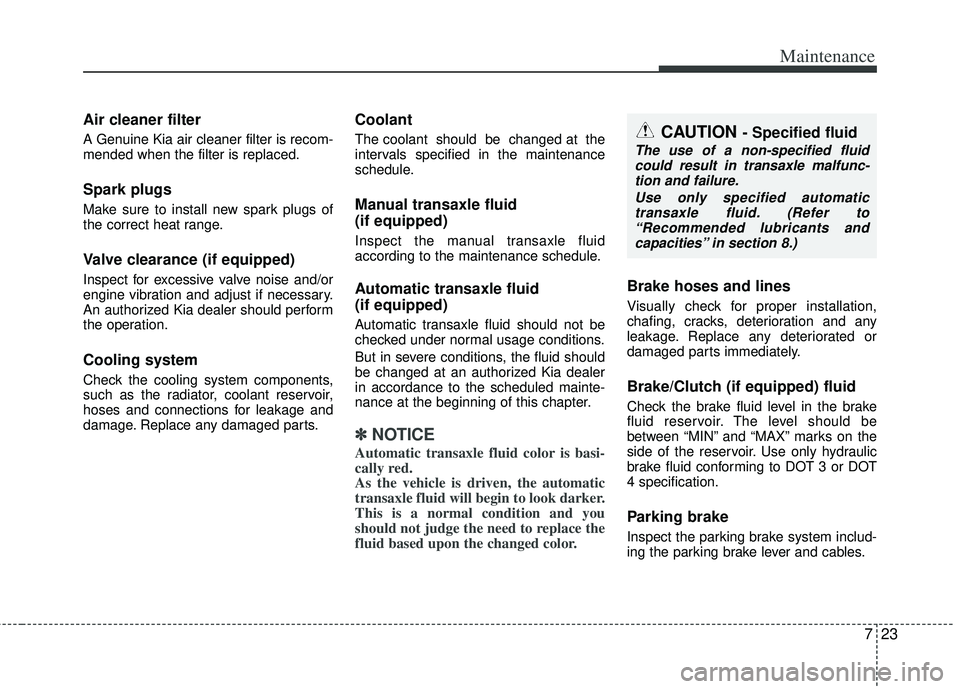
Air cleaner filter
A Genuine Kia air cleaner filter is recom-
mended when the filter is replaced.
Spark plugs
Make sure to install new spark plugs of
the correct heat range.
Valve clearance (if equipped)
Inspect for excessive valve noise and/or
engine vibration and adjust if necessary.
An authorized Kia dealer should perform
the operation.
Cooling system
Check the cooling system components,
such as the radiator, coolant reservoir,
hoses and connections for leakage and
damage. Replace any damaged parts.
Coolant
The coolant should be changed at the
intervals specified in the maintenance
schedule.
Manual transaxle fluid
(if equipped)
Inspect the manual transaxle fluid
according to the maintenance schedule.
Automatic transaxle fluid
(if equipped)
Automatic transaxle fluid should not be
checked under normal usage conditions.
But in severe conditions, the fluid should
be changed at an authorized Kia dealer
in accordance to the scheduled mainte-
nance at the beginning of this chapter.
✽ ✽NOTICE
Automatic transaxle fluid color is basi-
cally red.
As the vehicle is driven, the automatic
transaxle fluid will begin to look darker.
This is a normal condition and you
should not judge the need to replace the
fluid based upon the changed color.
Brake hoses and lines
Visually check for proper installation,
chafing, cracks, deterioration and any
leakage. Replace any deteriorated or
damaged parts immediately.
Brake/Clutch (if equipped) fluid
Check the brake fluid level in the brake
fluid reservoir. The level should be
between “MIN” and “MAX” marks on the
side of the reservoir. Use only hydraulic
brake fluid conforming to DOT 3 or DOT
4 specification.
Parking brake
Inspect the parking brake system includ-
ing the parking brake lever and cables.
CAUTION - Specified fluid
The use of a non-specified fluid
could result in transaxle malfunc-tion and failure.
Use only specified automatictransaxle fluid. (Refer to“Recommended lubricants andcapacities” in section 8.)
Page 333 of 385
Maintenance
24
7
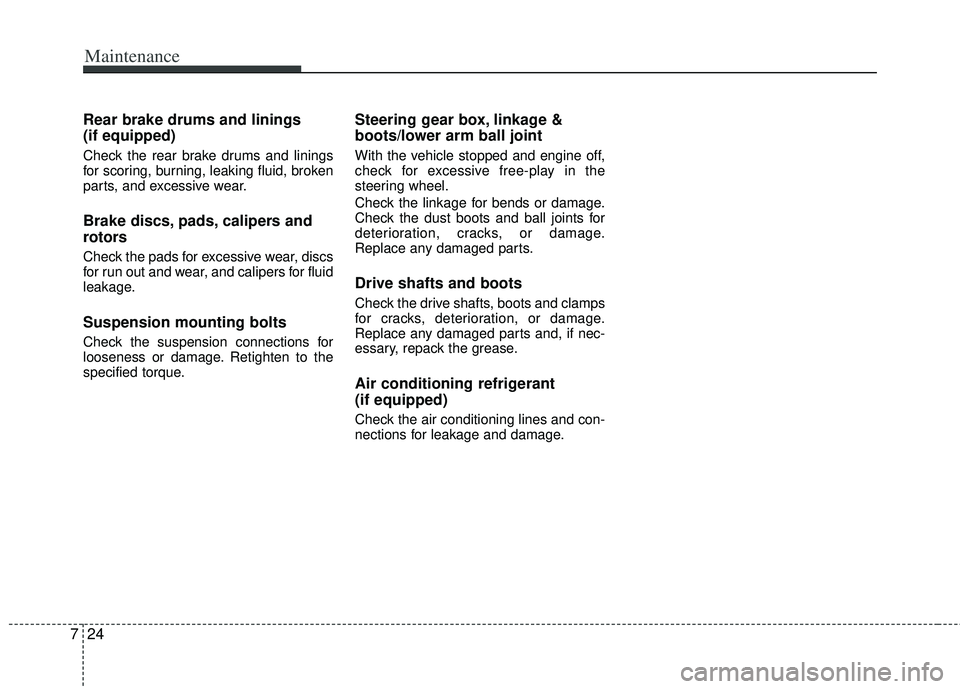
Rear brake drums and linings
(if equipped)
Check the rear brake drums and linings
for scoring, burning, leaking fluid, broken
parts, and excessive wear.
Brake discs, pads, calipers and
rotors
Check the pads for excessive wear, discs
for run out and wear, and calipers for fluid
leakage.
Suspension mounting bolts
Check the suspension connections for
looseness or damage. Retighten to the
specified torque.
Steering gear box, linkage &
boots/lower arm ball joint
With the vehicle stopped and engine off,
check for excessive free-play in the
steering wheel.
Check the linkage for bends or damage.
Check the dust boots and ball joints for
deterioration, cracks, or damage.
Replace any damaged parts.
Drive shafts and boots
Check the drive shafts, boots and clamps
for cracks, deterioration, or damage.
Replace any damaged parts and, if nec-
essary, repack the grease.
Air conditioning refrigerant
(if equipped)
Check the air conditioning lines and con-
nections for leakage and damage.
Page 338 of 385
729
Maintenance
BRAKE/CLUTCH (IF EQUIPPED) FLUID
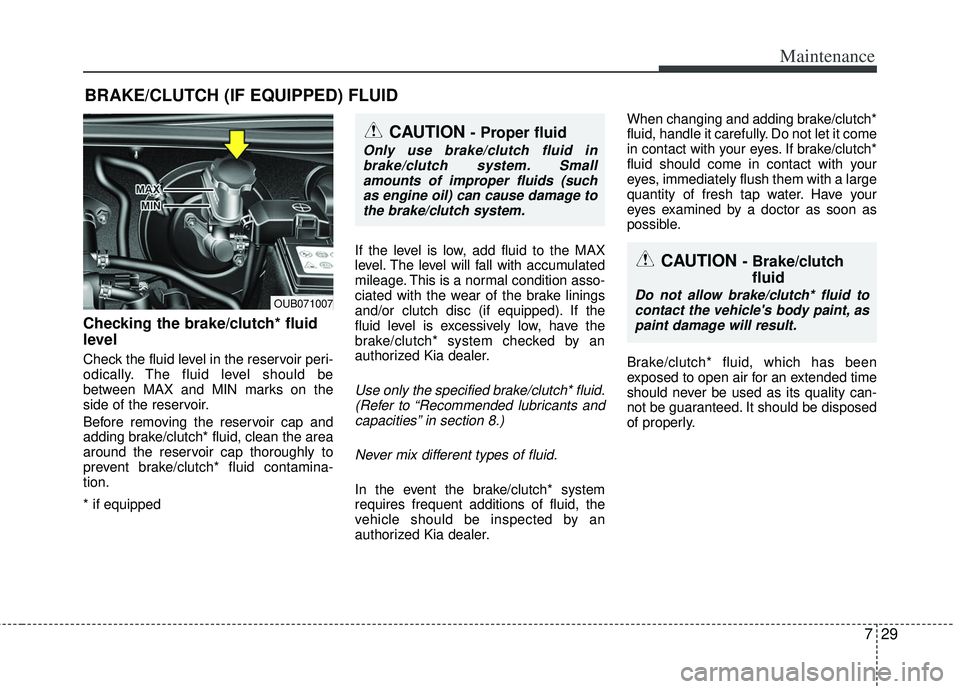
Checking the brake/clutch* fluid
level
Check the fluid level in the reservoir peri-
odically. The fluid level should be
between MAX and MIN marks on the
side of the reservoir.
Before removing the reservoir cap and
adding brake/clutch* fluid, clean the area
around the reservoir cap thoroughly to
prevent brake/clutch* fluid contamina-
tion.
* if equippedIf the level is low, add fluid to the MAX
level. The level will fall with accumulated
mileage. This is a normal condition asso-
ciated with the wear of the brake linings
and/or clutch disc (if equipped). If the
fluid level is excessively low, have the
brake/clutch* system checked by an
authorized Kia dealer.
Use only the specified brake/clutch* fluid.
(Refer to “Recommended lubricants and capacities” in section 8.)
Never mix different types of fluid.
In the event the brake/clutch* system
requires frequent additions of fluid, the
vehicle should be inspected by an
authorized Kia dealer. When changing and adding brake/clutch*
fluid, handle it carefully. Do not let it come
in contact with your eyes. If brake/clutch*
fluid should come in contact with your
eyes, immediately flush them with a large
quantity of fresh tap water. Have your
eyes examined by a doctor as soon as
possible.
Brake/clutch* fluid, which has been
exposed to open air for an extended time
should never be used as its quality can-
not be guaranteed. It should be disposed
of properly.
CAUTION - Brake/clutch
fluid
Do not allow brake/clutch* fluid to
contact the vehicle's body paint, aspaint damage will result.
CAUTION - Proper fluid
Only use brake/clutch fluid in brake/clutch system. Smallamounts of improper fluids (suchas engine oil) can cause damage tothe brake/clutch system.
OUB071007
Page 348 of 385
739
Maintenance
Remove the valve cap from the tire
valve stem. Press the tire guage firm-
ly onto the valve to get a pressure
measurement. If the cold tire inflation
pressure matches the recommended
pressure on the tire and loading
information label, no further adjust-
ment is necessary. If the pressure is
low, add air until you reach the rec-
ommended amount.
If you overfill the tire, release air by
pushing on the metal stem in the
center of the tire valve. Recheck the
tire pressure with the tire guage. Be
sure to put the valve caps back on
the valve stems. They help prevent
leaks by keeping out dirt and mois-
ture. Inspect your tires frequently for
proper inflation as well as wear and
damage. Always use a tire pres-
sure gauge.
Tires with too much or too little pressure wear unevenly causing
poor handling, loss of vehicle con-
trol, and sudden tire failure leading
to accidents, injuries, and even
death. The recommended cold tire
pressure for your vehicle can be
found in this manual and on the tire
label located on the driver's side
center pillar.
Remember to check the pressure of your spare tire. Kia recommends
that you check the spare every
time you check the pressure of the
other tires on your vehicle. Tire rotation
To equalize tread wear, it is recom-
mended that the tires be rotated
every 12,000 km miles (7,500) or
sooner if irregular wear develops.
During rotation, check the tires for
correct balance.
When rotating tires, check for uneven
wear and damage. Abnormal wear is
usually caused by incorrect tire pres-
sure, improper wheel alignment, out-
of-balance wheels, severe braking or
severe cornering. Look for bumps or
bulges in the tread or side of tire.
Replace the tire if you find either of
these conditions. Replace the tire if
fabric or cord is visible. After rotation,
be sure to bring the front and rear tire
pressures to specification and check
lug nut tightness.
Refer to “Tire and wheels” in section
8.