wheel KIA RIO HATCHBACK 2017 Owners Manual
[x] Cancel search | Manufacturer: KIA, Model Year: 2017, Model line: RIO HATCHBACK, Model: KIA RIO HATCHBACK 2017Pages: 532, PDF Size: 12.04 MB
Page 468 of 532
763
Maintenance
Snow tires
If you equip your car with snow tires,
they should be the same size and
have the same load capacity as the
original tires. Snow tires should be
installed on all four wheels; other-
wise, poor handling may result.
Snow tires should carry 4 psi (28
kPa) more air pressure than the
pressure recommended for the stan-
dard tires on the tire label on the dri-
ver's side of the center pillar, or up to
the maximum pressure shown on the
tire sidewall, whichever is less.
Do not drive faster than 75 mph (120
km/h) when your vehicle is equipped
with snow tires.
Tire chains
Tire chains, if necessary, should be
installed on the front wheels.
Be sure that the chains are installed
in accordance with the manufactur-
er's instructions.
To minimize tire and chain wear, do
not continue to use tire chains when
they are no longer needed.
When driving on roads coveredwith snow or ice, drive at less than
20 mph (30 km/h).
Use the SAE “S” class or wire chains.
If you hear noise caused by chains contacting the body, retighten the
chain to avoid contact with the
vehicle body.
To prevent body damage, retighten the chains after driving 0.3~0.6
miles (0.5~1.0 km).
Do not use tire chains on vehicles equipped with aluminum wheels.
In unavoidable circumstance, use
a wire type chain.
Use wire chains less than 0.59 inches (15 mm) to prevent damage
to the chain’s connection.
Radial-ply tires
Radial-ply tires provide improved
tread life, road hazard resistance and
smoother high speed ride. The radi-
al-ply tires used on this vehicle are of
belted construction, and are selected
to complement the ride and handling
characteristics of your vehicle.
Radial-ply tires have the same load
carrying capacity as bias-ply or bias
belted tires of the same size and use
the same recommended inflation
pressure. Mixing of radial-ply tires
with bias-ply or bias belted tires is
not recommended. Any combina-
tions of radial-ply and bias-ply or bias
belted tires when used on the same
vehicle will seriously deteriorate
vehicle handling. The best rule to fol-
low is: Identical radial-ply tires should
always be used as a set of four.
Page 469 of 532
Maintenance
64
7
Longer wearing tires can be more
susceptible to irregular tread wear. It
is very important to follow the tire
rotation interval shown in this section
to achieve the tread life potential of
these tires. Cuts and punctures in
radial-ply tires are repairable only in
the tread area, because of sidewall
flexing. Consult your tire dealer for
radial-ply tire repairs.
Low aspect ratio tire
(if equipped)
Low aspect ratio tires, whose aspect
ratio is lower than 50, are provided
for sporty looks.
Because the low aspect ratio tires
are optimized for handling and brak-
ing, it may be more uncomfortable to
ride in and there is more noise com-
pare with normal tires. It is not easy to recognize the tire
damage with your own eyes. But if
there is the slightest hint of tire
damage, even though you cannot
see the tire damage with your own
eyes, have the tire checked or
replaced because the tire damage
may cause air leakage from the
tire.
If the tire is damaged by driving on a rough road, off road, pothole,
manhole, or curb stone, it will not
be covered by the warranty.
You can find out the tire information on the tire sidewall.
CAUTION
Because the sidewall of the lowaspect ratio tire is shorter thanthe normal, the wheel and tire ofthe low aspect ratio tire is easi-er to be damaged. So, follow theinstructions below.
- When driving on a rough road or off road, drive cautiouslybecause tires and wheels maybe damaged. And after driving,inspect tires and wheels.
- When passing over a pothole, speed bump, manhole, or curbstone, drive slowly so that thetires and wheels are not dam-aged.
- If the tire is impacted, we rec- ommend that you inspect thetire condition or contact anauthorized Kia dealer.
- To prevent damage to the tire, inspect the tire condition andpressure every 3,000km.
Page 477 of 532

Maintenance
72
7
Instrument panel fuse panel
Fuse Name Fuse rating Circuit Protected
POWER OUTLET 15A Power Outlet
C/LIGHTER 20A Cigarette Lighter
ACC 10AFront Map Lamp, Power Outside Mirror Switch, BCM,
Low DC-DC Convertor, Smart Key Control Module, Audio,
A/V & Navigation Head Unit, Digital Clock
A/BAG IND 10A Instrument Cluster
A/BAG 10ASBR PAB Indicator, SRS Control Module
Passenger Weight Classification Sensor
MODULE 2 10A BCM
MDPS 10A EPS Control Module
WIPER RR 15A Multifunction Switch, Rear Wiper Relay, Rear Wiper Motor
HTD STRG 15A Steering Wheel Heater
FOG LAMP RR 10A -
FOG LAMP FRT 15A Front Fog Lamp Relay
MODULE 1 10A ATM Shift Lever Switch, Door Warning Switch
STOP LAMP 15AData Link Connector, Smart Key Control Module, Stop Lamp Switch
Stop Lamp Relay, PCB Fuse & Relay Box (HAC Relay)
CLUSTER 10AAudio, BCM, ATM Shift Lever ILL., Crash Pad Switch
Instrument Cluster, Tire Pressure Monitoring Module
IG1 1 10AMultipurpose Check Connector, Driver CCS Seat Warmer Module
Passenger Seat Warmer Module
With ISG : Crash Pad Switch, Low DC-DC Convertor
ABS 10ACrash Pad Switch, ESC Module
PCB Fuse & Relay Box (HAC Relay)
B/UP LAMP 10A Back-Up Lamp Switch
Page 498 of 532
793
Maintenance
Finish damage repair
Deep scratches or stone chips in the
painted surface must be repaired
promptly. Exposed metal will quickly
rust and may develop into a major
repair expense.
If your vehicle is damaged and
requires any metal repair or replace-
ment, be sure the body shop applies
anti-corrosion materials to the parts
repaired or replaced.
Bright-metal maintenance
To remove road tar and insects,use a tar remover, not a scraper or
other sharp object.
To protect the surfaces of bright- metal parts from corrosion, apply a
coating of wax or chrome preser-
vative and rub to a high luster.
During winter weather or in coastal areas, cover the bright metal parts
with a heavier coating of wax or
preservative. If necessary, coat the
parts with non-corrosive petroleum
jelly or other protective compound.
Underbody maintenance
Corrosive materials used for ice and
snow removal and dust control may
collect on the underbody. If these
materials are not removed, acceler-
ated rusting can occur on underbody
parts such as the fuel lines, frame,
floor pan and exhaust system, even
though they have been treated with
rust protection.
Thoroughly flush the vehicle under-
body and wheel openings with luke-
warm or cold water once a month,
after off-road driving and at the end
of each winter. Pay special attention
to these areas because it is difficult
to see all the mud and dirt. It will do
more harm than good to wet down
the road grime without removing it.
The lower edges of doors, rocker
panels, and frame members have
drain holes that should not be
allowed to clog with dirt; trapped
water in these areas can cause rust-
ing.CAUTION - Drying vehicle
Wiping dust or dirt off the
body with a dry cloth willscratch the finish.
Do not use steel wool, abra- sive cleaners, or strong deter-gents containing highly alka-line or caustic agents onchrome-plated or anodizedaluminum parts. This mayresult in damage to the pro-tective coating and cause dis-coloration or paint deteriora-tion.
Page 499 of 532
Maintenance
94
7
Aluminum wheel maintenance
The aluminum wheels are coated
with a clear protective finish.
Do not use any abrasive cleaner,
polishing compound, solvent, or
wire brushes on aluminum wheels.
They may scratch or damage the
finish.
Clean the wheel when it has cooled.
Use only a mild soap or neutral detergent, and rinse thoroughly
with water. Also, be sure to clean
the wheels after driving on salted
roads. This helps prevent corrosion.
Avoid washing the wheels with high-speed car wash brushes.
Do not use any alkaline or acid detergents. It may damage and
corrode the aluminum wheels coat-
ed with a clear protective finish.
Corrosion protection
Protecting your vehicle from corro-
sion
By using the most advanced design
and construction practices to combat
corrosion, we produces vehicles of
the highest quality. However, this is
only part of the job. To achieve the
long-term corrosion resistance your
vehicle can deliver, the owner's
cooperation and assistance is also
required. Common causes of corrosion
The most common causes of corro-
sion on your vehicle are:
Road salt, dirt and moisture that is
allowed to accumulate underneath
the vehicle.
coatings by stones, gravel, abra-
sion or minor scrapes and dents
which leave unprotected metal
exposed to corrosion.
High-corrosion areas
If you live in an area where your vehi-
cle is regularly exposed to corrosive
materials, corrosion protection is
particularly important. Some of the
common causes of accelerated cor-
rosion are road salts, dust control
chemicals, ocean air and industrial
pollution.
Page 502 of 532
797
Maintenance
Cleaning the upholstery and inte-rior trim
Vinyl
Remove dust and loose dirt from
vinyl with a whisk broom or vacuum
cleaner. Clean vinyl surfaces with a
vinyl cleaner.
Fabric
Remove dust and loose dirt from fab-
ric with a whisk broom or vacuum
cleaner. Clean with a mild soap solu-
tion recommended for upholstery or
carpets. Remove fresh spots imme-
diately with a fabric spot cleaner. If
fresh spots do not receive immediate
attention, the fabric can be stained
and its color can be affected. Also, its
fire-resistant properties can be
reduced if the material is not proper-
ly maintained.
Using anything but recommended
cleaners and procedures may affect
the fabric’s appearance and fire-
resistant properties.
Cleaning the lap/shoulder beltwebbing
Clean the belt webbing with any mild
soap solution recommended for
cleaning upholstery or carpet. Follow
the instructions provided with the
soap. Do not bleach or re-dye the
webbing because this may weaken
it.
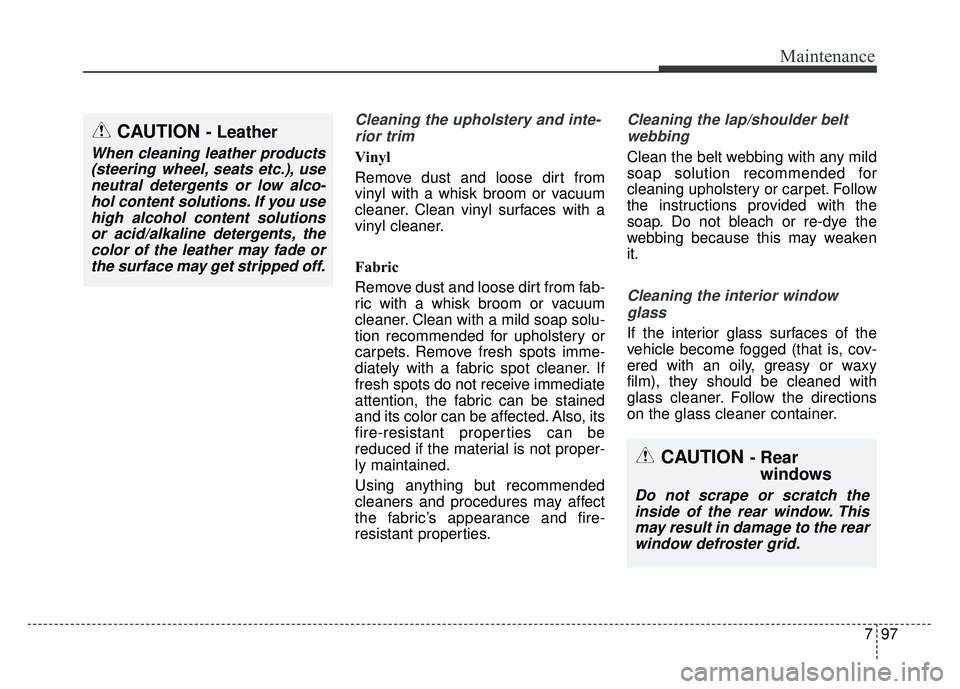
Cleaning the interior windowglass
If the interior glass surfaces of the
vehicle become fogged (that is, cov-
ered with an oily, greasy or waxy
film), they should be cleaned with
glass cleaner. Follow the directions
on the glass cleaner container.
CAUTION - Rear windows
Do not scrape or scratch the
inside of the rear window. Thismay result in damage to the rearwindow defroster grid.
CAUTION - Leather
When cleaning leather products(steering wheel, seats etc.), useneutral detergents or low alco-hol content solutions. If you usehigh alcohol content solutionsor acid/alkaline detergents, thecolor of the leather may fade orthe surface may get stripped off.
Page 507 of 532

Specifications, Consumer information and Reporting safety defects
Engine . . . . . . . . . . . . . . . . . . . . . . . . . . . . . . . . . . . . \
8-2
Dimensions . . . . . . . . . . . . . . . . . . . . . . . . . . . . . . . . 8-2
Bulb wattage . . . . . . . . . . . . . . . . . . . . . . . . . . . . . . . 8-3
Tires and wheels . . . . . . . . . . . . . . . . . . . . . . . . . . . . 8-5
Weight and volume . . . . . . . . . . . . . . . . . . . . . . . . . 8-6
Air conditioning system. . . . . . . . . . . . . . . . . . . . . . 8-6
Recommended lubricants and capacities . . . . . . . 8-7
• Recommended SAE viscosity number. . . . . . . . . . . . 8-8
Vehicle identification number (VIN) . . . . . . . . . . . 8-9
Vehicle certification label . . . . . . . . . . . . . . . . . . . . 8-9
Tire specification and pressure label . . . . . . . . . . . 8-10
Engine number . . . . . . . . . . . . . . . . . . . . . . . . . . . . . 8-10
Refrigerant label . . . . . . . . . . . . . . . . . . . . . . . . . . . 8-10
Consumer assistance . . . . . . . . . . . . . . . . . . . . . . . . 8-11
Electrical equipment . . . . . . . . . . . . . . . . . . . . . . . . 8-13
Reporting safety defects . . . . . . . . . . . . . . . . . . . . . 8-14
Online factory authorized manuals . . . . . . . . . . . . 8-15
8
Page 508 of 532
![KIA RIO HATCHBACK 2017 Owners Manual Specifications, Consumer information, Reporting safety defects
28
ENGINE
DIMENSIONS
ItemGasoline 1.6
Displacement [cu.in(cc)] 97.09
(1,591)
Bore x Stroke [in(mm)] 3.03 x 3.36
(77 x 85.44)
Firing orde](/img/2/57977/w960_57977-507.png "KIA RIO HATCHBACK 2017 Owners Manual Specifications, Consumer information, Reporting safety defects
28
ENGINE
DIMENSIONS
ItemGasoline 1.6
Displacement [cu.in(cc)] 97.09
(1,591)
Bore x Stroke [in(mm)] 3.03 x 3.36
(77 x 85.44)
Firing orde")
Specifications, Consumer information, Reporting safety defects
28
ENGINE
DIMENSIONS
ItemGasoline 1.6
Displacement [cu.in(cc)] 97.09
(1,591)
Bore x Stroke [in(mm)] 3.03 x 3.36
(77 x 85.44)
Firing order 1-3-4-2
No. of cylinders 4, In-line
Itemin (mm)
Overall length 4 door 172 (4370)
5 door 159.4 (4050)
Overall width
67.7 (1720)
Overall height57.2 (1455)
Front tread185/65R1559.8 (1520)
205/45R1759.3 (1507)
Rear tread185/65R15 60 (1525)
205/45R1759.4 (1511)
Wheelbase 101.1 (2570)
Page 511 of 532
85
Specifications, Consumer information, Reporting safety defects
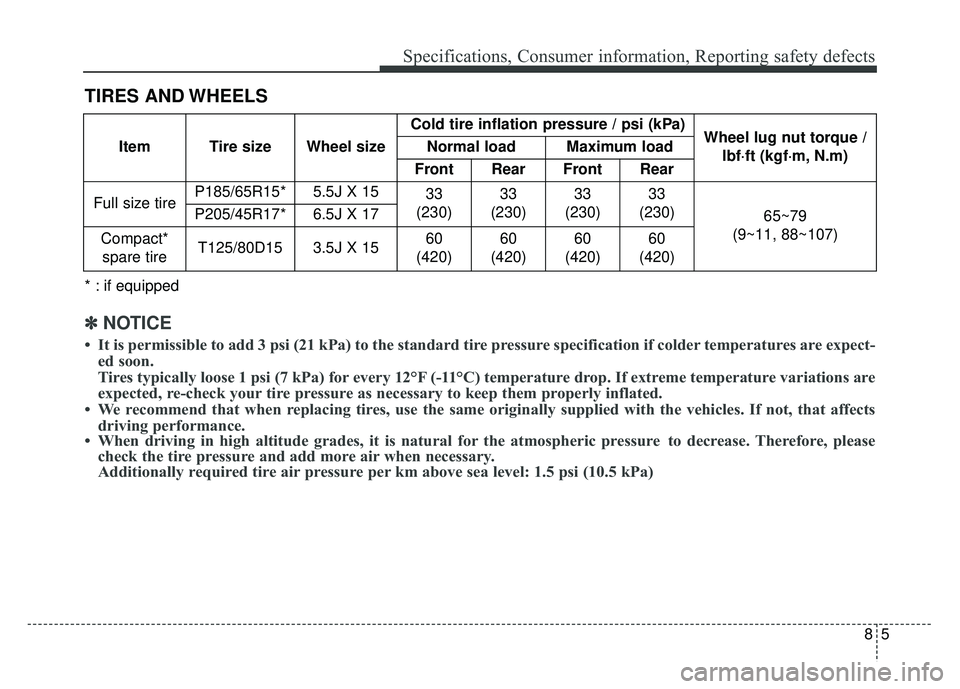
TIRES AND WHEELS
Item Tire size Wheel sizeCold tire inflation pressure / psi (kPa)
Wheel lug nut torque /
lbf·ft (kgf·m, N.m)
Normal load Maximum load
Front Rear Front Rear
Full size tire
P185/65R15* 5.5J X 15 33
(230) 33
(230) 33
(230) 33
(230) 65~79
(9~11, 88~107)
P205/45R17* 6.5J X 17
Compact* spare tire
T125/80D15 3.5J X 15 60
(420) 60
(420) 60
(420) 60
(420)
* : if equipped
✽
✽ NOTICE
• It is permissible to add 3 psi (21 kPa) to the standard tire pressure specification if colder temperatures are expect-
ed soon.
Tires typically loose 1 psi (7 kPa) for every 12°F (-11°C) temperature drop. If extreme temperature variations are
expected, re-check your tire pressure as necessary to keep them properly inflated.
• We recommend that when replacing tires, use the same originally supplied with the vehicles. If not, that aff\
ects driving performance.
• When driving in high altitude grades, it is natural for the atmospheric pressure to decrease. Therefore, please check the tire pressure and add more air when necessary.
Additionally required tire air pressure per km above sea level: 1.5 psi (10.5 kPa)
Page 523 of 532

Index
2I
Active Eco System ··················\
··················\
··················\
···5-45
Air bag warning label ··················\
··················\
················3-54
Air bag warning light··················\
··················\
·················3-34\
Air bag ··················\
··················\
··················\
··················\
···3-31Air bag warning label ··················\
··················\
··············3-54
Air bag warning light ··················\
··················\
··············3-34
Curtain air bag ··················\
··················\
··················\
·······3-46
Driver's and passenger's front air bag··········\
················3-42
Occupant detection system ··················\
··················\
······3-37
Side impact air bag ··················\
··················\
··················\
3-45
SRS components and functions ··················\
·················3-34\
Air cleaner ··················\
··················\
··················\
···············7-41
Air conditioning system··················\
··················\
···············8-6
Antenna ··················\
··················\
··················\
··················\
4-125
Anti-Lock Brake System (ABS) ··················\
··················\
5-26
Appearance care··················\
··················\
··················\
·······7-91 Exterior care ··················\
··················\
··················\
··········7-91
Interior care ··················\
··················\
··················\
···········7-96
Ashtray ··················\
··················\
··················\
··················\
·4-118
Audio system ··················\
··················\
··················\
·········4-125 Audio ··················\
··················\
··················\
········4-139, 4-181
Antenna··················\
··················\
··················\
················4-125
Steering wheel audio control ··················\
··················\
·4-126 Automatic climate control system ··················\
···············4-98
Air conditioning ··················\
··················\
··················\
··4-105
Climate control air filter ··················\
··················\
········4-107
Automatic transaxle ··················\
··················\
··················\
·5-16 Shift lock ··················\
··················\
··················\
···············5-20
Sports mode ··················\
··················\
··················\
···········5-18
Automatic transaxle fluid ··················\
··················\
··········7-40
AUX, USB and iPod ··················\
··················\
················4-127
Base curb weight ··················\
··················\
··················\
·····5-61
Battery··················\
··················\
··················\
··················\
····7-48
Battery saver function ··················\
··················\
················4-77
Before driving ··················\
··················\
··················\
············5-3
Bottle holders, see cup holders ··················\
··················\
4-119
Brake system··················\
··················\
··················\
············5-22 Anti-lock brake system (ABS) ··················\
··················\
5-26
Electronic stability program (ESC) ··················\
···········5-27
Hill-start assist control (HAC) ··················\
··················\
5-31
Parking brake ··················\
··················\
··················\
·········5-24
Power brakes··················\
··················\
··················\
··········5-22
Vehicle stability management (VSM) ··················\
·······5-31
Brakes/clutch fluid ··················\
··················\
··················\
···7-39
Bulb replacement ··················\
··················\
··················\
·····7-78
Bulb wattage ··················\
··················\
··················\
··············8-3
A
B