oil temperature KIA RIO HATCHBACK 2018 Owners Manual
[x] Cancel search | Manufacturer: KIA, Model Year: 2018, Model line: RIO HATCHBACK, Model: KIA RIO HATCHBACK 2018Pages: 492, PDF Size: 10.36 MB
Page 370 of 492
Maintenance
20
8
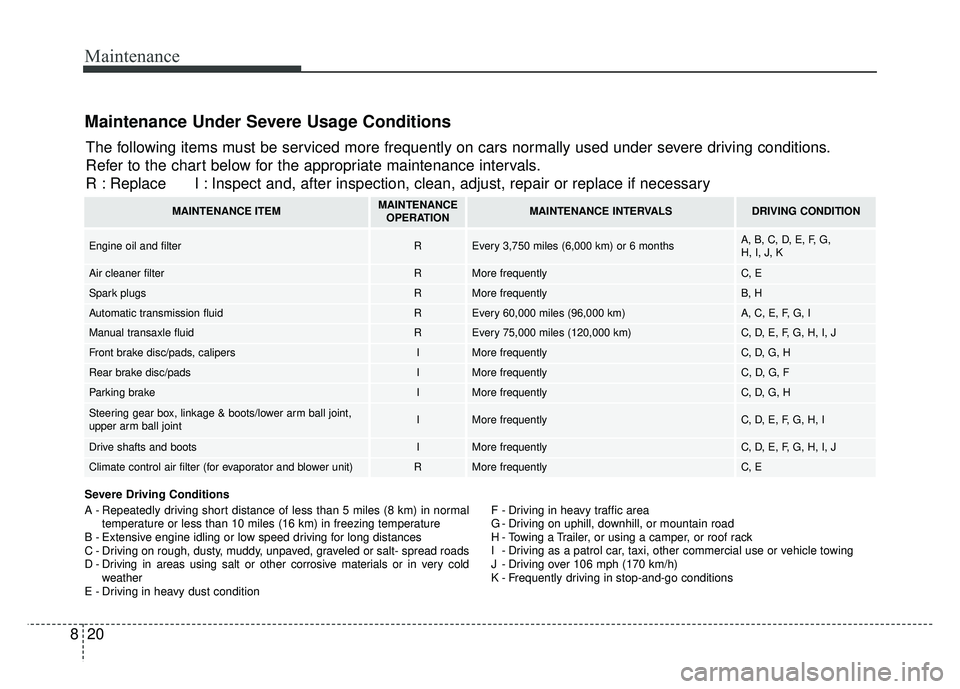
Maintenance Under Severe Usage Conditions
Severe Driving Conditions
A - Repeatedly driving short distance of less than 5 miles (8 km) in normal
temperature or less than 10 miles (16 km) in freezing temperature
B - Extensive engine idling or low speed driving for long distances
C - Driving on rough, dusty, muddy, unpaved, graveled or salt- spread roads
D - Driving in areas using salt or other corrosive materials or in very cold weather
E - Driving in heavy dust condition F - Driving in heavy traffic area
G - Driving on uphill, downhill, or mountain road
H - Towing a Trailer, or using a camper, or roof rack
I - Driving as a patrol car, taxi, other commercial use or vehicle towing
J - Driving over 106 mph (170 km/h)
K - Frequently driving in stop-and-go conditions
The following items must be serviced more frequently on cars normally used under severe driving conditions.
Refer to the chart below for the appropriate maintenance intervals.
R : Replace I : Inspect and, after inspection, clean, adjust, repair or replace if neces\
sary
MAINTENANCE ITEMMAINTENANCE
OPERATIONMAINTENANCE INTERVALSDRIVING CONDITION
Engine oil and filterREvery 3,750 miles (6,000 km) or 6 monthsA, B, C, D, E, F, G,
H, I, J, K
Air cleaner filterRMore frequentlyC, E
Spark plugsRMore frequentlyB, H
Automatic transmission fluidREvery 60,000 miles (96,000 km)A, C, E, F, G, I
Manual transaxle fluidREvery 75,000 miles (120,000 km)C, D, E, F, G, H, I, J
Front brake disc/pads, calipersIMore frequentlyC, D, G, H
Rear brake disc/padsIMore frequentlyC, D, G, F
Parking brakeIMore frequentlyC, D, G, H
Steering gear box, linkage & boots/lower arm ball joint,
upper arm ball jointIMore frequentlyC, D, E, F, G, H, I
Drive shafts and bootsIMore frequentlyC, D, E, F, G, H, I, J
Climate control air filter (for evaporator and blower unit)RMore frequentlyC, E
Page 394 of 492
Maintenance
44
8
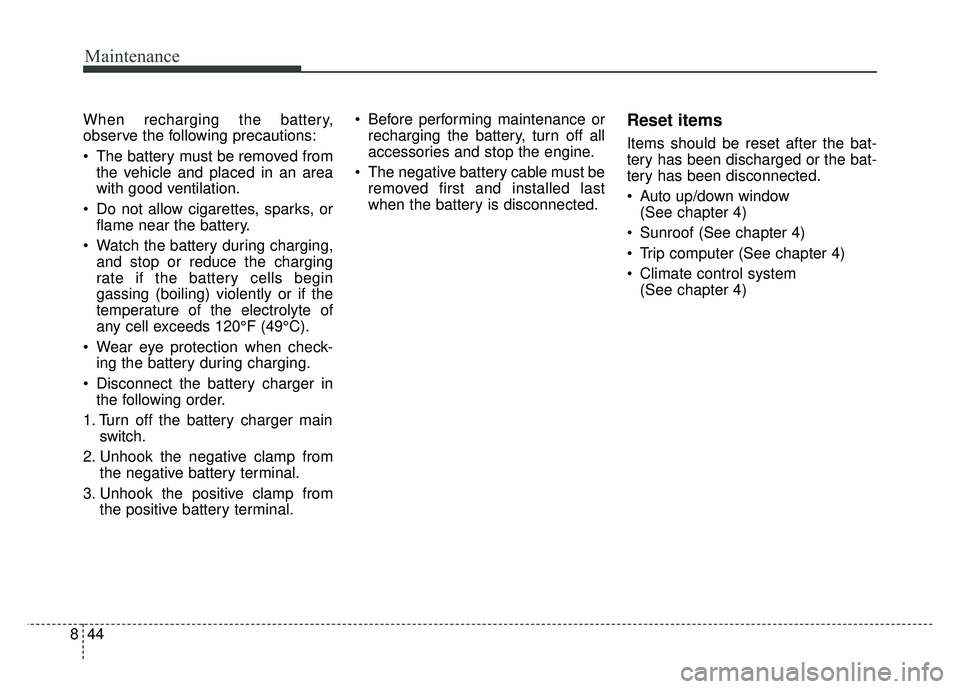
When recharging the battery,
observe the following precautions:
The battery must be removed from
the vehicle and placed in an area
with good ventilation.
Do not allow cigarettes, sparks, or flame near the battery.
Watch the battery during charging, and stop or reduce the charging
rate if the battery cells begin
gassing (boiling) violently or if the
temperature of the electrolyte of
any cell exceeds 120°F (49°C).
Wear eye protection when check- ing the battery during charging.
Disconnect the battery charger in the following order.
1. Turn off the battery charger main switch.
2. Unhook the negative clamp from the negative battery terminal.
3. Unhook the positive clamp from the positive battery terminal. Before performing maintenance or
recharging the battery, turn off all
accessories and stop the engine.
The negative battery cable must be removed first and installed last
when the battery is disconnected.Reset items
Items should be reset after the bat-
tery has been discharged or the bat-
tery has been disconnected.
Auto up/down window (See chapter 4)
Sunroof (See chapter 4)
Trip computer (See chapter 4)
Climate control system (See chapter 4)
Page 404 of 492
Maintenance
54
8
Temperature -A, B & C
The temperature grades are A (the
highest), B and C representing the
tire’s resistance to the generation of
heat and its ability to dissipate heat
when tested under controlled condi-
tions on a specified indoor laboratory
test wheel.
Sustained high temperature can
cause the material of the tire to
degenerate and reduce tire life, and
excessive temperature can lead to
sudden tire failure. The grade C cor-
responds to a level of performance
which all passenger car tires must
meet under the Federal Motor
Vehicle Safety Standard No. 109.
Grades B and A represent higher
levels of performance on the labora-
tory test wheel than the minimum
required by law. Tire terminology and definitions
Air Pressure:
The amount of air
inside the tire pressing outward on
the tire. Air pressure is expressed in
kilopascal (kPa) or pounds per
square inch (psi).
Accessory Weight: This means the
combined weight of optional acces-
sories. Some examples of optional
accessories are, automatic
transaxle, power seats, and air con-
ditioning.
Aspect Ratio: The relationship of a
tire's height to its width.
Belt: A rubber coated layer of cords
that is located between the plies and
the tread. Cords may be made from
steel or other reinforcing materials.
Bead: The tire bead contains steel
wires wrapped by steel cords that
hold the tire onto the rim.
Bias Ply Tire: A pneumatic tire in
which the plies are laid at alternate
angles less than 90 degrees to the
centerline of the tread. Cold Tire Pressure:
The amount of
air pressure in a tire, measured in
kilopascals (kPa) or pounds per
square inch (psi) before a tire has
built up heat from driving.
Curb Weight: This means the weight
of a motor vehicle with standard and
optional equipment including the
maximum capacity of fuel, oil and
coolant, but without passengers and
cargo.
DOT Markings: A code molded into
the sidewall of a tire signifying that
the tire is in compliance with the U.S.
Department of Transportation motor
vehicle safety standards. The DOT
code includes the Tire Identification
Number (TIN), an alphanumeric des-
ignator which can also identify the
tire manufacturer, production plant,
brand and date of production.
Page 471 of 492
99
Specifications, Consumer information, Reporting safety defects
Recommended SAE viscosity
number
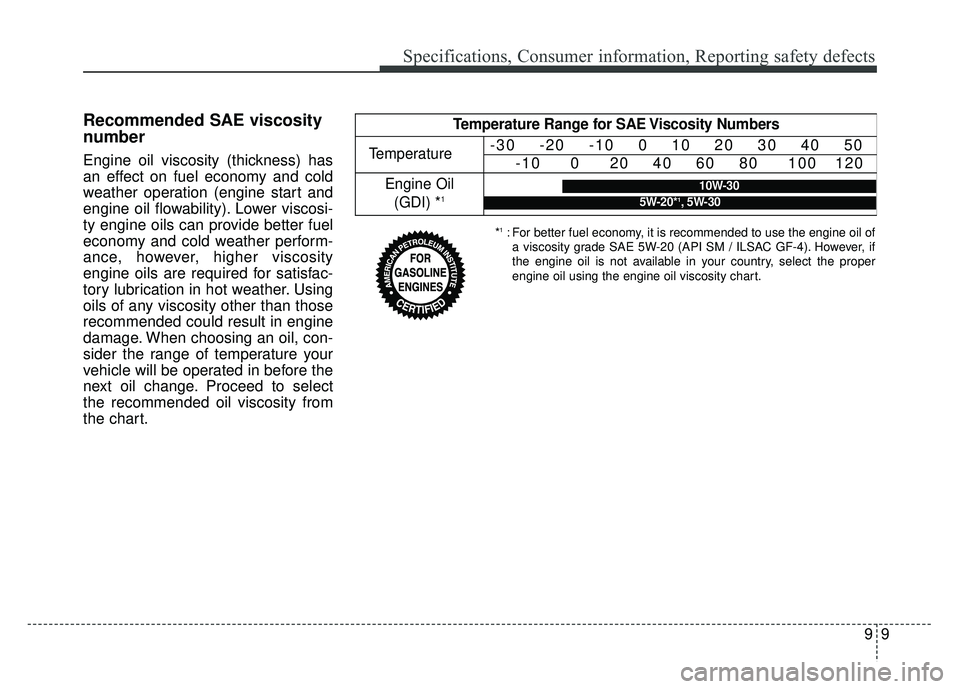
Engine oil viscosity (thickness) has
an effect on fuel economy and cold
weather operation (engine start and
engine oil flowability). Lower viscosi-
ty engine oils can provide better fuel
economy and cold weather perform-
ance, however, higher viscosity
engine oils are required for satisfac-
tory lubrication in hot weather. Using
oils of any viscosity other than those
recommended could result in engine
damage. When choosing an oil, con-
sider the range of temperature your
vehicle will be operated in before the
next oil change. Proceed to select
the recommended oil viscosity from
the chart.
Temperature Range for SAE Viscosity Numbers
Temperature -30 -20 -10 0 10 20 30 40 50
-10 0 20 40 60 80 100 120
Engine Oil(GDI) *110W-30
5W-20*1, 5W-30
*1: For better fuel economy, it is recommended to use the engine oil ofa viscosity grade SAE 5W-20 (API SM / ILSAC GF-4). However, if
the engine oil is not available in your country, select the proper
engine oil using the engine oil viscosity chart.
Page 482 of 492
Index
4I
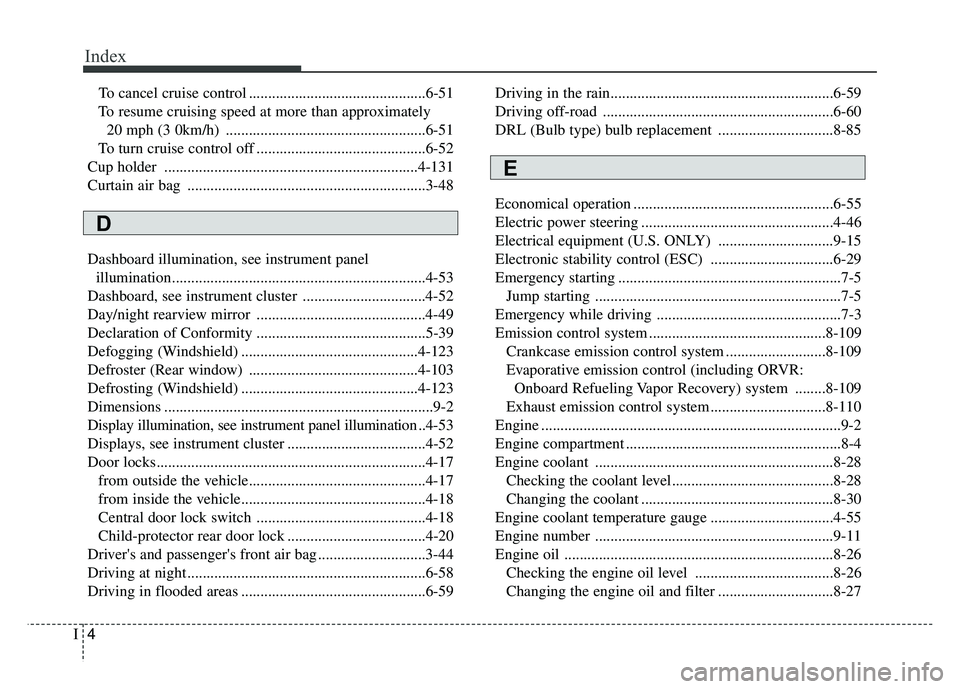
To cancel cruise control ..............................................6-51
To resume cruising speed at more than approximately 20 mph (3 0km/h) ....................................................6-51
To turn cruise control off ............................................6-52
Cup holder ..................................................................4-131
Curtain air bag ..............................................................3-48
Dashboard illumination, see instrument panel illumination..................................................................4-53
Dashboard, see instrument cluster ................................4-52
Day/night rearview mirror ............................................4-49
Declaration of Conformity ............................................5-39
Defogging (Windshield) ..............................................4-123
Defroster (Rear window) ............................................4-103
Defrosting (Windshield) ..............................................4-123
Dimensions ......................................................................9-\
2
Display illumination, see instrument panel illumination ..4-53
Displays, see instrument cluster ....................................4-52
Door locks......................................................................4-\
17 from outside the vehicle..............................................4-17
from inside the vehicle................................................4-18
Central door lock switch ............................................4-18
Child-protector rear door lock ....................................4-20
Driver's and passenger's front air bag ............................3-44
Driving at night ..............................................................6-58
Driving in flooded areas ................................................6-59 Driving in the rain..........................................................6-59
Driving off-road ............................................................6-60
DRL (Bulb type) bulb replacement ..............................8-85
Economical operation ....................................................6-55
Electric power steering ..................................................4-46
Electrical equipment (U.S. ONLY) ..............................9-15
Electronic stability control (ESC) ................................6-29
Emergency starting ..........................................................7-5
Jump starting ................................................................7-5
Emergency while driving ................................................7-3
Emission control system ..............................................8-109 Crankcase emission control system ..........................8-109
Evaporative emission control (including ORVR: Onboard Refueling Vapor Recovery) system ........8-109
Exhaust emission control system ..............................8-110
Engine ........................................................................\
......9-2
Engine compartment ........................................................8-4
Engine coolant ..............................................................8-28 Checking the coolant level..........................................8-28
Changing the coolant ..................................................8-30
Engine coolant temperature gauge ................................4-55
Engine number ..............................................................9-11
Engine oil ......................................................................8-\
26 Checking the engine oil level ....................................8-26
Changing the engine oil and filter ..............................8-27
D
E
Page 487 of 492
I9
Index
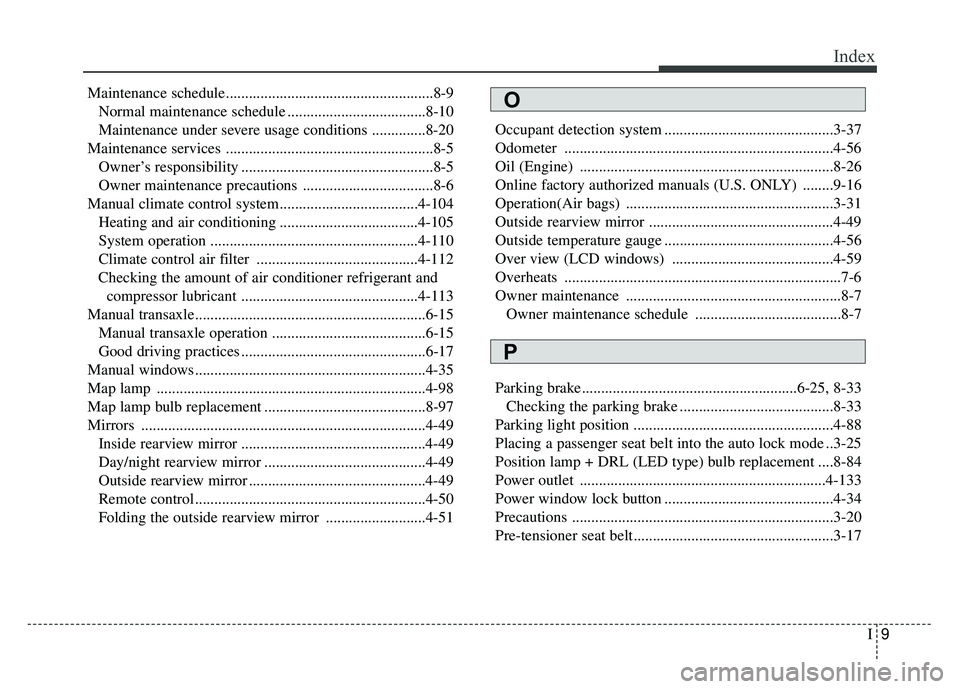
Maintenance schedule......................................................8-9Normal maintenance schedule ....................................8-10
Maintenance under severe usage conditions ..............8-20
Maintenance services ......................................................8-5 Owner’s responsibility ..................................................8-5
Owner maintenance precautions ..................................8-6
Manual climate control system....................................4-104 Heating and air conditioning ....................................4-105
System operation ......................................................4-110
Climate control air filter ..........................................4-112
Checking the amount of air conditioner refrigerant and compressor lubricant ..............................................4-113
Manual transaxle............................................................6-15 Manual transaxle operation ........................................6-15
Good driving practices ................................................6-17
Manual windows ............................................................4-35
Map lamp ......................................................................4-\
98
Map lamp bulb replacement ..........................................8-97
Mirrors ........................................................................\
..4-49 Inside rearview mirror ................................................4-49
Day/night rearview mirror ..........................................4-49
Outside rearview mirror ..............................................4-49
Remote control ............................................................4-50
Folding the outside rearview mirror ..........................4-51 Occupant detection system ............................................3-37
Odometer ......................................................................4-\
56
Oil (Engine) ..................................................................8-26
Online factory authorized manuals (U.S. ONLY) ........9-16
Operation(Air bags) ......................................................3-31
Outside rearview mirror ................................................4-49
Outside temperature gauge ............................................4-56
Over view (LCD windows) ..........................................4-59
Overheats ........................................................................\
7-6
Owner maintenance ........................................................8-7
Owner maintenance schedule ......................................8-7
Parking brake........................................................6-25, 8-33 Checking the parking brake ........................................8-33
Parking light position ....................................................4-88
Placing a passenger seat belt into the auto lock mode ..3-25
Position lamp + DRL (LED type) bulb replacement ....8-84
Power outlet ................................................................4-133
Power window lock button ............................................4-34
Precautions ....................................................................3-20\
Pre-tensioner seat belt....................................................3-17O
P