oil type KIA RIO HATCHBACK 2018 Owners Manual
[x] Cancel search | Manufacturer: KIA, Model Year: 2018, Model line: RIO HATCHBACK, Model: KIA RIO HATCHBACK 2018Pages: 492, PDF Size: 10.36 MB
Page 136 of 492
Features of your vehicle
64
4
- If the engine is running, even when
the vehicle is not in motion, the infor-
mation will be accumulated.LCD Modes (for type B cluster)
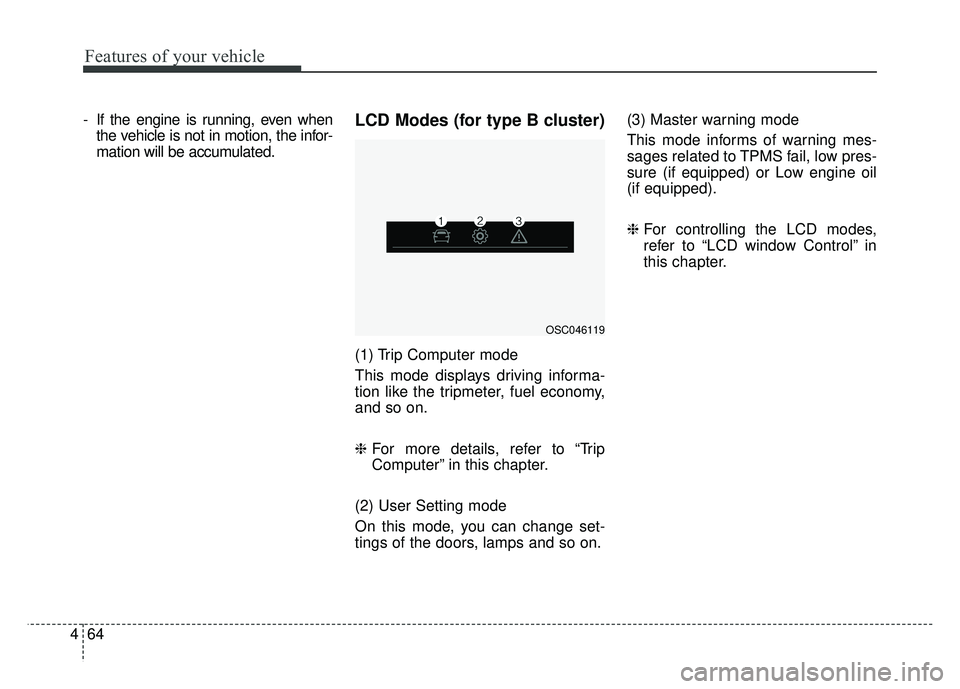
(1) Trip Computer mode
This mode displays driving informa-
tion like the tripmeter, fuel economy,
and so on.
❈ For more details, refer to “Trip
Computer” in this chapter.
(2) User Setting mode
On this mode, you can change set-
tings of the doors, lamps and so on. (3) Master warning mode
This mode informs of warning mes-
sages related to TPMS fail, low pres-
sure (if equipped) or Low engine oil
(if equipped).
❈
For controlling the LCD modes,
refer to “LCD window Control” in
this chapter.
OSC046119
Page 185 of 492
4113
Features of your vehicle
Checking the amount of air
conditioner refrigerant and
compressor lubricant
When the amount of refrigerant is
low, the performance of the air con-
ditioning is reduced. Overfilling also
has a negative influence on the air
conditioning system.
Therefore, if abnormal operation is
found, have the system inspected by
an authorized Kia dealer.The air conditioning system should
be serviced by an authorized Kia
dealer.
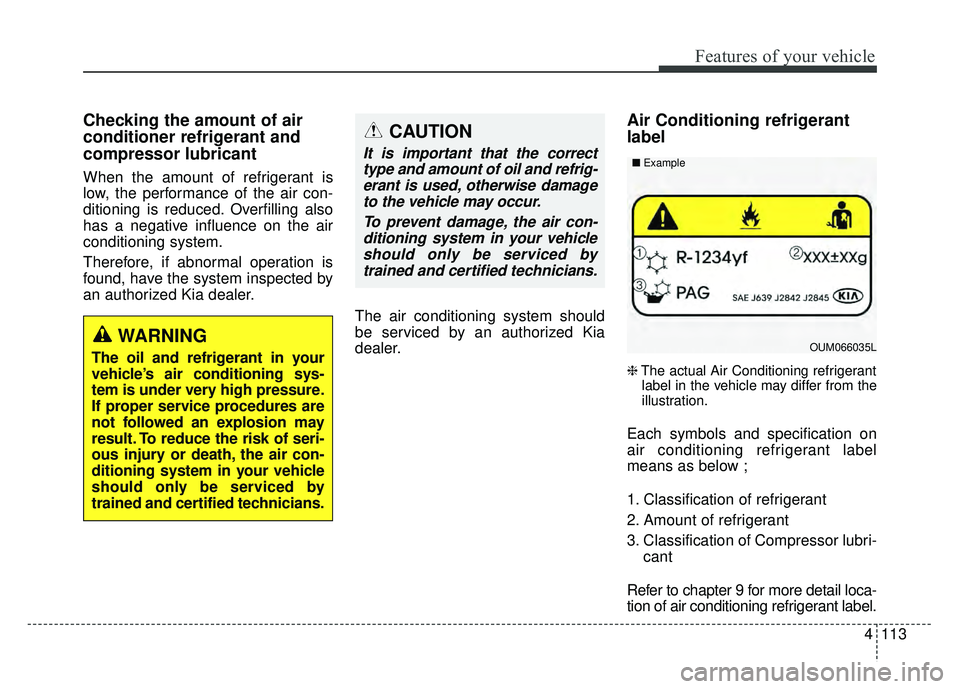
Air Conditioning refrigerant
label
❈The actual Air Conditioning refrigerant
label in the vehicle may differ from the
illustration.
Each symbols and specification on
air conditioning refrigerant label
means as below ;
1. Classification of refrigerant
2. Amount of refrigerant
3. Classification of Compressor lubri- cant
Refer to chapter 9 for more detail loca-
tion of air conditioning refrigerant label.
CAUTION
It is important that the correct type and amount of oil and refrig-erant is used, otherwise damageto the vehicle may occur.
To prevent damage, the air con-ditioning system in your vehicleshould only be serviced bytrained and certified technicians.
OUM066035L
■
ExampleWARNING
The oil and refrigerant in your
vehicle’s air conditioning sys-
tem is under very high pressure.
If proper service procedures are
not followed an explosion may
result. To reduce the risk of seri-
ous injury or death, the air con-
ditioning system in your vehicle
should only be serviced by
trained and certified technicians.
Page 312 of 492
Driving your vehicle
64
6
Change to "winter weight" oil
if necessary
In some climates it is recommended
that a lower viscosity "winter weight"
oil be used during cold weather. See
section 9 for recommendations. If
you aren't sure what weight oil you
should use, consult an authorized
Kia dealer.
Check spark plugs and igni-
tion system
Inspect your spark plugs as
described in section 8 and replace
them if necessary. Also check all
ignition wiring and components to be
sure they are not cracked, worn or
damaged in any way.
To keep locks from freezing
To keep the locks from freezing,
squirt an approved de-icer fluid or
glycerine into the key opening. If a
lock is covered with ice, squirt it with
an approved de-icing fluid to remove
the ice. If the lock is frozen internally,
you may be able to thaw it out by
using a heated key. Handle the heat-
ed key with care to avoid injury.
Use approved window washer
anti-freeze in system
To keep the water in the window
washer system from freezing, add an
approved window washer anti-freeze
solution in accordance with instruc-
tions on the container. Window wash-
er anti-freeze is available from an
authorized Kia dealer and most auto
parts outlets. Do not use engine
coolant or other types of anti-freeze
as these may damage the paint fin-
ish.
Don't let your parking brake
freeze
Under some conditions your parking
brake can freeze in the engaged
position. This is most likely to hap-
pen when there is an accumulation
of snow or ice around or near the
rear brakes or if the brakes are wet.
If there is a risk the parking brake
may freeze, apply it only temporarily
while you put the shift lever in P
(automatic transaxle) or in first or
reverse gear (manual transaxle) and
block the rear wheels so the vehicle
cannot roll. Then release the parking
brake.
Don't let ice and snow accu-
mulate underneath
Under some conditions, snow and
ice can build up under the fenders
and interfere with the steering. When
driving in severe winter conditions
where this may happen, you should
periodically check underneath the
car to be sure the movement of the
front wheels and the steering com-
ponents is not obstructed.
Page 381 of 492
831
Maintenance
BRAKE/CLUTCH FLUID (IF EQUIPPED)
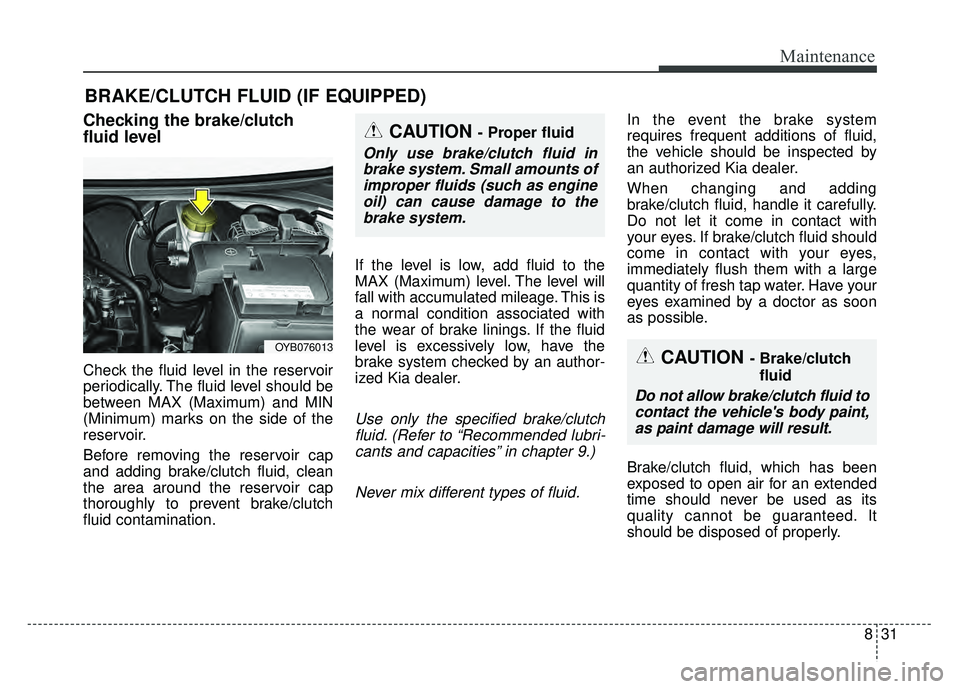
Checking the brake/clutch
fluid level
Check the fluid level in the reservoir
periodically. The fluid level should be
between MAX (Maximum) and MIN
(Minimum) marks on the side of the
reservoir.
Before removing the reservoir cap
and adding brake/clutch fluid, clean
the area around the reservoir cap
thoroughly to prevent brake/clutch
fluid contamination.If the level is low, add fluid to the
MAX (Maximum) level. The level will
fall with accumulated mileage. This is
a normal condition associated with
the wear of brake linings. If the fluid
level is excessively low, have the
brake system checked by an author-
ized Kia dealer.
Use only the specified brake/clutch
fluid. (Refer to “Recommended lubri-cants and capacities” in chapter 9.)
Never mix different types of fluid.
In the event the brake system
requires frequent additions of fluid,
the vehicle should be inspected by
an authorized Kia dealer.
When changing and adding
brake/clutch fluid, handle it carefully.
Do not let it come in contact with
your eyes. If brake/clutch fluid should
come in contact with your eyes,
immediately flush them with a large
quantity of fresh tap water. Have your
eyes examined by a doctor as soon
as possible.
Brake/clutch fluid, which has been
exposed to open air for an extended
time should never be used as its
quality cannot be guaranteed. It
should be disposed of properly.
OYB076013CAUTION - Brake/clutch fluid
Do not allow brake/clutch fluid tocontact the vehicle's body paint,as paint damage will result.
CAUTION - Proper fluid
Only use brake/clutch fluid inbrake system. Small amounts ofimproper fluids (such as engineoil) can cause damage to thebrake system.
Page 410 of 492
Maintenance
60
8
FUSES
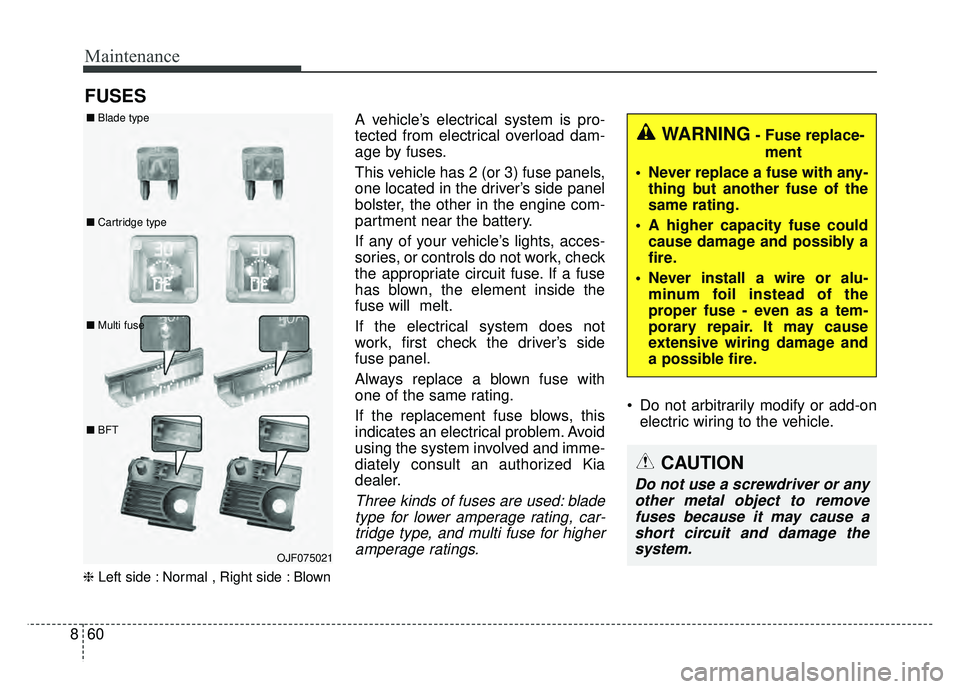
❈ Left side : Normal , Right side : Blown
A vehicle’s electrical system is pro-
tected from electrical overload dam-
age by fuses.
This vehicle has 2 (or 3) fuse panels,
one located in the driver’s side panel
bolster, the other in the engine com-
partment near the battery.
If any of your vehicle’s lights, acces-
sories, or controls do not work, check
the appropriate circuit fuse. If a fuse
has blown, the element inside the
fuse will melt.
If the electrical system does not
work, first check the driver’s side
fuse panel.
Always replace a blown fuse with
one of the same rating.
If the replacement fuse blows, this
indicates an electrical problem. Avoid
using the system involved and imme-
diately consult an authorized Kia
dealer.
Three kinds of fuses are used: blade
type for lower amperage rating, car-tridge type, and multi fuse for higheramperage ratings.
Do not arbitrarily modify or add-on electric wiring to the vehicle.
WARNING- Fuse replace-
ment
Never replace a fuse with any- thing but another fuse of the
same rating.
A higher capacity fuse could cause damage and possibly a
fire.
Never install a wire or alu- minum foil instead of the
proper fuse - even as a tem-
porary repair. It may cause
extensive wiring damage and
a possible fire.
CAUTION
Do not use a screwdriver or anyother metal object to removefuses because it may cause ashort circuit and damage thesystem.
OJF075021
■
Blade type
■ Cartridge type
■ Multi fuse
■ BFT
Page 431 of 492
881
Maintenance
Headlamp bulb Always handle them carefully, andavoid scratches and abrasions. If
the bulbs are lit, avoid contact with
liquids. Never touch the glass with
bare hands. Residual oil may
cause the bulb to overheat and
burst when lit. A bulb should be
operated only when installed in a
headlamp.
If a bulb becomes damaged or cracked, replace it immediately
and carefully dispose of it.
Wear eye protection when chang- ing a bulb. Allow the bulb to cool
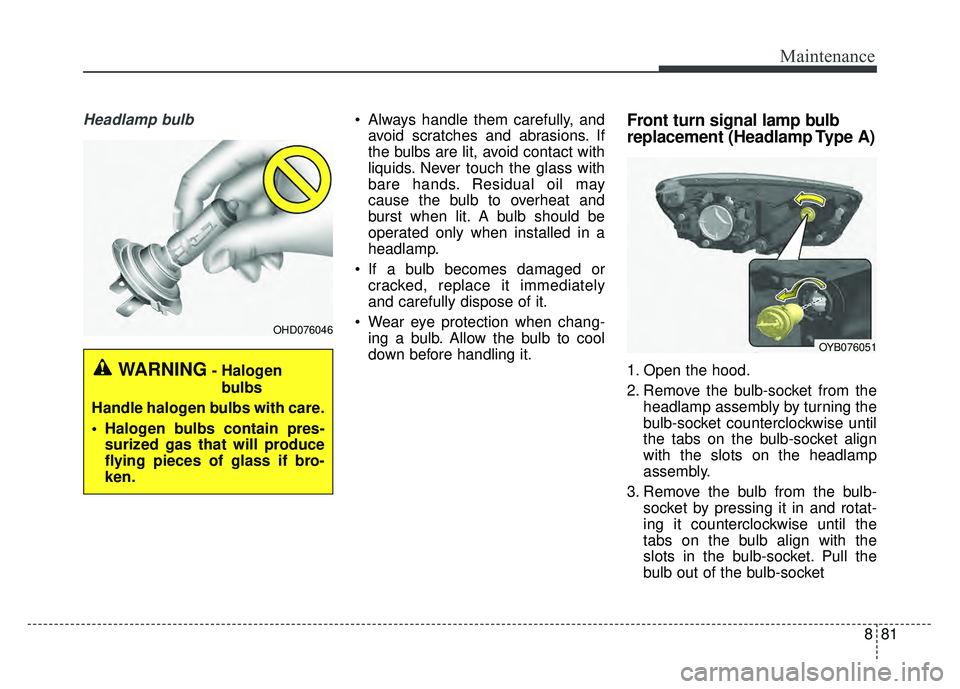
down before handling it.Front turn signal lamp bulb
replacement (Headlamp Type A)
1. Open the hood.
2. Remove the bulb-socket from the headlamp assembly by turning the
bulb-socket counterclockwise until
the tabs on the bulb-socket align
with the slots on the headlamp
assembly.
3. Remove the bulb from the bulb- socket by pressing it in and rotat-
ing it counterclockwise until the
tabs on the bulb align with the
slots in the bulb-socket. Pull the
bulb out of the bulb-socketWARNING- Halogen
bulbs
Handle halogen bulbs with care.
Halogen bulbs contain pres- surized gas that will produce
flying pieces of glass if bro-
ken.
OHD076046
OYB076051
Page 433 of 492
883
Maintenance
Headlamp bulb Always handle them carefully, andavoid scratches and abrasions. If
the bulbs are lit, avoid contact with
liquids. Never touch the glass with
bare hands. Residual oil may
cause the bulb to overheat and
burst when lit. A bulb should be
operated only when installed in a
headlamp.
If a bulb becomes damaged or cracked, replace it immediately
and carefully dispose of it.
Wear eye protection when chang- ing a bulb. Allow the bulb to cool
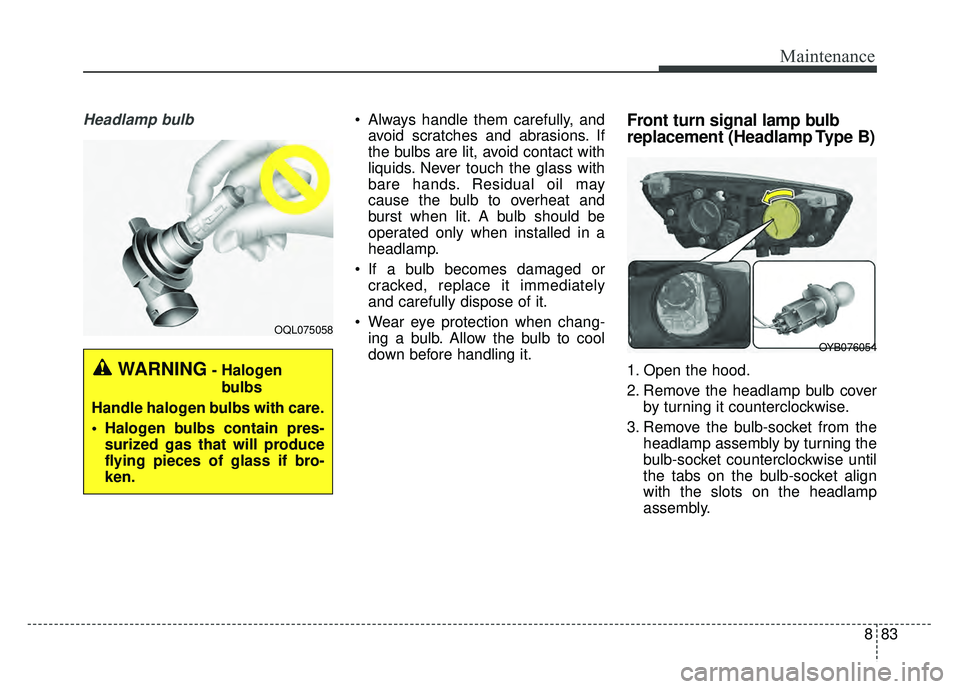
down before handling it.Front turn signal lamp bulb
replacement (Headlamp Type B)
1. Open the hood.
2. Remove the headlamp bulb cover by turning it counterclockwise.
3. Remove the bulb-socket from the headlamp assembly by turning the
bulb-socket counterclockwise until
the tabs on the bulb-socket align
with the slots on the headlamp
assembly.
OQL075058
WARNING- Halogen
bulbs
Handle halogen bulbs with care.
Halogen bulbs contain pres- surized gas that will produce
flying pieces of glass if bro-
ken.
OYB076054
Page 482 of 492
Index
4I
To cancel cruise control ..............................................6-51
To resume cruising speed at more than approximately 20 mph (3 0km/h) ....................................................6-51
To turn cruise control off ............................................6-52
Cup holder ..................................................................4-131
Curtain air bag ..............................................................3-48
Dashboard illumination, see instrument panel illumination..................................................................4-53
Dashboard, see instrument cluster ................................4-52
Day/night rearview mirror ............................................4-49
Declaration of Conformity ............................................5-39
Defogging (Windshield) ..............................................4-123
Defroster (Rear window) ............................................4-103
Defrosting (Windshield) ..............................................4-123
Dimensions ......................................................................9-\
2
Display illumination, see instrument panel illumination ..4-53
Displays, see instrument cluster ....................................4-52
Door locks......................................................................4-\
17 from outside the vehicle..............................................4-17
from inside the vehicle................................................4-18
Central door lock switch ............................................4-18
Child-protector rear door lock ....................................4-20
Driver's and passenger's front air bag ............................3-44
Driving at night ..............................................................6-58
Driving in flooded areas ................................................6-59 Driving in the rain..........................................................6-59
Driving off-road ............................................................6-60
DRL (Bulb type) bulb replacement ..............................8-85
Economical operation ....................................................6-55
Electric power steering ..................................................4-46
Electrical equipment (U.S. ONLY) ..............................9-15
Electronic stability control (ESC) ................................6-29
Emergency starting ..........................................................7-5
Jump starting ................................................................7-5
Emergency while driving ................................................7-3
Emission control system ..............................................8-109 Crankcase emission control system ..........................8-109
Evaporative emission control (including ORVR: Onboard Refueling Vapor Recovery) system ........8-109
Exhaust emission control system ..............................8-110
Engine ........................................................................\
......9-2
Engine compartment ........................................................8-4
Engine coolant ..............................................................8-28 Checking the coolant level..........................................8-28
Changing the coolant ..................................................8-30
Engine coolant temperature gauge ................................4-55
Engine number ..............................................................9-11
Engine oil ......................................................................8-\
26 Checking the engine oil level ....................................8-26
Changing the engine oil and filter ..............................8-27
D
E
Page 483 of 492
I5
Index
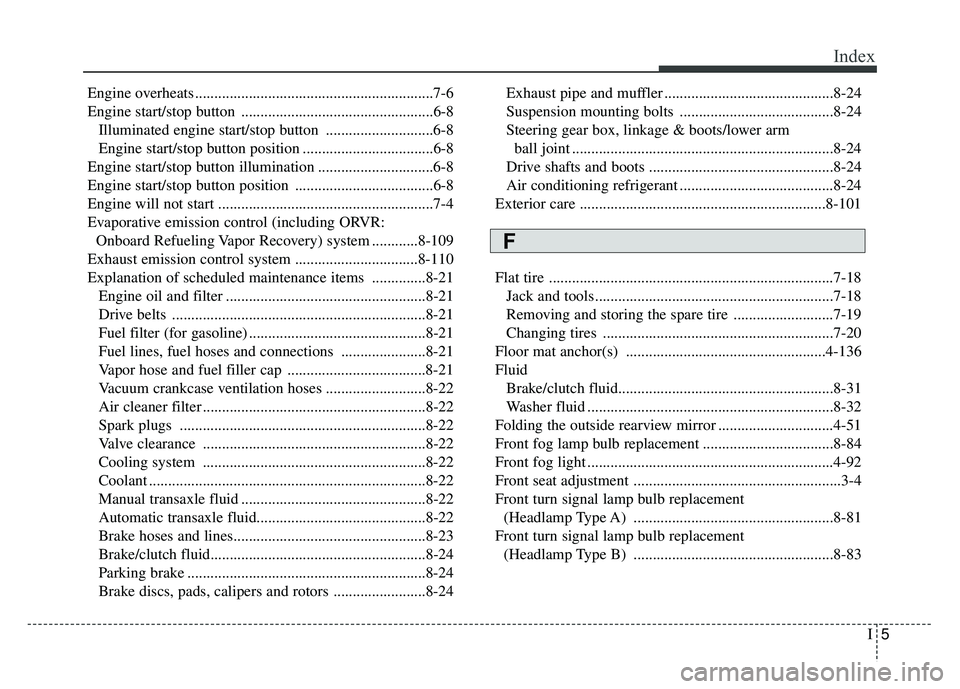
Engine overheats ..............................................................7-6
Engine start/stop button ..................................................6-8Illuminated engine start/stop button ............................6-8
Engine start/stop button position ..................................6-8
Engine start/stop button illumination ..............................6-8
Engine start/stop button position ....................................6-8
Engine will not start ........................................................7-4
Evaporative emission control (including ORVR: Onboard Refueling Vapor Recovery) system ............8-109
Exhaust emission control system ................................8-110
Explanation of scheduled maintenance items ..............8-21 Engine oil and filter ....................................................8-21
Drive belts ..................................................................8-21
Fuel filter (for gasoline) ..............................................8-21
Fuel lines, fuel hoses and connections ......................8-21
Vapor hose and fuel filler cap ....................................8-21
Vacuum crankcase ventilation hoses ..........................8-22
Air cleaner filter ..........................................................8-22
Spark plugs ................................................................8-22
Valve clearance ..........................................................8-22
Cooling system ..........................................................8-22
Coolant ........................................................................\
8-22
Manual transaxle fluid ................................................8-22
Automatic transaxle fluid............................................8-2\
2
Brake hoses and lines..................................................8-23
Brake/clutch fluid........................................................8-24
Parking brake ..............................................................8-24
Brake discs, pads, calipers and rotors ........................8-24 Exhaust pipe and muffler ............................................8-24
Suspension mounting bolts ........................................8-24
Steering gear box, linkage & boots/lower arm ball joint ....................................................................8-24\
Drive shafts and boots ................................................8-24
Air conditioning refrigerant ........................................8-24
Exterior care ................................................................8-101
Flat tire ........................................................................\
..7-18 Jack and tools ..............................................................7-18
Removing and storing the spare tire ..........................7-19
Changing tires ............................................................7-20
Floor mat anchor(s) ....................................................4-136
Fluid Brake/clutch fluid........................................................8-31
Washer fluid ................................................................8-32
Folding the outside rearview mirror ..............................4-51
Front fog lamp bulb replacement ..................................8-84
Front fog light ................................................................4-92
Front seat adjustment ......................................................3-4
Front turn signal lamp bulb replacement (Headlamp Type A) ....................................................8-81
Front turn signal lamp bulb replacement (Headlamp Type B) ....................................................8-83
F
Page 487 of 492
I9
Index
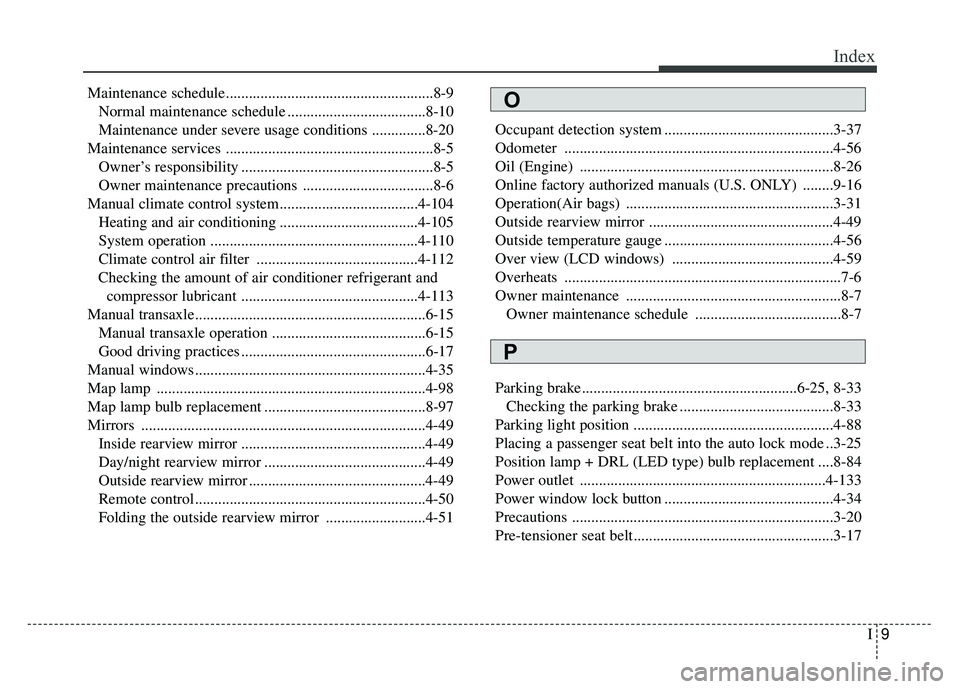
Maintenance schedule......................................................8-9Normal maintenance schedule ....................................8-10
Maintenance under severe usage conditions ..............8-20
Maintenance services ......................................................8-5 Owner’s responsibility ..................................................8-5
Owner maintenance precautions ..................................8-6
Manual climate control system....................................4-104 Heating and air conditioning ....................................4-105
System operation ......................................................4-110
Climate control air filter ..........................................4-112
Checking the amount of air conditioner refrigerant and compressor lubricant ..............................................4-113
Manual transaxle............................................................6-15 Manual transaxle operation ........................................6-15
Good driving practices ................................................6-17
Manual windows ............................................................4-35
Map lamp ......................................................................4-\
98
Map lamp bulb replacement ..........................................8-97
Mirrors ........................................................................\
..4-49 Inside rearview mirror ................................................4-49
Day/night rearview mirror ..........................................4-49
Outside rearview mirror ..............................................4-49
Remote control ............................................................4-50
Folding the outside rearview mirror ..........................4-51 Occupant detection system ............................................3-37
Odometer ......................................................................4-\
56
Oil (Engine) ..................................................................8-26
Online factory authorized manuals (U.S. ONLY) ........9-16
Operation(Air bags) ......................................................3-31
Outside rearview mirror ................................................4-49
Outside temperature gauge ............................................4-56
Over view (LCD windows) ..........................................4-59
Overheats ........................................................................\
7-6
Owner maintenance ........................................................8-7
Owner maintenance schedule ......................................8-7
Parking brake........................................................6-25, 8-33 Checking the parking brake ........................................8-33
Parking light position ....................................................4-88
Placing a passenger seat belt into the auto lock mode ..3-25
Position lamp + DRL (LED type) bulb replacement ....8-84
Power outlet ................................................................4-133
Power window lock button ............................................4-34
Precautions ....................................................................3-20\
Pre-tensioner seat belt....................................................3-17O
P