warning KIA RIO HATCHBACK 2019 Owners Manual
[x] Cancel search | Manufacturer: KIA, Model Year: 2019, Model line: RIO HATCHBACK, Model: KIA RIO HATCHBACK 2019Pages: 503, PDF Size: 10.42 MB
Page 366 of 503
733
What to do in an emergency
The compact spare should be inflat-
ed to 420 kPa (60 psi).
✽ ✽NOTICE
Check the inflation pressure after
installing the spare tire. Adjust it to
the specified pressure, as necessary.
When using a compact spare tire,
observe the following precautions:
Under no circumstances should you
exceed 80 km/h (50 mph); a higher
speed could damage the tire.
Ensure that you drive slowly enough for the road conditions to avoid all
hazards. Any road hazard, such as a
pothole or debris, could seriously
damage the compact spare.
Any continuous road use of this tire could result in tire failure, loss of
vehicle control, and possible per-
sonal injury.
Do not exceed the vehicle’s maxi- mum load rating or the load-carry-
ing capacity shown on the sidewall
of the compact spare tire.
Avoid driving over obstacles. The compact spare tire diameter is
smaller than the diameter of a con-
ventional tire and reduces the
ground clearance approximately
25 mm (1 inch), which could result
in damage to the vehicle. Do not take this vehicle through an
automatic car wash while the com-
pact spare tire is installed.
The compact spare tire should not be installed on the front axle if the
vehicle must be driven in snow or
on ice.
WARNING- Spare tire
Do not operate your vehicle on
this compact spare at speeds
over 80 km/h (50 mph). The
compact spare tire is for emer-
gency use only. The original tire
should be repaired or replaced
as soon as possible to avoid
failure of the spare that may
possibly lead to bodily injury or
death.
SC CAN (ENG) 7.qxp 7/18/2018 5:39 PM Page 33
Page 369 of 503
What to do in an emergency
36
7
TOWING
Towing service
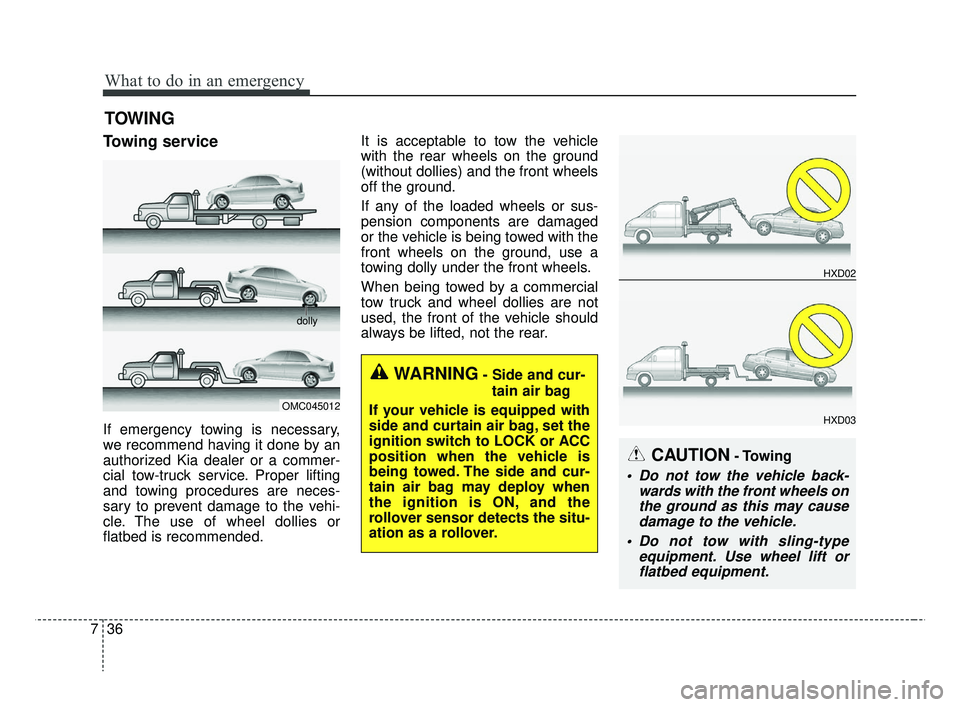
If emergency towing is necessary,
we recommend having it done by an
authorized Kia dealer or a commer-
cial tow-truck service. Proper lifting
and towing procedures are neces-
sary to prevent damage to the vehi-
cle. The use of wheel dollies or
flatbed is recommended. It is acceptable to tow the vehicle
with the rear wheels on the ground
(without dollies) and the front wheels
off the ground.
If any of the loaded wheels or sus-
pension components are damaged
or the vehicle is being towed with the
front wheels on the ground, use a
towing dolly under the front wheels.
When being towed by a commercial
tow truck and wheel dollies are not
used, the front of the vehicle should
always be lifted, not the rear.
CAUTION- Towing
Do not tow the vehicle back-
wards with the front wheels onthe ground as this may causedamage to the vehicle.
Do not tow with sling-type equipment. Use wheel lift orflatbed equipment.
OMC045012 dolly
HXD02
HXD03
WARNING- Side and cur-
tain air bag
If your vehicle is equipped with
side and curtain air bag, set the
ignition switch to LOCK or ACC
position when the vehicle is
being towed. The side and cur-
tain air bag may deploy when
the ignition is ON, and the
rollover sensor detects the situ-
ation as a rollover.
SC CAN (ENG) 7.qxp 7/18/2018 5:40 PM Page 36
Page 372 of 503
739
What to do in an emergency
Emergency towing precautions
Turn the ignition switch to ACC sothe steering wheel isn’t locked.
Place the transmission shift lever in N (Neutral).
Release the parking brake.
Press the brake pedal with more force than normal since you will
have reduced brake performance.
More steering effort will be required because the power steer-
ing system will be disabled.
If you are driving down a long hill, the brakes may overheat and brake
performance will be reduced. Stop
often and let the brakes cool off.
If the car is being towed with all four
wheels on the ground, it can be
towed only from the front. Be sure
that the transmission is in neutral. Be
sure the steering is unlocked by plac-
ing the ignition switch in the ACC
position. A driver must be in the
towed vehicle to operate the steering
and brakes.WARNING- Emergency
Towing Precautions
Use extreme caution when tow-
ing the vehicle.
Avoid sudden starts or erratic driving maneuvers which
would place excessive stress
on the emergency towing hook
and towing cable or chain. The
hook and towing cable or
chain may break and cause
serious injury or damage.
If the disabled vehicle is unable to be moved, do not
forcibly continue the towing.
In this case, contact an
authorized Kia dealer or a
commercial tow truck service
for assistance.
Tow the vehicle as straight ahead as possible.
Keep away from the vehicle during towing.CAUTION- Automatic
Transmission
To avoid serious damage to the Automatic Transmission,limit the vehicle speed to 10mph (15 km/h) and drive lessthan 1 mile (1.5 km/h) whentowing.
Before towing, check for an Automatic Transmission fluidleak under your vehicle. If theAutomatic Transmission fluidis leaking, a flatbed equipmentor towing dolly must be used.
SC CAN (ENG) 7.qxp 7/18/2018 5:40 PM Page 39
Page 378 of 503
Maintenance
68
Owner maintenance precau-
tions
Improper or incomplete service may
result in problems. This section gives
instructions only for the maintenance
items that are easy to perform.
As explained earlier in this section,
several procedures can be done only
by an authorized Kia dealer with spe-
cial tools.
✽ ✽NOTICE
Improper owner maintenance dur-
ing the warranty period may affect
warranty coverage. For details, read
the separate Warranty & Consumer
Information manual provided with
the vehicle. If you're unsure about
any servicing or maintenance proce-
dure, have it done by an authorized
Kia dealer.
WARNING- Maintenance
work
Do not wear jewelry or loose
clothing while working under
the hood of your vehicle with
the engine running. These can
become entangled in moving
parts, if you must run the
engine while working under the
hood, make certain that you
remove all jewelry (especially
rings, bracelets, watches, and
necklaces) and all neckties,
scarves, and similar loose
clothing before getting near the
engine or cooling fans.WARNING- Touching metal parts
Do not touch metal parts
(including strut bars) while the
engine is operating or hot.
Doing so could result in serious
personal injury. Turn the engine
off and wait until the metal parts
cool down to perform mainte-
nance work on the vehicle.
SC CAN (ENG) 8.qxp 7/18/2018 5:32 PM Page 6
Page 379 of 503
87
Maintenance
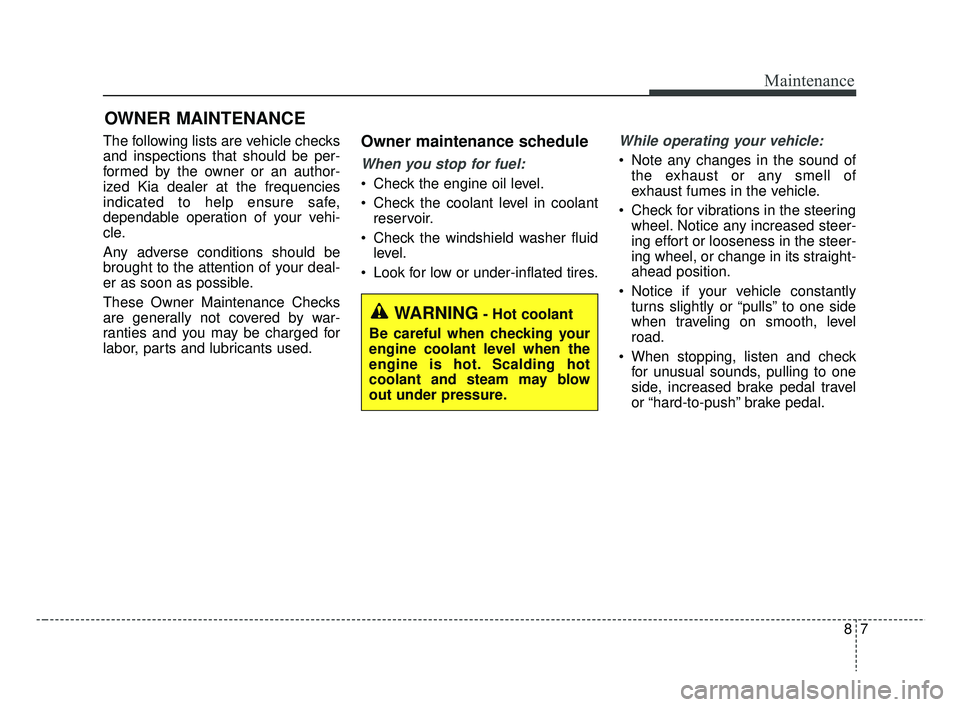
OWNER MAINTENANCE
The following lists are vehicle checks
and inspections that should be per-
formed by the owner or an author-
ized Kia dealer at the frequencies
indicated to help ensure safe,
dependable operation of your vehi-
cle.
Any adverse conditions should be
brought to the attention of your deal-
er as soon as possible.
These Owner Maintenance Checks
are generally not covered by war-
ranties and you may be charged for
labor, parts and lubricants used.Owner maintenance schedule
When you stop for fuel:
Check the engine oil level.
Check the coolant level in coolantreservoir.
Check the windshield washer fluid level.
Look for low or under-inflated tires.
While operating your vehicle:
Note any changes in the sound of the exhaust or any smell of
exhaust fumes in the vehicle.
Check for vibrations in the steering wheel. Notice any increased steer-
ing effort or looseness in the steer-
ing wheel, or change in its straight-
ahead position.
Notice if your vehicle constantly turns slightly or “pulls” to one side
when traveling on smooth, level
road.
When stopping, listen and check for unusual sounds, pulling to one
side, increased brake pedal travel
or “hard-to-push” brake pedal.
WARNING- Hot coolant
Be careful when checking your
engine coolant level when the
engine is hot. Scalding hot
coolant and steam may blow
out under pressure.
SC CAN (ENG) 8.qxp 7/18/2018 5:32 PM Page 7
Page 380 of 503
Maintenance
88
If any slipping or changes in theoperation of your transmission
occurs, check the transmission
fluid level.
Check manual transmission opera- tion, including clutch operation.
Check the automatic transmission P (Park) function.
Check the parking brake.
Check for fluid leaks under your vehicle (water dripping from the air
conditioning system during or after
use is normal).At least monthly:
Check the coolant level in theengine coolant reservoir.
Check the operation of all exterior lights, including the stoplights, turn
signals and hazard warning flash-
ers.
Check the inflation pressures of all tires including the spare for tires
that are worn, show uneven wear,
or are damaged.
Check for loose wheel lug nuts.
At least twice a year (i.e., every Spring and Fall) :
Check the radiator, heater and air conditioning hoses for leaks or
damage.
Check the windshield washer spray and wiper operation. Clean
the wiper blades with clean cloth
dampened with washer fluid.
Check the headlight alignment.
Check the muffler, exhaust pipes, shields and clamps.
Check the lap/shoulder belts for wear and function.
SC CAN (ENG) 8.qxp 7/18/2018 5:32 PM Page 8
Page 393 of 503
821
Maintenance
ENGINE OIL
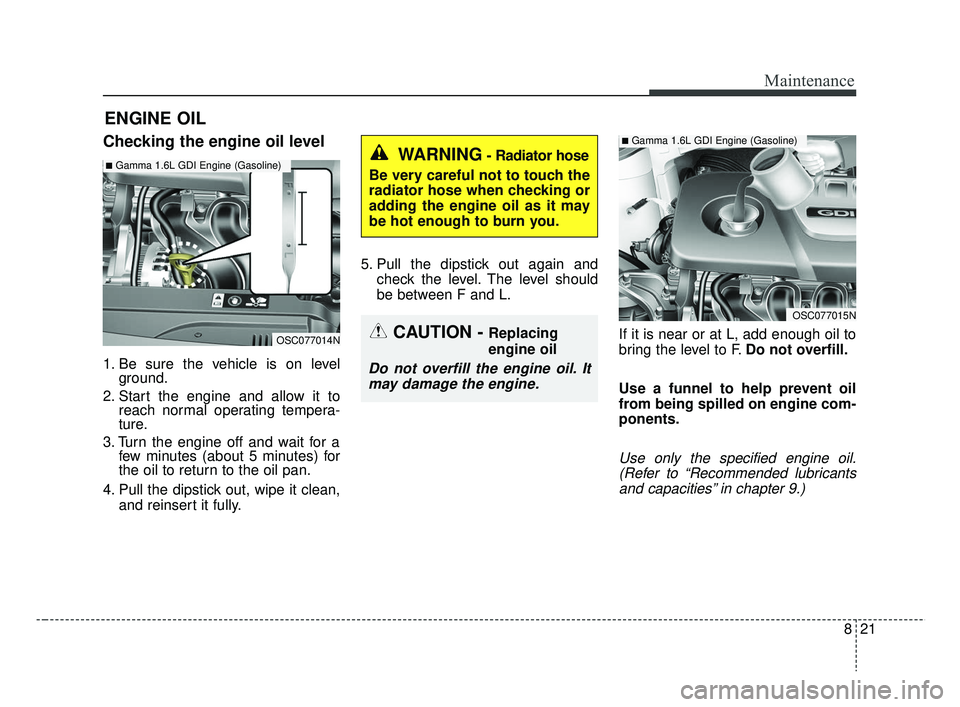
Checking the engine oil level
1. Be sure the vehicle is on levelground.
2. Start the engine and allow it to reach normal operating tempera-
ture.
3. Turn the engine off and wait for a few minutes (about 5 minutes) for
the oil to return to the oil pan.
4. Pull the dipstick out, wipe it clean, and reinsert it fully. 5. Pull the dipstick out again and
check the level. The level should
be between F and L.
If it is near or at L, add enough oil to
bring the level to F.Do not overfill.
Use a funnel to help prevent oil
from being spilled on engine com-
ponents.
Use only the specified engine oil. (Refer to “Recommended lubricantsand capacities” in chapter 9.)
CAUTION - Replacing
engine oil
Do not overfill the engine oil. Itmay damage the engine.
WARNING- Radiator hose
Be very careful not to touch the
radiator hose when checking or
adding the engine oil as it may
be hot enough to burn you.
OSC077014N
■Gamma 1.6L GDI Engine (Gasoline)
OSC077015N
■Gamma 1.6L GDI Engine (Gasoline)
SC CAN (ENG) 8.qxp 7/18/2018 5:32 PM Page 21
Page 394 of 503
Maintenance
22
8
Changing the engine oil and
filter
Have engine oil and filter changed by
an authorized Kia dealer according
to the Maintenance Schedule at the
beginning of this chapter.
WARNING - Used engine
oil
Used engine oil may cause irrita-
tion or cancer of the skin if left in
contact with the skin for pro-
longed periods of time. Always
protect your skin by washing
your hands thoroughly with
soap and warm water as soon as
possible after handling used oil.
SC CAN (ENG) 8.qxp 7/18/2018 5:32 PM Page 22
Page 395 of 503
823
Maintenance
ENGINE COOLANT
The high-pressure cooling system
has a reservoir filled with year round
antifreeze coolant. The reservoir is
filled at the factory.
Check the antifreeze protection and
coolant level at least once a year: at
the beginning of the winter season,
and before traveling to a colder cli-
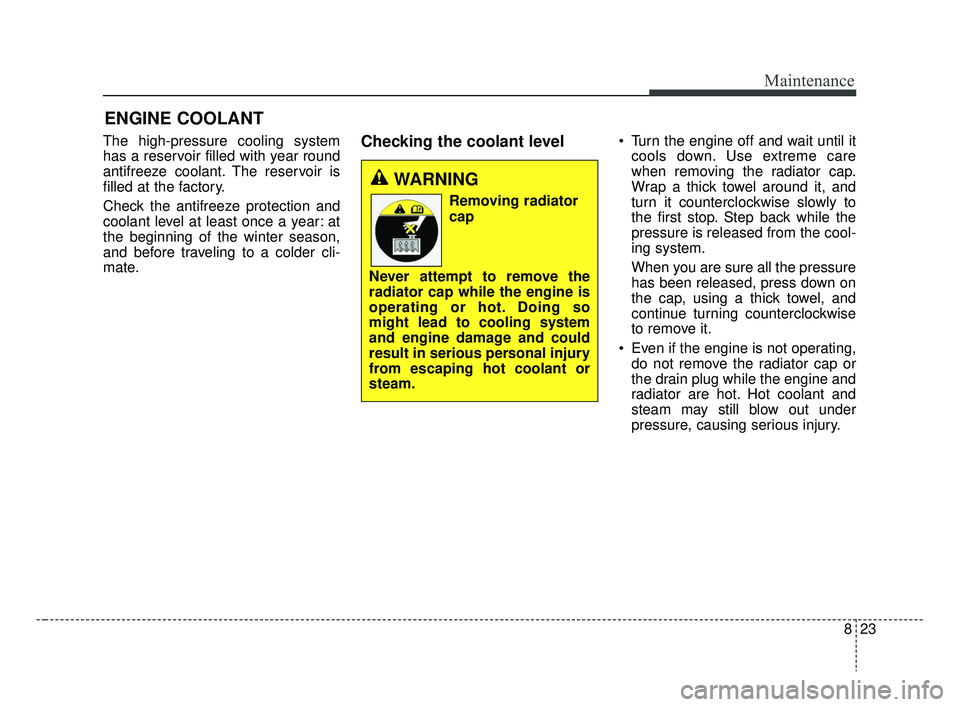
mate.Checking the coolant level Turn the engine off and wait until itcools down. Use extreme care
when removing the radiator cap.
Wrap a thick towel around it, and
turn it counterclockwise slowly to
the first stop. Step back while the
pressure is released from the cool-
ing system.
When you are sure all the pressure
has been released, press down on
the cap, using a thick towel, and
continue turning counterclockwise
to remove it.
Even if the engine is not operating, do not remove the radiator cap or
the drain plug while the engine and
radiator are hot. Hot coolant and
steam may still blow out under
pressure, causing serious injury.
WARNING
Removing radiator
cap
Never attempt to remove the
radiator cap while the engine is
operating or hot. Doing so
might lead to cooling system
and engine damage and could
result in serious personal injury
from escaping hot coolant or
steam.
SC CAN (ENG) 8.qxp 7/18/2018 5:33 PM Page 23
Page 396 of 503
Maintenance
24
8
Check the condition and connections
of all cooling system hoses and
heater hoses. Replace any swollen
or deteriorated hoses.
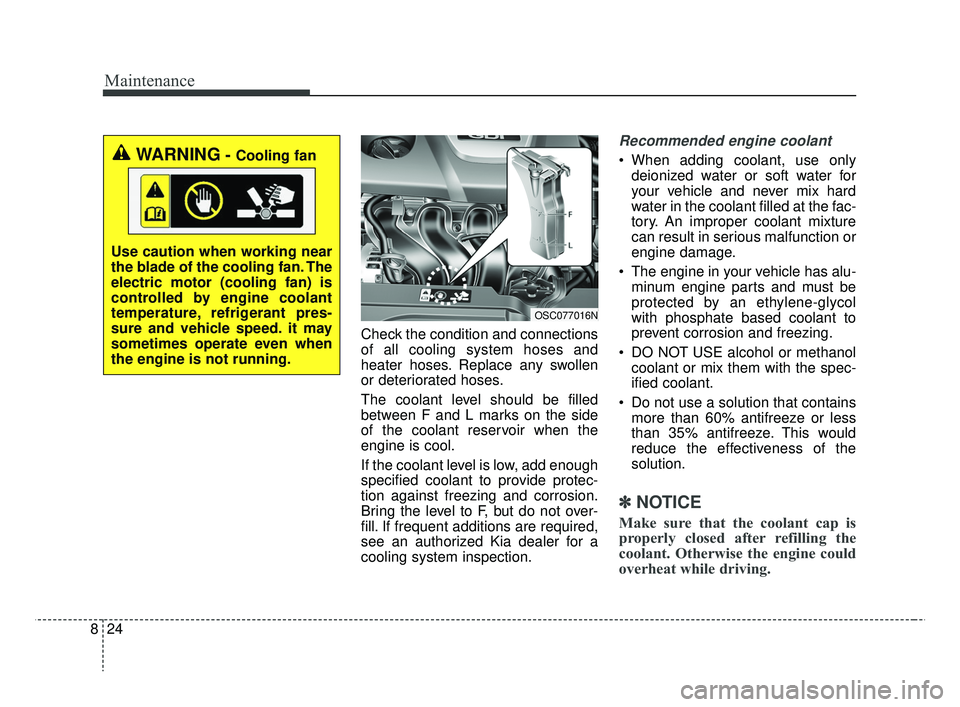
The coolant level should be filled
between F and L marks on the side
of the coolant reservoir when the
engine is cool.
If the coolant level is low, add enough
specified coolant to provide protec-
tion against freezing and corrosion.
Bring the level to F, but do not over-
fill. If frequent additions are required,
see an authorized Kia dealer for a
cooling system inspection.
Recommended engine coolant
When adding coolant, use only
deionized water or soft water for
your vehicle and never mix hard
water in the coolant filled at the fac-
tory. An improper coolant mixture
can result in serious malfunction or
engine damage.
The engine in your vehicle has alu- minum engine parts and must be
protected by an ethylene-glycol
with phosphate based coolant to
prevent corrosion and freezing.
DO NOT USE alcohol or methanol coolant or mix them with the spec-
ified coolant.
Do not use a solution that contains more than 60% antifreeze or less
than 35% antifreeze. This would
reduce the effectiveness of the
solution.
✽ ✽
NOTICE
Make sure that the coolant cap is
properly closed after refilling the
coolant. Otherwise the engine could
overheat while driving.
OSC077016N
WARNING- Cooling fan
Use caution when working near
the blade of the cooling fan. The
electric motor (cooling fan) is
controlled by engine coolant
temperature, refrigerant pres-
sure and vehicle speed. it may
sometimes operate even when
the engine is not running.
SC CAN (ENG) 8.qxp 7/18/2018 5:33 PM Page 24