ABS KIA Rondo 2007 2.G User Guide
[x] Cancel search | Manufacturer: KIA, Model Year: 2007, Model line: Rondo, Model: KIA Rondo 2007 2.GPages: 343, PDF Size: 3.61 MB
Page 240 of 343
Driving your vehicle40
5An authorized KIA dealer can assist you
in installing the wiring harness.E140406AUNDriving on grades Reduce speed and shift to a lower gear
before you start down a long or steep
downgrade. If you don’t shift down, you
might have to use your brakes so much
that they would get hot and no longer
operate efficiently.
On a long uphill grade, shift down and
reduce your speed to around 70 km/h (45
mph) to reduce the possibility of engine
and transaxle overheating.
If your trailer weighs more than the max-
imum trailer weight without trailer brakes
and you have an automatic transaxle,
you should drive in D (Drive) when tow-
ing a trailer.
Operating your vehicle in D (Drive) when
towing a trailer will minimize heat build up
and extend the life of your transaxle.
E140407AUN-EUParking on hills Generally, you should not park your vehi-
cle with a trailer attached on a hill. People
can be seriously or fatally injured, and
both your vehicle and the trailer can be
damaged if they begin a downhill trajec-
tory.
However, if you ever have to park your
trailer on a hill, here’s how to do it:
1. Apply your brakes, but don’t shift into
gear.
2. Have someone place chocks under the trailer wheels.
3. When the wheel chocks are in place, release the brakes until the chocks
absorb the load.
4. Reapply the brakes. Apply your park- ing brake, and then shift to P (Park) for
an automatic transaxle.
5. Release the brakes.
CAUTION
When towing a trailer on steep grades (in excess of 6%) payclose attention to the enginecoolant temperature gauge toensure the engine does not over- heat. If the needle of the coolanttemperature gauge moves across the dial towards “H” (HOT), pullover and stop as soon as it is safe to do so, and allow the engine toidle until it cools down. You may proceed once the engine hascooled sufficiently.
You must decide driving speed depending on trailer weight anduphill grade to reduce the possi-bility of engine and transaxle overheating.
WARNING
Failure to use an approved trailer
wiring harness could result in dam-
age to the vehicle electrical system
and/or personal injury.
WARNING
- Parking on a hill
Parking your vehicle on a hill with a
trailer attached could cause seri-
ous injury or death should the trail-
er break lose.
Page 260 of 343
611
What to do in an emergency
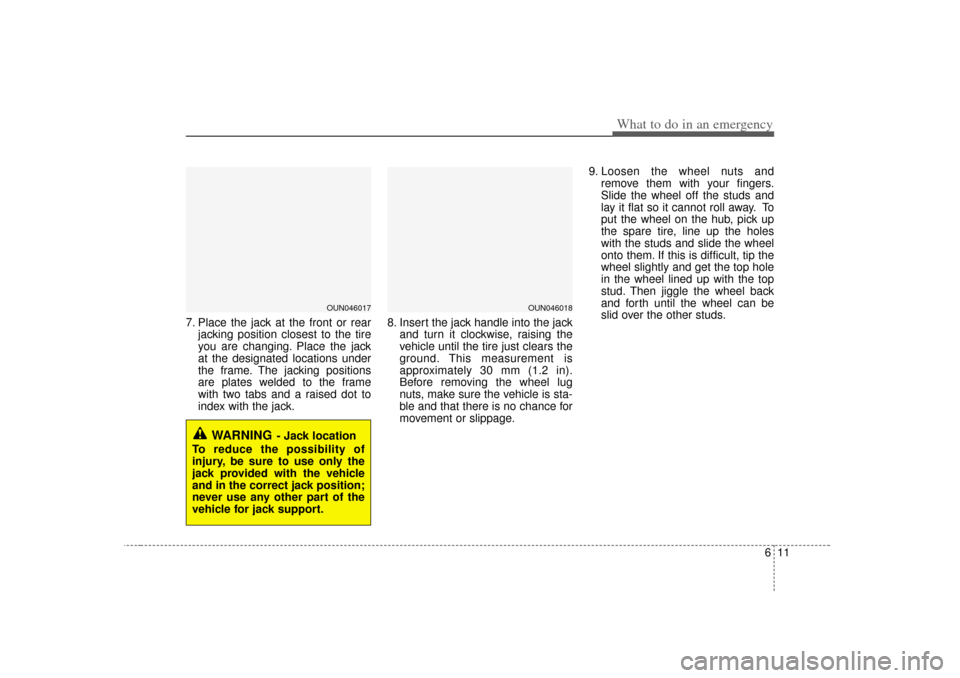
7. Place the jack at the front or rearjacking position closest to the tire
you are changing. Place the jack
at the designated locations under
the frame. The jacking positions
are plates welded to the frame
with two tabs and a raised dot to
index with the jack. 8. Insert the jack handle into the jack
and turn it clockwise, raising the
vehicle until the tire just clears the
ground. This measurement is
approximately 30 mm (1.2 in).
Before removing the wheel lug
nuts, make sure the vehicle is sta-
ble and that there is no chance for
movement or slippage. 9. Loosen the wheel nuts and
remove them with your fingers.
Slide the wheel off the studs and
lay it flat so it cannot roll away. To
put the wheel on the hub, pick up
the spare tire, line up the holes
with the studs and slide the wheel
onto them. If this is difficult, tip the
wheel slightly and get the top hole
in the wheel lined up with the top
stud. Then jiggle the wheel back
and forth until the wheel can be
slid over the other studs.
WARNING
- Jack location
To reduce the possibility of
injury, be sure to use only the
jack provided with the vehicle
and in the correct jack position;
never use any other part of the
vehicle for jack support.
OUN046017
OUN046018
Page 321 of 343
751
Maintenance
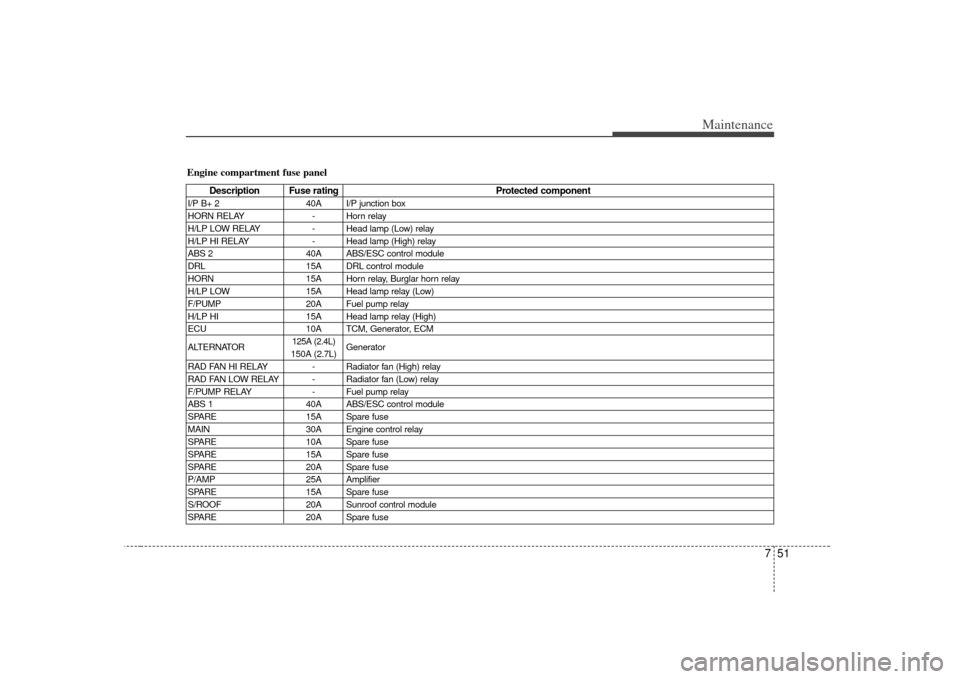
Engine compartment fuse panel
Description Fuse ratingProtected component
I/P B+ 240A I/P junction box
HORN RELAY - Horn relay
H/LP LOW RELAY - Head lamp (Low) relay
H/LP HI RELAY - Head lamp (High) relay
ABS 2 40A ABS/ESC control module
DRL 15A DRL control module
HORN 15A Horn relay, Burglar horn relay
H/LP LOW 15A Head lamp relay (Low)
F/PUMP 20A Fuel pump relay
H/LP HI 15A Head lamp relay (High)
ECU 10A TCM, Generator, ECM
ALTERNATOR
125A (2.4L)
Generator
150A (2.7L)
RAD FAN HI RELAY - Radiator fan (High) relay
RAD FAN LOW RELAY - Radiator fan (Low) relay
F/PUMP RELAY - Fuel pump relay
ABS 1 40A ABS/ESC control module
SPARE 15A Spare fuse
MAIN 30A Engine control relay
SPARE 10A Spare fuse
SPARE 15A Spare fuse
SPARE 20A Spare fuse
P/AMP 25A Amplifier
SPARE 15A Spare fuse
S/ROOF 20A Sunroof control module
SPARE 20A Spare fuse
Page 322 of 343
Maintenance52
7
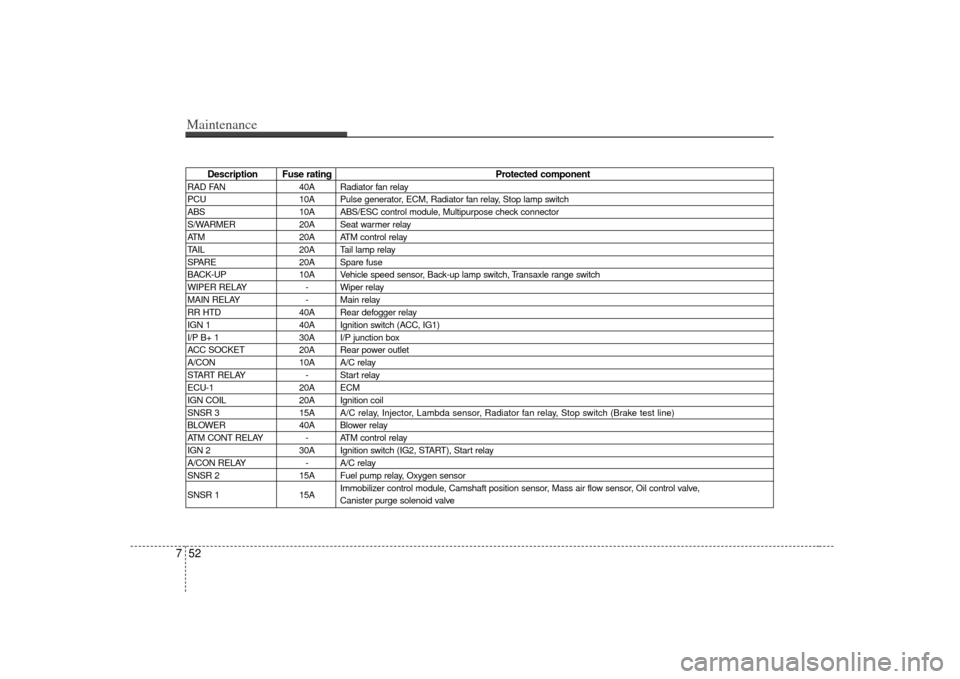
Description Fuse rating Protected component
RAD FAN40A Radiator fan relay
PCU 10A Pulse generator, ECM, Radiator fan relay, Stop lamp switch
ABS 10A ABS/ESC control module, Multipurpose check connector
S/WARMER 20A Seat warmer relay
ATM 20A ATM control relay
TAIL 20A Tail lamp relay
SPARE 20A Spare fuse
BACK-UP 10A Vehicle speed sensor, Back-up lamp switch, Transaxle range switch
WIPER RELAY - Wiper relay
MAIN RELAY - Main relay
RR HTD 40A Rear defogger relay
IGN 1 40A Ignition switch (ACC, IG1)
I/P B+ 1 30A I/P junction box
ACC SOCKET 20A Rear power outlet
A/CON 10A A/C relay
START RELAY - Start relay
ECU-1 20A ECM
IGN COIL 20A Ignition coil
SNSR 3 15AA/C relay, Injector, Lambda sensor, Radiator fan relay, Stop switch (Brake test line)
BLOWER 40A Blower relay
ATM CONT RELAY - ATM control relay
IGN 2 30A Ignition switch (IG2, START), Start relay
A/CON RELAY - A/C relay
SNSR 2 15A Fuel pump relay, Oxygen sensor
SNSR 1 15AImmobilizer control module, Camshaft position sensor, Mass air flow sensor, Oil control valve,
Canister purge solenoid valve
Page 330 of 343
Maintenance60
7G270201AUNCanisterFuel vapors generated inside the fuel
tank are absorbed and stored in the
onboard canister. When the engine is
running, the fuel vapors absorbed in the
canister are drawn into the surge tank
through the purge control solenoid valve.G270202AUNPurge Control Solenoid Valve (PCSV)The purge control solenoid valve is con-
trolled by the Engine Control Module
(ECM); when the engine coolant temper-
ature is low during idling, the PCSV clos-
es so that evaporated fuel is not taken
into the engine. After the engine warms-
up during ordinary driving, the PCSV
opens to introduce evaporated fuel to the
engine.
G270300AUN3. Exhaust emission control
systemThe Exhaust Emission Control System is
a highly effective system which controls
exhaust emissions while maintaining
good vehicle performance.G270301AUNVehicle modifications This vehicle should not be modified.
Modification of your vehicle could affect
its performance, safety or durability and
may even violate governmental safety
and emissions regulations.
In addition, damage or performance
problems resulting from any modification
may not be covered under warranty.
G270302AUNEngine exhaust gas precautions
(carbon monoxide) Carbon monoxide can be present with other exhaust fumes. Therefore, if you
smell exhaust fumes of any kind inside
your vehicle, have it inspected and
repaired immediately. If you ever sus-
pect exhaust fumes are coming into
your vehicle, drive it only with all the
windows fully open. Have your vehicle
checked and repaired immediately.
WARNING
- Exhaust
Engine exhaust gases contain car-
bon monoxide (CO). Though color-
less and odorless, it is dangerous
and could be lethal if inhaled.
Follow the instructions on this
page to avoid CO poisoning.