trailer KIA Rondo 2010 2.G User Guide
[x] Cancel search | Manufacturer: KIA, Model Year: 2010, Model line: Rondo, Model: KIA Rondo 2010 2.GPages: 338, PDF Size: 6.39 MB
Page 241 of 338
Driving your vehicle
44
5
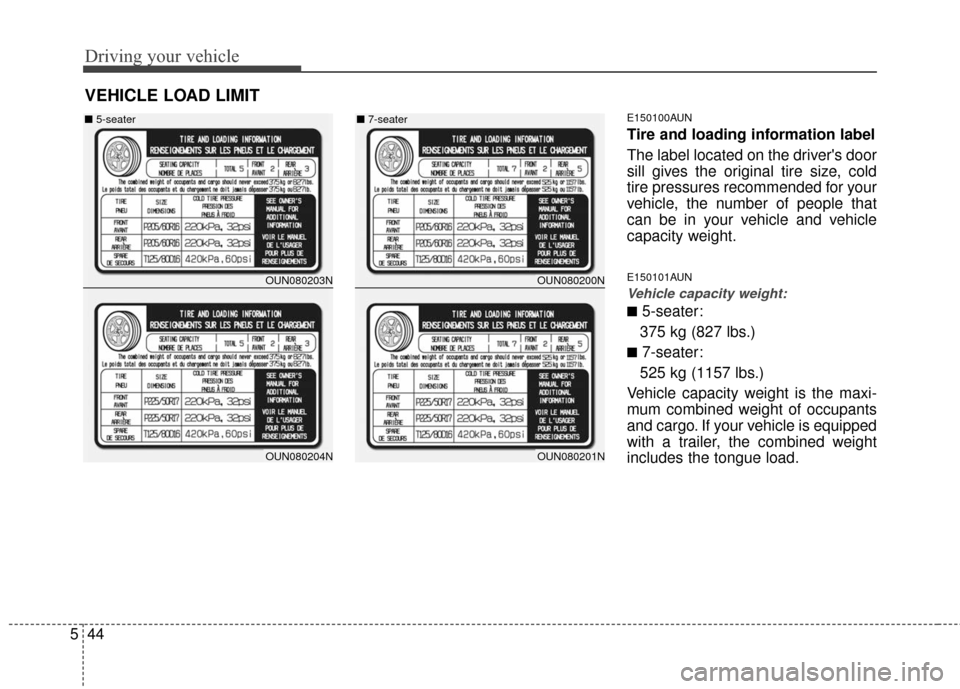
E150100AUN
Tire and loading information label
The label located on the driver's door
sill gives the original tire size, cold
tire pressures recommended for your
vehicle, the number of people that
can be in your vehicle and vehicle
capacity weight.
E150101AUN
Vehicle capacity weight:
■5-seater:
375 kg (827 lbs.)
■7-seater:
525 kg (1157 lbs.)
Vehicle capacity weight is the maxi-
mum combined weight of occupants
and cargo. If your vehicle is equipped
with a trailer, the combined weight
includes the tongue load.
VEHICLE LOAD LIMIT
OUN080203N
OUN080204N
■ 5-seater
OUN080200N
OUN080201N
■7-seater
Page 242 of 338
545
Driving your vehicle
E150102AUN
Seating capacity:
■5-seater:Total : 5 persons (Front seat : 2 persons, Rear seat : 3 persons)
■7-seater:
Total : 7 persons (Front seat : 2 persons, Rear seat : 5 persons)
Seating capacity is the maximum
number of occupants including a
driver, your vehicle may carry.
However, the seating capacity may
be reduced based upon the weight of
all of the occupants, and the weight
of the cargo being carried or towed.
Do not overload the vehicle as there
is a limit to the total weight, or load
limit including occupants and cargo,
the vehicle can carry.
E150103AUN
Towing capacity:
■2.4L engine: Without trailer brakes:454 kg (1000 lbs)
With trailer brakes: 680 kg (1500 lbs)
■2.7L engine:
Without trailer brakes:454 kg (1000 lbs)
With trailer brakes: 907 kg (2000 lbs)
Towing capacity is the maximum
trailer weight including its cargo
weight, your vehicle can tow.
E150104AUN
Cargo capacity:
The cargo capacity of your vehicle
will increase or decrease depending
on the weight and the number of
occupants and the tongue load, if
your vehicle is equipped with a trail-
er.
E150105AUN
Steps for determining correct load limit
1. Locate the statement "The com- bined weight of occupants and
cargo should never exceed XXX
kg or XXX lbs.'' on your vehicle's
placard.
2. Determine the combined weight of the driver and passengers that will
be riding in your vehicle.
3. Subtract the combined weight of the driver and passengers from
XXX kg or XXX lbs.
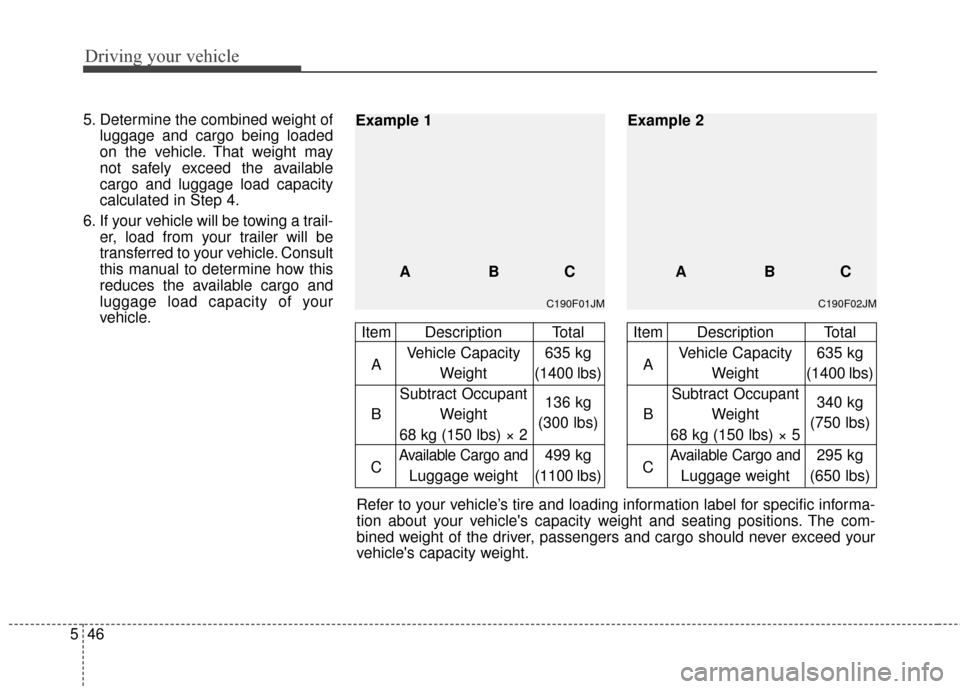
4. The resulting figure equals the available amount of cargo and lug-
gage load capacity. For example, if
the "XXX" amount equals 635 kg
(1400 lbs.), and there will be five
68 kg (150 lbs.) passengers in
your vehicle, the amount of avail-
able cargo and luggage load
capacity is 295 kg (650 lbs.).
(635-340 (5 x 68) = 295 kg or 1400-750 (5 x 150) = 650 lbs.)
Page 243 of 338
Driving your vehicle
46
5
5. Determine the combined weight of
luggage and cargo being loaded
on the vehicle. That weight may
not safely exceed the available
cargo and luggage load capacity
calculated in Step 4.
6. If your vehicle will be towing a trail- er, load from your trailer will be
transferred to your vehicle. Consult
this manual to determine how this
reduces the available cargo and
luggage load capacity of your
vehicle.
Refer to your vehicle’s tire and loading information label for specific informa-
tion about your vehicle's capacity weight and seating positions. The com-
bined weight of the driver, passengers and cargo should never exceed your
vehicle's capacity weight.
C190F01JM
Item Description TotalA Vehicle Capacity 635 kg
Weight (1400 lbs)
Subtract Occupant
B Weight 136 kg
68 kg (150 lbs) × 2 (300 lbs)
C
Available Cargo and499 kg
Luggage weight (1100 lbs)
Example 1
ABC
C190F02JM
Item Description TotalA Vehicle Capacity 635 kg
Weight (1400 lbs)
Subtract Occupant
B Weight 340 kg
68 kg (150 lbs) × 5 (750 lbs)
C
Available Cargo and295 kg
Luggage weight (650 lbs)
ABC
Example 2
Page 246 of 338
549
Driving your vehicle
E160000AUN
This section will guide you in the proper
loading of your vehicle and/or trailer, to
keep your loaded vehicle weight within its
design rating capability, with or without a
trailer. Properly loading your vehicle will
provide maximum return of the vehicle
design performance. Before loading your
vehicle, familiarize yourself with the fol-
lowing terms for determining your vehi-
cle's weight ratings, with or without a
trailer, from the vehicle's specifications
and the certification label:
E160100AUN
Base curb weight
This is the weight of the vehicle including
a full tank of fuel and all standard equip-
ment. It does not include passengers,
cargo, or optional equipment.
E160200AUN
Vehicle curb weight
This is the weight of your new vehicle
when you picked it up from your dealer
plus any aftermarket equipment.
E160300AUN
Cargo weight
This figure includes all weight added to
the Base Curb Weight, including cargo
and optional equipment.
E160400AUN
GAW (Gross axle weight)
This is the total weight placed on each
axle (front and rear) - including vehicle
curb weight and all payload.
E160500AUN
GAWR (Gross axle weight rating)
This is the maximum allowable weight
that can be carried by a single axle (front
or rear). These numbers are shown on
the certification label.
The total load on each axle must never
exceed its GAWR.
E160600AUN
GVW (Gross vehicle weight)
This is the Base Curb Weight plus actual
Cargo Weight plus passengers.
E160700AUN-EU
GVWR (Gross vehicle weight rating)
This is the maximum allowable weight of
the fully loaded vehicle (including all
options, equipment, passengers and
cargo). The GVWR is shown on the cer-
tification label located on the driver’s
door sill.
VEHICLE WEIGHT
Page 261 of 338
615
What to do in an emergency
When using a compact spare tire,
observe the following precautions:
Under no circumstances shouldyou exceed 80 km/h (50 mph); a
higher speed could damage the
tire.
Ensure that you drive slowly enough for the road conditions to
avoid all hazards. Any road hazard,
such as a pothole or debris, could
seriously damage the compact
spare.
Any continuous road use of this tire could result in tire failure, loss of
vehicle control, and possible per-
sonal injury.
Do not exceed the vehicle’s maxi- mum load rating or the load-carry-
ing capacity shown on the sidewall
of the compact spare tire.
Avoid driving over obstacles. The compact spare tire diameter is
smaller than the diameter of a con-
ventional tire and reduces the
ground clearance approximately
25 mm (1 inch), which could result
in damage to the vehicle. Do not take this vehicle through an
automatic car wash while the com-
pact spare tire is installed.
The compact spare tire should not be installed on the front axle if the
vehicle must be driven in snow or
on ice.
Do not use the compact spare tire on any other vehicle because this
tire has been designed especially
for your vehicle.
The compact spare tire’s tread life is shorter than a regular tire.
Inspect your compact spare tire
regularly and replace worn com-
pact spare tires with the same size
and design, mounted on the same
wheel.
The compact spare tire should not be used on any other wheels, nor
should standard tires, snow tires,
wheel covers or trim rings be used
with the compact spare wheel. If
such use is attempted, damage to
these items or other car compo-
nents may occur. Do not use more than one compact
spare tire at a time.
Do not tow a trailer while the com- pact spare tire is installed.
Page 263 of 338
617
What to do in an emergency
TOWING
F080100AUN
Towing service
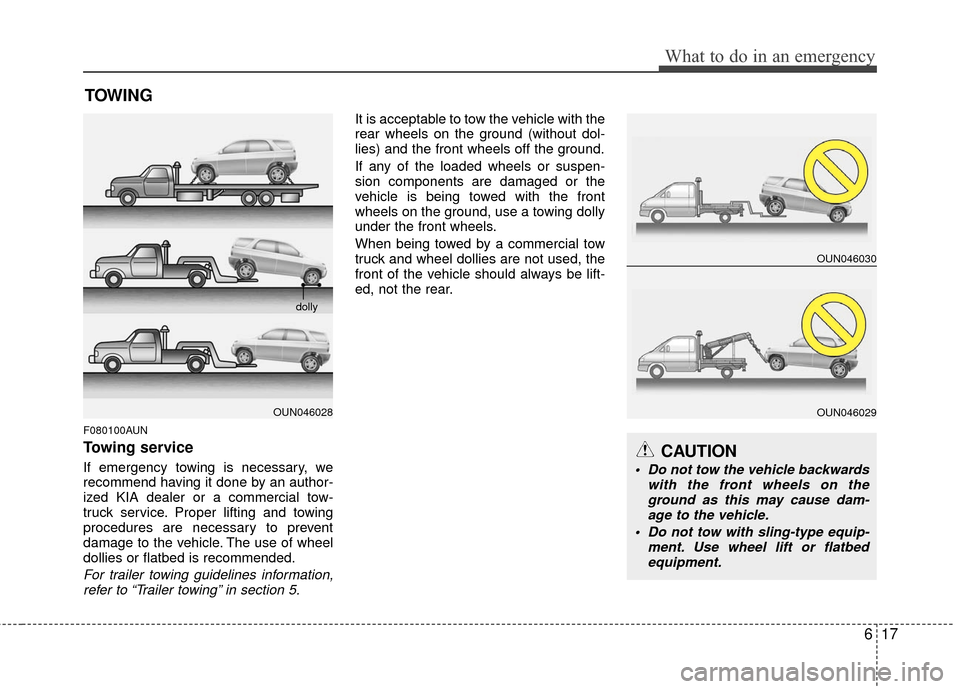
If emergency towing is necessary, we
recommend having it done by an author-
ized KIA dealer or a commercial tow-
truck service. Proper lifting and towing
procedures are necessary to prevent
damage to the vehicle. The use of wheel
dollies or flatbed is recommended.
For trailer towing guidelines information,refer to “Trailer towing” in section 5.
It is acceptable to tow the vehicle with the
rear wheels on the ground (without dol-
lies) and the front wheels off the ground.
If any of the loaded wheels or suspen-
sion components are damaged or the
vehicle is being towed with the front
wheels on the ground, use a towing dolly
under the front wheels.
When being towed by a commercial tow
truck and wheel dollies are not used, the
front of the vehicle should always be lift-
ed, not the rear.
OUN046028
OUN046030
OUN046029
CAUTION
Do not tow the vehicle backwards with the front wheels on theground as this may cause dam- age to the vehicle.
Do not tow with sling-type equip- ment. Use wheel lift or flatbedequipment.
dolly
Page 338 of 338

Index
4I
Tailgate··················\
··················\
··················\
··················\
···4-13
Theft-alarm system ··················\
··················\
··················\
····4-9
Tire specification and pressure label ··················\
·············8-6
Tires and wheels ··················\
··················\
··················\
7-31/8-3
Towing ··················\
··················\
··················\
··················\
···6-18
Trailer towing··················\
··················\
··················\
···········5-37
Vehicle break-in process ··················\
··················\
··············1-4
Vehicle certification label ··················\
··················\
············8-6
Vehicle identification number (VIN) ··················\
·············8-6
Vehicle load limit ··················\
··················\
··················\
·····5-44
Vehicle weight ··················\
··················\
··················\
·········5-49
Washer fluid ··················\
··················\
··················\
·············7-24
Windows ··················\
··················\
··················\
··················\
4-15
Windshield defrosting and defogging··················\
··········4-77
Winter driving ··················\
··················\
··················\
··········5-34
Wiper blades ··················\
··················\
··················\
············7-26
Wipers and washers ··················\
··················\
··················\
·4-54
V
W
T