Transaxle KIA Rondo 2014 3.G Repair Manual
[x] Cancel search | Manufacturer: KIA, Model Year: 2014, Model line: Rondo, Model: KIA Rondo 2014 3.GPages: 517, PDF Size: 13.98 MB
Page 434 of 517
Maintenance
22
7
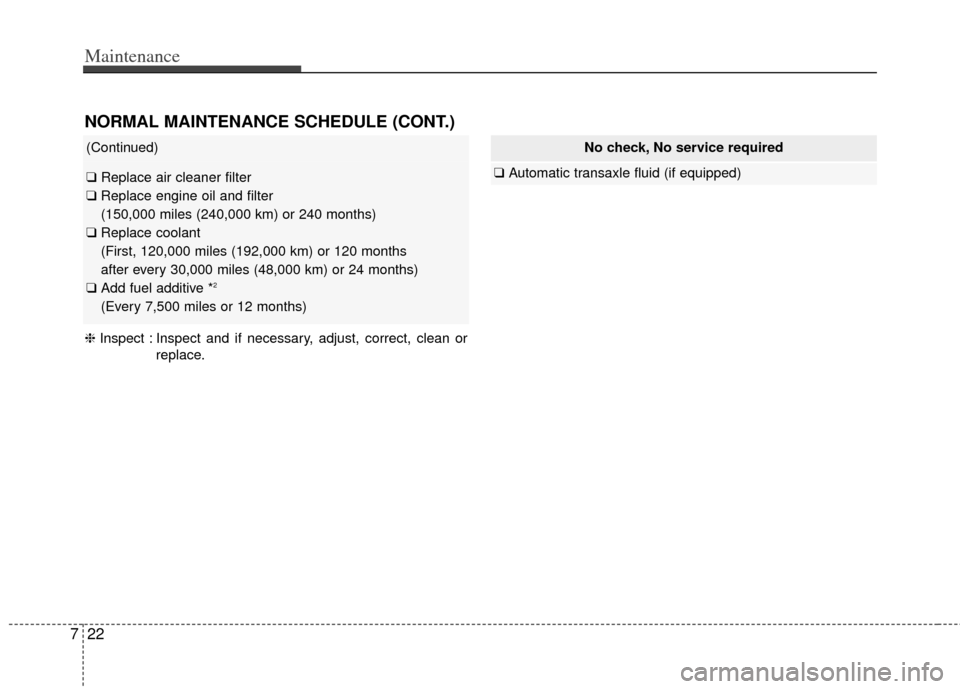
NORMAL MAINTENANCE SCHEDULE (CONT.)
No check, No service required
❑ Automatic transaxle fluid (if equipped)
(Continued)
❑Replace air cleaner filter
❑ Replace engine oil and filter
(150,000 miles (240,000 km) or 240 months)
❑ Replace coolant
(First, 120,000 miles (192,000 km) or 120 months
after every 30,000 miles (48,000 km) or 24 months)
❑ Add fuel additive *
2
(Every 7,500 miles or 12 months)
❈ Inspect : Inspect and if necessary, adjust, correct, clean or
replace.
Page 435 of 517
723
Maintenance
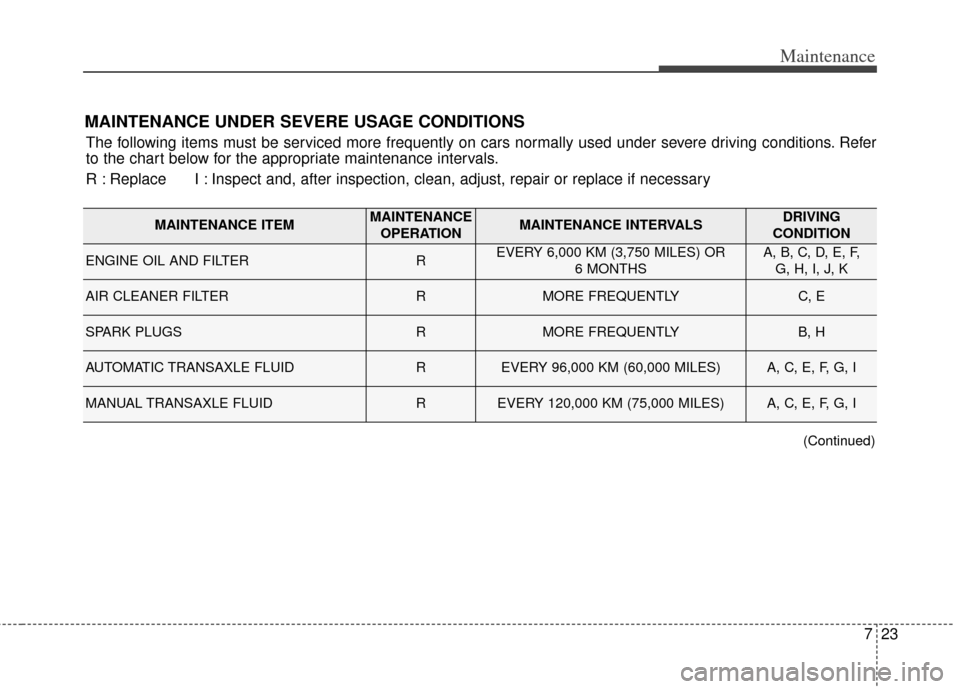
MAINTENANCE UNDER SEVERE USAGE CONDITIONS
The following items must be serviced more frequently on cars normally used under severe driving conditions. Refer
to the chart below for the appropriate maintenance intervals.
R : Replace I : Inspect and, after inspection, clean, adjust, repair or replace if neces\
sary
MAINTENANCE ITEMMAINTENANCEOPERATIONMAINTENANCE INTERVALSDRIVING
CONDITION
ENGINE OIL AND FILTERREVERY 6,000 KM (3,750 MILES) OR 6 MONTHSA, B, C, D, E, F,G, H, I, J, K
AIR CLEANER FILTERRMORE FREQUENTLYC, E
SPARK PLUGSRMORE FREQUENTLYB, H
AUTOMATIC TRANSAXLE FLUIDREVERY 96,000 KM (60,000 MILES) A, C, E, F, G, I
MANUAL TRANSAXLE FLUIDREVERY 120,000 KM (75,000 MILES) A, C, E, F, G, I
(Continued)
Page 438 of 517
Maintenance
26
7
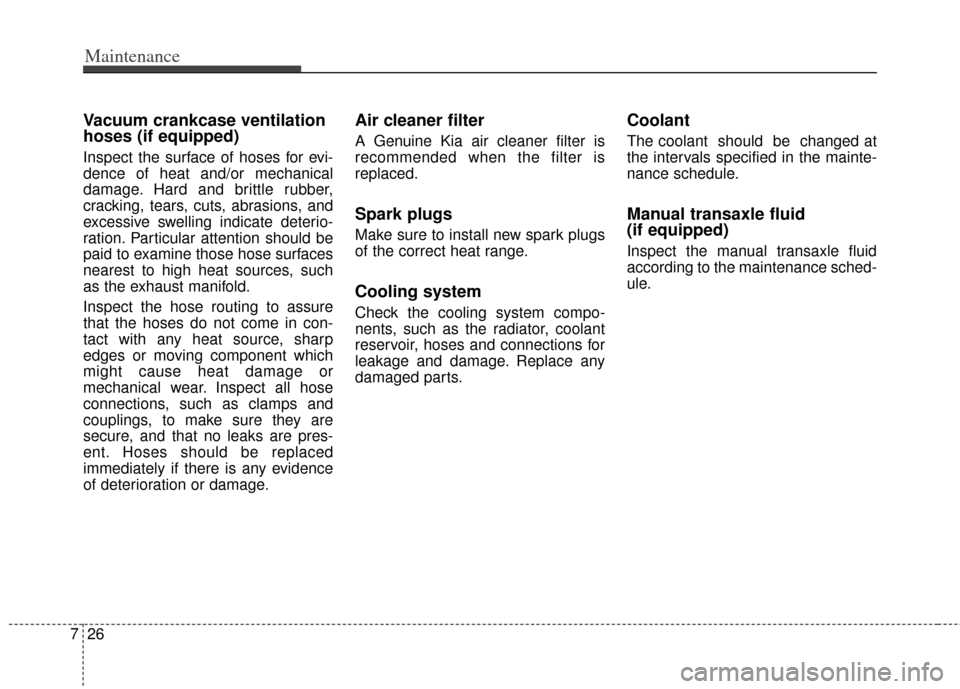
Vacuum crankcase ventilation
hoses (if equipped)
Inspect the surface of hoses for evi-
dence of heat and/or mechanical
damage. Hard and brittle rubber,
cracking, tears, cuts, abrasions, and
excessive swelling indicate deterio-
ration. Particular attention should be
paid to examine those hose surfaces
nearest to high heat sources, such
as the exhaust manifold.
Inspect the hose routing to assure
that the hoses do not come in con-
tact with any heat source, sharp
edges or moving component which
might cause heat damage or
mechanical wear. Inspect all hose
connections, such as clamps and
couplings, to make sure they are
secure, and that no leaks are pres-
ent. Hoses should be replaced
immediately if there is any evidence
of deterioration or damage.
Air cleaner filter
A Genuine Kia air cleaner filter is
recommended when the filter is
replaced.
Spark plugs
Make sure to install new spark plugs
of the correct heat range.
Cooling system
Check the cooling system compo-
nents, such as the radiator, coolant
reservoir, hoses and connections for
leakage and damage. Replace any
damaged parts.
Coolant
The coolant should be changed at
the intervals specified in the mainte-
nance schedule.
Manual transaxle fluid
(if equipped)
Inspect the manual transaxle fluid
according to the maintenance sched-
ule.
Page 439 of 517
727
Maintenance
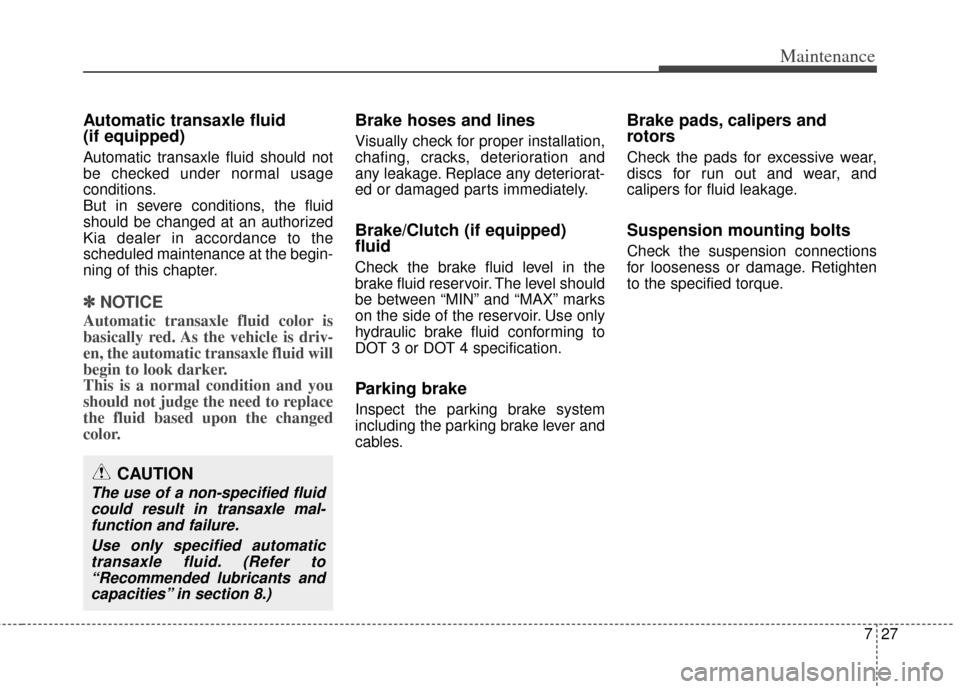
Automatic transaxle fluid
(if equipped)
Automatic transaxle fluid should not
be checked under normal usage
conditions.
But in severe conditions, the fluid
should be changed at an authorized
Kia dealer in accordance to the
scheduled maintenance at the begin-
ning of this chapter.
✽ ✽NOTICE
Automatic transaxle fluid color is
basically red. As the vehicle is driv-
en, the automatic transaxle fluid will
begin to look darker.
This is a normal condition and you
should not judge the need to replace
the fluid based upon the changed
color.
Brake hoses and lines
Visually check for proper installation,
chafing, cracks, deterioration and
any leakage. Replace any deteriorat-
ed or damaged parts immediately.
Brake/Clutch (if equipped)
fluid
Check the brake fluid level in the
brake fluid reservoir. The level should
be between “MIN” and “MAX” marks
on the side of the reservoir. Use only
hydraulic brake fluid conforming to
DOT 3 or DOT 4 specification.
Parking brake
Inspect the parking brake system
including the parking brake lever and
cables.
Brake pads, calipers and
rotors
Check the pads for excessive wear,
discs for run out and wear, and
calipers for fluid leakage.
Suspension mounting bolts
Check the suspension connections
for looseness or damage. Retighten
to the specified torque.
CAUTION
The use of a non-specified fluid
could result in transaxle mal-function and failure.
Use only specified automatictransaxle fluid. (Refer to“Recommended lubricants andcapacities” in section 8.)
Page 448 of 517
Maintenance
36
7
It is recommended that the automat-
ic transaxle fluid should be checked
by an authorized Kia dealer.
In severe conditions, the fluid should
be changed at an authorized Kia
dealer in accordance to the sched-
uled maintenance at the beginning of
this chapter.
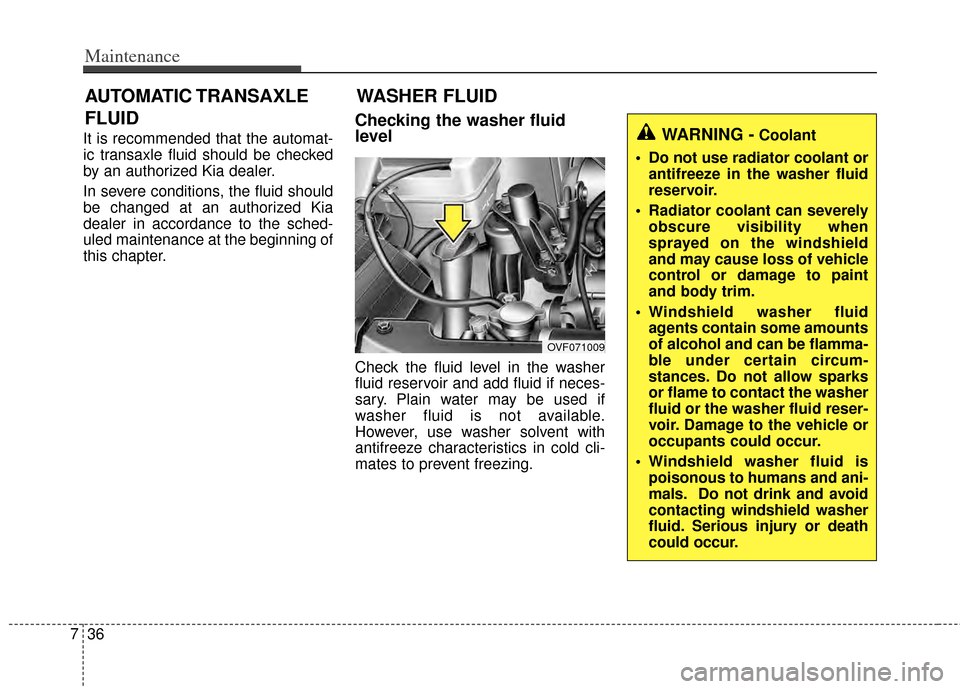
Checking the washer fluid
level
Check the fluid level in the washer
fluid reservoir and add fluid if neces-
sary. Plain water may be used if
washer fluid is not available.
However, use washer solvent with
antifreeze characteristics in cold cli-
mates to prevent freezing.
WASHER FLUID
AUTOMATIC TRANSAXLE
FLUID
OVF071009
WARNING -Coolant
Do not use radiator coolant or antifreeze in the washer fluid
reservoir.
Radiator coolant can severely obscure visibility when
sprayed on the windshield
and may cause loss of vehicle
control or damage to paint
and body trim.
Windshield washer fluid agents contain some amounts
of alcohol and can be flamma-
ble under certain circum-
stances. Do not allow sparks
or flame to contact the washer
fluid or the washer fluid reser-
voir. Damage to the vehicle or
occupants could occur.
Windshield washer fluid is poisonous to humans and ani-
mals. Do not drink and avoid
contacting windshield washer
fluid. Serious injury or death
could occur.
Page 468 of 517
Maintenance
56
7
Temperature -A, B & C
The temperature grades are A (the
highest), B and C representing the
tire’s resistance to the generation of
heat and its ability to dissipate heat
when tested under controlled condi-
tions on a specified indoor laboratory
test wheel.
Sustained high temperature can
cause the material of the tire to
degenerate and reduce tire life, and
excessive temperature can lead to
sudden tire failure. Grades B and A
represent higher levels of perform-
ance on the laboratory test wheel
than the minimum required by law. Tire terminology and definitions
Air Pressure: The amount of air
inside the tire pressing outward on
the tire. Air pressure is expressed in
kilopascal (kPa) or pounds per
square inch (psi).
Accessory Weight
: This means the
combined weight of optional acces-
sories. Some examples of optional
accessories are, automatic
transaxle, power seats, and air con-
ditioning.
Aspect Ratio : The relationship of a
tire's height to its width.
Belt: A rubber coated layer of cords
that is located between the plies and
the tread. Cords may be made from
steel or other reinforcing materials.
Bead: The tire bead contains steel
wires wrapped by steel cords that
hold the tire onto the rim.
Bias Ply Tire : A pneumatic tire in
which the plies are laid at alternate
angles less than 90 degrees to the
centerline of the tread.
WARNING - Tire tempera-
ture
The temperature grade for this
tire is established for a tire that
is properly inflated and not
overloaded. Excessive speed,
underinflation, or excessive
loading, either separately or in
combination, can cause heat
build-up and possible sudden
tire failure. This can cause loss
of vehicle control and serious
injury.
Page 482 of 517
Maintenance
70
7
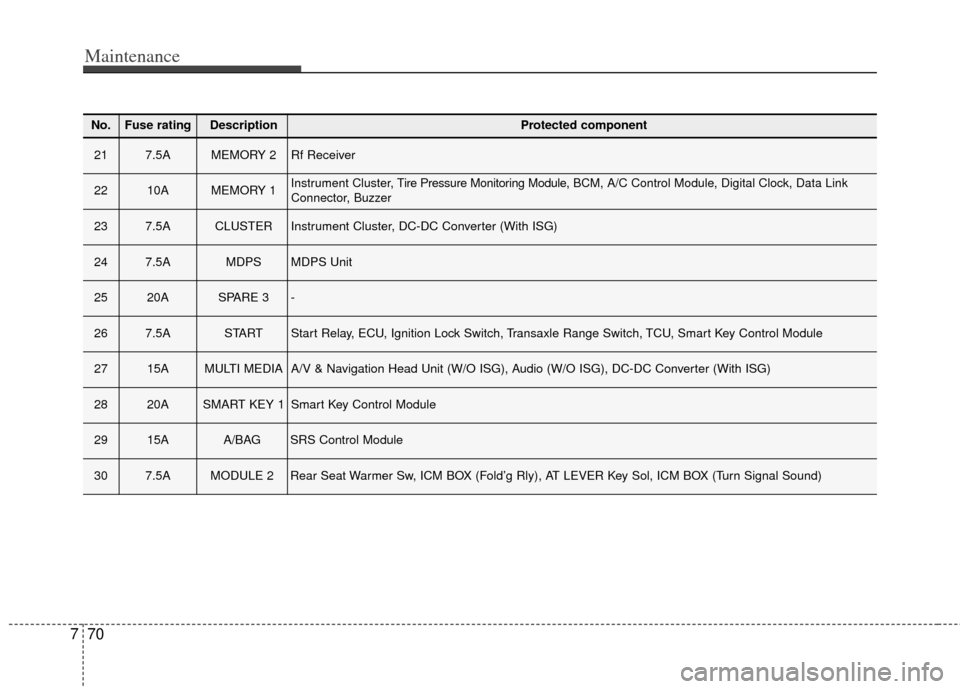
No.Fuse ratingDescriptionProtected component
217.5AMEMORY 2Rf Receiver
2210AMEMORY 1Instrument Cluster, Tire Pressure Monitoring Module, BCM, A/C Control Module, Digital Clock, Data Link
Connector, Buzzer
237.5ACLUSTERInstrument Cluster, DC-DC Converter (With ISG)
247.5AMDPSMDPS Unit
2520ASPARE 3-
267.5ASTARTStart Relay, ECU, Ignition Lock Switch, Transaxle Range Switch, TCU, Smart Key Control Module
2715AMULTI MEDIAA/V & Navigation Head Unit (W/O ISG), Audio (W/O ISG), DC-DC Converter (With ISG)
2820ASMART KEY 1Smart Key Control Module
2915AA/BAGSRS Control Module
307.5AMODULE 2Rear Seat Warmer Sw, ICM BOX (Fold’g Rly), AT LEVER Key Sol, ICM BOX (Turn Signal Sound)
Page 483 of 517
771
Maintenance
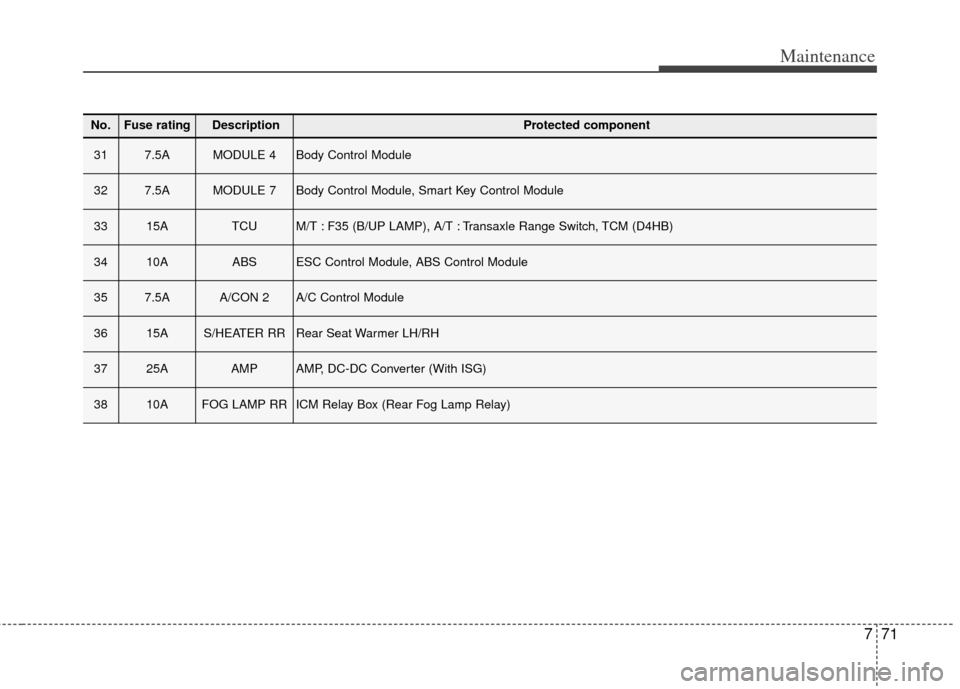
No.Fuse ratingDescriptionProtected component
317.5AMODULE 4Body Control Module
327.5AMODULE 7Body Control Module, Smart Key Control Module
3315ATCUM/T : F35 (B/UP LAMP), A/T : Transaxle Range Switch, TCM (D4HB)
3410AABSESC Control Module, ABS Control Module
357.5AA/CON 2A/C Control Module
3615AS/HEATER RRRear Seat Warmer LH/RH
3725AAMPAMP, DC-DC Converter (With ISG)
3810AFOG LAMP RRICM Relay Box (Rear Fog Lamp Relay)
Page 485 of 517
773
Maintenance
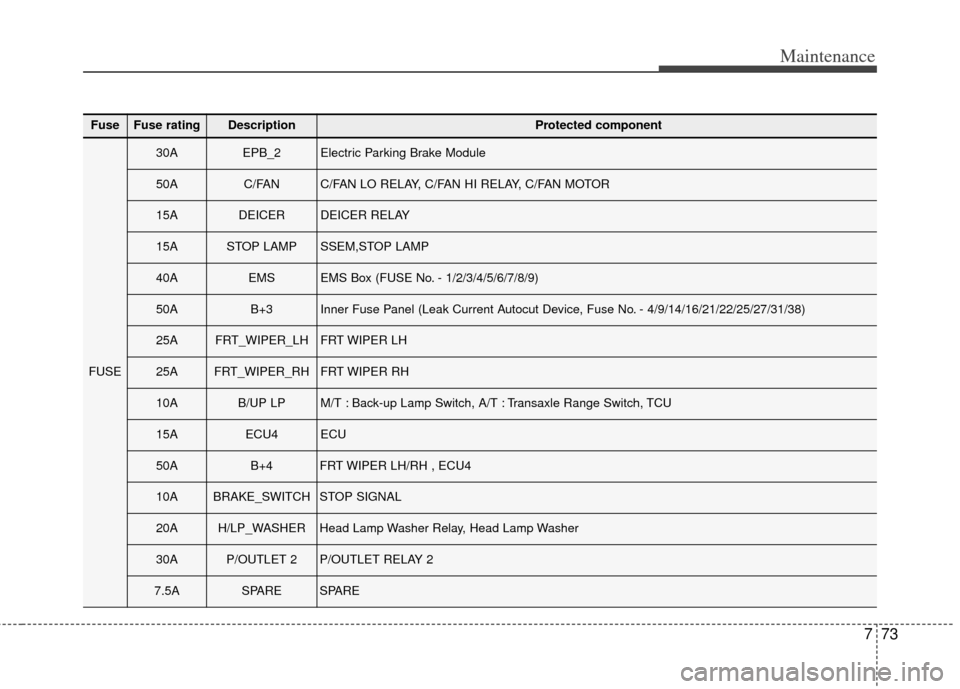
FuseFuse ratingDescriptionProtected component
FUSE
30AEPB_2Electric Parking Brake Module
50AC/FANC/FAN LO RELAY, C/FAN HI RELAY, C/FAN MOTOR
15ADEICERDEICER RELAY
15ASTOP LAMPSSEM,STOP LAMP
40AEMSEMS Box (FUSE No. - 1/2/3/4/5/6/7/8/9)
50AB+3Inner Fuse Panel (Leak Current Autocut Device, Fuse No. - 4/9/14/16/21/22/25/27/31/38)
25AFRT_WIPER_LHFRT WIPER LH
25AFRT_WIPER_RHFRT WIPER RH
10AB/UP LPM/T : Back-up Lamp Switch, A/T : Transaxle Range Switch, TCU
15AECU4ECU
50AB+4FRT WIPER LH/RH , ECU4
10ABRAKE_SWITCHSTOP SIGNAL
20AH/LP_WASHERHead Lamp Washer Relay, Head Lamp Washer
30AP/OUTLET 2P/OUTLET RELAY 2
7.5ASPARESPARE
Page 503 of 517
Specifications & Consumer information
68
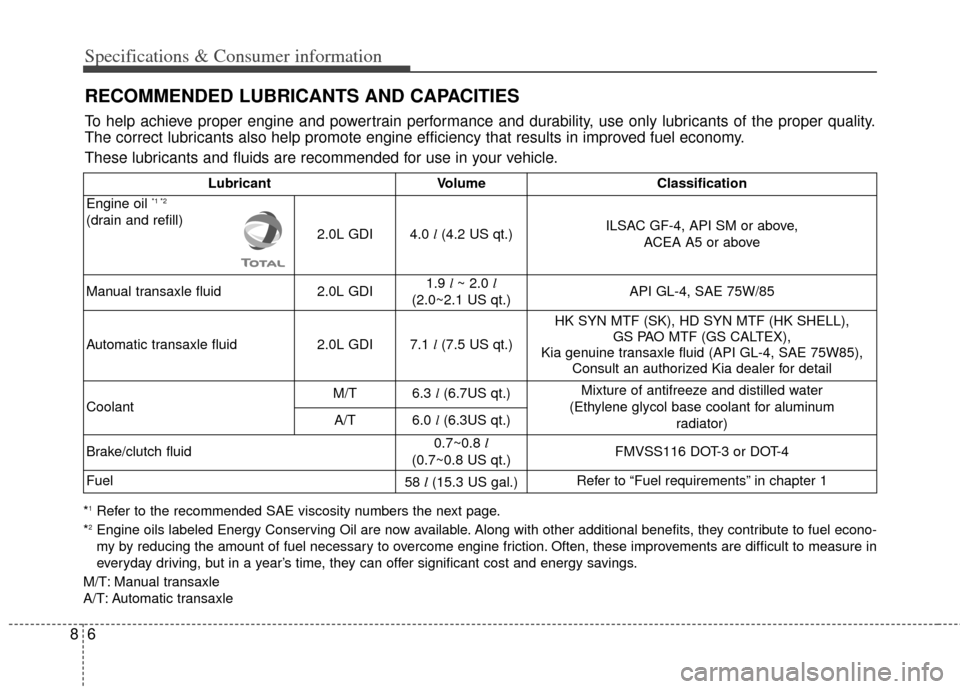
RECOMMENDED LUBRICANTS AND CAPACITIES
To help achieve proper engine and powertrain performance and durability, use only lubricants of the proper quality.
The correct lubricants also help promote engine efficiency that results in improved fuel economy.
These lubricants and fluids are recommended for use in your vehicle.
LubricantVolume Classification
Engine oil
*1 *2
(drain and refill) 2.0L GDI4.0
l(4.2 US qt.) ILSAC GF-4, API SM or above,
ACEA A5 or above
Manual transaxle fluid 2.0L GDI 1.9
l ~ 2.0 l
(2.0~2.1 US qt.) API GL-4, SAE 75W/85
Automatic transaxle fluid 2.0L GDI7.1
l(7.5 US qt.)
HK SYN MTF (SK), HD SYN MTF (HK SHELL),
GS PAO MTF (GS CALTEX),
Kia genuine transaxle fluid (API GL-4, SAE 75W85), Consult an authorized Kia dealer for detail
Coolant M/T
6.3
l(6.7US qt.) Mixture of antifreeze and distilled water
(Ethylene glycol base coolant for aluminum radiator)
A/T6.0l(6.3US qt.)
Brake/clutch fluid 0.7~0.8
l
(0.7~0.8 US qt.) FMVSS116 DOT-3 or DOT-4
Fuel58
l (15.3 US gal.)Refer to “Fuel requirements” in chapter 1
*1Refer to the recommended SAE viscosity numbers the next page.
*2Engine oils labeled Energy Conserving Oil are now available. Along with other additional benefits, they contribute to fuel econo -
my by reducing the amount of fuel necessary to overcome engine friction. Often, these improvements are difficult to measure in
everyday driving, but in a year’s time, they can offer significant cost and energy savings.
M/T: Manual transaxle
A/T: Automatic transaxle