boot KIA Rondo 2017 3.G User Guide
[x] Cancel search | Manufacturer: KIA, Model Year: 2017, Model line: Rondo, Model: KIA Rondo 2017 3.GPages: 625, PDF Size: 19.69 MB
Page 518 of 625
Maintenance
18
8
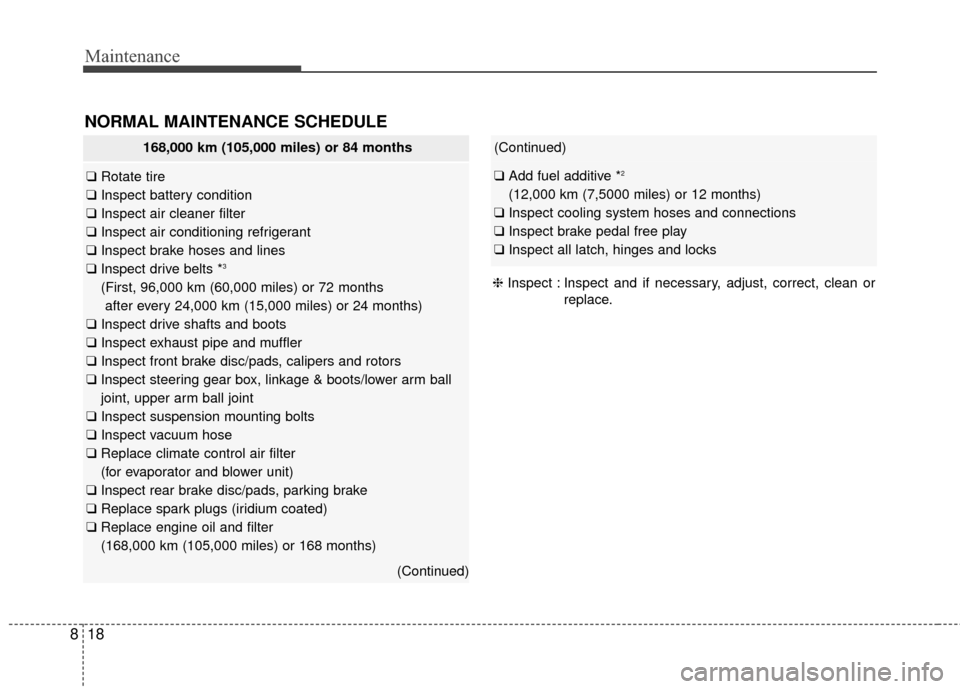
(Continued)
❑ Add fuel additive *2
(12,000 km (7,5000 miles) or 12 months)
❑ Inspect cooling system hoses and connections
❑ Inspect brake pedal free play
❑ Inspect all latch, hinges and locks
❈ Inspect : Inspect and if necessary, adjust, correct, clean or
replace.
168,000 km (105,000 miles) or 84 months
❑Rotate tire
❑ Inspect battery condition
❑ Inspect air cleaner filter
❑ Inspect air conditioning refrigerant
❑ Inspect brake hoses and lines
❑ Inspect drive belts *
3
(First, 96,000 km (60,000 miles) or 72 months
after every 24,000 km (15,000 miles) or 24 months)
❑ Inspect drive shafts and boots
❑ Inspect exhaust pipe and muffler
❑ Inspect front brake disc/pads, calipers and rotors
❑ Inspect steering gear box, linkage & boots/lower arm ball
joint, upper arm ball joint
❑ Inspect suspension mounting bolts
❑ Inspect vacuum hose
❑ Replace climate control air filter
(for evaporator and blower unit)
❑ Inspect rear brake disc/pads, parking brake
❑ Replace spark plugs (iridium coated)
❑ Replace engine oil and filter
(168,000 km (105,000 miles) or 168 months)
(Continued)
NORMAL MAINTENANCE SCHEDULE
Page 519 of 625
819
Maintenance
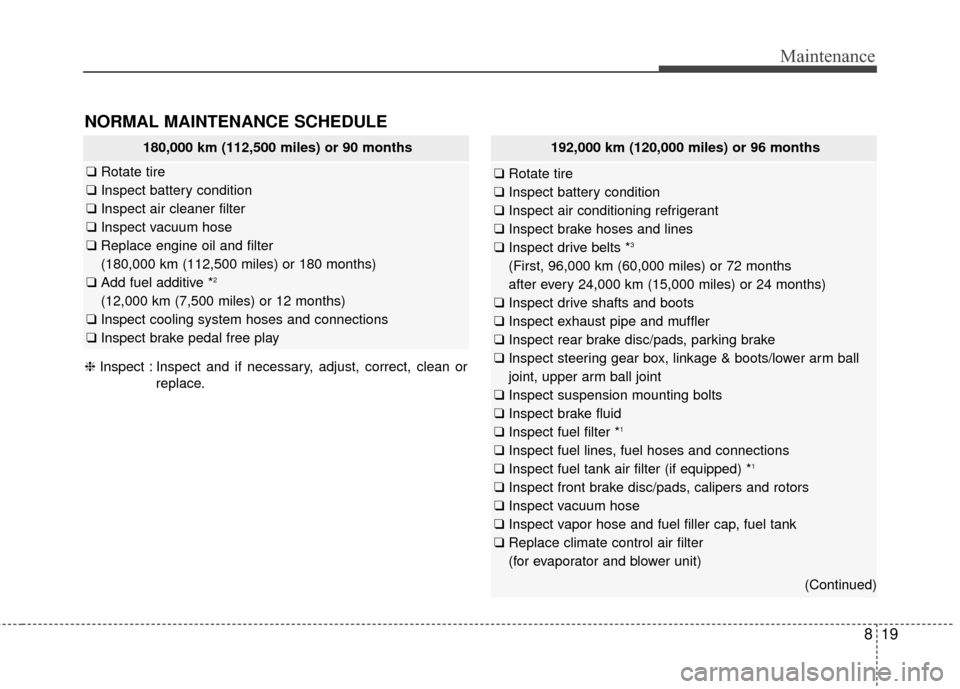
NORMAL MAINTENANCE SCHEDULE
❈Inspect : Inspect and if necessary, adjust, correct, clean or
replace.
180,000 km (112,500 miles) or 90 months
❑Rotate tire
❑ Inspect battery condition
❑ Inspect air cleaner filter
❑ Inspect vacuum hose
❑ Replace engine oil and filter
(180,000 km (112,500 miles) or 180 months)
❑ Add fuel additive *
2
(12,000 km (7,500 miles) or 12 months)
❑ Inspect cooling system hoses and connections
❑ Inspect brake pedal free play
192,000 km (120,000 miles) or 96 months
❑ Rotate tire
❑ Inspect battery condition
❑ Inspect air conditioning refrigerant
❑ Inspect brake hoses and lines
❑ Inspect drive belts *
3
(First, 96,000 km (60,000 miles) or 72 months
after every 24,000 km (15,000 miles) or 24 months)
❑ Inspect drive shafts and boots
❑ Inspect exhaust pipe and muffler
❑ Inspect rear brake disc/pads, parking brake
❑ Inspect steering gear box, linkage & boots/lower arm ball
joint, upper arm ball joint
❑ Inspect suspension mounting bolts
❑ Inspect brake fluid
❑ Inspect fuel filter *
1
❑Inspect fuel lines, fuel hoses and connections
❑ Inspect fuel tank air filter (if equipped) *1
❑Inspect front brake disc/pads, calipers and rotors
❑ Inspect vacuum hose
❑ Inspect vapor hose and fuel filler cap, fuel tank
❑ Replace climate control air filter
(for evaporator and blower unit)
(Continued)
Page 521 of 625
821
Maintenance
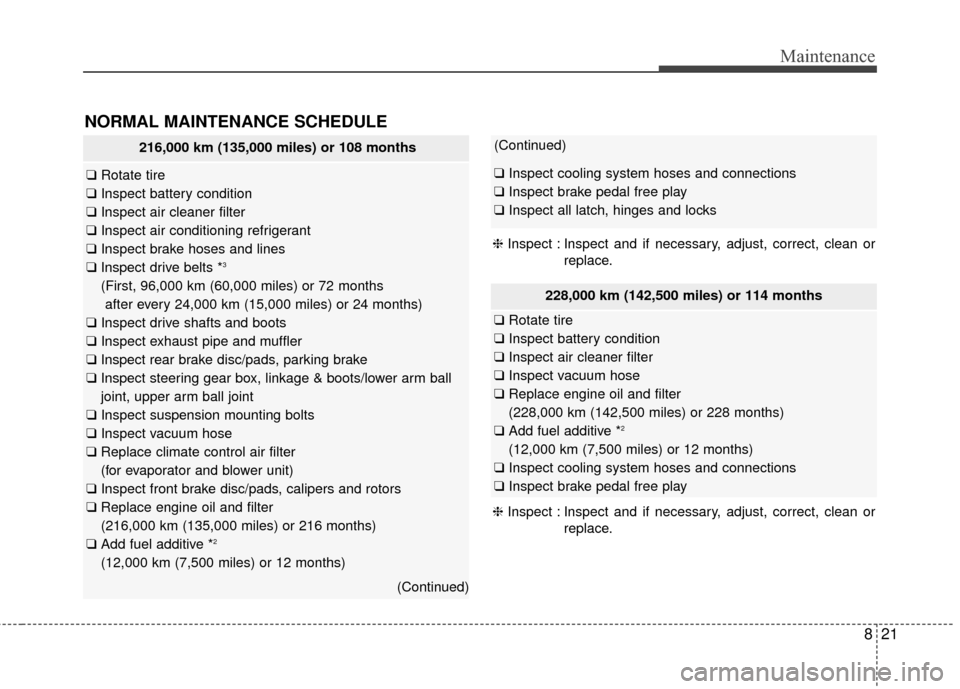
NORMAL MAINTENANCE SCHEDULE
216,000 km (135,000 miles) or 108 months
❑Rotate tire
❑ Inspect battery condition
❑ Inspect air cleaner filter
❑ Inspect air conditioning refrigerant
❑ Inspect brake hoses and lines
❑ Inspect drive belts *
3
(First, 96,000 km (60,000 miles) or 72 months
after every 24,000 km (15,000 miles) or 24 months)
❑ Inspect drive shafts and boots
❑ Inspect exhaust pipe and muffler
❑ Inspect rear brake disc/pads, parking brake
❑ Inspect steering gear box, linkage & boots/lower arm ball
joint, upper arm ball joint
❑ Inspect suspension mounting bolts
❑ Inspect vacuum hose
❑ Replace climate control air filter
(for evaporator and blower unit)
❑ Inspect front brake disc/pads, calipers and rotors
❑ Replace engine oil and filter
(216,000 km (135,000 miles) or 216 months)
❑ Add fuel additive *
2
(12,000 km (7,500 miles) or 12 months)
(Continued)
(Continued)
❑ Inspect cooling system hoses and connections
❑ Inspect brake pedal free play
❑ Inspect all latch, hinges and locks
❈ Inspect : Inspect and if necessary, adjust, correct, clean or
replace.
228,000 km (142,500 miles) or 114 months
❑Rotate tire
❑ Inspect battery condition
❑ Inspect air cleaner filter
❑ Inspect vacuum hose
❑ Replace engine oil and filter
(228,000 km (142,500 miles) or 228 months)
❑ Add fuel additive *
2
(12,000 km (7,500 miles) or 12 months)
❑ Inspect cooling system hoses and connections
❑ Inspect brake pedal free play
❈ Inspect : Inspect and if necessary, adjust, correct, clean or
replace.
Page 522 of 625
Maintenance
22
8
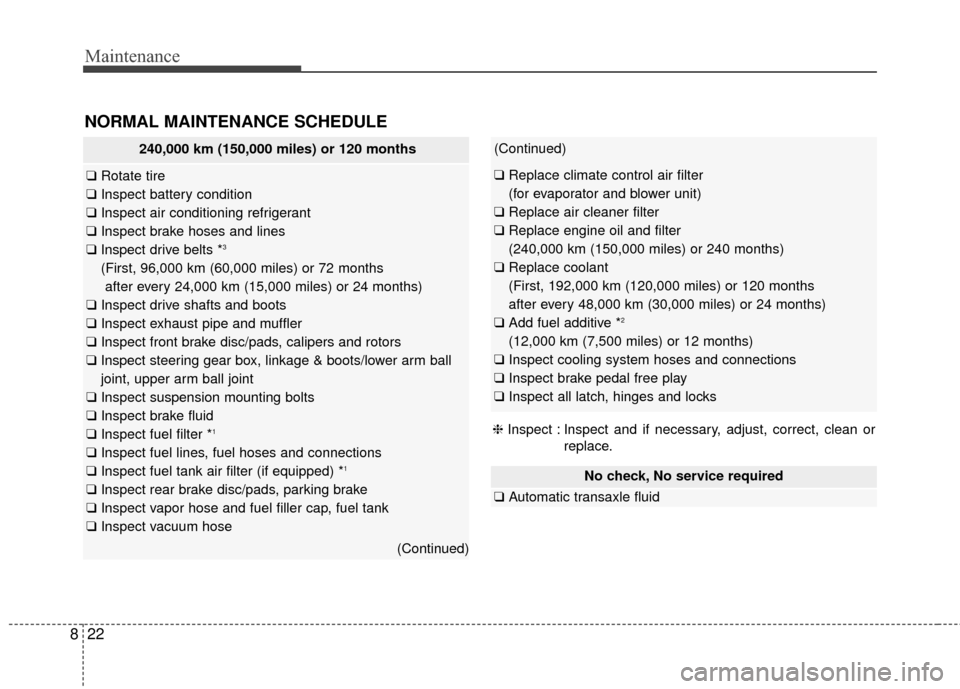
No check, No service required
❑ Automatic transaxle fluid
240,000 km (150,000 miles) or 120 months
❑Rotate tire
❑ Inspect battery condition
❑ Inspect air conditioning refrigerant
❑ Inspect brake hoses and lines
❑ Inspect drive belts *
3
(First, 96,000 km (60,000 miles) or 72 months
after every 24,000 km (15,000 miles) or 24 months)
❑ Inspect drive shafts and boots
❑ Inspect exhaust pipe and muffler
❑ Inspect front brake disc/pads, calipers and rotors
❑ Inspect steering gear box, linkage & boots/lower arm ball
joint, upper arm ball joint
❑ Inspect suspension mounting bolts
❑ Inspect brake fluid
❑ Inspect fuel filter *
1
❑Inspect fuel lines, fuel hoses and connections
❑ Inspect fuel tank air filter (if equipped) *1
❑Inspect rear brake disc/pads, parking brake
❑ Inspect vapor hose and fuel filler cap, fuel tank
❑ Inspect vacuum hose
(Continued)
(Continued)
❑Replace climate control air filter
(for evaporator and blower unit)
❑ Replace air cleaner filter
❑ Replace engine oil and filter
(240,000 km (150,000 miles) or 240 months)
❑ Replace coolant
(First, 192,000 km (120,000 miles) or 120 months
after every 48,000 km (30,000 miles) or 24 months)
❑ Add fuel additive *
2
(12,000 km (7,500 miles) or 12 months)
❑ Inspect cooling system hoses and connections
❑ Inspect brake pedal free play
❑ Inspect all latch, hinges and locks
❈ Inspect : Inspect and if necessary, adjust, correct, clean or
replace.
NORMAL MAINTENANCE SCHEDULE
Page 524 of 625
Maintenance
24
8
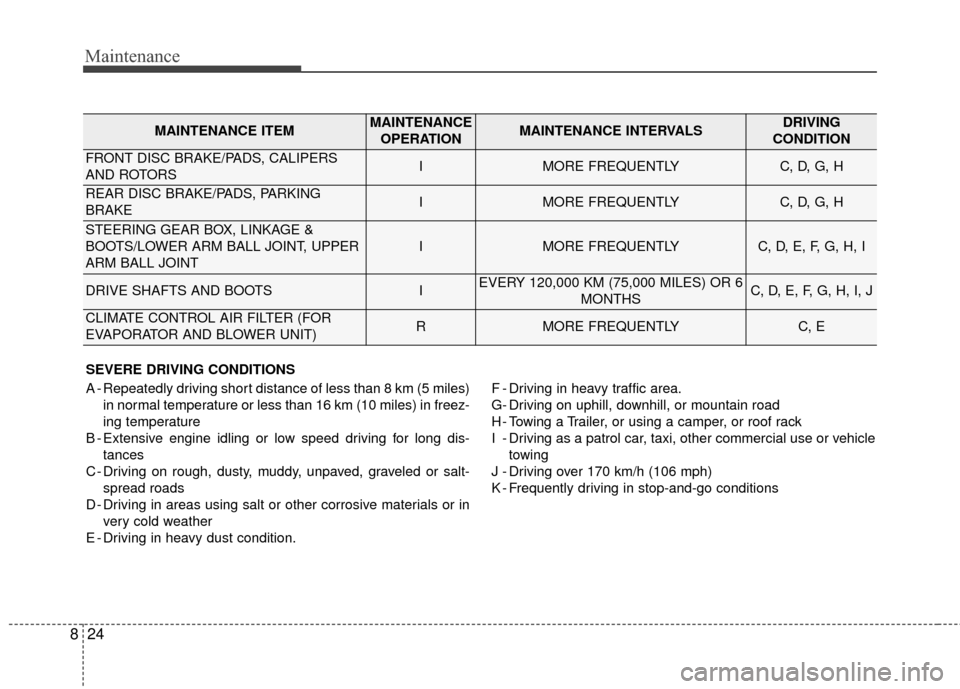
SEVERE DRIVING CONDITIONS
A - Repeatedly driving short distance of less than 8 km (5 miles)
in normal temperature or less than 16 km (10 miles) in freez-
ing temperature
B - Extensive engine idling or low speed driving for long dis- tances
C - Driving on rough, dusty, muddy, unpaved, graveled or salt- spread roads
D - Driving in areas using salt or other corrosive materials or in very cold weather
E - Driving in heavy dust condition. F - Driving in heavy traffic area.
G- Driving on uphill, downhill, or mountain road
H - Towing a Trailer, or using a camper, or roof rack
I - Driving as a patrol car, taxi, other commercial use or vehicle
towing
J - Driving over 170 km/h (106 mph)
K - Frequently driving in stop-and-go conditions
MAINTENANCE ITEMMAINTENANCE OPERATIONMAINTENANCE INTERVALSDRIVING
CONDITION
FRONT DISC BRAKE/PADS, CALIPERS
AND ROTORSIMORE FREQUENTLYC, D, G, H
REAR DISC BRAKE/PADS, PARKING
BRAKEIMORE FREQUENTLYC, D, G, H
STEERING GEAR BOX, LINKAGE &
BOOTS/LOWER ARM BALL JOINT, UPPER
ARM BALL JOINT
IMORE FREQUENTLYC, D, E, F, G, H, I
DRIVE SHAFTS AND BOOTSIEVERY 120,000 KM (75,000 MILES) OR 6 MONTHSC, D, E, F, G, H, I, J
CLIMATE CONTROL AIR FILTER (FOR
EVAPORATOR AND BLOWER UNIT)RMORE FREQUENTLYC, E
Page 528 of 625
Maintenance
28
8
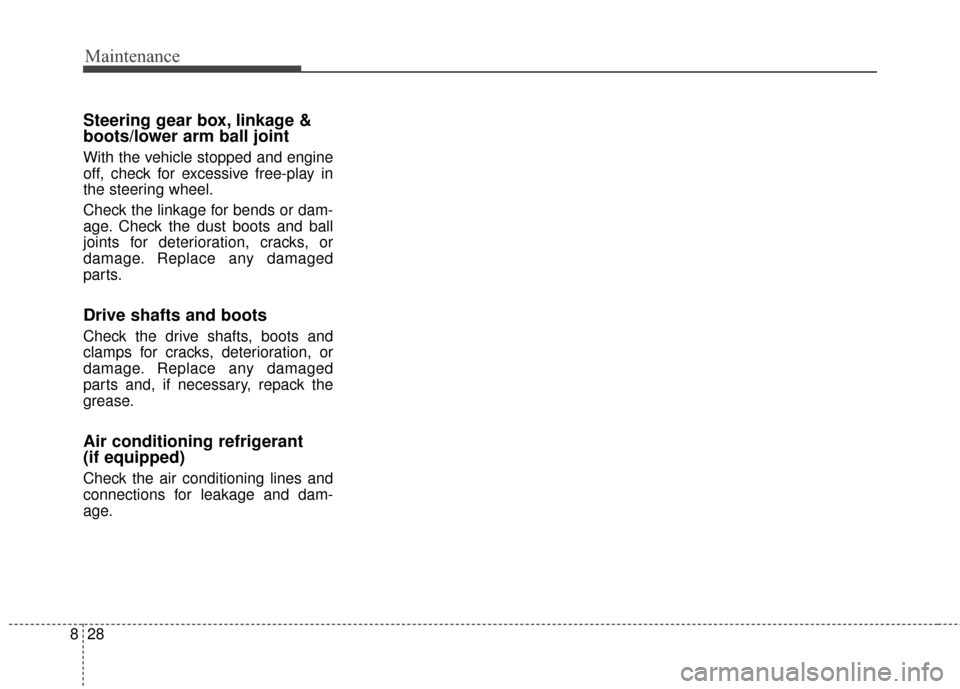
Steering gear box, linkage &
boots/lower arm ball joint
With the vehicle stopped and engine
off, check for excessive free-play in
the steering wheel.
Check the linkage for bends or dam-
age. Check the dust boots and ball
joints for deterioration, cracks, or
damage. Replace any damaged
parts.
Drive shafts and boots
Check the drive shafts, boots and
clamps for cracks, deterioration, or
damage. Replace any damaged
parts and, if necessary, repack the
grease.
Air conditioning refrigerant
(if equipped)
Check the air conditioning lines and
connections for leakage and dam-
age.
Page 593 of 625
893
Maintenance
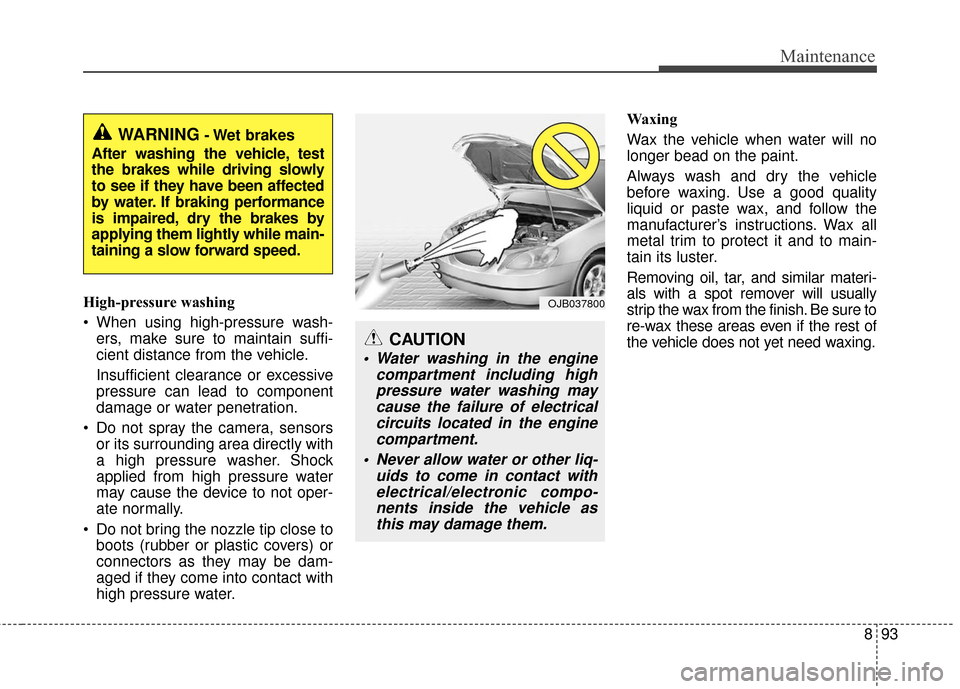
High-pressure washing
When using high-pressure wash-ers, make sure to maintain suffi-
cient distance from the vehicle.
Insufficient clearance or excessive
pressure can lead to component
damage or water penetration.
Do not spray the camera, sensors or its surrounding area directly with
a high pressure washer. Shock
applied from high pressure water
may cause the device to not oper-
ate normally.
Do not bring the nozzle tip close to boots (rubber or plastic covers) or
connectors as they may be dam-
aged if they come into contact with
high pressure water. Waxing
Wax the vehicle when water will no
longer bead on the paint.
Always wash and dry the vehicle
before waxing. Use a good quality
liquid or paste wax, and follow the
manufacturer’s instructions. Wax all
metal trim to protect it and to main-
tain its luster.
Removing oil, tar, and similar materi-
als with a spot remover will usually
strip the wax from the finish. Be sure to
re-wax these areas even if the rest of
the vehicle does not yet need waxing.
CAUTION
Water washing in the engine
compartment including highpressure water washing maycause the failure of electricalcircuits located in the enginecompartment.
Never allow water or other liq- uids to come in contact withelectrical/electronic compo-nents inside the vehicle asthis may damage them.
OJB037800
WARNING- Wet brakes
After washing the vehicle, test
the brakes while driving slowly
to see if they have been affected
by water. If braking performance
is impaired, dry the brakes by
applying them lightly while main-
taining a slow forward speed.
Page 617 of 625
I5
Index
Engine compartment ........................................................2-6
Engine compartment ........................................................8-3
Engine coolant ..............................................................8-31Checking the coolant level..........................................8-31\
Changing the coolant ..................................................8-33
Engine Coolant Temperature Gauge..............................4-61
Engine number ................................................................9-9
Engine oil ......................................................................8-\
29 Checking the engine oil level ....................................8-29
Changing the engine oil and filter ..............................8-30
Engine overheats..............................................................7-8
Engine start/stop button ..................................................6-9 Illuminated engine start/stop button ............................6-9
Engine start/stop button position ..................................6-9
Starting the engine ......................................................6-12
Engine start/stop button illumination ..............................6-9
Engine start/stop button position ....................................6-9
Engine will not start ........................................................7-4
Evaporative emission control (including ORVR: Onboard Refueling Vapor Recovery) system ............8-100
Exhaust emission control system ................................8-101
Explanation of scheduled maintenance items ..............8-25 Engine oil and filter ....................................................8-25
Drive belts ..................................................................8-25
Fuel filter ..................................................................8-25
Fuel lines, fuel hoses and connections ......................8-25
Vapor hose and fuel filler cap ....................................8-25
Vacuum crankcase ventilation hoses ..........................8-26 Air cleaner filter ..........................................................8-26
Spark plugs ................................................................8-26
Cooling system ..........................................................8-26
Coolant ................................................................\
......8-26
Automatic transaxle fluid............................................8-2\
6
Brake hoses and lines..................................................8\
-27
Brake fluid ..................................................................8-27
Parking brake ............................................................8-27
Brake discs, pads, calipers and rotors ........................8-27
Suspension mounting bolts ........................................8-27
Steering gear box, linkage & boots/lower arm ball joint ........................................8-28
Drive shafts and boots ................................................8-28
Air conditioning refrigerant ......................................8-28
Exterior care ..................................................................8-92
Exterior features ..........................................................4-172 Roof rack ..................................................................4-172
Exterior overview (Front) ................................................2-2
Exterior overview (Rear) ................................................2-3
Flat tire ........................................................................\
..7-15 Jack and tools ..............................................................7-15
Removing and storing the spare tire ..........................7-16
Changing tires ............................................................7-17
Removing and storing the spare tire ..........................7-16
Changing tires ............................................................7-17
F