brake fluid KIA Sedona 2007 2.G User Guide
[x] Cancel search | Manufacturer: KIA, Model Year: 2007, Model line: Sedona, Model: KIA Sedona 2007 2.GPages: 344, PDF Size: 3.76 MB
Page 303 of 344
613
Maintenance
AIR CLEANER Element replacement Have the air cleaner element checked
and replaced in accordance with the
maintenance schedule.
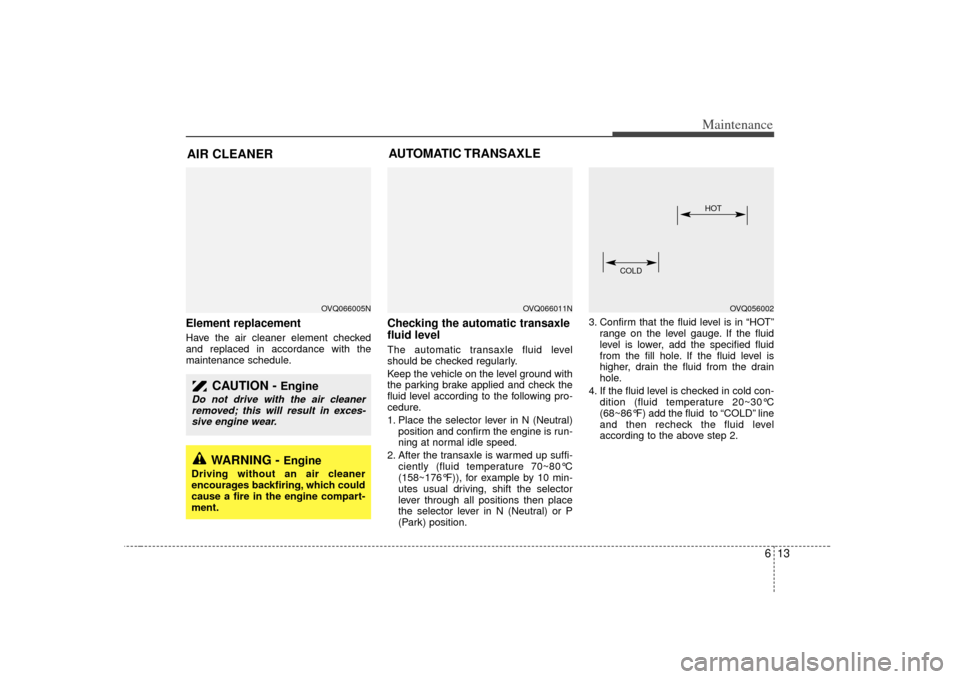
Checking the automatic transaxle
fluid level The automatic transaxle fluid level
should be checked regularly.
Keep the vehicle on the level ground with
the parking brake applied and check the
fluid level according to the following pro-
cedure.
1. Place the selector lever in N (Neutral)position and confirm the engine is run-
ning at normal idle speed.
2. After the transaxle is warmed up suffi- ciently (fluid temperature 70~80°C
(158~176°F)), for example by 10 min-
utes usual driving, shift the selector
lever through all positions then place
the selector lever in N (Neutral) or P
(Park) position. 3. Confirm that the fluid level is in “HOT”
range on the level gauge. If the fluid
level is lower, add the specified fluid
from the fill hole. If the fluid level is
higher, drain the fluid from the drain
hole.
4. If the fluid level is checked in cold con- dition (fluid temperature 20~30°C
(68~86°F) add the fluid to “COLD” line
and then recheck the fluid level
according to the above step 2.
OVQ066005N
WARNING -
Engine
Driving without an air cleaner
encourages backfiring, which could
cause a fire in the engine compart-
ment.
CAUTION -
Engine
Do not drive with the air cleanerremoved; this will result in exces-sive engine wear.
AUTOMATIC TRANSAXLE
OVQ066011N
OVQ056002
COLD
HOT
Page 304 of 344
Maintenance14
6
“COLD” scale is for reference only
and should NOT be used to determine
transaxle fluid level.
New automatic transaxle fluid should
be red. The red dye is added so the
assembly plant can identify it as auto-
matic transaxle fluid and distinguish it
from engine oil or antifreeze. The red
dye, which is not an indicator of fluid
quality, is not permanent. As the vehi-
cle is driven, the automatic transaxle
fluid will begin to look darker. The
color may eventually appear light
brown.
✽ ✽
NOTICEHave an Authorized Kia dealer change
the automatic transaxle fluid according
to the Scheduled Maintenance at the
beginning of this section.Use only the specified automatic
transaxle fluid. (Refer to "Recommended
Lubricants" later in this section.)
WARNING
- Parking brake
To avoid sudden movement of the
vehicle, apply parking brake and
depress the brake pedal before
moving the shift lever.
CAUTION
Low fluid level causes transaxle
slippage. Overfilling can causefoaming, loss of fluid andtransaxle malfunction.
The use of a non-specified fluid could result in transaxle malfunc-tion and failure.
WARNING -
Transaxle fluid
The transaxle fluid level should be
checked when the engine is at nor-
mal operating temperature. This
means that the engine, radiator,
radiator hose and exhaust system
etc., are very hot. Exercise great
care not to burn yourself during this
procedure.
Page 305 of 344
615
Maintenance
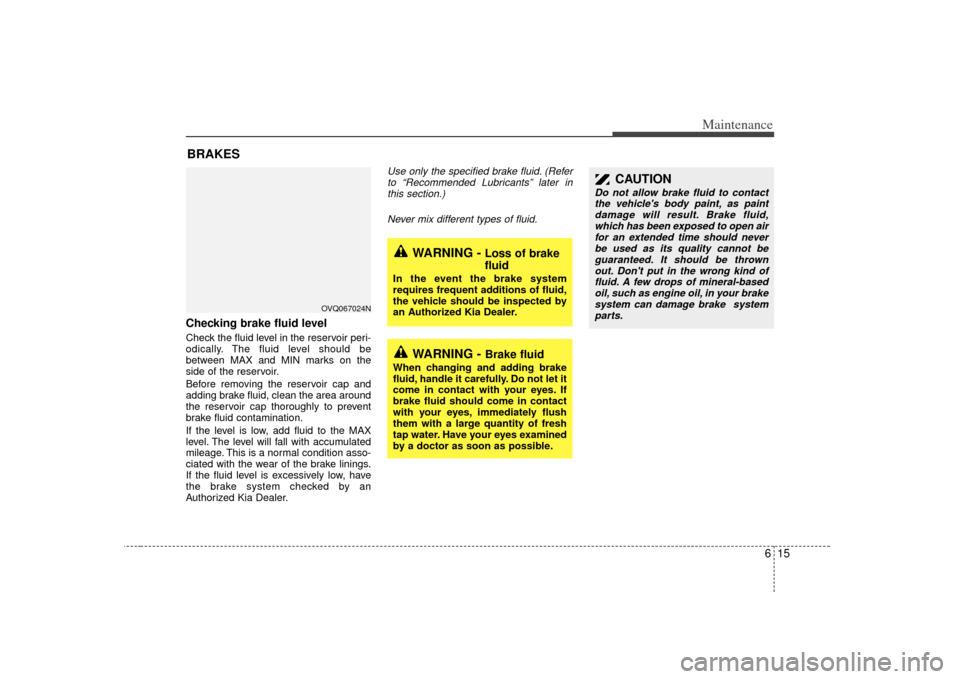
BRAKESChecking brake fluid level Check the fluid level in the reservoir peri-
odically. The fluid level should be
between MAX and MIN marks on the
side of the reservoir.
Before removing the reservoir cap and
adding brake fluid, clean the area around
the reservoir cap thoroughly to prevent
brake fluid contamination.
If the level is low, add fluid to the MAX
level. The level will fall with accumulated
mileage. This is a normal condition asso-
ciated with the wear of the brake linings.
If the fluid level is excessively low, have
the brake system checked by an
Authorized Kia Dealer.
Use only the specified brake fluid. (Referto “Recommended Lubricants” later inthis section.)
Never mix different types of fluid.
WARNING -
Brake fluid
When changing and adding brake
fluid, handle it carefully. Do not let it
come in contact with your eyes. If
brake fluid should come in contact
with your eyes, immediately flush
them with a large quantity of fresh
tap water. Have your eyes examined
by a doctor as soon as possible.
WARNING -
Loss of brake
fluid
In the event the brake system
requires frequent additions of fluid,
the vehicle should be inspected by
an Authorized Kia Dealer.
CAUTION
Do not allow brake fluid to contactthe vehicle's body paint, as paintdamage will result. Brake fluid, which has been exposed to open airfor an extended time should never be used as its quality cannot beguaranteed. It should be thrown out. Don't put in the wrong kind offluid. A few drops of mineral-basedoil, such as engine oil, in your brake system can damage brake systemparts.
OVQ067024N
Page 332 of 344

Maintenance42
6LUBRICANT
Recommended lubricants To help achieve proper engine and powertrain performance and
durability, use only lubricants of the proper quality. The correct
lubricants also help promote engine efficiency that results in
improved fuel economy.
Engine oils labeled Energy Conserving Oil are now available.
Along with other additional benefits, they contribute to fuel
economy by reducing the amount of fuel necessary to over-
come engine friction. Often, these improvements are difficult to
measure in everyday driving, but in a year’s time, they can offer
significant cost and energy savings.
These lubricants and fluids are recommended for use in your
vehicle.
Recommended SAE viscosity number Engine oil viscosity (thickness) has an effect on fuel economy
and cold weather operating (starting and oil flow). Lower viscos-
ity engine oils can provide better fuel economy and cold weath-
er performance, however, higher viscosity engine oils are
required for satisfactory lubrication in hot weather. Using oils of
any viscosity other than those recommended could result in
engine damage.
When choosing an oil, consider the range of temperature your
vehicle will be operated in before the next oil change. Proceed to
select the recommended oil viscosity from the chart.
CAUTION
Always be sure to clean the area around any filler plug, drain plug, or dipstick before checking or draining anylubricant. This is especially important in dusty or sandy areas and when the vehicle is used on unpaved roads.Cleaning the plug and dipstick areas will prevent dirt and grit from entering the engine and other mechanisms thatcould be damaged.
*¹ Refer to the recommended SAE viscosity numbers.
Lubricant Classification
API Service SJ, SL or above,
ILSAC GF-3 or above
Automatic transaxle fluid
DIAMOND ATF SP-III or SK ATF SP-III
Power steering fluid PSF-III
Brake fluid FMVSS116 DOT-3 or DOT-4Engine oil
*¹
Temperature Range for SAE Viscosity Numbers
Temperature
Engine Oil *
1°C
(°F)
-30 -20 -10 0 10 20 30 40 50
-10 0 20 40 60 80 100 120
1. For better fuel economy, it is recommended to use the engine oil of a viscositygrade SAE 5W-20, 5W-30 (API SJ, SL / ILSAC GF-3). However, if the engine
oil is not available in your country, select the proper engine oil using the engine
oil viscosity chart.
10W-30
5W-20, 5W-30
Page 340 of 344

73
Specifications
Inflation pressure kPa (psi)
Front Rear
225/70R16 6.5J×16 240 240
235/60R17 6.5J×17 (35) (35)
T135/90R17 4.0T×17 420 420
(60) (60)
Full size tire
Compact
spare tire Wheel lug nut torque kg•m
(Nm, lbft)
9~11
(88~107, 65~79)TIRES
Item Tire
size Wheel size
CAPACITIESLubricant
Volume Classification
5.2 l (5.49 US qt.)
Automatic transaxle fluid 10.9 l (11.52 US qt.) DIAMOND ATF SP-III, SK ATF SP-III
Power steering 1.0 l (1.06 US qt.) PSF-III
Coolant 8.6 l(9.09 US qt.) Ethylene glycol base for aluminum radiator
Brake fluid 0.7~0.8
l
FMVSS116 DOT-3 or DOT-4
(0.7~0.8 US qt.)
Fuel 80 l (21.1 US gal.) -Engine oil
*1
(drain and refill) API Service SJ, SL or above, ILSAC GF-3 or above
(SAE 5W-20)*1Refer to the recommended SAE viscosity numbers on the page 6-42.