coolant KIA Sedona 2007 2.G User Guide
[x] Cancel search | Manufacturer: KIA, Model Year: 2007, Model line: Sedona, Model: KIA Sedona 2007 2.GPages: 344, PDF Size: 3.76 MB
Page 299 of 344

69
Maintenance
ENGINE COMPARTMENT
OVQ067001N
1. Engine coolant reservoir
2. Engine oil filler cap
3. Brake fluid reservoir
4. Air cleaner
5. Fuse box
6. Negative battery terminal
7. Positive battery terminal
8. Auto transaxle oil dipstick
9. Radiator cap
10. Engine oil dipstick
11. Power steering fluid reservoir
12. Windshield washer fluid reservoir
Page 301 of 344
611
Maintenance
ENGINE COOLANTThe high-pressure cooling system has a
reservoir filled with year-round antifreeze
coolant. The reservoir is filled at the fac-
tory.
Check the antifreeze protection and
coolant level at least once a year, at the
beginning of the winter season, and
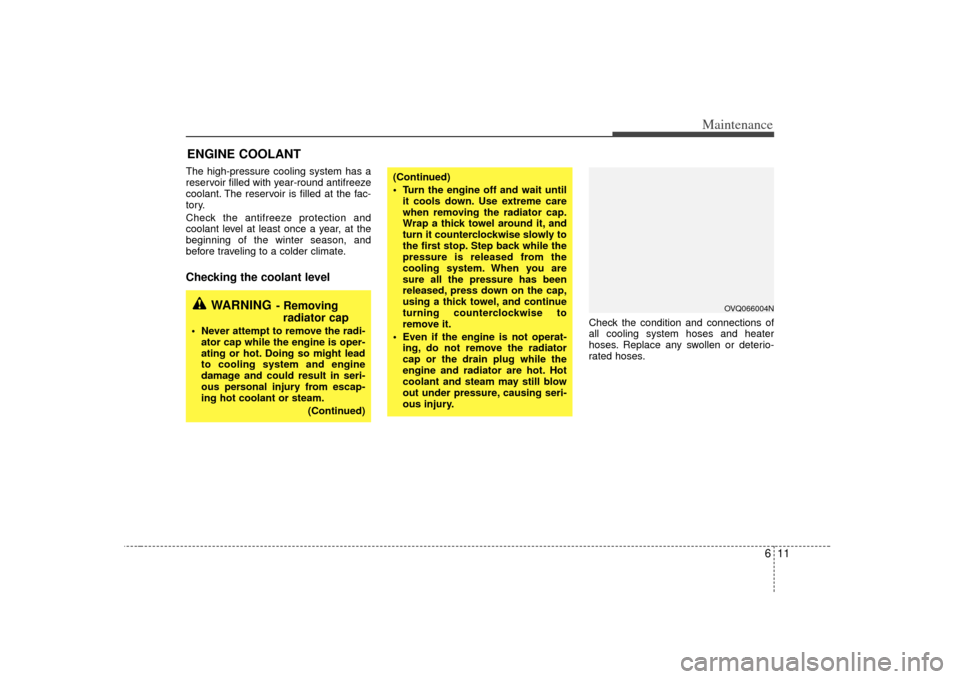
before traveling to a colder climate.Checking the coolant level
Check the condition and connections of
all cooling system hoses and heater
hoses. Replace any swollen or deterio-
rated hoses.
WARNING
- Removingradiator cap
Never attempt to remove the radi-
ator cap while the engine is oper-
ating or hot. Doing so might lead
to cooling system and engine
damage and could result in seri-
ous personal injury from escap-
ing hot coolant or steam.
(Continued)
(Continued)
Turn the engine off and wait untilit cools down. Use extreme care
when removing the radiator cap.
Wrap a thick towel around it, and
turn it counterclockwise slowly to
the first stop. Step back while the
pressure is released from the
cooling system. When you are
sure all the pressure has been
released, press down on the cap,
using a thick towel, and continue
turning counterclockwise to
remove it.
Even if the engine is not operat- ing, do not remove the radiator
cap or the drain plug while the
engine and radiator are hot. Hot
coolant and steam may still blow
out under pressure, causing seri-
ous injury.
OVQ066004N
Page 302 of 344
Maintenance12
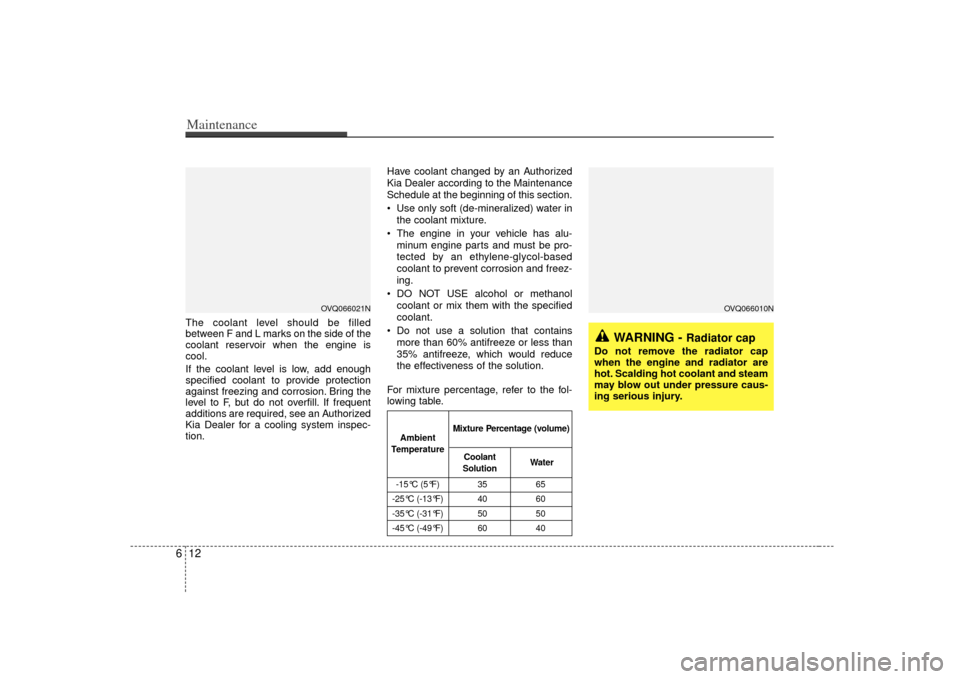
6The coolant level should be filled
between F and L marks on the side of the
coolant reservoir when the engine is
cool.
If the coolant level is low, add enough
specified coolant to provide protection
against freezing and corrosion. Bring the
level to F, but do not overfill. If frequent
additions are required, see an Authorized
Kia Dealer for a cooling system inspec-
tion. Have coolant changed by an Authorized
Kia Dealer according to the Maintenance
Schedule at the beginning of this section.
Use only soft (de-mineralized) water in
the coolant mixture.
The engine in your vehicle has alu- minum engine parts and must be pro-
tected by an ethylene-glycol-based
coolant to prevent corrosion and freez-
ing.
DO NOT USE alcohol or methanol coolant or mix them with the specified
coolant.
Do not use a solution that contains more than 60% antifreeze or less than
35% antifreeze, which would reduce
the effectiveness of the solution.
For mixture percentage, refer to the fol-
lowing table.
-15°C (5°F) 35 65
-25°C (-13°F) 40 60
-35°C (-31°F) 50 50
-45°C (-49°F) 60 40Ambient
Temperature Mixture Percentage (volume)
Coolant
Solution Water
WARNING -
Radiator cap
Do not remove the radiator cap
when the engine and radiator are
hot. Scalding hot coolant and steam
may blow out under pressure caus-
ing serious injury.
OVQ066010N
OVQ066021N
Page 306 of 344
Maintenance16
6LUBRICANTS AND FLUIDS Checking the washer fluid level The reservoir is translucent so that you
can check the level with a quick visual
inspection.
Check the fluid level in the washer fluid
reservoir and add fluid if necessary. Plain
water may be used if washer fluid is not
available. However, use washer solvent
with antifreeze characteristics in cold cli-
mates to prevent freezing.
This warning light indicatesthe washer fluid reservoir is
near empty. Refill the washer
fluid as soon as possible.
Body lubrication All moving points of the body, such as
door hinges, hood hinges, and locks,
should be lubricated each time the
engine oil is changed. Use a non-freez-
ing lubricant on locks during cold weath-
er.
Make sure the engine hood secondary
latch keeps the hood from opening when
the primary latch is released.
WARNING -
Coolant
Do not use radiator coolant or antifreeze in the washer fluid
reservoir.
Radiator coolant can severely obscure visibility when sprayed
on the windshield and may cause
loss of vehicle control or damage
to paint and body trim.
Windshield washer fluid agents contain some amounts of alcohol
and can be flammable under cer-
tain circumstances. Do not allow
sparks or flame to contact the
washer fluid or the washer fluid
reservoir. Damage to the vehicle
or it's occupants could occur.
Windshield washer fluid is poi- sonous to humans and animals.
Do not drink and avoid contacting
windshield washer fluid. Serious
injury or death could occur.
OVQ066013N
Page 330 of 344

Maintenance40
6Cold Tire Pressure: The amount of
air pressure in a tire, measured in
kilopascals (kPa) or pounds per
square inch (psi) before a tire has
built up heat from driving.
Curb Weight: This means the weight
of a motor vehicle with standard and
optional equipment including the
maximum capacity of fuel, oil and
coolant, but without passengers and
cargo.
DOT Markings: The DOT code
includes the Tire Identification
Number (TIN), an alphanumeric des-
ignator which can also identify the
tire manufacturer, production plant,
brand and date of production.
GVWR: Gross Vehicle Weight Rating
GAWR FRT: Gross Axle Weight
Rating for the front Axle.
GAWR RR: Gross Axle Weight
Rating for the rear axle. Intended Outboard Sidewall
: The
side of an asymmetrical tire, that
must always face outward when
mounted on a vehicle.
Kilopascal (kPa): The metric unit for
air pressure.
Load Index: An assigned number
ranging from 1 to 279 that corre-
sponds to the load carrying capacity
of a tire.
Maximum Inflation Pressure : The
maximum air pressure to which a
cold tire may be inflated. The maxi-
mum air pressure is molded onto the
sidewall.
Maximum Load Rating : The load
rating for a tire at the maximum per-
missible inflation pressure for that
tire.
Maximum Loaded Vehicle Weight:
The sum of curb weight; accessory
weight; vehicle capacity weight; and
production options weight.
Normal Occupant Weight:The
number of occupants a vehicle is
designed to seat multiplied by 68 kg
(150 pounds). Occupant Distribution
: Designated
seating positions.
Outward Facing Sidewall: The side
of a asymmetrical tire that has a par-
ticular side that faces outward when
mounted on a vehicle. The outward
facing sidewall bears white lettering
or bears manufacturer, brand, and/or
model name molding that is higher or
deeper than the same moldings on
the inner facing sidewall.
Passenger (P-Metric) Tire : A tire
used on passenger cars and some
light duty trucks and multipurpose
vehicles.
Recommended Inflation Pressure :
Vehicle manufacturer's recommend-
ed tire inflation pressure and shown
on the tire placard.
Radial Ply tire: A pneumatic tire in
which the ply cords that extend to the
beads are laid at 90 degrees to the
centerline of the tread.
Rim: A metal support for a tire and
upon which the tire beads are seat-
ed.
Sidewall: The portion of a tire
between the tread and the bead.
Page 340 of 344

73
Specifications
Inflation pressure kPa (psi)
Front Rear
225/70R16 6.5J×16 240 240
235/60R17 6.5J×17 (35) (35)
T135/90R17 4.0T×17 420 420
(60) (60)
Full size tire
Compact
spare tire Wheel lug nut torque kg•m
(Nm, lbft)
9~11
(88~107, 65~79)TIRES
Item Tire
size Wheel size
CAPACITIESLubricant
Volume Classification
5.2 l (5.49 US qt.)
Automatic transaxle fluid 10.9 l (11.52 US qt.) DIAMOND ATF SP-III, SK ATF SP-III
Power steering 1.0 l (1.06 US qt.) PSF-III
Coolant 8.6 l(9.09 US qt.) Ethylene glycol base for aluminum radiator
Brake fluid 0.7~0.8
l
FMVSS116 DOT-3 or DOT-4
(0.7~0.8 US qt.)
Fuel 80 l (21.1 US gal.) -Engine oil
*1
(drain and refill) API Service SJ, SL or above, ILSAC GF-3 or above
(SAE 5W-20)*1Refer to the recommended SAE viscosity numbers on the page 6-42.
Page 342 of 344

Index28Air bags-advanced restraint system ··················\
·············3-78
Air cleaner ··················\
··················\
··················\
···············6-13
Antenna ··················\
··················\
··················\
··················\
3-179
Appearance care··················\
··················\
··················\
·······6-43
Audio remote control ··················\
··················\
···············3-179
Audio system ··················\
··················\
··················\
·········3-180
Automatic climate control system ··················\
·············3-147
Automatic transaxle··················\
··················\
············4-5, 6-13
Battery··················\
··················\
··················\
··················\
····6-28
Before driving ··················\
··················\
··················\
············4-2
Brake system··················\
··················\
··················\
············4-14
Brakes ··················\
··················\
··················\
··················\
····6-15
Bulb wattage ··················\
··················\
··················\
··············7-2
Capacities ··················\
··················\
··················\
··················\
·7-3
Child restraint system ··················\
··················\
················3-71
Cruise control system ··················\
··················\
················4-11
Climate control air filter ··················\
··················\
············6-17
Defroster ··················\
··················\
··················\
················3-134
Dimensions ··················\
··················\
··················\
················7-2Door locks ··················\
··················\
··················\
················3-11
Driver position memory system ··················\
··················\
3-57
Economical operation ··················\
··················\
···············4-25
Electronic stability control··················\
··················\
·········4-19
Emergency starting ··················\
··················\
··················\
····5-2
Emission control system ··················\
··················\
············6-46
Engine compartment ··················\
··················\
··················\
··6-9
Engine coolant ··················\
··················\
··················\
·········6-11
Engine oil ··················\
··················\
··················\
·················6-10\
Fuel filler lid ··················\
··················\
··················\
············3-30
Fuel requirements ··················\
··················\
··················\
······1-2
Fuses ··················\
··················\
··················\
··················\
······6-20
Gauges ··················\
··················\
··················\
··················\
·3-109
Hazard warning flasher ··················\
··················\
···········3-135
Homelink® wireless control system··················\
··········3-165
Hood··················\
··················\
··················\
··················\
·······3-29
Horn ··················\
··················\
··················\
··················\
·····3-133
How to use this manual ··················\
··················\
···············1-2ABCD
EFGH