roof KIA Sedona 2009 2.G Owner's Manual
[x] Cancel search | Manufacturer: KIA, Model Year: 2009, Model line: Sedona, Model: KIA Sedona 2009 2.GPages: 356, PDF Size: 4.04 MB
Page 9 of 356
23
Your vehicle at a glance
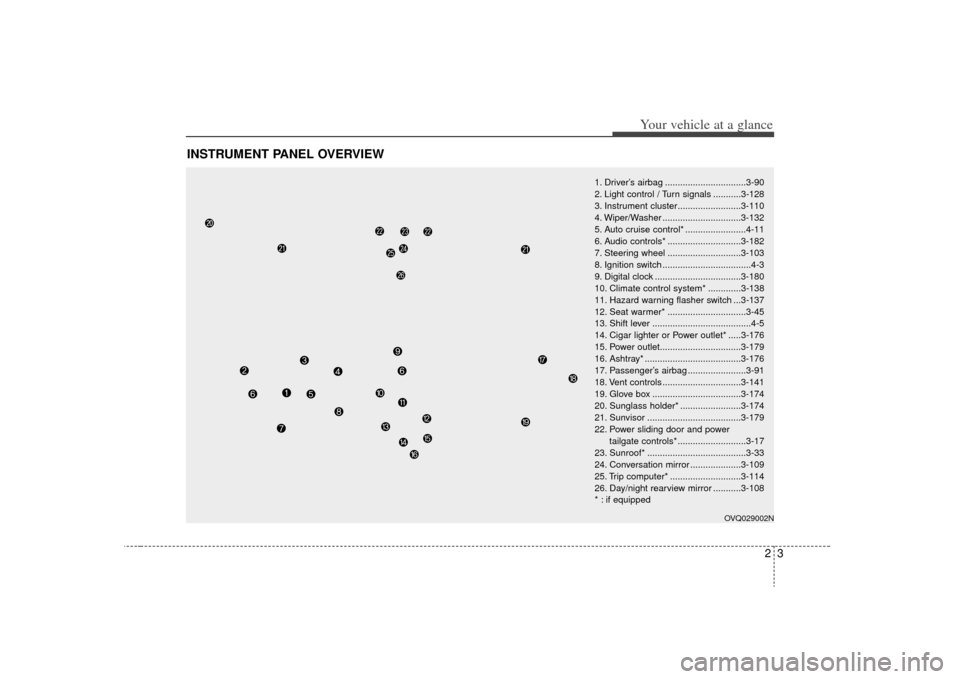
INSTRUMENT PANEL OVERVIEW
1. Driver’s airbag ................................3-90
2. Light control / Turn signals ...........3-128
3. Instrument cluster.........................3-110
4. Wiper/Washer ...............................3-132
5. Auto cruise control* ........................4-11
6. Audio controls* .............................3-182
7. Steering wheel .............................3-103
8. Ignition switch ...................................4-3
9. Digital clock ..................................3-180
10. Climate control system* .............3-138
11. Hazard warning flasher switch ...3-137
12. Seat warmer* ...............................3-45
13. Shift lever .......................................4-5
14. Cigar lighter or Power outlet* .....3-176
15. Power outlet................................3-179
16. Ashtray* ......................................3-176
17. Passenger’s airbag .......................3-91
18. Vent controls ...............................3-141
19. Glove box ...................................3-174
20. Sunglass holder* ........................3-174
21. Sunvisor .....................................3-179
22. Power sliding door and power tailgate controls* ...........................3-17
23. Sunroof* .......................................3-33
24. Conversation mirror ....................3-109
25. Trip computer* ............................3-114
26. Day/night rearview mirror ...........3-108
* : if equipped
OVQ029002N
Page 10 of 356
3
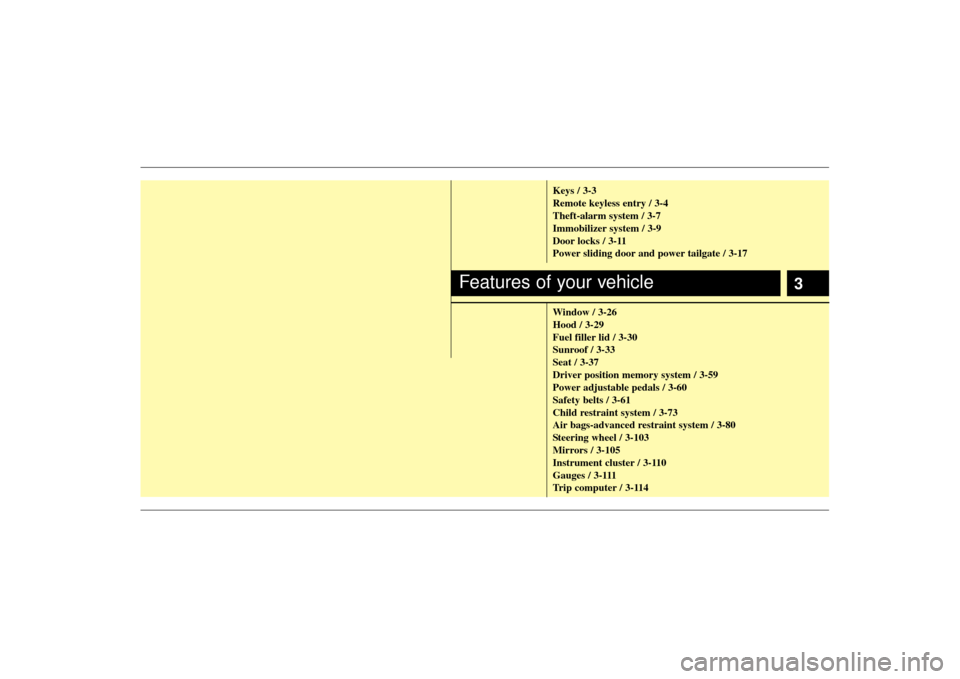
Keys / 3-3
Remote keyless entry / 3-4
Theft-alarm system / 3-7
Immobilizer system / 3-9
Door locks / 3-11
Power sliding door and power tailgate / 3-17
Window / 3-26
Hood / 3-29
Fuel filler lid / 3-30
Sunroof / 3-33
Seat / 3-37
Driver position memory system / 3-59
Power adjustable pedals / 3-60
Safety belts / 3-61
Child restraint system / 3-73
Air bags-advanced restraint system / 3-80
Steering wheel / 3-103
Mirrors / 3-105
Instrument cluster / 3-110
Gauges / 3-111
Trip computer / 3-114
Features of your vehicle
Page 11 of 356
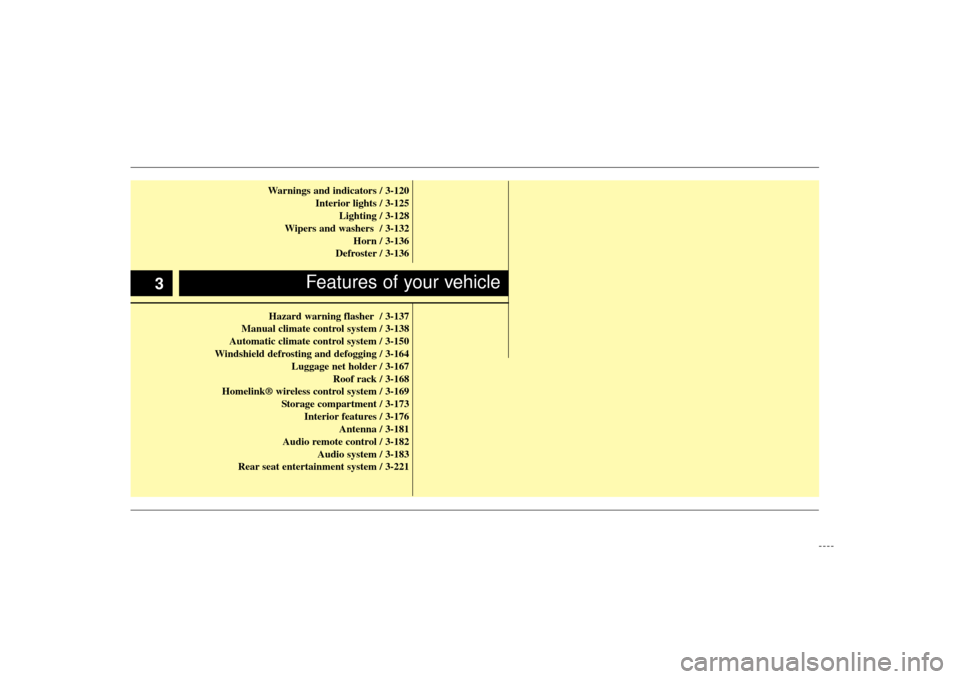
Warnings and indicators / 3-120Interior lights / 3-125Lighting / 3-128
Wipers and washers / 3-132 Horn / 3-136
Defroster / 3-136
Hazard warning flasher / 3-137
Manual climate control system / 3-138
Automatic climate control system / 3-150
Windshield defrosting and defogging / 3-164 Luggage net holder / 3-167Roof rack / 3-168
Homelink® wireless control system / 3-169 Storage compartment / 3-173Interior features / 3-176 Antenna / 3-181
Audio remote control / 3-182 Audio system / 3-183
Rear seat entertainment system / 3-221
Features of your vehicle
3
Page 36 of 356
327
Features of your vehicle
The ignition switch must be in the ON
position for power windows to operate.
Each door has a power window switch
that controls that door’s window.
However, the driver has a power window
lock switch which can block the operation
of passenger windows.
The power windows can be operated for
approximately 30 seconds after the igni-
tion key is removed or turned to the ACC
or LOCK position. However, if the front
doors are opened, the power windows
cannot be operated even within the 30
seconds after the ignition key removal.✽ ✽NOTICEWhile driving with the rear windows
down or with the sunroof in an open (or
partially open position), your vehicle
may demonstrate a wind buffeting or
pulsation noise. This noise is a normal
occurrence and can be reduced or elim-
inated by taking the following actions.
If the noise occurs with one or both of
the rear windows down, partially lower
both front windows approximately one
inch. If you experience the noise with
the sunroof open, slightly reduce the size
of the sunroof opening.
Window opening and closingThe driver’s door has a master power
window switch that controls all the win-
dows in the vehicle.
To open or close a window, press down
(8) or pull up (8) the front portion of the
corresponding switch.
To open or close a rear quarter win- dow, push (8) the corresponding
switch.
CAUTION
To prevent the power window system from the possibility ofdamage, do not open or close twowindows at the same time. This will also ensure the longevity ofthe fuse.
Never try to operate the main switch on the driver's door andthe individual door windowswitch in opposing directions at the same time. If this is done, thewindow will stop and cannot be opened or closed.
WARNING -
Windows
Always double check to make sure all arms, hands, head and
other obstructions are safely out
of the way before closing a win-
dow.
Do not allow children to play with the power windows. Keep the dri-
ver’s door power window lock
switch in the LOCK position
(depressed). Serious injury can
result from unintentional window
operation by the child.
Do not extend face or arms out- side through the window opening
while driving.
Page 42 of 356
333
Features of your vehicle
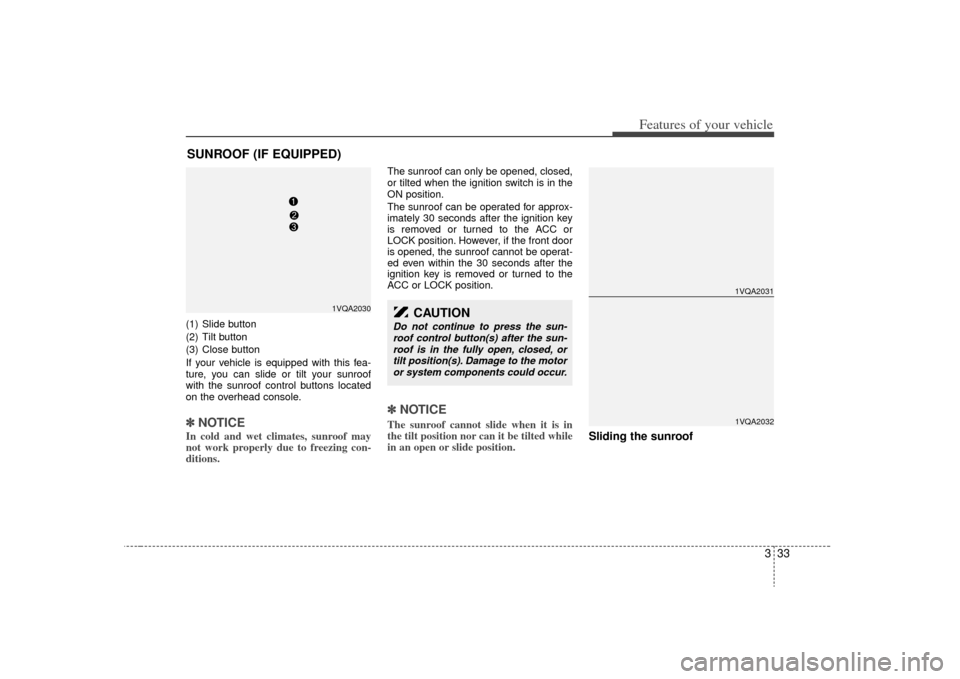
(1) Slide button
(2) Tilt button
(3) Close button
If your vehicle is equipped with this fea-
ture, you can slide or tilt your sunroof
with the sunroof control buttons located
on the overhead console.✽ ✽NOTICEIn cold and wet climates, sunroof may
not work properly due to freezing con-
ditions.
The sunroof can only be opened, closed,
or tilted when the ignition switch is in the
ON position.
The sunroof can be operated for approx-
imately 30 seconds after the ignition key
is removed or turned to the ACC or
LOCK position. However, if the front door
is opened, the sunroof cannot be operat-
ed even within the 30 seconds after the
ignition key is removed or turned to the
ACC or LOCK position.✽ ✽NOTICEThe sunroof cannot slide when it is in
the tilt position nor can it be tilted while
in an open or slide position.
Sliding the sunroof
SUNROOF (IF EQUIPPED)
1VQA20311VQA2032
CAUTION
Do not continue to press the sun-
roof control button(s) after the sun-roof is in the fully open, closed, ortilt position(s). Damage to the motoror system components could occur.
1VQA2030
Page 43 of 356
Features of your vehicle34
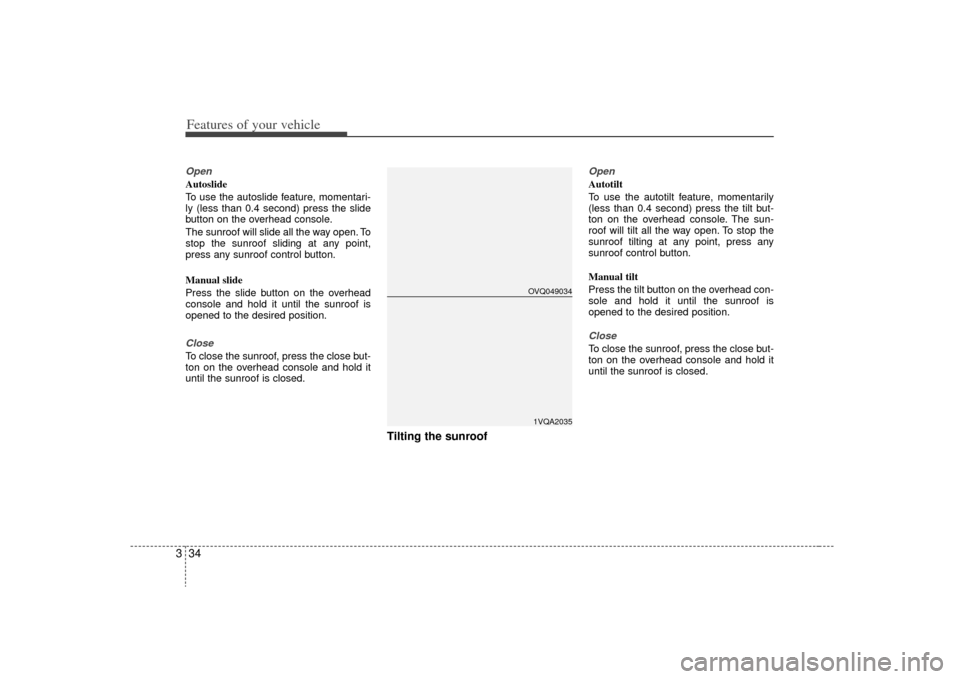
3OpenAutoslide
To use the autoslide feature, momentari-
ly (less than 0.4 second) press the slide
button on the overhead console.
The sunroof will slide all the way open. To
stop the sunroof sliding at any point,
press any sunroof control button.
Manual slide
Press the slide button on the overhead
console and hold it until the sunroof is
opened to the desired position.CloseTo close the sunroof, press the close but-
ton on the overhead console and hold it
until the sunroof is closed.
Tilting the sunroof
OpenAutotilt
To use the autotilt feature, momentarily
(less than 0.4 second) press the tilt but-
ton on the overhead console. The sun-
roof will tilt all the way open. To stop the
sunroof tilting at any point, press any
sunroof control button.
Manual tilt
Press the tilt button on the overhead con-
sole and hold it until the sunroof is
opened to the desired position.CloseTo close the sunroof, press the close but-
ton on the overhead console and hold it
until the sunroof is closed.
OVQ0490341VQA2035
Page 44 of 356
335
Features of your vehicle
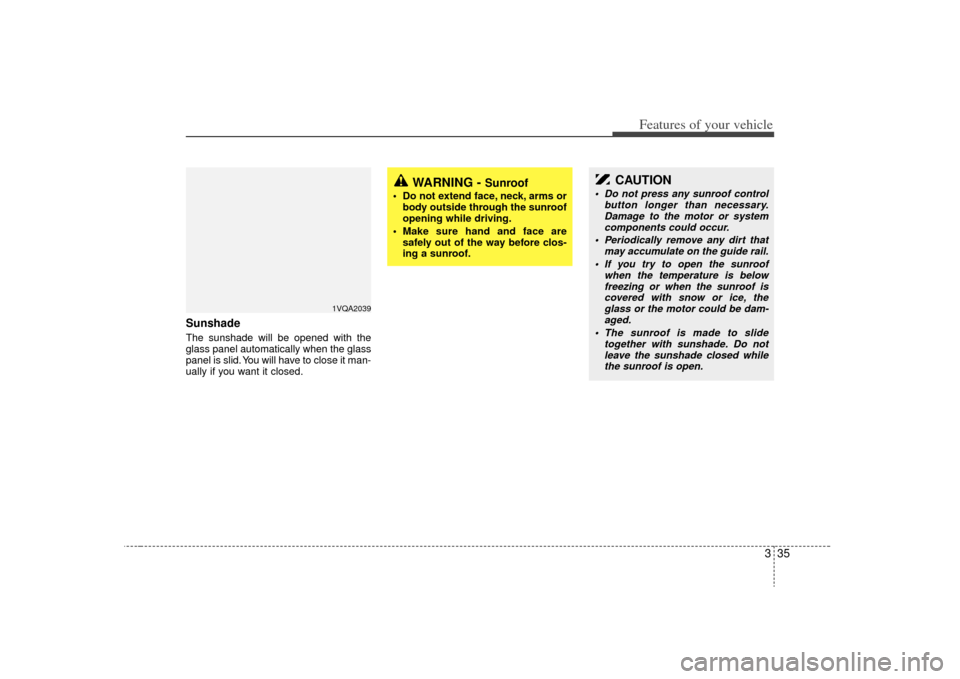
Sunshade The sunshade will be opened with the
glass panel automatically when the glass
panel is slid. You will have to close it man-
ually if you want it closed.
1VQA2039
WARNING -
Sunroof
Do not extend face, neck, arms orbody outside through the sunroof
opening while driving.
Make sure hand and face are safely out of the way before clos-
ing a sunroof.
CAUTION
Do not press any sunroof control button longer than necessary.Damage to the motor or systemcomponents could occur.
Periodically remove any dirt that may accumulate on the guide rail.
If you try to open the sunroof when the temperature is belowfreezing or when the sunroof iscovered with snow or ice, the glass or the motor could be dam-aged.
The sunroof is made to slide together with sunshade. Do notleave the sunshade closed whilethe sunroof is open.
Page 45 of 356
Features of your vehicle36
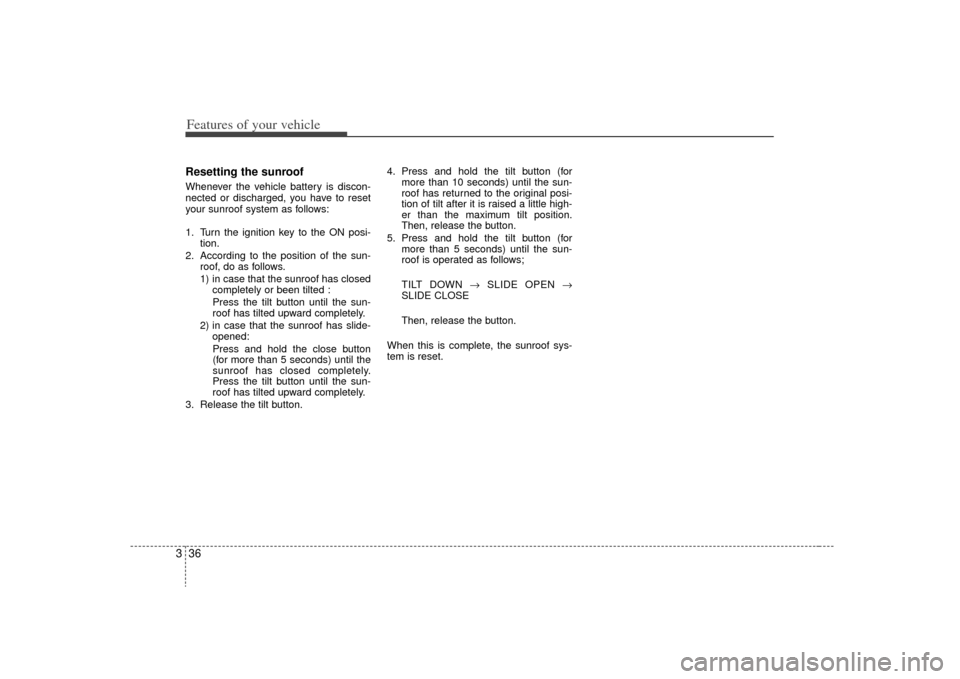
3Resetting the sunroofWhenever the vehicle battery is discon-
nected or discharged, you have to reset
your sunroof system as follows:
1. Turn the ignition key to the ON posi-
tion.
2. According to the position of the sun- roof, do as follows.
1) in case that the sunroof has closedcompletely or been tilted :
Press the tilt button until the sun-
roof has tilted upward completely.
2) in case that the sunroof has slide- opened:
Press and hold the close button
(for more than 5 seconds) until the
sunroof has closed completely.
Press the tilt button until the sun-
roof has tilted upward completely.
3. Release the tilt button. 4. Press and hold the tilt button (for
more than 10 seconds) until the sun-
roof has returned to the original posi-
tion of tilt after it is raised a little high-
er than the maximum tilt position.
Then, release the button.
5. Press and hold the tilt button (for more than 5 seconds) until the sun-
roof is operated as follows;
TILT DOWN → SLIDE OPEN →
SLIDE CLOSE
Then, release the button.
When this is complete, the sunroof sys-
tem is reset.
Page 101 of 356
Features of your vehicle92
3Curtain air bag (if equipped)Curtain air bags are located along both
sides of the roof rails above the front and
rear doors.
It is designed to help protect the heads of
the front seat occupants and the rear out-
board seat occupants in certain side
impact collisions. If the curtain air bag deploys, it
remains inflated for approximately 3
seconds. The curtain air bag deploy-
ment occurs only on the side of the
vehicle affected by the impact.
The side air bags (side and curtain air bags) are not designed to deploy dur-
ing collisions from the front or rear of
the vehicle or in most rollover situa-
tions.
The curtain air bags are designed to deploy only during certain side-impact
collisions, depending on the crash
severity, angle, speed and impact. The
curtain air bags are not designed to
deploy in all side impact situations.
WARNING
In order for side air bags (side
and curtain air bags) to provide
its best protection, both front seat
occupants and both outboard
rear occupants should sit in an
upright position with the seat
belts properly fastened.
Importantly, children should sit in
a proper child restraint system in
the rear seat.
(Continued)
(Continued)
When children are seated in therear outboard seats, they must be
seated in the proper child
restraint system. Make sure to put
the child restraint system as far
away from the door side as possi-
ble, and secure the child restraint
system in a locked position.
Do not allow the passengers to lean their heads or bodies onto
doors, put their arms on the
doors, stretch their arms out of
the window, or place objects
between the doors and passen-
gers when they are seated on
seats equipped with side air
bags.
Never try to open or repair any components of the side curtain
air bag system. This should only
be done by an authorized Kia
dealer.
Failure to follow the above men-
tioned instructions can result in
injury or death to the vehicle occu-
pants in an accident.
OVQ036017NOVQ036093N
Page 108 of 356
399
Features of your vehicle
Noise and smokeWhen the air bags inflate, they make a
loud noise and they leave smoke and
powder in the air inside of the vehicle.
This is normal and is a result of the igni-
tion of the air bag inflator. After the air
bag inflates, you may feel substantial dis-
comfort in breathing due to the contact of
your chest to both the safety belt and the
air bag, as well as from breathing the
smoke and powder.We strongly urge
you to open your doors and/or win-
dows as soon as possible after impact
in order to reduce discomfort and pre-
vent prolonged exposure to the
smoke and powder.
Though smoke and powder are non-
toxic, it may cause irritation to the skin
(eyes, nose and throat etc). If this is the
case, wash and rinse with the cold water
immediately and consult the doctor if the
symptom persists.
WARNING -
Seated
positioning
Driver should sit as far back (at least 250 mm (10 inches) away)
from the steering wheel air bag as
possible to reduce the risk of
injury or death in a collision. The
front passenger should always
move their seat as far back as
possible and sit back in their
seat.
Air bag inflates instantly in an event of collision, passengers
may be injured by the air bag
expansion force if they are not in
proper position.
Air bag inflation may cause injuries which normally include
facial or bodily abrasions, injuries
by the broken glasses or burns by
the explosives.
WARNING
When the air bags deploy, the air
bag related parts in steering wheel
and/or instrument panel and/or in
both sides of the roof rails above
the front and rear doors are very
hot. To prevent injury, do not touch
the air bag storage areas internal
components immediately after an
air bag has inflated.