Break KIA Sedona 2011 2.G Owner's Manual
[x] Cancel search | Manufacturer: KIA, Model Year: 2011, Model line: Sedona, Model: KIA Sedona 2011 2.GPages: 370, PDF Size: 6.75 MB
Page 11 of 370

Index
8I
Side table ··················\
··················\
··················\
···········3-185
Sunglass holder ··················\
··················\
··················\
3-184
Sunroof··················\
··················\
··················\
··················\
····3-33
Sunvisor ·················\
··················\
··················\
··················\
3-188
Tachometer ················\
··················\
··················\
···············3-116
Tailgate ················\
··················\
··················\
··················\
·····3-15
Tether anchor system ··················\
··················\
·················3-76\
Theft-alarm system ··················\
··················\
··················\
····3-7
Tilt steering ··················\
··················\
··················\
············3-105
Tire specification / pressure label ··················\
················4-36
Tires ··················\
··················\
··················\
··················\
··········7-3
Tires and wheels ··················\
··················\
··················\
······6-32 Checking tire inflation pressure ··················\
·············6-34
Compact spare tire replacement ··················\
·············6-36
Recommended cold tire inflation pressures ·············6-32
Tire care ··················\
··················\
··················\
·············6-32
Tire maintenance ··················\
··················\
··················\
6-38
Tire replacement ··················\
··················\
··················\
·6-36
Tire rotation ··················\
··················\
··················\
········6-35
Tire sidewall labeling ··················\
··················\
···········6-38
Tire traction ··················\
··················\
··················\
········6-38
Wheel alignment and tire balance ··················\
··········6-37
Wheel replacement ··················\
··················\
···············6-37
Towing ·················\
··················\
··················\
··················\
····5-15 Tie-down hook (for flatbed towing) ··················\
·······5-18 Trailer towing ··················\
··················\
··················\
···········4-28
Safety chains ··················\
··················\
··················\
······4-30
Transaxle Automatic transaxle ··················\
··················\
···············4-5
Trip computer ··················\
··················\
··················\
········3-119
Vehicle break-in process ··················\
··················\
··············1-3
Vehicle certification label ··················\
··················\
··········4-35
Vehicle identification number (VIN) ··················\
···········4-35
Washer fluid level ··················\
··················\
··················\
·····6-18
Waste tray, see ashtray ··················\
··················\
·············3-186
Warnings and indicators ··················\
··················\
··········3-125
Wheel alignment and tire balance ··················\
···············6-37
Wheel replacement ··················\
··················\
··················\
··6-37
Windows ··················\
··················\
··················\
··················\
3-26 Power window lock switch ··················\
··················\
··3-28
Windshield defrosting and defogging ··················\
········3-170 Defogging logic ··················\
··················\
··················\
3-172
Winter driving ··················\
··················\
··················\
··········4-28 Snow tires ··················\
··················\
··················\
···········4-28
Wiper blades ··················\
··················\
··················\
············6-20
Wipers and washers ··················\
··················\
·················3-13\
8
T
V
W
Page 12 of 370
1
How to use this manual / 1-2
Fuel requirements / 1-2
Vehicle break-in process / 1-3
Introduction
Page 14 of 370
13
Introduction
Gasoline containing alcohol and
methanol
Gasohol, a mixture of gasoline and
ethanol (also known as grain alcohol),
and gasoline or gasohol containing
methanol (also known as wood alcohol)
are being marketed along with or instead
of leaded or unleaded gasoline.
Do not use gasohol containing more than
10% ethanol, and do not use gasoline or
gasohol containing any methanol. Either
of these fuels may cause drivability prob-
lems and damage to the fuel system.
Discontinue using gasohol of any kind if
drivability problems occur.Vehicle damage or driveability problems
may not be covered by the manufactur-
er’s warranty if they result from the use
of:
1. Gasohol containing more than 10%
ethanol.
2. Gasoline or gasohol containing methanol.
3. Leaded fuel or leaded gasohol. No special break-in period is needed. By
following a few simple precautions for the
first 1,000 km (600 miles) you may add to
the performance, economy and life of
your vehicle.
Do not race the engine.
Do not maintain a single speed for long
periods of time, either fast or slow.
Varying engine speed is needed to
properly break-in the engine.
Avoid hard stops, except in emergen- cies, to allow the brakes to seat prop-
erly.
Avoid full-throttle starts.
CAUTION
Never use gasohol which contains methanol. Discontinue use of any gasohol product which impairs dri-vability.
VEHICLE BREAK-IN PROCESS
Page 49 of 370
Features of your vehicle
32
3
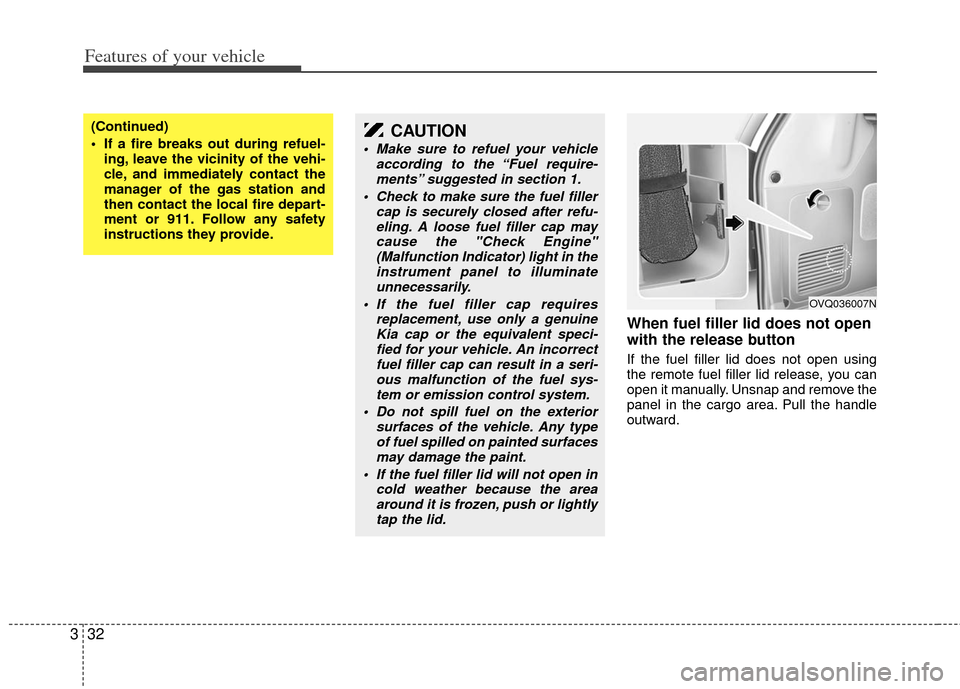
When fuel filler lid does not open
with the release button
If the fuel filler lid does not open using
the remote fuel filler lid release, you can
open it manually. Unsnap and remove the
panel in the cargo area. Pull the handle
outward.
(Continued)
If a fire breaks out during refuel-
ing, leave the vicinity of the vehi-
cle, and immediately contact the
manager of the gas station and
then contact the local fire depart-
ment or 911. Follow any safety
instructions they provide.CAUTION
Make sure to refuel your vehicle according to the “Fuel require-ments” suggested in section 1.
Check to make sure the fuel filler cap is securely closed after refu-eling. A loose fuel filler cap maycause the "Check Engine"(Malfunction Indicator) light in theinstrument panel to illuminateunnecessarily.
If the fuel filler cap requires replacement, use only a genuineKia cap or the equivalent speci-fied for your vehicle. An incorrect fuel filler cap can result in a seri-ous malfunction of the fuel sys-tem or emission control system.
Do not spill fuel on the exterior surfaces of the vehicle. Any typeof fuel spilled on painted surfacesmay damage the paint.
If the fuel filler lid will not open in cold weather because the areaaround it is frozen, push or lightlytap the lid.
OVQ036007N
Page 81 of 370
Features of your vehicle
64
3
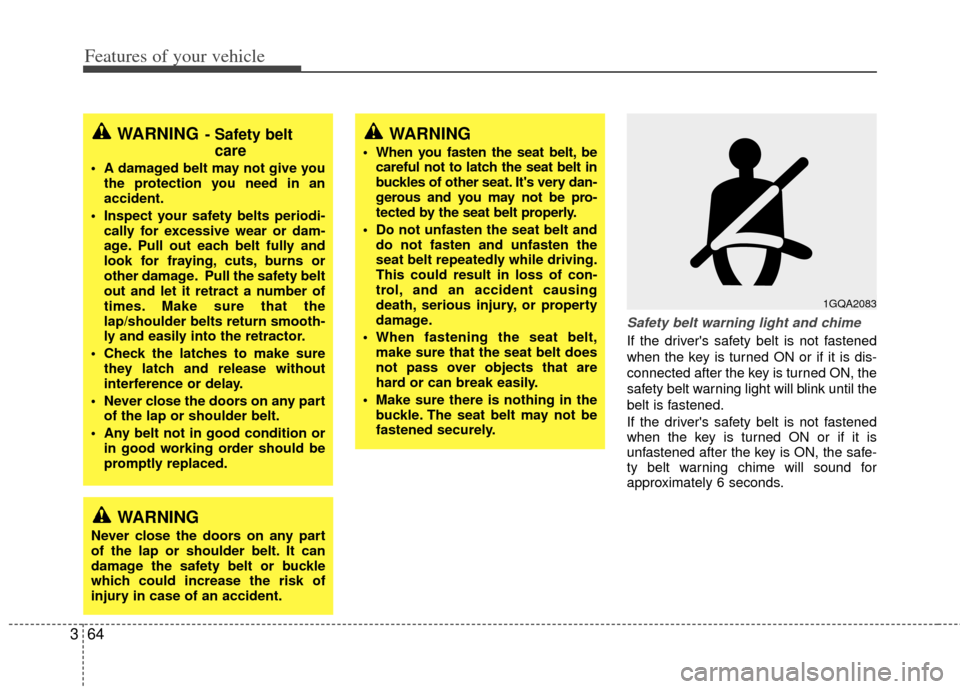
Safety belt warning light and chime
If the driver's safety belt is not fastened
when the key is turned ON or if it is dis-
connected after the key is turned ON, the
safety belt warning light will blink until the
belt is fastened.
If the driver's safety belt is not fastened
when the key is turned ON or if it is
unfastened after the key is ON, the safe-
ty belt warning chime will sound for
approximately 6 seconds.
WARNING- Safety belt
care
A damaged belt may not give you
the protection you need in an
accident.
Inspect your safety belts periodi- cally for excessive wear or dam-
age. Pull out each belt fully and
look for fraying, cuts, burns or
other damage. Pull the safety belt
out and let it retract a number of
times. Make sure that the
lap/shoulder belts return smooth-
ly and easily into the retractor.
Check the latches to make sure they latch and release without
interference or delay.
Never close the doors on any part of the lap or shoulder belt.
Any belt not in good condition or in good working order should be
promptly replaced.
WARNING
Never close the doors on any part
of the lap or shoulder belt. It can
damage the safety belt or buckle
which could increase the risk of
injury in case of an accident.
1GQA2083
WARNING
When you fasten the seat belt, becareful not to latch the seat belt in
buckles of other seat. It's very dan-
gerous and you may not be pro-
tected by the seat belt properly.
Do not unfasten the seat belt and do not fasten and unfasten the
seat belt repeatedly while driving.
This could result in loss of con-
trol, and an accident causing
death, serious injury, or property
damage.
When fastening the seat belt, make sure that the seat belt does
not pass over objects that are
hard or can break easily.
Make sure there is nothing in the buckle. The seat belt may not be
fastened securely.
Page 95 of 370
Features of your vehicle
78
3
Follow the child seat manufacturer’s
instructions to properly install child
restraint seats with LATCH or LATCH-
compatible attachments.
Once you have installed the LATCH child
restraint, assure that the seat is properly
attached to the LATCH and tether
anchors. Also, test the child restraint seat
before you place the child in it. Tilt the
seat from side to side. Also try to tug the
seat forward. Check to see if the anchors
hold the seat in place.
Placing a passenger safety belt
into the auto lock mode
The use of the auto lock mode will
ensure that the normal movement of the
child in the vehicle does not cause the
safety belt to be pulled out and loosen
the firmness of its hold on the child
restraint system. To secure a child
restraint system, use the following proce-
dure.
WARNING
If the child restraint is not anchored
properly, there is a significant risk
of a child being seriously injured or
killed in a collision.
WARNING - LATCH lower
anchors
LATCH lower anchors are only to be
used with the left and right rear out-
board seating positions. Never
attempt to attach an LATCH
equipped seat in the center seating
position. You may damage the
anchors or the anchors may fail and
break in a collision.
WARNING
Install the child restraint seat fully
rearward against the seatback with
the seatback in a vertical position,
not reclined.
WARNING
When using the vehicle's
"LATCH" system to install a child
restraint system in the rear seat,
all unused vehicle rear seat belt
metal latch plates or tabs must be
latched securely in their seat belt
buckles and the seat belt webbing
must be retracted behind the
child restraint to prevent the child
from reaching and taking hold of
unretracted seat belts. Unlatched
metal latch plates or tabs may
allow the child to reach the unre-
tracted seat belts which may
result in strangulation and a seri-
ous injury or death to the child in
the child restraint.
Do not place anything around the lower anchors. Also make sure
that the seat belt is not caught in
the lower anchors.
CAUTION
Do not allow the rear seat belt web-bing to get scratched or pinched bythe Child-seat latch and LATCH anchor during the installation.
Page 121 of 370
Features of your vehicle
104
3
Power steering
Power steering uses energy from the
engine to assist you in steering the vehi-
cle. If the engine is off or if the power
steering system becomes inoperative,
the vehicle may still be steered, but it will
require increased steering effort.
Should you notice any change in the
effort required to steer during normal
vehicle operation, have the power steer-
ing checked by an Authorized Kia Dealer.
✽ ✽
NOTICE
If the vehicle is parked for extended
periods outside in cold weather (below -
10 °C/14 °F), the power steering may
require increased effort when the engine
is first started. This is caused by
increased fluid viscosity due to the cold
weather and does not indicate a mal-
function.
When this happens, increase the engine
RPM by depressing accelerator until the
RPM reaches 1,500 rpm then release or
let the engine idle for two or three min-
utes to warm up the fluid.
STEERING WHEEL
CAUTION
Never hold the steering wheel
against a stop (extreme right orleft turn) for more than 5 secondswith the engine running. Holding the steering wheel for more than5 seconds in either position may cause damage to the power steer-ing pump.
If the power steering drive belt breaks or if the power steeringpump malfunctions, the steering effort will greatly increase.
Page 145 of 370
Features of your vehicle
128
3
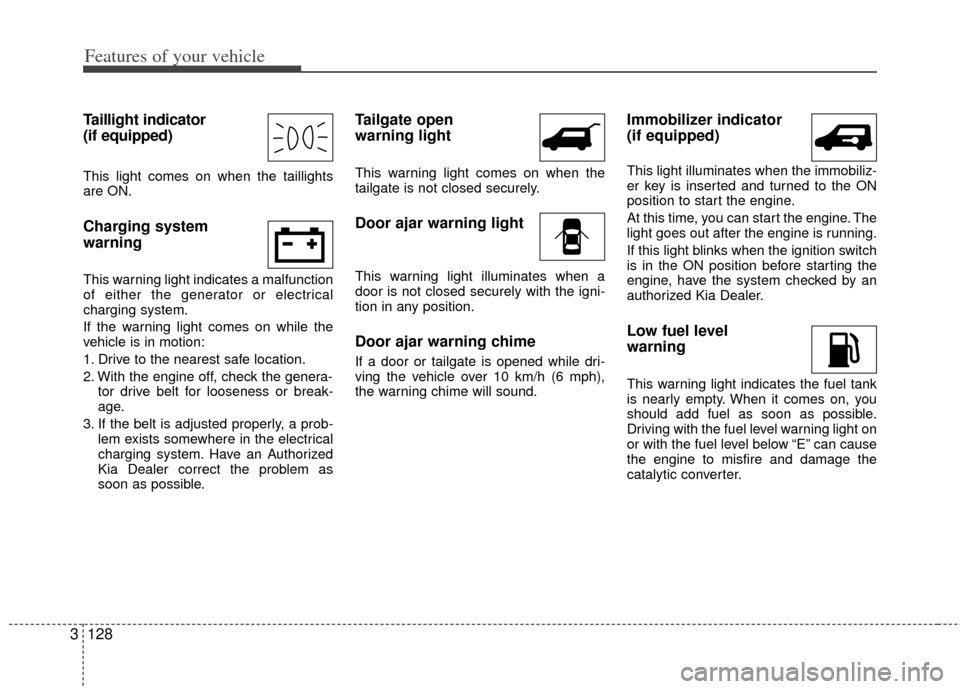
Taillight indicator
(if equipped)
This light comes on when the taillights
are ON.
Charging system
warning
This warning light indicates a malfunction
of either the generator or electrical
charging system.
If the warning light comes on while the
vehicle is in motion:
1. Drive to the nearest safe location.
2. With the engine off, check the genera-
tor drive belt for looseness or break-
age.
3. If the belt is adjusted properly, a prob- lem exists somewhere in the electrical
charging system. Have an Authorized
Kia Dealer correct the problem as
soon as possible.
Tailgate open
warning light
This warning light comes on when the
tailgate is not closed securely.
Door ajar warning light
This warning light illuminates when a
door is not closed securely with the igni-
tion in any position.
Door ajar warning chime
If a door or tailgate is opened while dri-
ving the vehicle over 10 km/h (6 mph),
the warning chime will sound.
Immobilizer indicator
(if equipped)
This light illuminates when the immobiliz-
er key is inserted and turned to the ON
position to start the engine.
At this time, you can start the engine. The
light goes out after the engine is running.
If this light blinks when the ignition switch
is in the ON position before starting the
engine, have the system checked by an
authorized Kia Dealer.
Low fuel level
warning
This warning light indicates the fuel tank
is nearly empty. When it comes on, you
should add fuel as soon as possible.
Driving with the fuel level warning light on
or with the fuel level below “E” can cause
the engine to misfire and damage the
catalytic converter.
Page 221 of 370
Features of your vehicle
204
3
CAUTION IN USING
USB DEVICE
To use an external USB device,
make sure the device is not con-nected when starting up the vehi-cle. Connect the device afterstarting up.
If you start the engine when the USB device is connected, it maydamage the USB device. (USBflashdrives are very sensitive toelectric shock.)
If the engine is started up or turned off while the external USBdevice is connected, the externalUSB device may not work.
It may not play inauthentic MP3 or WMA files.
1) It can only play MP3 files with the compression rate between8Kbps~320Kbps.
2) It can only play WMA music files with the compression ratebetween 8Kbps~320Kbps.
Take precautions for static electrici- ty when connecting or disconnect-ing the external USB device.
(Continued)
(Continued) An encrypted MP3 PLAYER is not recognizable.
Depending on the condition of the external USB device, the con-nected external USB device canbe unrecognizable.
When the formatted byte/sector setting of External USB device isnot either 512BYTE or 2048BYTE,then the device will not be recog- nized.
Use only a USB device formatted to FAT 12/16/32.
USB devices without USB I/F authentication may not be recog-nizable.
Make sure the USB connection terminal does not come in contactwith the human body or otherobjects.
If you repeatedly connect or dis- connect the USB device in a shortperiod of time, it may break thedevice.
You may hear a strange noise when connecting or disconnect-ing a USB device.
(Continued)(Continued) If you disconnect the external USB device during playback in USBmode, the external USB device canbe damaged or may malfunction. Therefore, disconnect the externalUSB device when the audio is turned off or in another mode. (e.g,Radio, SIRIUS or CD)
Depending on the type and capacity of the external USB device or thetype of the files stored in the device, there is a difference in the timetaken for recognition of the device.
Do not use the USB device for pur- poses other than playing music files.
Playing videos through the USB isnot supported.
Use of USB accessories such as rechargers or heaters using USBI/F may lower performance or cause trouble.
If you use devices such as a USB hub purchased separately, thevehicle’s audio system may notrecognize the USB device. In that case, connect the USB devicedirectly to the multimedia termi-nal of the vehicle.
(Continued)
Page 294 of 370
Driving your vehicle
32
4
Parking on hills
Generally, you should not park your vehi-
cle, with a trailer attached, on a hill.
People can be seriously or fatally injured,
and both your vehicle and the trailer can
be damaged if they begin a downhill tra-
jectory.
However, if you ever have to park your
trailer on a hill, here’s how to do it:
1. Apply your brakes, but don’t shift into
gear.
2. Have someone place chocks under the trailer wheels.
3. When the wheel chocks are in place, release the brakes until the chocks
absorb the load.
4. Reapply the brakes. Apply your park- ing brake, and then shift to P (Park) for
an automatic transaxle.
5. Release the brakes.
When you are ready to leave after parking on a hill
1. With the automatic transaxle in P (Park), apply your brakes and hold the
brake pedal down while you:
and
2. Slowly remove your foot from the brake pedal.
3. Drive slowly until the trailer is clear of the chocks.
4. Stop and have someone pick up and store the chocks.
CAUTION
When towing a trailer on steep grades (in excess of 6%) payclose attention to the enginecoolant temperature gauge toensure the engine does not over-heat. If the needle of the coolanttemperature gauge moves acrossthe dial towards “H” (HOT), pullover and stop as soon as it is safe to do so, and allow the engine toidle until it cools down. You mayproceed once the engine hascooled sufficiently.
You must decide driving speed depending on trailer weight anduphill grade to reduce the possi-bility of engine and transaxleoverheating.
WARNING- Parking on a hill
Parking your vehicle on a hill with a
trailer attached could cause serious
injury or death, should the trailer
break lose.
WARNING- Parking brake
It can be dangerous to get out of
your vehicle if the parking brake is
not firmly set.
If you have left the engine running,
the vehicle can move suddenly. You
or others could be seriously or
fatally injured.