towing KIA Sedona 2012 2.G Owner's Manual
[x] Cancel search | Manufacturer: KIA, Model Year: 2012, Model line: Sedona, Model: KIA Sedona 2012 2.GPages: 370, PDF Size: 6.75 MB
Page 6 of 370

I3
Index
Child-protector rear door lock ··················\
··················\
···3-15
Cigarette lighter ··················\
··················\
··················\
······3-185
Climate control air filter ··················\
··················\
············6-19
Climate control system (Automatic) ··················\
·········3-156Air conditioning ··················\
··················\
·················3-16\
3
Climate control system (Manual) ··················\
··············3-144 Air conditioning ··················\
··················\
·················3-14\
9
Clock (Digital) ··················\
··················\
··················\
·······3-190
Clothes hanger ··················\
··················\
··················\
········3-185
Combined instrument, see instrument cluster ·············3-114
Compact spare tire replacement ··················\
··················\
6-36
Compass mirror, see the Electric chromic mirror (ECM) ···············\
··················\
··················\
·········3-108
Coolant ················\
··················\
··················\
··················\
·····6-14
Cooling fluid, see engine coolant ··················\
················6-14
Cruise control system ··················\
··················\
················4-11
Cup holder ··················\
··················\
··················\
·············3-186
Curtain air bag ··················\
··················\
··················\
·········3-93
Dashboard, see instrument cluster ··················\
·············3-114
Dashboard illumination, see instrument panel illumination ··················\
··················\
·················3-11\
8
Defogging (Windshield) ··················\
··················\
··········3-170
Defogging logic (Windshield) ··················\
··················\
·3-172
Defroster ················\
··················\
··················\
··················\
3-142
Defrosting (Windshield) ··················\
··················\
··········3-170 Digital clock ··················\
··················\
··················\
···········3-190
Dimensions ················\
··················\
··················\
··················\
7-2
Displays, see instrument cluster ··················\
················3-114
Display illumination, see instrument
panel illumination ··················\
··················\
·················3-11\
8
Door locks ··················\
··················\
··················\
·················3-11\
Central door lock switch ··················\
··················\
······3-13
Child-protector rear door lock ··················\
···············3-15
Drinks holders, see cup holders ··················\
·················3-18\
7
Driver position memory system ··················\
··················\
·3-59
Driver's air bag ··················\
··················\
··················\
·········3-91
Driving at night ··················\
··················\
··················\
········4-27
Driving in flooded areas ··················\
··················\
············4-27
Driving in the rain ··················\
··················\
··················\
····4-27
Economical operation ··················\
··················\
················4-25
Electronic stability control (ESC)··················\
·················4-19\
Electric chromic mirror (ECM) ··················\
·················3-10\
8
Emergency starting ··················\
··················\
··················\
····5-3 Jump starting ··················\
··················\
··················\
········5-3
Push starting ··················\
··················\
··················\
·········5-5
Emergency towing ··················\
··················\
··················\
···5-15
Emergency while driving ··················\
··················\
·············5-2
Emission control system ··················\
··················\
············6-49
Engine compartment ··················\
··················\
··················\
6-12
Engine coolant ··················\
··················\
··················\
·········6-14
D
E
Page 11 of 370

Index
8I
Side table ··················\
··················\
··················\
···········3-185
Sunglass holder ··················\
··················\
··················\
3-184
Sunroof··················\
··················\
··················\
··················\
····3-33
Sunvisor ·················\
··················\
··················\
··················\
3-188
Tachometer ················\
··················\
··················\
···············3-116
Tailgate ················\
··················\
··················\
··················\
·····3-15
Tether anchor system ··················\
··················\
·················3-76\
Theft-alarm system ··················\
··················\
··················\
····3-7
Tilt steering ··················\
··················\
··················\
············3-105
Tire specification / pressure label ··················\
················4-36
Tires ··················\
··················\
··················\
··················\
··········7-3
Tires and wheels ··················\
··················\
··················\
······6-32 Checking tire inflation pressure ··················\
·············6-34
Compact spare tire replacement ··················\
·············6-36
Recommended cold tire inflation pressures ·············6-32
Tire care ··················\
··················\
··················\
·············6-32
Tire maintenance ··················\
··················\
··················\
6-38
Tire replacement ··················\
··················\
··················\
·6-36
Tire rotation ··················\
··················\
··················\
········6-35
Tire sidewall labeling ··················\
··················\
···········6-38
Tire traction ··················\
··················\
··················\
········6-38
Wheel alignment and tire balance ··················\
··········6-37
Wheel replacement ··················\
··················\
···············6-37
Towing ·················\
··················\
··················\
··················\
····5-15 Tie-down hook (for flatbed towing) ··················\
·······5-18 Trailer towing ··················\
··················\
··················\
···········4-28
Safety chains ··················\
··················\
··················\
······4-30
Transaxle Automatic transaxle ··················\
··················\
···············4-5
Trip computer ··················\
··················\
··················\
········3-119
Vehicle break-in process ··················\
··················\
··············1-3
Vehicle certification label ··················\
··················\
··········4-35
Vehicle identification number (VIN) ··················\
···········4-35
Washer fluid level ··················\
··················\
··················\
·····6-18
Waste tray, see ashtray ··················\
··················\
·············3-186
Warnings and indicators ··················\
··················\
··········3-125
Wheel alignment and tire balance ··················\
···············6-37
Wheel replacement ··················\
··················\
··················\
··6-37
Windows ··················\
··················\
··················\
··················\
3-26 Power window lock switch ··················\
··················\
··3-28
Windshield defrosting and defogging ··················\
········3-170 Defogging logic ··················\
··················\
··················\
3-172
Winter driving ··················\
··················\
··················\
··········4-28 Snow tires ··················\
··················\
··················\
···········4-28
Wiper blades ··················\
··················\
··················\
············6-20
Wipers and washers ··················\
··················\
·················3-13\
8
T
V
W
Page 54 of 370
337
Features of your vehicle
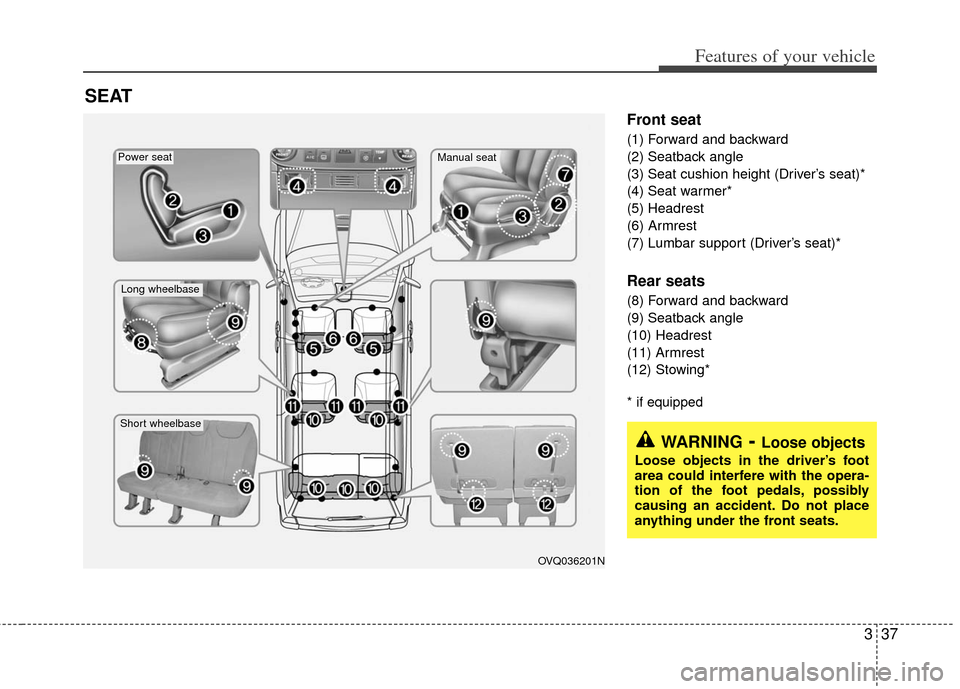
Front seat
(1) Forward and backward
(2) Seatback angle
(3) Seat cushion height (Driver’s seat)*
(4) Seat warmer*
(5) Headrest
(6) Armrest
(7) Lumbar support (Driver’s seat)*
Rear seats
(8) Forward and backward
(9) Seatback angle
(10) Headrest
(11) Armrest
(12) Stowing*
* if equipped
SEAT
OVQ036201N
Long wheelbase
Short wheelbase
Power seatManual seat
WARNING- Loose objects
Loose objects in the driver’s foot
area could interfere with the opera-
tion of the foot pedals, possibly
causing an accident. Do not place
anything under the front seats.
Page 73 of 370
Features of your vehicle
56
3
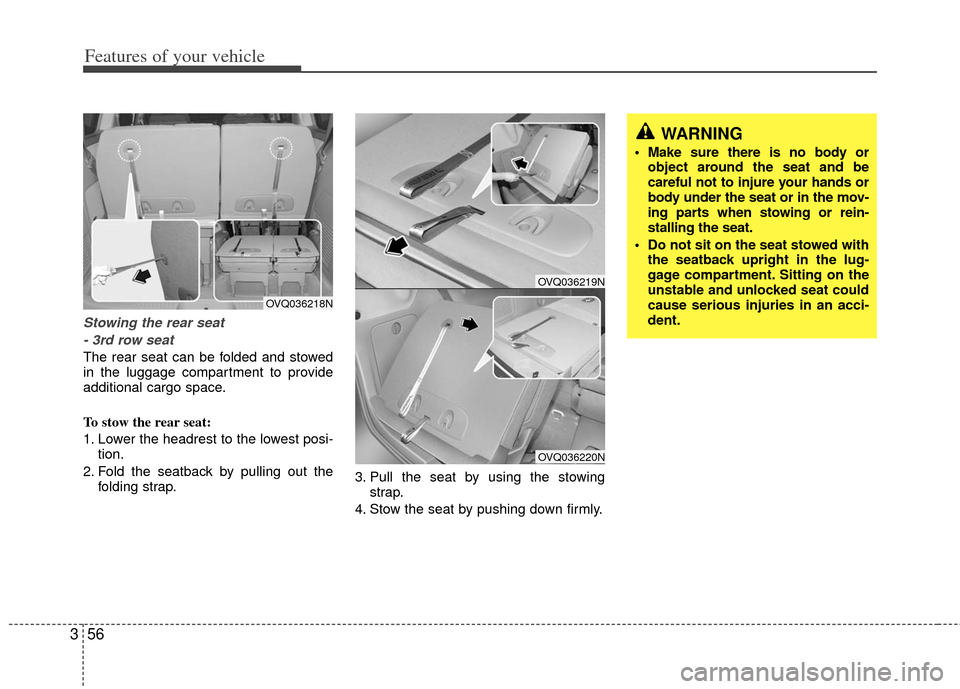
Stowing the rear seat
- 3rd row seat
The rear seat can be folded and stowed
in the luggage compartment to provide
additional cargo space.
To stow the rear seat:
1. Lower the headrest to the lowest posi- tion.
2. Fold the seatback by pulling out the folding strap. 3. Pull the seat by using the stowing
strap.
4. Stow the seat by pushing down firmly.
OVQ036219N
OVQ036220N
WARNING
Make sure there is no body or object around the seat and be
careful not to injure your hands or
body under the seat or in the mov-
ing parts when stowing or rein-
stalling the seat.
Do not sit on the seat stowed with the seatback upright in the lug-
gage compartment. Sitting on the
unstable and unlocked seat could
cause serious injuries in an acci-
dent.
OVQ036218N
Page 74 of 370
357
Features of your vehicle
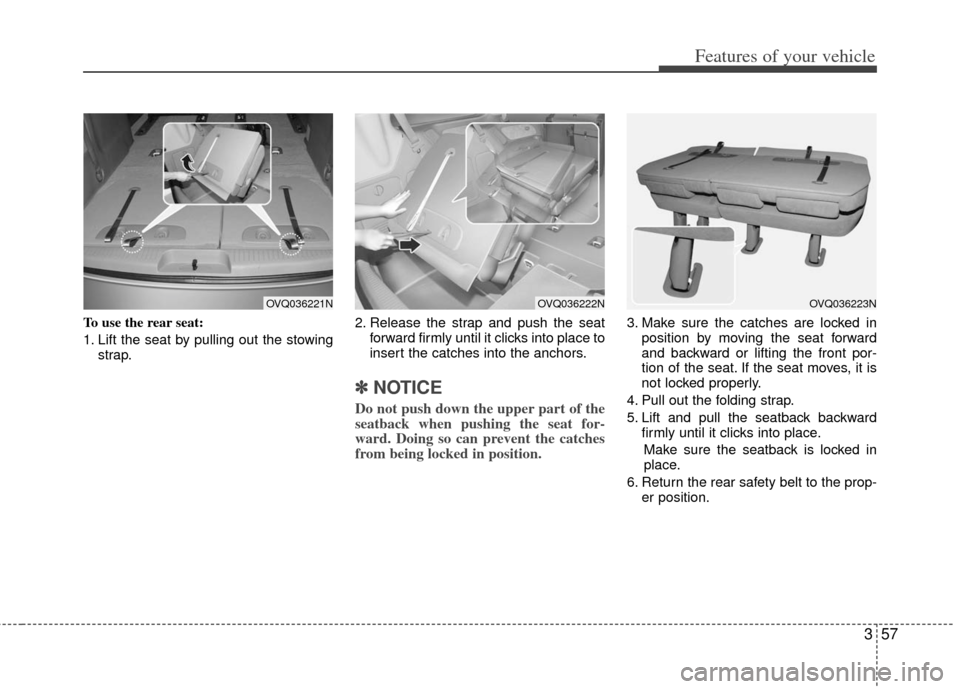
To use the rear seat:
1. Lift the seat by pulling out the stowingstrap. 2. Release the strap and push the seat
forward firmly until it clicks into place to
insert the catches into the anchors.
✽ ✽NOTICE
Do not push down the upper part of the
seatback when pushing the seat for-
ward. Doing so can prevent the catches
from being locked in position.
3. Make sure the catches are locked in
position by moving the seat forward
and backward or lifting the front por-
tion of the seat. If the seat moves, it is
not locked properly.
4. Pull out the folding strap.
5. Lift and pull the seatback backward firmly until it clicks into place.
Make sure the seatback is locked in
place.
6. Return the rear safety belt to the prop- er position.
OVQ036222NOVQ036223NOVQ036221N
Page 86 of 370
369
Features of your vehicle
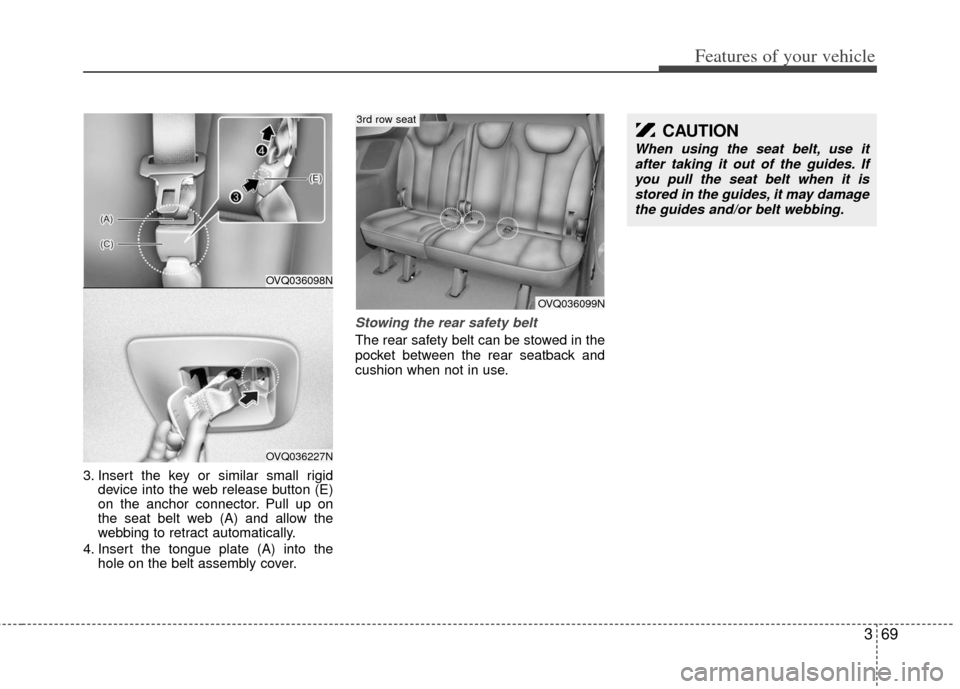
3. Insert the key or similar small rigiddevice into the web release button (E)
on the anchor connector. Pull up on
the seat belt web (A) and allow the
webbing to retract automatically.
4. Insert the tongue plate (A) into the hole on the belt assembly cover.
Stowing the rear safety belt
The rear safety belt can be stowed in the
pocket between the rear seatback and
cushion when not in use.
OVQ036098N
OVQ036227N
CAUTION
When using the seat belt, use it
after taking it out of the guides. Ifyou pull the seat belt when it is stored in the guides, it may damagethe guides and/or belt webbing.
OVQ036099N
3rd row seat
Page 263 of 370
4
Before driving / 4-2
Key positions / 4-3
Starting the engine / 4-4
Automatic transaxle / 4-5
Cruise control system / 4-11
Brake system / 4-14
Electronic stability control / 4-19
Rear parking assist system / 4-21
Rearview camera / 4-24
Economical operation / 4-25
Special driving conditions / 4-26
Winter driving / 4-28
Trailer towing / 4-28
Overloading / 4-34
Label information / 4-35
Driving your vehicle
Page 284 of 370
Driving your vehicle
22
4
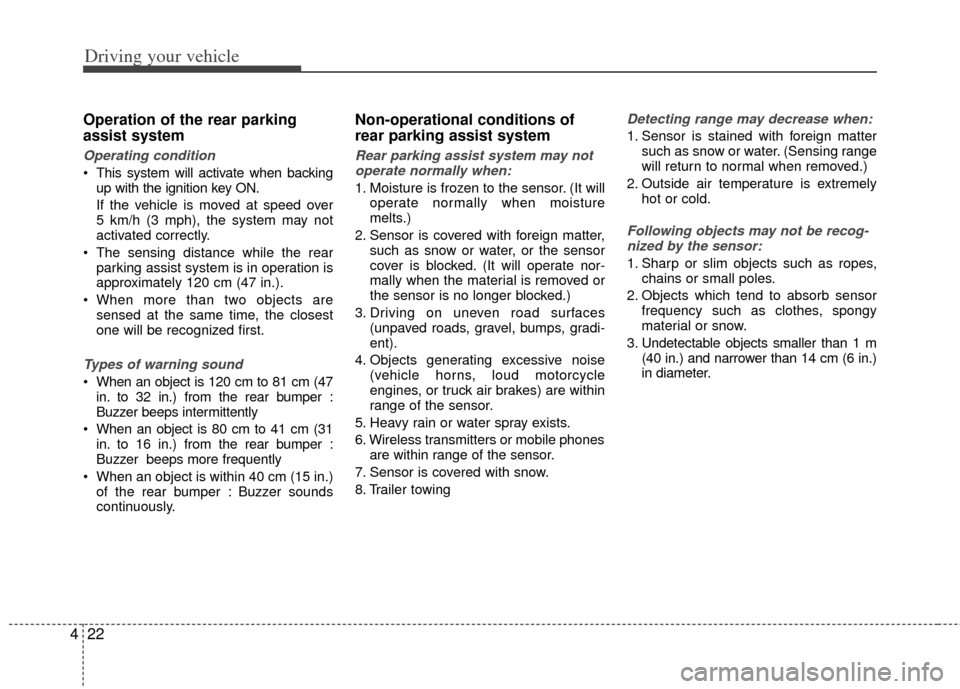
Operation of the rear parking
assist system
Operating condition
This system will activate when backing
up with the ignition key ON.
If the vehicle is moved at speed over
5 km/h (3 mph), the system may not
activated correctly.
The sensing distance while the rear parking assist system is in operation is
approximately 120 cm (47 in.).
When more than two objects are sensed at the same time, the closest
one will be recognized first.
Types of warning sound
When an object is 120 cm to 81 cm (47in. to 32 in.) from the rear bumper :
Buzzer beeps intermittently
When an object is 80 cm to 41 cm (31 in. to 16 in.) from the rear bumper :
Buzzer beeps more frequently
When an object is within 40 cm (15 in.) of the rear bumper : Buzzer sounds
continuously.
Non-operational conditions of
rear parking assist system
Rear parking assist system may notoperate normally when:
1. Moisture is frozen to the sensor. (It will operate normally when moisture
melts.)
2. Sensor is covered with foreign matter, such as snow or water, or the sensor
cover is blocked. (It will operate nor-
mally when the material is removed or
the sensor is no longer blocked.)
3. Driving on uneven road surfaces (unpaved roads, gravel, bumps, gradi-
ent).
4. Objects generating excessive noise (vehicle horns, loud motorcycle
engines, or truck air brakes) are within
range of the sensor.
5. Heavy rain or water spray exists.
6. Wireless transmitters or mobile phones are within range of the sensor.
7. Sensor is covered with snow.
8. Trailer towing
Detecting range may decrease when:
1. Sensor is stained with foreign matter such as snow or water. (Sensing range
will return to normal when removed.)
2. Outside air temperature is extremely hot or cold.
Following objects may not be recog-nized by the sensor:
1. Sharp or slim objects such as ropes, chains or small poles.
2. Objects which tend to absorb sensor frequency such as clothes, spongy
material or snow.
3. Undetectable objects smaller than 1 m (40 in.) and narrower than 14 cm (6 in.)
in diameter.
Page 290 of 370
Driving your vehicle
28
4
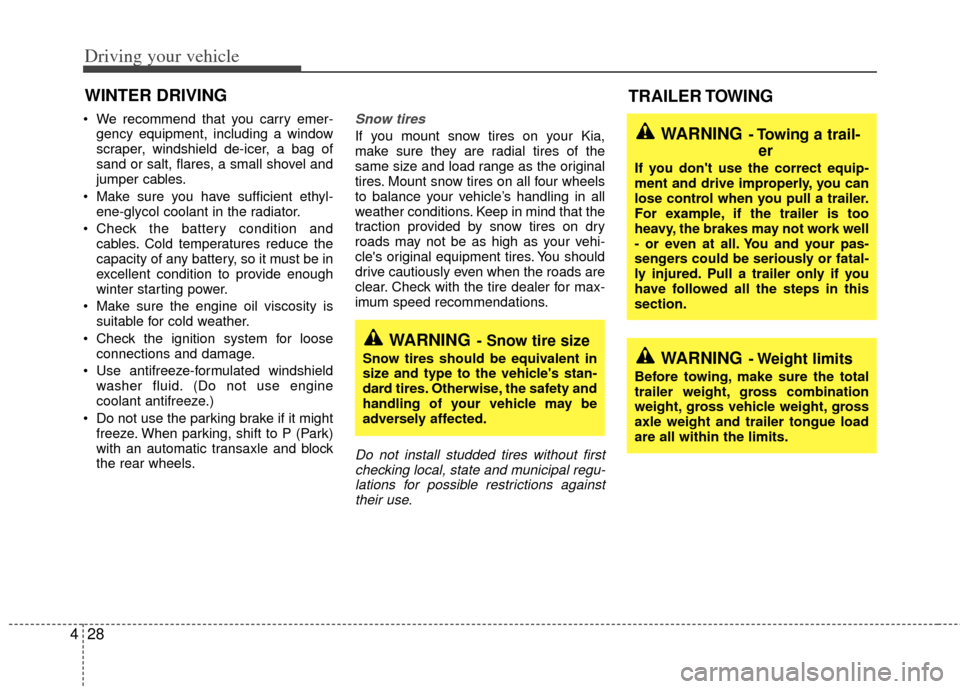
We recommend that you carry emer-
gency equipment, including a window
scraper, windshield de-icer, a bag of
sand or salt, flares, a small shovel and
jumper cables.
Make sure you have sufficient ethyl- ene-glycol coolant in the radiator.
Check the battery condition and cables. Cold temperatures reduce the
capacity of any battery, so it must be in
excellent condition to provide enough
winter starting power.
Make sure the engine oil viscosity is suitable for cold weather.
Check the ignition system for loose connections and damage.
Use antifreeze-formulated windshield washer fluid. (Do not use engine
coolant antifreeze.)
Do not use the parking brake if it might freeze. When parking, shift to P (Park)
with an automatic transaxle and block
the rear wheels.Snow tires
If you mount snow tires on your Kia,
make sure they are radial tires of the
same size and load range as the original
tires. Mount snow tires on all four wheels
to balance your vehicle’s handling in all
weather conditions. Keep in mind that the
traction provided by snow tires on dry
roads may not be as high as your vehi-
cle's original equipment tires. You should
drive cautiously even when the roads are
clear. Check with the tire dealer for max-
imum speed recommendations.
Do not install studded tires without firstchecking local, state and municipal regu-lations for possible restrictions againsttheir use.
WINTER DRIVING
WARNING- Snow tire size
Snow tires should be equivalent in
size and type to the vehicle's stan-
dard tires. Otherwise, the safety and
handling of your vehicle may be
adversely affected.
TRAILER TOWING
WARNING- Towing a trail- er
If you don't use the correct equip-
ment and drive improperly, you can
lose control when you pull a trailer.
For example, if the trailer is too
heavy, the brakes may not work well
- or even at all. You and your pas-
sengers could be seriously or fatal-
ly injured. Pull a trailer only if you
have followed all the steps in this
section.
WARNING- Weight limits
Before towing, make sure the total
trailer weight, gross combination
weight, gross vehicle weight, gross
axle weight and trailer tongue load
are all within the limits.
Page 292 of 370
Driving your vehicle
30
4
Safety chains
You should always attach chains
between your vehicle and your trailer.
Cross the safety chains under the tongue
of the trailer so that the tongue will not
drop to the road if it becomes separated
from the hitch.
Instructions about safety chains may be
provided by the hitch manufacturer or by
the trailer manufacturer. Follow the man-
ufacturer’s recommendation for attaching
safety chains. Always leave just enough
slack so you can turn with your trailer.
And, never allow safety chains to drag on
the ground.
Trailer brakes
If your trailer weighs more than the max-
imum trailer weight without trailer brakes
loaded, then it needs its own brakes and
they must be adequate. Be sure to read
and follow the instructions for the trailer
brakes so you’ll be able to install, adjust
and maintain them properly.
Don’t tap into your vehicle's brake sys-
tem.
Driving with a trailer
Towing a trailer requires a certain
amount of experience. Before setting out
for the open road, you must get to know
your trailer. Acquaint yourself with the
feel of handling and braking with the
added weight of the trailer. And always
keep in mind that the vehicle you are
driving is now a good deal longer and not
nearly so responsive as your vehicle is
by itself.
Before you start, check the trailer hitch
and platform, safety chains, electrical
connector(s), lights, tires and mirror
adjustment. If the trailer has electric
brakes, start your vehicle and trailer mov-
ing and then apply the trailer brake con-
troller by hand to be sure the brakes are
working. This lets you check your electri-
cal connection at the same time.
During your trip, check occasionally to be
sure that the load is secure, and that the
lights and any trailer brakes are still work-
ing.
WARNING- Trailer brakes
Do not use a trailer with its own
brakes unless you are absolutely
certain that you have properly set
up the brake system. This is not a
task for amateurs. Use an experi-
enced, competent trailer shop for
this work.