key battery KIA SEDONA 2017 User Guide
[x] Cancel search | Manufacturer: KIA, Model Year: 2017, Model line: SEDONA, Model: KIA SEDONA 2017Pages: 586, PDF Size: 14.12 MB
Page 334 of 586
4 232
Features of your vehicle
3) Power down your Bluetooth®
Wireless Technology device ➟
Turn it on and try again.
4) Completely remove the battery from your
Bluetooth®Wireless
Technology device; reinsert it,
reboot, and attempt connection.
5) Restart the vehicle and reat- tempt connection.
Pairing a Bluetooth®Wireless
Technology device
Information on pairing Bluetooth®
Wireless Technology devices
Pairing refers to the process of
pairing
Bluetooth®Wireless
Technology cell phones or devices
with the system prior to connec-
tion. This is a necessary procedure
for
Bluetooth®Wireless Technology
connection and usage.
Up to five devices can be paired.
Pairing
Bluetooth®Wireless
Technology device is not allowed
while vehicle is moving. Pairing the first Bluetooth
®Wireless
Technology device
Select the [PHONE] button on the
audio system or the [CALL] button
on the steering wheel remote control
➟ Search for the vehicle from the
Bluetooth®Wireless Technology
device, and pair ➟ Enter the passkey
on the
Bluetooth®Wireless
Technology device or approve
passkey ➟
Bluetooth®Wireless
Technology pairing completed.
1. When the [PHONE] button on the
audio or the [CALL] button on the
steering wheel remote control is
pressed, the following screen is dis-
played. Devices can now be paired.
Page 351 of 586
57
Driving your vehicle
ON
The warning lights can be checked
before the engine is started. This is
the normal running position after the
engine is started.
Do not leave the ignition switch ON ifthe engine is not running to preventbattery discharge.
START
Turn the ignition switch to the START
position to start the engine. The
engine will crank until you release
the key; then it returns to the ON
position. The brake warning light can
be checked in this position. The anti-theft steering column lock (if
equipped) is not a substitute for the
parking brake. Before leaving the dri-
ver’s seat, always make sure the shift
lever is engaged in P (Park) for auto-
matic transaxle, set the parking
brake fully and shut the engine off.
Unexpected and sudden vehicle
movement may occur if these pre-
cautions are not taken.
Starting the engine
1. Make sure the parking brake is
applied.
2. Place the transaxle shift lever in P (Park). Depress the brake pedal
fully.
You can also start the engine when the shift lever is in the N
(Neutral) position.WARNING- Ignition
switch
Never turn the ignition switch to
LOCK or ACC while the vehicle
is moving. This would result in
loss of directional control and
braking function, which could
cause an accident.
WARNING- Proper footwear
Always wear appropriate shoes
when operating your vehicle.
Unsuitable shoes (high heels,
ski boots, sandals, etc.) may
interfere with your ability to use
the brake and accelerator pedal.
Page 355 of 586
511
Driving your vehicle
✽ ✽
NOTICE
If you leave the ENGINE START/
STOP button in the ACC or ON
position for a long time, the battery
will discharge.
Starting the engine with a
smart key
1.Carry the smart key or leave it
inside the vehicle.
2.Make sure the parking brake is firmly applied
3.Place the transaxle shift lever in P (Park). Depress the brake pedal
fully.
You can also start the engine whenthe shift lever is in the N (Neutral)position.
4.Press the ENGINE START/STOP button while depressing the brake
pedal.
It should be started withoutdepressing the accelerator.
5.Do not wait for the engine to warm up while the vehicle remains sta-
tionary.
Start driving at moderate engine
speeds. (Steep accelerating and
decelerating should be avoided.) Even if the smart key is in the vehi-
cle, if it is far away from you, the
engine may not start.
When the ENGINE START/STOP button is in the ACC position or
above, if any door is opened, the
system checks for the smart key. If
the smart key is not in the vehicle,
a message "key not in the vehicle"
will appear on the LCD display. And
if all doors are closed, the chime
will sound for 5 seconds. The indi-
cator or warning will turn off while
the vehicle is moving. Always have
the smart key with you.
WARNING- Starting
vehicle
Never press the ENGINE
START/STOP button while the
vehicle is in motion except in an
emergency. This would result in
loss of directional control and
braking function, which could
cause an accident.
Page 356 of 586
Driving your vehicle
12
5
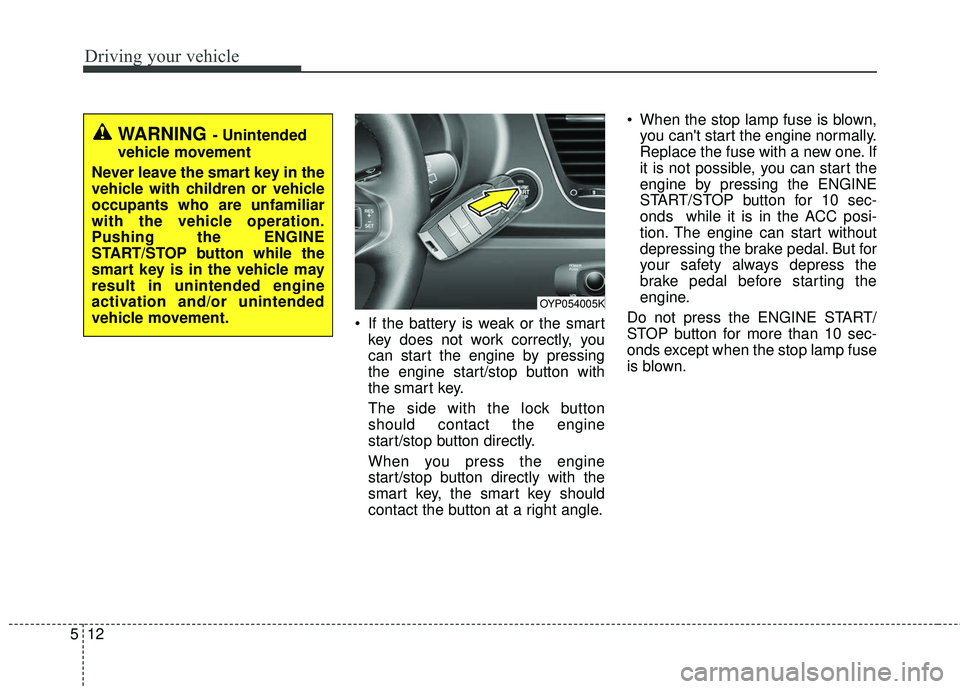
If the battery is weak or the smart
key does not work correctly, you
can start the engine by pressing
the engine start/stop button with
the smart key.
The side with the lock button
should contact the engine
start/stop button directly.
When you press the engine
start/stop button directly with the
smart key, the smart key should
contact the button at a right angle. When the stop lamp fuse is blown,
you can't start the engine normally.
Replace the fuse with a new one. If
it is not possible, you can start the
engine by pressing the ENGINE
START/STOP button for 10 sec-
onds while it is in the ACC posi-
tion. The engine can start without
depressing the brake pedal. But for
your safety always depress the
brake pedal before starting the
engine.
Do not press the ENGINE START/
STOP button for more than 10 sec-
onds except when the stop lamp fuse
is blown.
WARNING - Unintended
vehicle movement
Never leave the smart key in the
vehicle with children or vehicle
occupants who are unfamiliar
with the vehicle operation.
Pushing the ENGINE
START/STOP button while the
smart key is in the vehicle may
result in unintended engine
activation and/or unintended
vehicle movement.
OYP054005K
Page 433 of 586
589
Driving your vehicle
Use high quality ethylene gly-
col coolant
Your vehicle is delivered with high qual-
ity ethylene glycol coolant in the cool-
ing system. It is the only type of coolant
that should be used because it helps
prevent corrosion in the cooling sys-
tem, lubricates the water pump and
prevents freezing. Be sure to replace
or replenish your coolant in accor-
dance with the maintenance schedule
in section 7. Before winter, have your
coolant tested to assure that its freez-
ing point is sufficient for the tempera-
tures anticipated during the winter.
Check battery and cables
Winter puts additional burdens on
the battery system. Visually inspect
the battery and cables as described
in section 7. The level of charge in
your battery can be checked by an
authorized Kia dealer or a service
station.
Change to "winter weight" oil
if necessary
In some climates it is recommended
that a lower viscosity "winter weight"
oil be used during cold weather. See
section 8 for recommendations. If
you aren't sure what weight oil you
should use, consult an authorized
Kia dealer.
Check spark plugs and igni-
tion system
Inspect your spark plugs as
described in section 7 and replace
them if necessary. Also check all
ignition wiring and components to be
sure they are not cracked, worn or
damaged in any way.
To keep locks from freezing
To keep the locks from freezing,
squirt an approved de-icer fluid or
glycerine into the key opening. If a
lock is covered with ice, squirt it with
an approved de-icing fluid to remove
the ice. If the lock is frozen internally,
you may be able to thaw it out by
using a heated key. Handle the heat-
ed key with care to avoid injury.
Use approved window washer
anti-freeze in system
To keep the water in the window
washer system from freezing, add an
approved window washer anti-freeze
solution in accordance with instruc-
tions on the container. Window wash-
er anti-freeze is available from an
authorized Kia dealer and most auto
parts outlets. Do not use engine
coolant or other types of anti-freeze
as these may damage the paint finish.
Page 580 of 586
Index
4I
Operating door locks from inside the vehicle . . . . . 4-27
Operating door locks from outside the vehicle . . . . 4-25
Drive mode integrated control system . . . . . . . . . . . . . 5-67 DRIVE mode . . . . . . . . . . . . . . . . . . . . . . . . . . . . . . 5-67
Economical operation . . . . . . . . . . . . . . . . . . . . . . . . . . 5-81
Emergency starting . . . . . . . . . . . . . . . . . . . . . . . . . . . . . 6-5 Jump starting . . . . . . . . . . . . . . . . . . . . . . . . . . . . . . . 6-5
Push-starting . . . . . . . . . . . . . . . . . . . . . . . . . . . . . . . . 6-6
Emission control system . . . . . . . . . . . . . . . . . . . . . . . . 7-94 Crankcase emission control system . . . . . . . . . . . . . 7-94
Evaporative emission control (including ORVR:Onboard Refueling Vapor Recovery) system. . . . . 7-95
Exhaust emission control system . . . . . . . . . . . . . . . 7-95
Engine . . . . . . . . . . . . . . . . . . . . . . . . . . . . . . . . . . . . \
. . . 8-2
Engine compartment . . . . . . . . . . . . . . . . . . . . . . . . 2-6, 7-3
Engine coolant . . . . . . . . . . . . . . . . . . . . . . . . . . . . . . . 7-32 Changing the coolant . . . . . . . . . . . . . . . . . . . . . . . . 7-34
Checking the coolant level . . . . . . . . . . . . . . . . . . . . 7-32
Engine number . . . . . . . . . . . . . . . . . . . . . . . . . . . . . . . . 8-9
Engine oil . . . . . . . . . . . . . . . . . . . . . . . . . . . . . . . . . . . 7-\
30 Changing the engine oil and filter . . . . . . . . . . . . . . 7-31
Checking the engine oil level . . . . . . . . . . . . . . . . . 7-30
Engine start/stop button . . . . . . . . . . . . . . . . . . . . . . . . . 5-9 ENGINE START/STOP button position . . . . . . . . . . 5-9
Illuminated ENGINE START/STOP button . . . . . . . 5-9 Starting the engine with a smart key . . . . . . . . . . . . 5-11
Explanation of scheduled maintenance items . . . . . . . 7-26
Exterior features . . . . . . . . . . . . . . . . . . . . . . . . . . . . . 4-199 Roof rack . . . . . . . . . . . . . . . . . . . . . . . . . . . . . . . . 4-199
Exterior overview . . . . . . . . . . . . . . . . . . . . . . . . . . . . . . 2-2
Folding key . . . . . . . . . . . . . . . . . . . . . . . . . . . . . . . . . . . 4-\
5 Battery replacement . . . . . . . . . . . . . . . . . . . . . . . . . . 4-9
Immobilizer system . . . . . . . . . . . . . . . . . . . . . . . . . 4-10
Key operations . . . . . . . . . . . . . . . . . . . . . . . . . . . . . . 4-5
Limp home (override) procedure . . . . . . . . . . . . . . . 4-12
Record your key number . . . . . . . . . . . . . . . . . . . . . . 4-5
Transmitter precautions . . . . . . . . . . . . . . . . . . . . . . . 4-8
Fuel filler lid . . . . . . . . . . . . . . . . . . . . . . . . . . . . . . . . . 4-58 Closing the fuel filler lid . . . . . . . . . . . . . . . . . . . . . 4-58
Emergency fuel filler lid release . . . . . . . . . . . . . . . 4-61
Opening the fuel filler lid. . . . . . . . . . . . . . . . . . . . . 4-58
Fuel requirements . . . . . . . . . . . . . . . . . . . . . . . . . . . . . . 1-3 Do not use methanol . . . . . . . . . . . . . . . . . . . . . . . . . 1-5
Fuel Additives . . . . . . . . . . . . . . . . . . . . . . . . . . . . . . 1-5
Gasoline containing alcohol and methanol . . . . . . . . 1-3
Operation in foreign countries . . . . . . . . . . . . . . . . . . 1-6
Fuses . . . . . . . . . . . . . . . . . . . . . . . . . . . . . . . . . . . . \
. . . 7-64 Engine compartment fuse replacement . . . . . . . . . . 7-66
Fuse/relay panel description. . . . . . . . . . . . . . . . . . . 7-68
Inner panel fuse replacement . . . . . . . . . . . . . . . . . . 7-65
F
E
Page 582 of 586
Index
6I
Key positions . . . . . . . . . . . . . . . . . . . . . . . . . . . . . . . . . 5-6Ignition switch position . . . . . . . . . . . . . . . . . . . . . . . 5-6
Illuminated ignition switch . . . . . . . . . . . . . . . . . . . . 5-6
Starting the engine . . . . . . . . . . . . . . . . . . . . . . . . . . . 5-7
Lane departure warning system (LDWS) . . . . . . . . . . . 5-77 The LDWS does not operate when . . . . . . . . . . . . . 5-79
Warning indicator . . . . . . . . . . . . . . . . . . . . . . . . . . 5-79
LCD Display . . . . . . . . . . . . . . . . . . . . . . . . . . . . . . . . . 4-89 A/V Mode. . . . . . . . . . . . . . . . . . . . . . . . . . . . . . . . . 4-96
LCD Modes . . . . . . . . . . . . . . . . . . . . . . . . . . . . . . . 4-89
SCC/LDWS Mode . . . . . . . . . . . . . . . . . . . . . . . . . . 4-96
Service Mode . . . . . . . . . . . . . . . . . . . . . . . . . . . . . . 4-90
Turn By Turn Mode . . . . . . . . . . . . . . . . . . . . . . . . . 4-96
User Settings Mode . . . . . . . . . . . . . . . . . . . . . . . . . 4-92
Warning Messages . . . . . . . . . . . . . . . . . . . . . . . . . . 4-97
Light bulbs . . . . . . . . . . . . . . . . . . . . . . . . . . . . . . . . . . 7-74\
Front light bulb replacement . . . . . . . . . . . . . . . . . . 7-75
High mounted stop lamp replacement . . . . . . . . . . . 7-83
Interior light bulb replacement. . . . . . . . . . . . . . . . . 7-84
License plate light bulb replacement . . . . . . . . . . . 7-83
Rear combination lamp bulb replacement . . . . . . . . 7-80
Side repeater lamp replacement . . . . . . . . . . . . . . . 7-80 Lighting. . . . . . . . . . . . . . . . . . . . . . . . . . . . . . . . . . . . \
4-131
Battery saver function . . . . . . . . . . . . . . . . . . . . . . 4-131
Daytime running light . . . . . . . . . . . . . . . . . . . . . . 4-131
Front fog light . . . . . . . . . . . . . . . . . . . . . . . . . . . . 4-137
Headlight escort function . . . . . . . . . . . . . . . . . . . . 4-131
High beam operation . . . . . . . . . . . . . . . . . . . . . . . 4-133
Lighting control . . . . . . . . . . . . . . . . . . . . . . . . . . . 4-132
Turn signals and lane change signals . . . . . . . . . . . 4-136
Luggage volume . . . . . . . . . . . . . . . . . . . . . . . . . . . . . . . 8-5
Maintenance services . . . . . . . . . . . . . . . . . . . . . . . . . . . 7-4 Owner maintenance precautions . . . . . . . . . . . . . . . . 7-5
Owner’s responsibility . . . . . . . . . . . . . . . . . . . . . . . . 7-4
Manual climate control system. . . . . . . . . . . . . . . . . . 4-146 Checking the amount of air conditionerrefrigerant and compressor lubricant . . . . . . . . . . 4-161
Climate control air filter. . . . . . . . . . . . . . . . . . . . . 4-160
Heating and air conditioning . . . . . . . . . . . . . . . . . 4-147
Rear climate control . . . . . . . . . . . . . . . . . . . . . . . . 4-154
System operation . . . . . . . . . . . . . . . . . . . . . . . . . . 4-157
Mirrors . . . . . . . . . . . . . . . . . . . . . . . . . . . . . . . . . . . . \
. 4-71 Inside rearview mirror . . . . . . . . . . . . . . . . . . . . . . . 4-71
Outside rearview mirror . . . . . . . . . . . . . . . . . . . . . . 4-77
K
L
M
Page 584 of 586
Index
8I
Rear seat adjustment . . . . . . . . . . . . . . . . . . . . . . . . 3-16
Seatback pocket . . . . . . . . . . . . . . . . . . . . . . . . . . . . 3-15
Smart cruise control system (SCC) . . . . . . . . . . . . . . . 5-50 Limitations of the system . . . . . . . . . . . . . . . . . . . . . 5-60
Speed setting (SCC) . . . . . . . . . . . . . . . . . . . . . . . . . 5-51
To adjust the sensitivity of Smart Cruise Control . . 5-59
To convert to cruise control mode . . . . . . . . . . . . . . 5-59
Vehicle to vehicle distance setting (SCC) . . . . . . . . 5-55
Smart key . . . . . . . . . . . . . . . . . . . . . . . . . . . . . . . . . . . 4-\
14 Battery replacement . . . . . . . . . . . . . . . . . . . . . . . . . 4-20
Loss of the smart key . . . . . . . . . . . . . . . . . . . . . . . . 4-18
Record your key number . . . . . . . . . . . . . . . . . . . . . 4-14
Smart key function . . . . . . . . . . . . . . . . . . . . . . . . . . 4-14
Smart key immobilizer system. . . . . . . . . . . . . . . . . 4-21
Smart key precautions . . . . . . . . . . . . . . . . . . . . . . . 4-19
Special driving conditions . . . . . . . . . . . . . . . . . . . . . . 5-83 Driving at night . . . . . . . . . . . . . . . . . . . . . . . . . . . . 5-85
Driving in flooded areas. . . . . . . . . . . . . . . . . . . . . . 5-86
Driving in the rain . . . . . . . . . . . . . . . . . . . . . . . . . . 5-86
Driving off-road . . . . . . . . . . . . . . . . . . . . . . . . . . . 5-87
Hazardous driving conditions . . . . . . . . . . . . . . . . . 5-83
Highway driving . . . . . . . . . . . . . . . . . . . . . . . . . . . . 5-87
Reducing the risk of a rollover. . . . . . . . . . . . . . . . . 5-83
Rocking the vehicle . . . . . . . . . . . . . . . . . . . . . . . . . 5-84
Smooth cornering . . . . . . . . . . . . . . . . . . . . . . . . . . . 5-85
Steering wheel . . . . . . . . . . . . . . . . . . . . . . . . . . . . . . . 4-67 Electric power steering. . . . . . . . . . . . . . . . . . . . . . . 4-67
Heated steering wheel . . . . . . . . . . . . . . . . . . . . . . . 4-69 Horn . . . . . . . . . . . . . . . . . . . . . . . . . . . . . . . . . . . . \
. 4-70
Power steering . . . . . . . . . . . . . . . . . . . . . . . . . . . . . 4-67
Tilt and telescopic steering . . . . . . . . . . . . . . . . . . . 4-68
Storage compartments . . . . . . . . . . . . . . . . . . . . . . . . 4-186 Center console storage . . . . . . . . . . . . . . . . . . . . . 4-187
Glove box . . . . . . . . . . . . . . . . . . . . . . . . . . . . . . . . 4-188
Sunglass holder . . . . . . . . . . . . . . . . . . . . . . . . . . 4-188
Sunroof . . . . . . . . . . . . . . . . . . . . . . . . . . . . . . . . . . . . \
. 4-62 Rear sunroof lock . . . . . . . . . . . . . . . . . . . . . . . . . . . 4-66
Resetting the sunroof . . . . . . . . . . . . . . . . . . . . . . . . 4-65
Sliding the sunroof . . . . . . . . . . . . . . . . . . . . . . . . . 4-63
Sunroof open warning . . . . . . . . . . . . . . . . . . . . . . . 4-66
Sunshade . . . . . . . . . . . . . . . . . . . . . . . . . . . . . . . . . 4-65
Tilting the sunroof (for front sunroof) . . . . . . . . . . . 4-64
Tailgate (for manual tailgate) . . . . . . . . . . . . . . . . . . . . 4-31 Closing the tailgate. . . . . . . . . . . . . . . . . . . . . . . . . . 4-32
Emergency tailgate safety release . . . . . . . . . . . . . . 4-33
Opening the tailgate . . . . . . . . . . . . . . . . . . . . . . . . . 4-31
Theft-alarm system . . . . . . . . . . . . . . . . . . . . . . . . . . . . 4-22 Armed stage . . . . . . . . . . . . . . . . . . . . . . . . . . . . . . . 4-22
Disarmed stage . . . . . . . . . . . . . . . . . . . . . . . . . . . . . 4-23
Theft-alarm stage . . . . . . . . . . . . . . . . . . . . . . . . . . . 4-23
Tire specification and pressure label . . . . . . . . . . . . . . . 8-9
Tires and wheels . . . . . . . . . . . . . . . . . . . . . . . . . . . . . . . 8-4
Tires and wheels . . . . . . . . . . . . . . . . . . . . . . . . . . . . . . 7-49
T