spare wheel KIA SEDONA 2018 User Guide
[x] Cancel search | Manufacturer: KIA, Model Year: 2018, Model line: SEDONA, Model: KIA SEDONA 2018Pages: 586, PDF Size: 14.1 MB
Page 522 of 586
Maintenance
52
7
Disc brake pads should be inspected
for wear whenever tires are rotated.
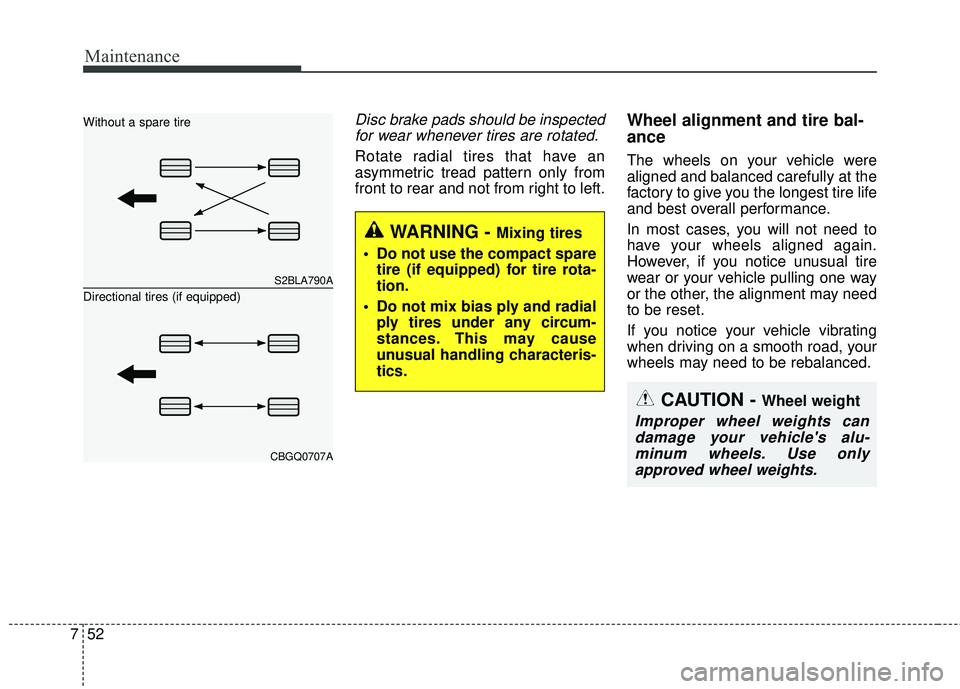
Rotate radial tires that have an
asymmetric tread pattern only from
front to rear and not from right to left.
Wheel alignment and tire bal-
ance
The wheels on your vehicle were
aligned and balanced carefully at the
factory to give you the longest tire life
and best overall performance.
In most cases, you will not need to
have your wheels aligned again.
However, if you notice unusual tire
wear or your vehicle pulling one way
or the other, the alignment may need
to be reset.
If you notice your vehicle vibrating
when driving on a smooth road, your
wheels may need to be rebalanced.
S2BLA790A
CBGQ0707A
Without a spare tire
Directional tires (if equipped)
WARNING - Mixing tires
Do not use the compact spare tire (if equipped) for tire rota-
tion.
Do not mix bias ply and radial ply tires under any circum-
stances. This may cause
unusual handling characteris-
tics.
CAUTION - Wheel weight
Improper wheel weights candamage your vehicle's alu-minum wheels. Use onlyapproved wheel weights.
Page 523 of 586
753
Maintenance
Tire replacement
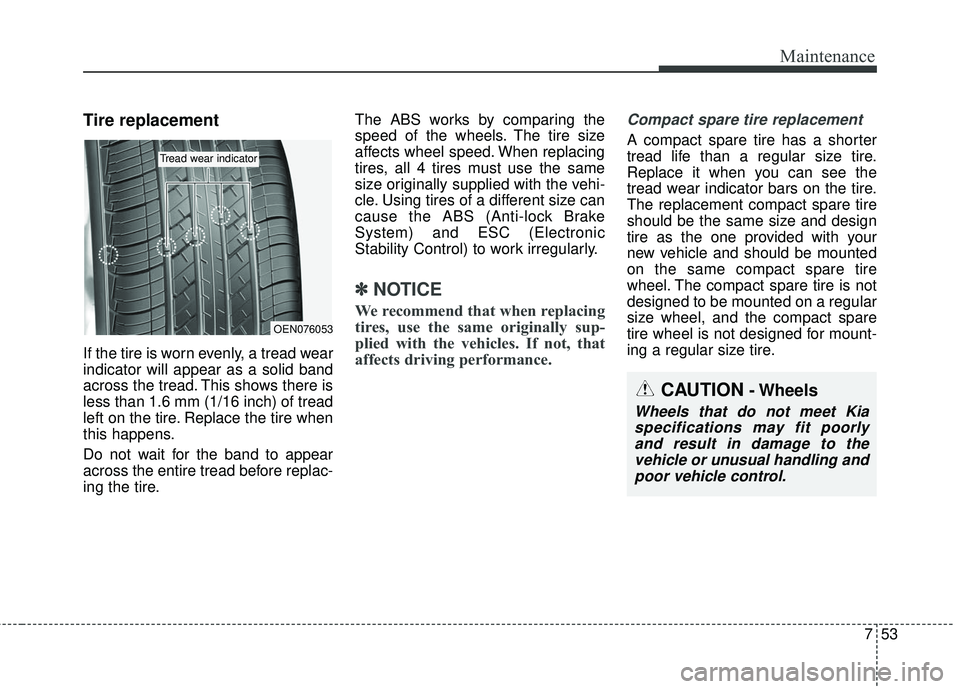
If the tire is worn evenly, a tread wear
indicator will appear as a solid band
across the tread. This shows there is
less than 1.6 mm (1/16 inch) of tread
left on the tire. Replace the tire when
this happens.
Do not wait for the band to appear
across the entire tread before replac-
ing the tire.The ABS works by comparing the
speed of the wheels. The tire size
affects wheel speed. When replacing
tires, all 4 tires must use the same
size originally supplied with the vehi-
cle. Using tires of a different size can
cause the ABS (Anti-lock Brake
System) and ESC (Electronic
Stability Control) to work irregularly.
✽ ✽
NOTICE
We recommend that when replacing
tires, use the same originally sup-
plied with the vehicles. If not, that
affects driving performance.
Compact spare tire replacement
A compact spare tire has a shorter
tread life than a regular size tire.
Replace it when you can see the
tread wear indicator bars on the tire.
The replacement compact spare tire
should be the same size and design
tire as the one provided with your
new vehicle and should be mounted
on the same compact spare tire
wheel. The compact spare tire is not
designed to be mounted on a regular
size wheel, and the compact spare
tire wheel is not designed for mount-
ing a regular size tire.
OEN076053
Tread wear indicator
CAUTION- Wheels
Wheels that do not meet Kia
specifications may fit poorlyand result in damage to thevehicle or unusual handling andpoor vehicle control.
Page 526 of 586
Maintenance
56
7
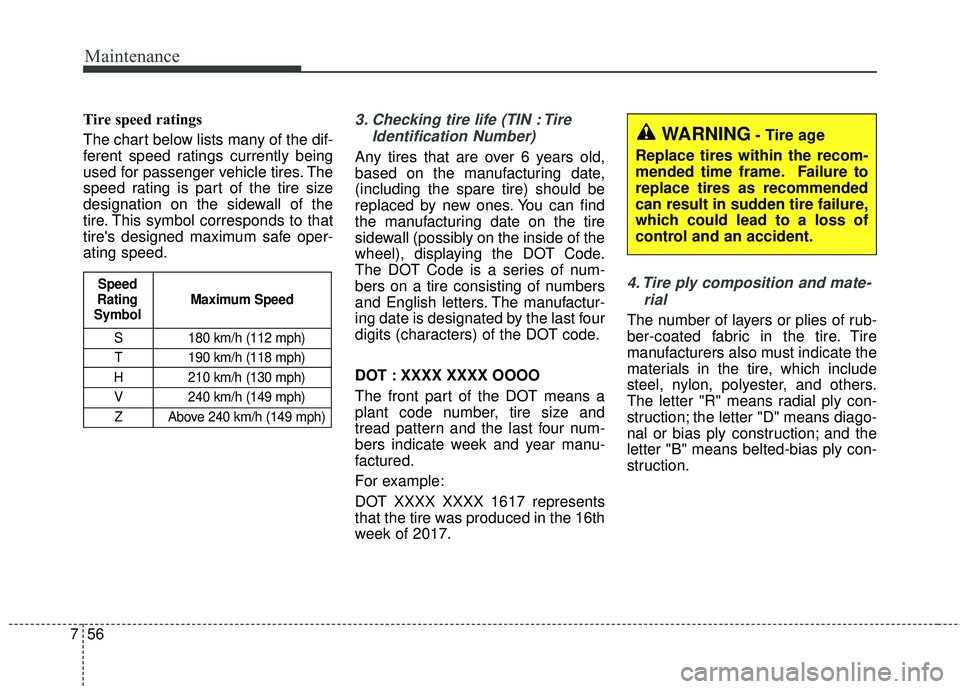
Tire speed ratings
The chart below lists many of the dif-
ferent speed ratings currently being
used for passenger vehicle tires. The
speed rating is part of the tire size
designation on the sidewall of the
tire. This symbol corresponds to that
tire's designed maximum safe oper-
ating speed.3. Checking tire life (TIN : Tire
Identification Number)
Any tires that are over 6 years old,
based on the manufacturing date,
(including the spare tire) should be
replaced by new ones. You can find
the manufacturing date on the tire
sidewall (possibly on the inside of the
wheel), displaying the DOT Code.
The DOT Code is a series of num-
bers on a tire consisting of numbers
and English letters. The manufactur-
ing date is designated by the last four
digits (characters) of the DOT code.
DOT : XXXX XXXX OOOO
The front part of the DOT means a
plant code number, tire size and
tread pattern and the last four num-
bers indicate week and year manu-
factured.
For example:
DOT XXXX XXXX 1617 represents
that the tire was produced in the 16th
week of 2017.
4. Tire ply composition and mate-rial
The number of layers or plies of rub-
ber-coated fabric in the tire. Tire
manufacturers also must indicate the
materials in the tire, which include
steel, nylon, polyester, and others.
The letter "R" means radial ply con-
struction; the letter "D" means diago-
nal or bias ply construction; and the
letter "B" means belted-bias ply con-
struction.
S 180 km/h (112 mph)
T 190 km/h (118 mph)
H 210 km/h (130 mph) V 240 km/h (149 mph)Z Above 240 km/h (149 mph)
Maximum Speed
Speed
Rating
Symbol
WARNING- Tire age
Replace tires within the recom-
mended time frame. Failure to
replace tires as recommended
can result in sudden tire failure,
which could lead to a loss of
control and an accident.
Page 571 of 586
![KIA SEDONA 2018 User Guide 48
TIRES AND WHEELS Specifications & Consumer information
ItemTire size Wheel sizee Inflation pressure [kPa (psi)]
Wheel lug nut torque
Normal load *1Maximum load
Front Rear Front Rear
Full size ti](/img/2/40452/w960_40452-570.png "KIA SEDONA 2018 User Guide 48
TIRES AND WHEELS Specifications & Consumer information
ItemTire size Wheel sizee Inflation pressure [kPa (psi)]
Wheel lug nut torque
Normal load *1Maximum load
Front Rear Front Rear
Full size ti")
48
TIRES AND WHEELS Specifications & Consumer information
ItemTire size Wheel sizee Inflation pressure [kPa (psi)]
Wheel lug nut torque
Normal load *1Maximum load
Front Rear Front Rear
Full size tire 235/65 R17 6.5J X 17 240 (35) 240 (35) 240 (35) 240 (35)
9 ~ 11
(65 ~ 79, 88 ~ 107)
235/60 R18 7.0J X 18 240 (35) 240 (35) 240 (35) 240 (35)
235/55 R19 7.5J X 19 240 (35) 240 (35) 240 (35) 240 (35)
Compact spare tire T135/90 R17 4.0T X 17 420 (60) 420 (60) 420 (60) 420 (60)
CAUTION
When replacing tires, use the same size originally supplied with the vehicle. Using tires of a different size can damage the related parts or make it work irregularly.
*1 : Normal load : Up to 3 persons
✽ ✽ NOTICE
• It is permissible to add 21 kPa (3 psi) to the standard tire pressure specification if colder temperatures are expect-
ed soon. Tires typically loose 7 kPa (1 psi) for every -11°C (12°F) temperature drop.
If extreme temperature variations are expected, re-check your tire pressure as necessary to keep them properly
inflated.
• We recommend that when replacing tires, use the same originally supplied with the vehicles. If not, that aff\
ects driving performance.
• When driving in high altitude grades, it is natural for the atmospheric pressure to decrease. Therefore, please check the tire pressure and add more air when necessary.
Additionally required tire air pressure per km above sea level: 10.5 kPa (1.5 psi)/km