engine coolant KIA SEDONA 2020 Owner's Manual
[x] Cancel search | Manufacturer: KIA, Model Year: 2020, Model line: SEDONA, Model: KIA SEDONA 2020Pages: 604, PDF Size: 16.24 MB
Page 507 of 604
Maintenance
24
7
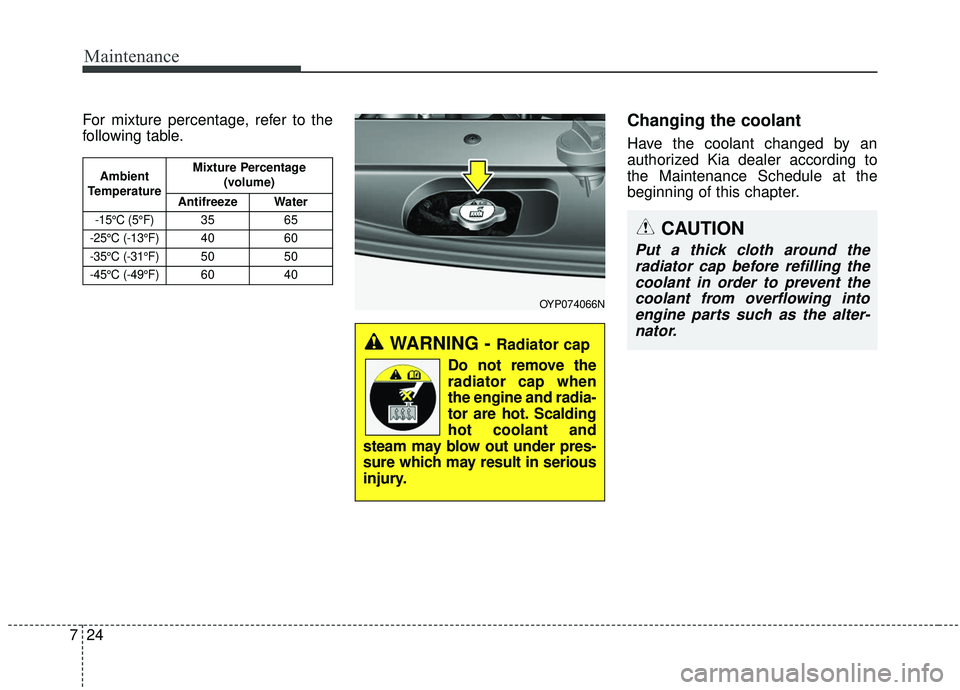
For mixture percentage, refer to the
following table.Changing the coolant
Have the coolant changed by an
authorized Kia dealer according to
the Maintenance Schedule at the
beginning of this chapter.
OYP074066N
Ambient
Temperature Mixture Percentage
(volume)
Antifreeze Water
-15°C (5°F)35 65
-25°C (-13°F)4060
-35°C (-31°F)5050
-45°C (-49°F)6040
WARNING - Radiator cap
Do not remove the
radiator cap when
the engine and radia-
tor are hot. Scalding
hot coolant and
steam may blow out under pres-
sure which may result in serious
injury.
CAUTION
Put a thick cloth around the radiator cap before refilling thecoolant in order to prevent thecoolant from overflowing intoengine parts such as the alter-nator.
Page 582 of 604
799
Maintenance
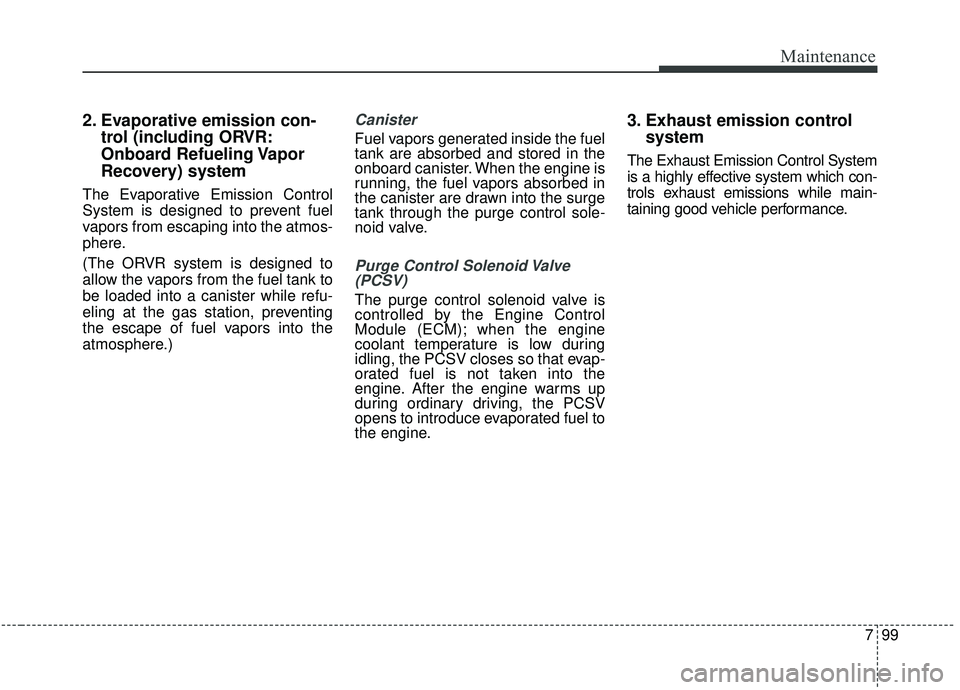
2. Evaporative emission con-trol (including ORVR:
Onboard Refueling Vapor
Recovery) system
The Evaporative Emission Control
System is designed to prevent fuel
vapors from escaping into the atmos-
phere.
(The ORVR system is designed to
allow the vapors from the fuel tank to
be loaded into a canister while refu-
eling at the gas station, preventing
the escape of fuel vapors into the
atmosphere.)
Canister
Fuel vapors generated inside the fuel
tank are absorbed and stored in the
onboard canister. When the engine is
running, the fuel vapors absorbed in
the canister are drawn into the surge
tank through the purge control sole-
noid valve.
Purge Control Solenoid Valve(PCSV)
The purge control solenoid valve is
controlled by the Engine Control
Module (ECM); when the engine
coolant temperature is low during
idling, the PCSV closes so that evap-
orated fuel is not taken into the
engine. After the engine warms up
during ordinary driving, the PCSV
opens to introduce evaporated fuel to
the engine.
3. Exhaust emission control
system
The Exhaust Emission Control System
is a highly effective system which con-
trols exhaust emissions while main-
taining good vehicle performance.
Page 590 of 604
68
Specifications & Consumer information
RECOMMENDED LUBRICANTS AND CAPACITIES
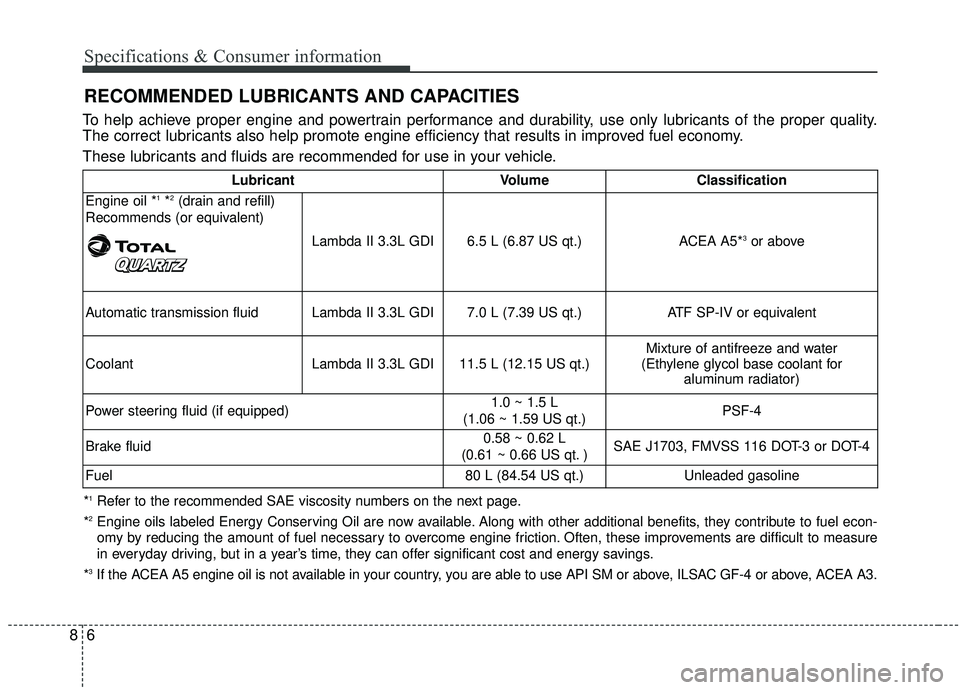
To help achieve proper engine and powertrain performance and durability, use only lubricants of the proper quality.
The correct lubricants also help promote engine efficiency that results in improved fuel economy.
These lubricants and fluids are recommended for use in your vehicle.
*1Refer to the recommended SAE viscosity numbers on the next page.
*
2Engine oils labeled Energy Conserving Oil are now available. Along with other additional benefits, they contribute to fuel econ-
omy by reducing the amount of fuel necessary to overcome engine friction. Often, these improvements are difficult to measure
in everyday driving, but in a year’s time, they can offer significant cost and energy savings.
*
3If the ACEA A5 engine oil is not available in your country, you are able to use API SM or above, ILSAC GF-4 or above, ACEA A3. Lubricant Volume Classification
Engine oil *
1*2(drain and refill)
Recommends (or equivalent)
Lambda II 3.3L GDI 6.5 L (6.87 US qt.) ACEA A5*
3or above
Automatic transmission fluid Lambda II 3.3L GDI 7.0 L (7.39 US qt.) ATF SP-IV or equivalent
Coolant Lambda II 3.3L GDI 11.5 L (12.15 US qt.) Mixture of antifreeze and water
(Ethylene glycol base coolant for aluminum radiator)
Power steering fluid (if equipped) 1.0 ~ 1.5 L
(1.06 ~ 1.59 US qt.) PSF-4
Brake fluid 0.58 ~ 0.62 L
(0.61 ~ 0.66 US qt. ) SAE J1703, FMVSS 116 DOT-3 or DOT-4
Fuel 80 L (84.54 US qt.)Unleaded gasoline
Page 597 of 604
Index
4I
Driver Attention Warning (DAW) system ....................5-94Resetting the system ..................................................5-96
System malfunction ....................................................5-96
System setting and activation ....................................5-94
System standby ..........................................................5-96
Economical operation ..................................................5-103
Emergency starting ..........................................................6-5 Jump starting ................................................................6-5
Push-starting ................................................................6-7
Emission control system ................................................7-98 Crankcase emission control system ............................7-98
Evaporative emission control (including ORVR: Onboard Refueling Vapor Recovery) system ..........7-99
Exhaust emission control system ................................7-99
Engine ........................................................................\
......8-2
Engine compartment ................................................2-6, 7-4
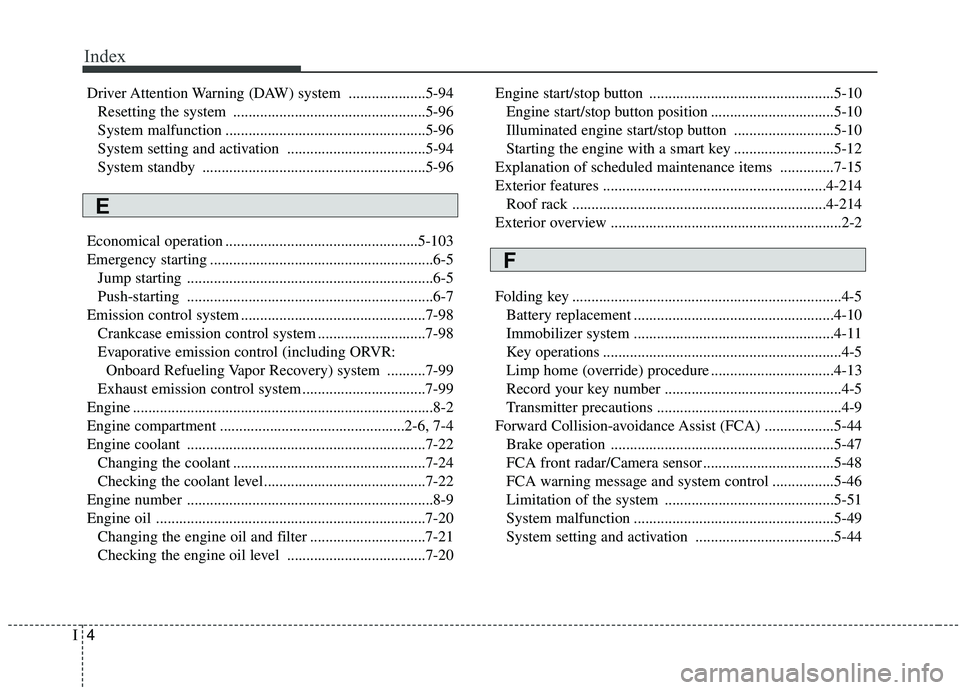
Engine coolant ..............................................................7-22 Changing the coolant ..................................................7-24
Checking the coolant level..........................................7-22
Engine number ................................................................8-9
Engine oil ......................................................................7-\
20 Changing the engine oil and filter ..............................7-21
Checking the engine oil level ....................................7-20 Engine start/stop button ................................................5-10
Engine start/stop button position ................................5-10
Illuminated engine start/stop button ..........................5-10
Starting the engine with a smart key ..........................5-12
Explanation of scheduled maintenance items ..............7-15
Exterior features ..........................................................4-214 Roof rack ..................................................................4-214
Exterior overview ............................................................2-2
Folding key ......................................................................4-\
5 Battery replacement ....................................................4-10
Immobilizer system ....................................................4-11
Key operations ..............................................................4-5
Limp home (override) procedure ................................4-13
Record your key number ..............................................4-5
Transmitter precautions ................................................4-9
Forward Collision-avoidance Assist (FCA) ..................5-44 Brake operation ..........................................................5-47
FCA front radar/Camera sensor ..................................5-48
FCA warning message and system control ................5-46
Limitation of the system ............................................5-51
System malfunction ....................................................5-49
System setting and activation ....................................5-44
E
F