air condition KIA SEDONA 2020 Owners Manual
[x] Cancel search | Manufacturer: KIA, Model Year: 2020, Model line: SEDONA, Model: KIA SEDONA 2020Pages: 604, PDF Size: 16.24 MB
Page 10 of 604
17
Introduction
This vehicle is equipped with an
event data recorder (EDR). The
main purpose of an EDR is to
record, in certain crash or near
crash-like situations, such as an
air bag deployment or hitting a
road obstacle, data that will assist
in understanding how a vehicle's
systems performed. The EDR is
designed to record data related to
vehicle dynamics and safety sys-
tems for a short period of time,
typically 30 seconds or less. The
EDR in this vehicle is designed to
record such data as:
How various systems in yourvehicle were operating;
Whether or not the driver and passenger safety belts were
buckled/fastened;
How far (if at all) the driver was depressing the accelerator
and/or brake pedal; and,
How fast the vehicle was travel- ing. These data can help provide a bet-
ter understanding of the circum-
stances in which crashes and
injuries occur. NOTE: EDR data
are recorded by your vehicle only
if a non-trivial crash situation
occurs; no data are recorded by
the EDR under normal driving
conditions and no personal data
(e.g., name, gender, age, and
crash location) are recorded.
However, other parties, such as
law enforcement, could combine
the EDR data with the type of per-
sonally identifying data routinely
acquired during a crash investiga-
tion.
To read data recorded by an EDR,
special equipment is required, and
access to the vehicle or the EDR is
needed. In addition to the vehicle
manufacturer, other parties, such
as law enforcement, that have the
special equipment, can read the
information if they have access to
the vehicle or the EDR.
VEHICLE DATA COLLECTION AND EVENT DATA RECORDERS
Page 86 of 604
Safety features of your vehicle
70
3
If any of the following conditions
occurs, this indicates a malfunction
in the air bag system. Have an
authorized Kia dealer inspect the air
bag system as soon as possible.
The light does not turn on briefly
when you turn the ignition ON.
The light stays on after illuminating for approximately 6 seconds.
The light comes on while the vehi- cle is in motion.
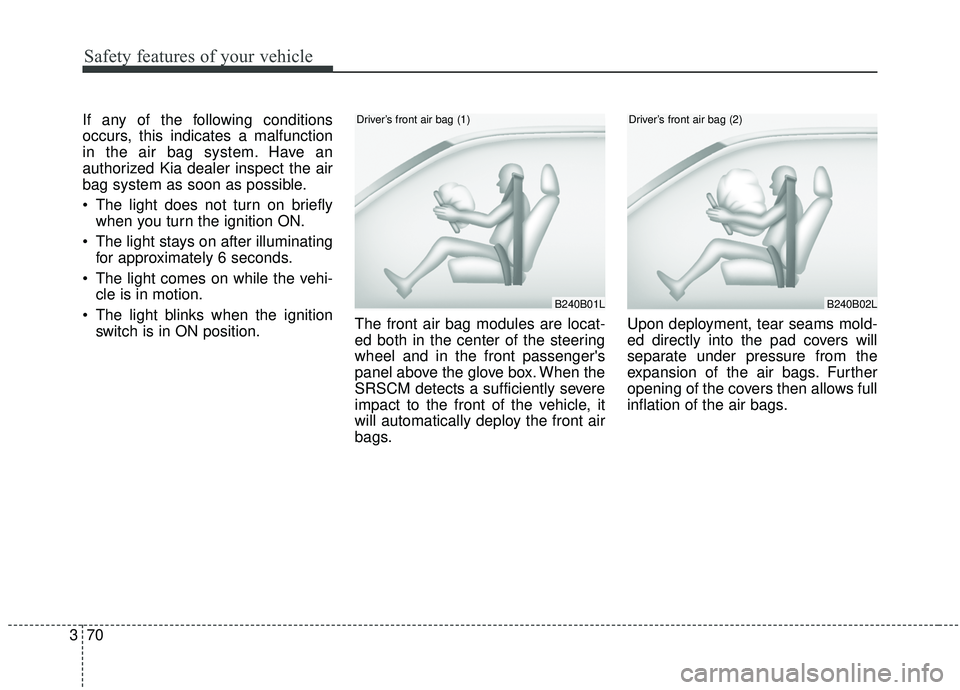
The light blinks when the ignition switch is in ON position. The front air bag modules are locat-
ed both in the center of the steering
wheel and in the front passenger's
panel above the glove box. When the
SRSCM detects a sufficiently severe
impact to the front of the vehicle, it
will automatically deploy the front air
bags. Upon deployment, tear seams mold-
ed directly into the pad covers will
separate under pressure from the
expansion of the air bags. Further
opening of the covers then allows full
inflation of the air bags.
B240B01L
Driver’s front air bag (1)
B240B02L
Driver’s front air bag (2)
Page 89 of 604
373
Safety features of your vehicle
The occupant detection system is
designed to detect the presence of a
properly-seated front passenger and
determine if the passenger's front air
bag should be enabled (may inflate)
or not. Only the front passenger front
air bag is controlled by the Occupant
Detection System.
Do not put anything in front of the
passenger air bag indicator.Main components of the occu-pant detection system
A detection device located within the front passenger seat cushion.
An electronic system which deter- mines whether the passenger air
bag systems should be activated
or deactivated.
A indicator light located on the instrument panel which illuminates
the words PASSENGER AIR BAG
“OFF” indicating the front passen-
ger air bag system is deactivated.
The instrument panel air bag warn- ing light is interconnected with the
occupant detection system. If the front passenger seat is occu-
pied by a person that the system
determines to be of appropriate size,
and he/she sits properly (sitting
upright with the seatback in an
upright position, centered on the
seat cushion with their seat belt on,
legs comfortably extended and their
feet on the floor), the PASSENGER
AIR BAG “OFF” indicator will turn off
and the front passenger's air bag will
be able to inflate, if necessary, in
frontal crashes.
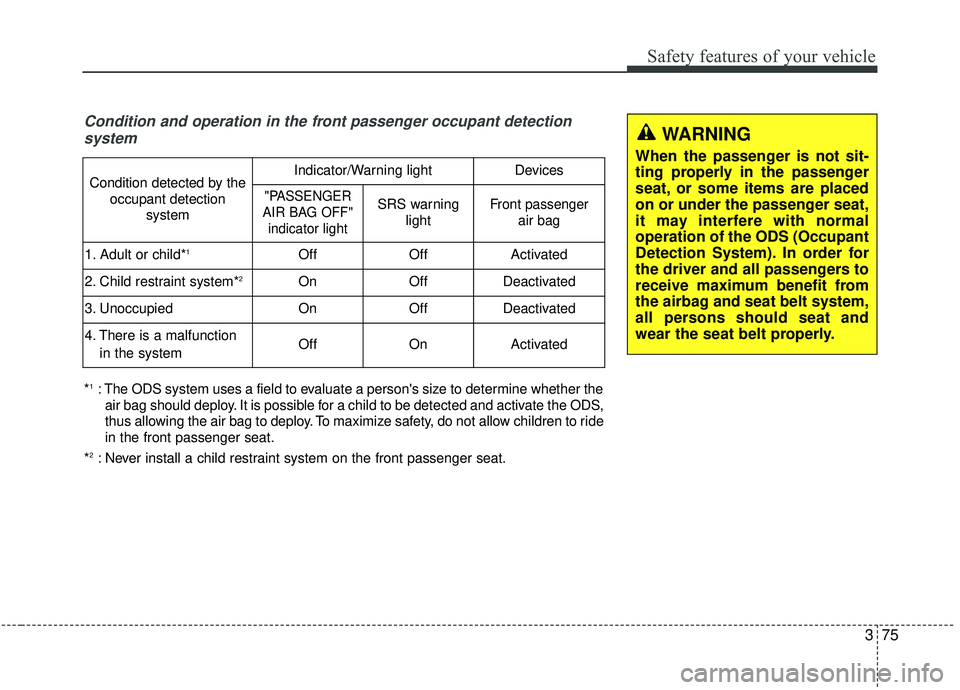
You will find the PASSENGER AIR
BAG “OFF” indicator on the center
facia panel. This system detects the
conditions 1~4 in the following table
and activates or deactivates the front
passenger air bag based on these
conditions.
Page 91 of 604
375
Safety features of your vehicle
Condition and operation in the front passenger occupant detectionsystem
*1: The ODS system uses a field to evaluate a person's size to determine whether the
air bag should deploy. It is possible for a child to be detected and activate the ODS,
thus allowing the air bag to deploy. To maximize safety, do not allow children to ride
in the front passenger seat.
*
2: Never install a child restraint system on the front passenger seat.
Condition detected by the occupant detection systemIndicator/Warning lightDevices
"PASSENGER
AIR BAG OFF" indicator lightSRS warning lightFront passenger air bag
1. Adult or child*1OffOffActivated
2. Child restraint system*2OnOffDeactivated
3. Unoccupied OnOffDeactivated
4. There is a malfunction
in the systemOffOnActivated
WARNING
When the passenger is not sit-
ting properly in the passenger
seat, or some items are placed
on or under the passenger seat,
it may interfere with normal
operation of the ODS (Occupant
Detection System). In order for
the driver and all passengers to
receive maximum benefit from
the airbag and seat belt system,
all persons should seat and
wear the seat belt properly.
Page 97 of 604
381
Safety features of your vehicle
The SRS consists of air bags
installed under the pad covers in the
center of the steering wheel and the
passenger's side front panel above
the glove box.
The purpose of the SRS is to provide
the vehicle's driver and/or the front
passenger with additional protection
than that offered by the seat belt sys-
tem alone in case of a frontal impact
of sufficient severity. The SRS uses
sensors to gather information about
the driver's and front passenger's
seat belt usage and impact severity.
The seat belt buckle sensors deter-
mine if the driver and front passen-
ger's seat belts are fastened.These sensors provide the ability to
control the SRS deployment based on
whether or not the seat belts are fas-
tened, and how severe the impact is.
The advanced SRS offers the ability
to control the air bag inflation with
two levels. A first stage level is pro-
vided for moderate-severity impacts.
A second stage level is provided for
more severe impacts.
The passenger’s front air bag is
designed to help reduce the injury of
children sitting close to the instru-
ment panel in low speed collisions.
However, children are safer if they
are restrained in the rear seat.
According to the impact severity and
seat belt usage, the SRSCM (SRS
Control Module) controls the air bag
inflation. Failure to properly wear
seat belts can increase the risk or
severity of injury in an accident.Additionally, your vehicle is equipped
with an occupant detection system in
the front passenger's seat. The occu-
pant detection system detects the
presence of a passenger in the front
passenger's seat and will turn off the
front passenger's air bag under cer-
tain conditions. For more detail, see
"Occupant detection system" in this
chapter.
WARNING
Modification to the seat struc-
ture can cause the air bag to
deploy at a different level than
should be provided.
Page 103 of 604
387
Safety features of your vehicle
Why didn’t my air bag go off in a
collision? (Inflation and non-infla-
tion conditions of the air bag)
There are many types of accidents
in which the air bag would not be
expected to provide additional
protection.
These include rear impacts, sec-
ond or third collisions in multiple
impact accidents, as well as low
speed impacts.Air bag collision sensors
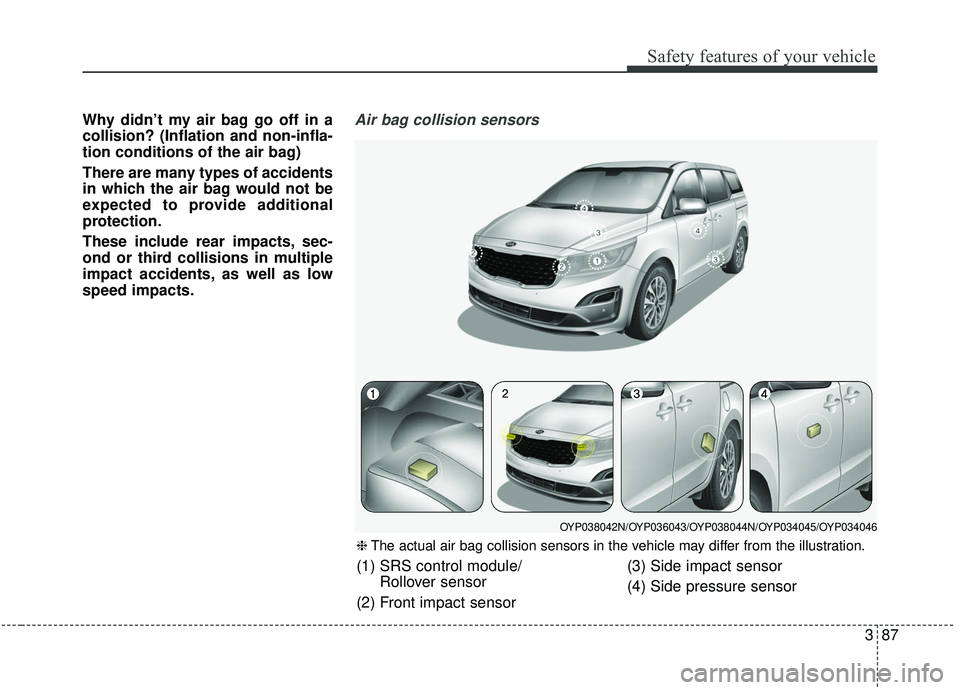
(1) SRS control module/Rollover sensor
(2) Front impact sensor (3) Side impact sensor
(4) Side pressure sensor
❈
The actual air bag collision sensors in the vehicle may differ from the illustration.
OYP038042N/OYP036043/OYP038044N/OYP034045/OYP034046
Page 104 of 604
Safety features of your vehicle
88
3
Problems may arise if the sensor
installation angles are changed due
to the deformation of the front
bumper, front end module, body or
front doors and/or B pillar where side
collision sensors are installed. Have
the vehicle checked and repaired by
an authorized Kia dealer.
Installing bumper guards (or side
step or running board) or replacing a
bumper (or front door module) with
non-genuine parts may adversely
affect your vehicle’s collision and air
bag deployment performance.Air bag inflation conditions
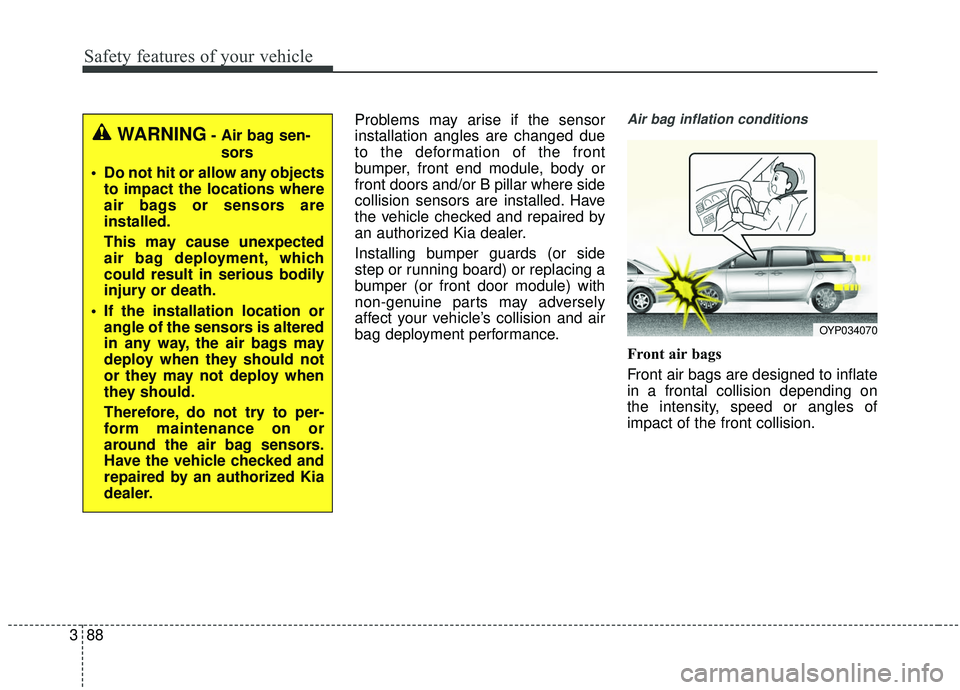
Front air bags
Front air bags are designed to inflate
in a frontal collision depending on
the intensity, speed or angles of
impact of the front collision.
OYP034070
WARNING- Air bag sen-
sors
Do not hit or allow any objects to impact the locations where
air bags or sensors are
installed.
This may cause unexpected
air bag deployment, which
could result in serious bodily
injury or death.
If the installation location or angle of the sensors is altered
in any way, the air bags may
deploy when they should not
or they may not deploy when
they should.
Therefore, do not try to per-
form maintenance on or
around the air bag sensors.
Have the vehicle checked and
repaired by an authorized Kia
dealer.
Page 106 of 604
Safety features of your vehicle
90
3
Air bag non-inflation conditions
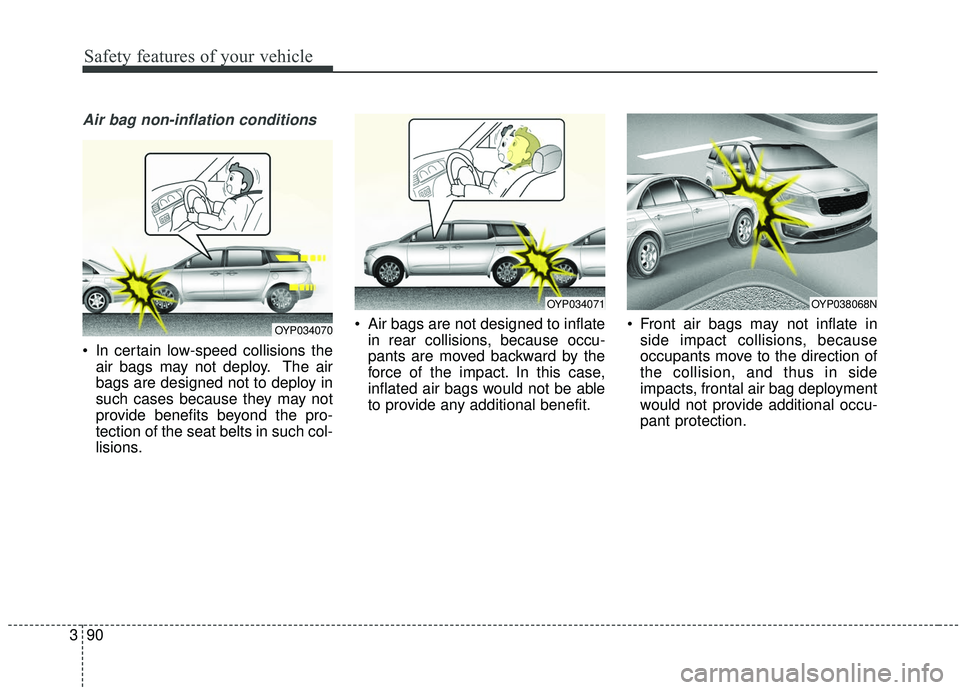
In certain low-speed collisions the
air bags may not deploy. The air
bags are designed not to deploy in
such cases because they may not
provide benefits beyond the pro-
tection of the seat belts in such col-
lisions. Air bags are not designed to inflate
in rear collisions, because occu-
pants are moved backward by the
force of the impact. In this case,
inflated air bags would not be able
to provide any additional benefit. Front air bags may not inflate in
side impact collisions, because
occupants move to the direction of
the collision, and thus in side
impacts, frontal air bag deployment
would not provide additional occu-
pant protection.
OYP034071OYP038068N
OYP034070
Page 112 of 604
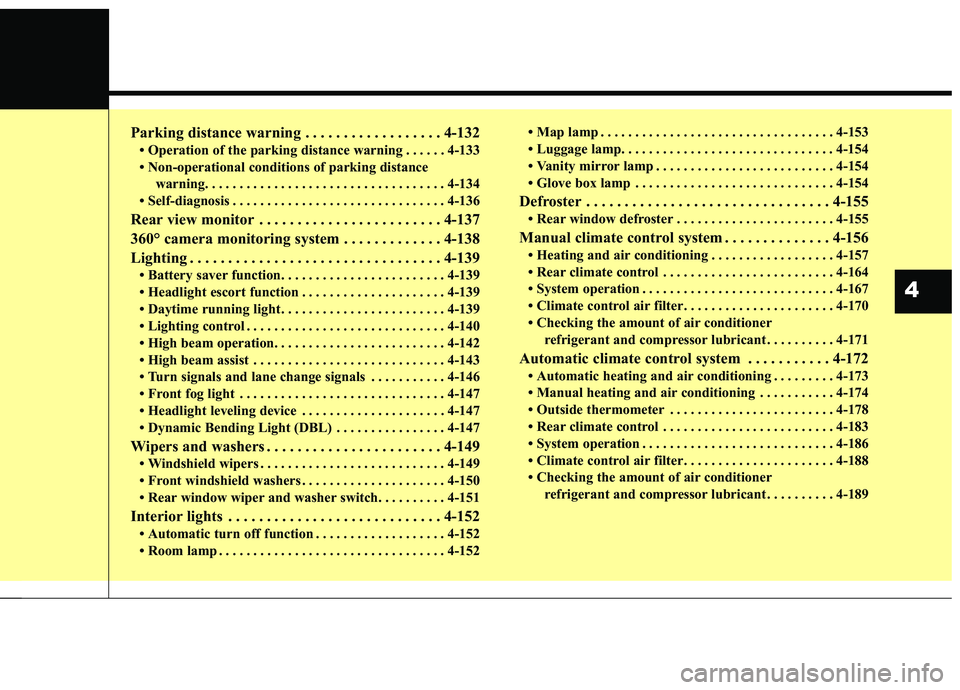
Parking distance warning . . . . . . . . . . . . . . . . . . 4-132
• Operation of the parking distance warning . . . . . . 4-133
• Non-operational conditions of parking distance warning. . . . . . . . . . . . . . . . . . . . . . . . . . . . . . . . . . . 4-\
134
• Self-diagnosis . . . . . . . . . . . . . . . . . . . . . . . . . . . . . . . 4-136
Rear view monitor . . . . . . . . . . . . . . . . . . . . . . . . 4-137
360° camera monitoring system . . . . . . . . . . . . . 4-138
Lighting . . . . . . . . . . . . . . . . . . . . . . . . . . . . . . . . . 4-139
• Battery saver function. . . . . . . . . . . . . . . . . . . . . . . . 4-139
• Headlight escort function . . . . . . . . . . . . . . . . . . . . . 4-139
• Daytime running light . . . . . . . . . . . . . . . . . . . . . . . . 4-139
• Lighting control . . . . . . . . . . . . . . . . . . . . . . . . . . . . . 4-140
• High beam operation. . . . . . . . . . . . . . . . . . . . . . . . . 4-142
• High beam assist . . . . . . . . . . . . . . . . . . . . . . . . . . . . 4-143
• Turn signals and lane change signals . . . . . . . . . . . 4-146
• Front fog light . . . . . . . . . . . . . . . . . . . . . . . . . . . . . . 4-147
• Headlight leveling device . . . . . . . . . . . . . . . . . . . . . 4-147
• Dynamic Bending Light (DBL) . . . . . . . . . . . . . . . . 4-147
Wipers and washers . . . . . . . . . . . . . . . . . . . . . . . 4-149
• Windshield wipers . . . . . . . . . . . . . . . . . . . . . . . . . . . 4-149
• Front windshield washers . . . . . . . . . . . . . . . . . . . . . 4-150
• Rear window wiper and washer switch. . . . . . . . . . 4-151
Interior lights . . . . . . . . . . . . . . . . . . . . . . . . . . . . 4-152
• Automatic turn off function . . . . . . . . . . . . . . . . . . . 4-152
• Room lamp . . . . . . . . . . . . . . . . . . . . . . . . . . . . . . . . . 4-152 • Map lamp . . . . . . . . . . . . . . . . . . . . . . . . . . . . . . . . . . 4-15\
3
• Luggage lamp. . . . . . . . . . . . . . . . . . . . . . . . . . . . . . . 4-154
• Vanity mirror lamp . . . . . . . . . . . . . . . . . . . . . . . . . . 4-154
• Glove box lamp . . . . . . . . . . . . . . . . . . . . . . . . . . . . . 4-154
Defroster . . . . . . . . . . . . . . . . . . . . . . . . . . . . . . . . 4-155
• Rear window defroster . . . . . . . . . . . . . . . . . . . . . . . 4-155
Manual climate control system . . . . . . . . . . . . . . 4-156
• Heating and air conditioning . . . . . . . . . . . . . . . . . . 4-157
• Rear climate control . . . . . . . . . . . . . . . . . . . . . . . . . 4-164
• System operation . . . . . . . . . . . . . . . . . . . . . . . . . . . . 4-167
• Climate control air filter . . . . . . . . . . . . . . . . . . . . . . 4-170
• Checking the amount of air conditioner
refrigerant and compressor lubricant . . . . . . . . . . 4-171
Automatic climate control system . . . . . . . . . . . 4-172
• Automatic heating and air conditioning . . . . . . . . . 4-173
• Manual heating and air conditioning . . . . . . . . . . . 4-174
• Outside thermometer . . . . . . . . . . . . . . . . . . . . . . . . 4-178
• Rear climate control . . . . . . . . . . . . . . . . . . . . . . . . . 4-183
• System operation . . . . . . . . . . . . . . . . . . . . . . . . . . . . 4-186
• Climate control air filter . . . . . . . . . . . . . . . . . . . . . . 4-188
• Checking the amount of air conditionerrefrigerant and compressor lubricant . . . . . . . . . . 4-189
4
Page 145 of 604
Features of your vehicle
36
4
✽ ✽
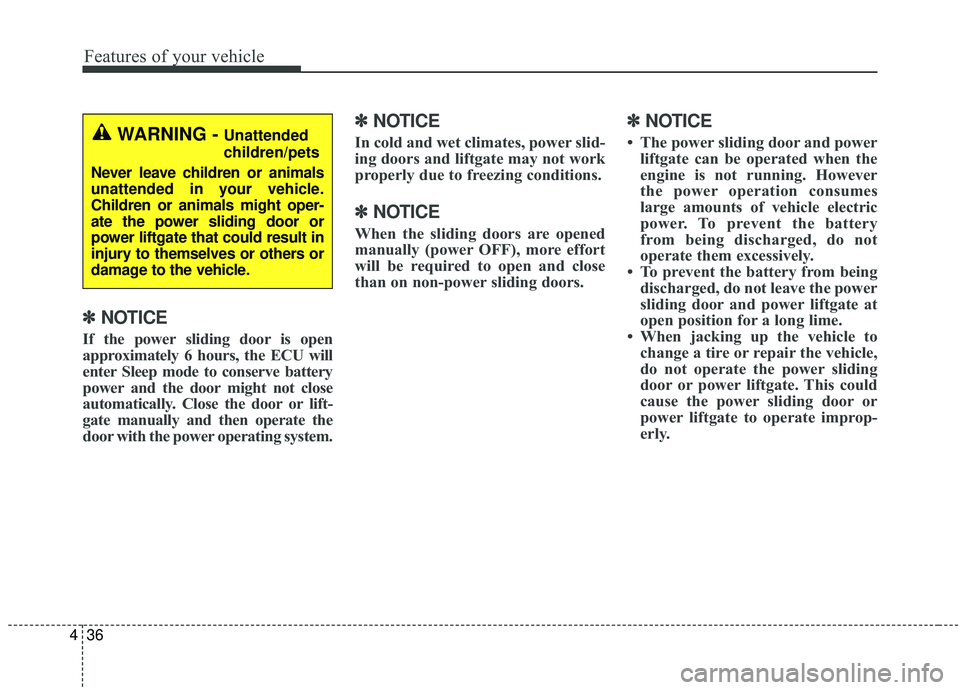
NOTICE
If the power sliding door is open
approximately 6 hours, the ECU will
enter Sleep mode to conserve battery
power and the door might not close
automatically. Close the door or lift-
gate manually and then operate the
door with the power operating system.
✽ ✽NOTICE
In cold and wet climates, power slid-
ing doors and liftgate may not work
properly due to freezing conditions.
✽ ✽NOTICE
When the sliding doors are opened
manually (power OFF), more effort
will be required to open and close
than on non-power sliding doors.
✽ ✽NOTICE
• The power sliding door and power
liftgate can be operated when the
engine is not running. However
the power operation consumes
large amounts of vehicle electric
power. To prevent the battery
from being discharged, do not
operate them excessively.
• To prevent the battery from being discharged, do not leave the power
sliding door and power liftgate at
open position for a long lime.
• When jacking up the vehicle to change a tire or repair the vehicle,
do not operate the power sliding
door or power liftgate. This could
cause the power sliding door or
power liftgate to operate improp-
erly.WARNING - Unattended
children/pets
Never leave children or animals
unattended in your vehicle.
Children or animals might oper-
ate the power sliding door or
power liftgate that could result in
injury to themselves or others or
damage to the vehicle.