mirror KIA Sephia 2006 2.G User Guide
[x] Cancel search | Manufacturer: KIA, Model Year: 2006, Model line: Sephia, Model: KIA Sephia 2006 2.GPages: 273, PDF Size: 2.83 MB
Page 110 of 273
399
1
2
3
4
5
6
7
8
9
Knowing your vehicle
✽ ✽NOTICEClose the vanity mirror cover
securely and return the sunvisor to
its original position after use. If the
vanity mirror is not closed securely,
the lamp will stay on and could
result in battery discharge and pos-
sible sunvisor damage.
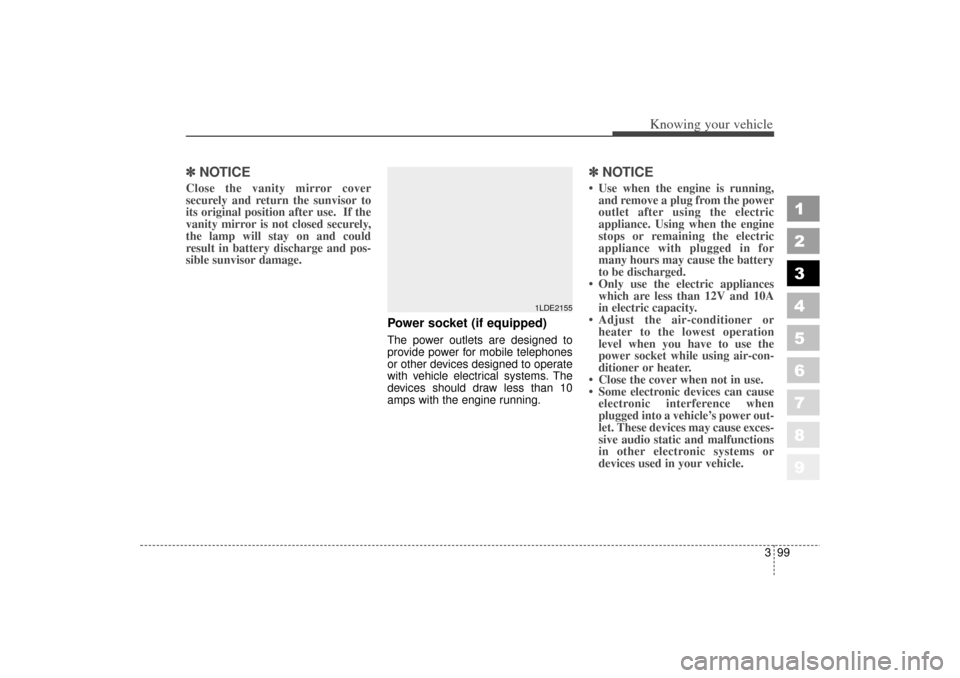
Power socket (if equipped)The power outlets are designed to
provide power for mobile telephones
or other devices designed to operate
with vehicle electrical systems. The
devices should draw less than 10
amps with the engine running.
✽ ✽NOTICE Use when the engine is running,
and remove a plug from the power
outlet after using the electric
appliance. Using when the engine
stops or remaining the electric
appliance with plugged in for
many hours may cause the battery
to be discharged.
Only use the electric appliances which are less than 12V and 10A
in electric capacity.
Adjust the air-conditioner or heater to the lowest operation
level when you have to use the
power socket while using air-con-
ditioner or heater.
Close the cover when not in use.
Some electronic devices can cause electronic interference when
plugged into a vehicle’s power out-
let. These devices may cause exces-
sive audio static and malfunctions
in other electronic systems or
devices used in your vehicle.
1LDE2155
LD CAN (ENG) 3-84~.qxd 7/29/05 10:15 AM Page 99
Page 164 of 273

447
1
2
3
4
5
6
7
8
9
Driving your vehicle
The defroster heats the window to
remove frost, fog and thin ice from
the interior and exterior of the rear
window, while engine is running.
✽ ✽NOTICE To prevent damage to the conduc-
tors bonded to the inside surface
of the rear window, never use
sharp instruments or window
cleaners containing abrasives to
clean the window.
To prevent the battery from being discharged, operate the defroster
only while the engine is running.
If you want to defrost and defog on the front windshield, refer to
“Windshield Defrosting and
Defogging” in this section.
To activate the rear window
defroster, press the rear window
defroster button located in the center
console switch panel. The indicator
in the instrument cluster illuminates
when the defroster is ON.
If your vehicle is equipped with the
outside mirror defroster, it will be
operating at the same time when you
operate the rear window defroster.
If there is heavy accumulation of
snow on the rear window, brush it off
before operating the rear defroster.
The rear window defroster automati-
cally turns off after 20 minutes or
when the ignition switch is turned off.
To turn off the defroster, press the
rear window defroster button again.
DEFROSTER
1LDN2116A1LDN2116
4 Door5 Door
LD CAN (ENG) 4.qxd 7/29/05 10:17 AM Page 47
Page 176 of 273
459
1
2
3
4
5
6
7
8
9
Driving your vehicle
For maximum defrosting, set the
temperature control to the extreme
right/hot position and the fan speed
control to the highest speed.
If warm air to the floor is desired
while defrosting or defogging, set
the mode to the floor- defrost posi-
tion.
Before driving, clear all snow and
ice from the windshield, rear win-
dow, outside rear view mirrors, and
all side windows.
Clear all snow and ice from the
hood and air inlet in the cowl grill to
improve heater and defroster effi-
ciency and to reduce the probabili-
ty of fogging up inside of the wind-
shield.
Defogging logicTo reduce the probability of fogging
up the inside of the windshield, the
air intake control is set to the outside
(fresh) air position automatically if
any of following occur:
The ignition switch is off.
The mode is selected to the OFF
position.
The ignition switch is turned on
while the mode is selected to the
, or .
The mode is selected to the ,
or while the system is acti-
vated.
Press the air intake control button to
select the recirculated air position
while the ignition switch is on.
LD CAN (ENG) 4.qxd 7/29/05 10:17 AM Page 59
Page 183 of 273
55
Driving tips
BEFORE DRIVING Before entering vehicle: Be sure that all windows, outsidemirror(s), and outside lights are
clean.
Check the condition of the tires.
Check under the vehicle for any sign of leaks.
Be sure there are no obstacles behind you if you intend to back up.Necessary inspections Fluid levels, such as engine oil,
engine coolant, brake fluid, and
washer fluid should be checked on a
regular basis, with the exact interval
depending on the fluid. Further
details are provided in Section 7,
Maintenance.
Before starting Close and lock all doors.
Position the seat so that all con-trols are easily reached.
Adjust the inside and outside rearview mirrors.
Be sure that all lights work.
Check all gauges.
Check the operation of warning lights when the ignition switch is
turned to the ON position.
Release the parking brake and make sure the brake warning light
goes out.
For safe operation, be sure you are
familiar with your vehicle and its
equipment.
1
2
3
4
5
6
7
8
9
WARNING
- Driving under
the influence of alcohol or
drugs
Drinking and driving is danger-
ous. Drunk driving is the num-
ber one contributor to the high-
way death toll each year. Even a
small amount of alcohol will
affect your reflexes, perceptions
and judgement.
You are much more likely to
have a serious accident if you
drink and drive.
If you are drinking or taking
drugs, don’t drive. Do not ride
with a driver who has been
drinking or taking drugs.
Choose a designated driver or
call a cab.
Driving while under the influ-
ence of drugs is as dangerous
or more dangerous than driving
drunk.
LD CAN (ENG) 5.qxd 7/29/05 10:18 AM Page 5
Page 186 of 273
Driving tips85
Driving at night Because night driving presents more
hazards than driving in the daylight,
here are some important tips to
remember:
Slow down and keep more dis-tance between you and other vehi-
cles, as it may be more difficult to
see at night, especially in areas
where there may not be any street
lights.
Adjust your mirrors to reduce the glare from other driver's head-
lights.
Keep your headlights clean and properly aimed on vehicles not
equipped with the automatic head-
light aiming feature. Dirty or
improperly aimed headlights will
make it much more difficult to see
at night.
Avoid staring directly at the head- lights of oncoming vehicles. You
could be temporarily blinded, and it
will take several seconds for your
eyes to readjust to the darkness.
Driving in the rain Rain and wet roads can make driving
dangerous, especially if you’re not
prepared for the slick pavement.
Here are a few things to consider
when driving in the rain:
A heavy rainfall will make it harderto see and will increase the dis-
tance needed to stop your vehicle,
so slow down.
Keep your windshield wiping equipment in good shape. Replace
your windshield wiper blades when
they show signs of streaking or
missing areas on the windshield.
If your tires are not in good condi- tion, making a quick stop on wet
pavement can cause a skid and
possibly lead to an accident. Be
sure your tires are in good shape.
Turn on your headlights to make it easier for others to see you.
1
2
3
4
5
6
7
8
9
WARNING
- Spinning tires
Do not spin the wheels, espe-
cially at speeds more than 56
km/h (35 mph). Spinning the
wheels at high speeds when the
vehicle is stationary could
cause a tire to overheat, explode
and injure bystanders.
LD CAN (ENG) 5.qxd 7/29/05 10:18 AM Page 8
Page 192 of 273
Driving tips14
5
1
2
3
4
5
6
7
8
9
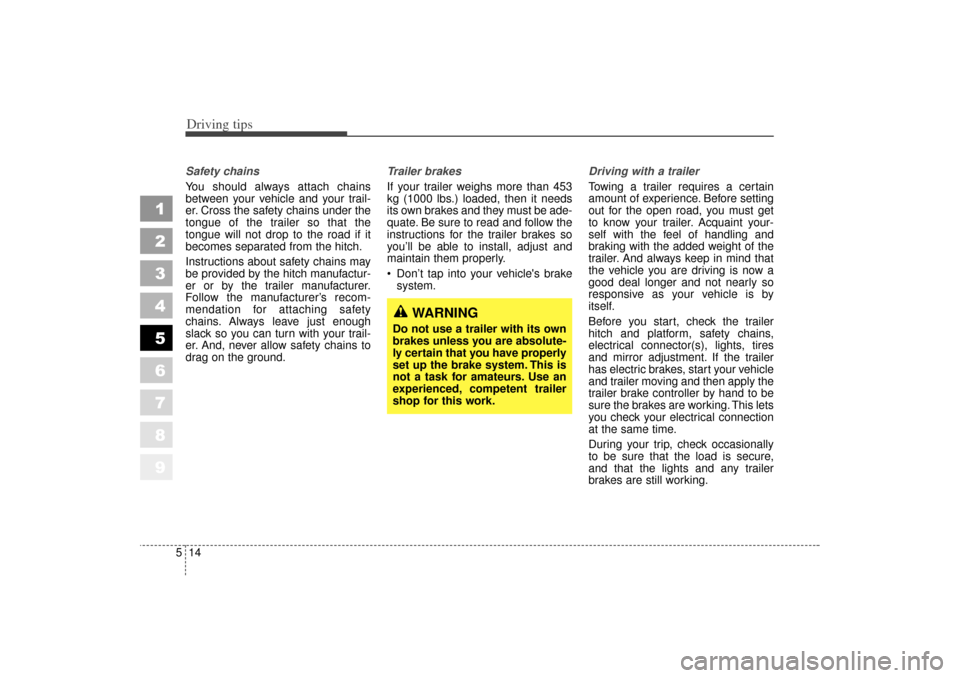
Safety chains
You should always attach chains
between your vehicle and your trail-
er. Cross the safety chains under the
tongue of the trailer so that the
tongue will not drop to the road if it
becomes separated from the hitch.
Instructions about safety chains may
be provided by the hitch manufactur-
er or by the trailer manufacturer.
Follow the manufacturer’s recom-
mendation for attaching safety
chains. Always leave just enough
slack so you can turn with your trail-
er. And, never allow safety chains to
drag on the ground. Trailer brakes
If your trailer weighs more than 453
kg (1000 lbs.) loaded, then it needs
its own brakes and they must be ade-
quate. Be sure to read and follow the
instructions for the trailer brakes so
you’ll be able to install, adjust and
maintain them properly.
Don’t tap into your vehicle's brake
system. Driving with a trailer
Towing a trailer requires a certain
amount of experience. Before setting
out for the open road, you must get
to know your trailer. Acquaint your-
self with the feel of handling and
braking with the added weight of the
trailer. And always keep in mind that
the vehicle you are driving is now a
good deal longer and not nearly so
responsive as your vehicle is by
itself.
Before you start, check the trailer
hitch and platform, safety chains,
electrical connector(s), lights, tires
and mirror adjustment. If the trailer
has electric brakes, start your vehicle
and trailer moving and then apply the
trailer brake controller by hand to be
sure the brakes are working. This lets
you check your electrical connection
at the same time.
During your trip, check occasionally
to be sure that the load is secure,
and that the lights and any trailer
brakes are still working.
WARNING
Do not use a trailer with its own
brakes unless you are absolute-
ly certain that you have properly
set up the brake system. This is
not a task for amateurs. Use an
experienced, competent trailer
shop for this work.
LD CAN (ENG) 5.qxd 7/29/05 10:18 AM Page 14
Page 209 of 273
611
In case of an emergency
1
2
3
4
5
6
7
8
9
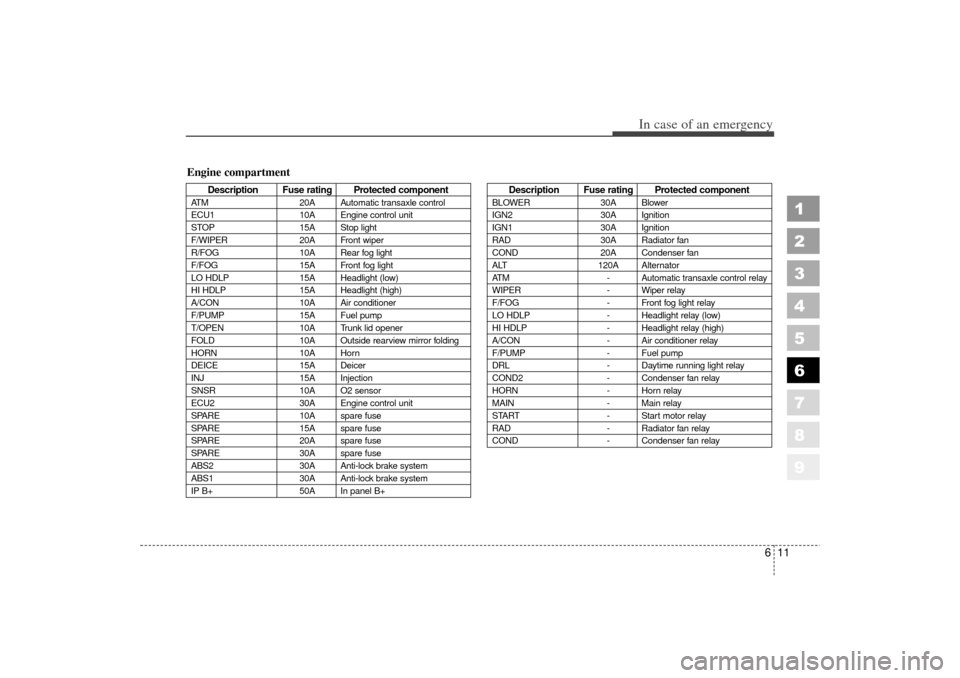
Description Fuse rating Protected component
ATM20A Automatic transaxle control
ECU1 10A Engine control unit
STOP 15A Stop light
F/WIPER 20A Front wiper
R/FOG 10A Rear fog light
F/FOG 15A Front fog light
LO HDLP 15A Headlight (low)
HI HDLP 15A Headlight (high)
A/CON 10A Air conditioner
F/PUMP 15A Fuel pump
T/OPEN 10A Trunk lid opener
FOLD 10A Outside rearview mirror folding
HORN 10A Horn
DEICE 15A Deicer
INJ 15A Injection
SNSR 10A O2 sensor
ECU2 30A Engine control unit
SPARE 10A spare fuse
SPARE 15A spare fuse
SPARE 20A spare fuse
SPARE 30A spare fuse
ABS2 30A Anti-lock brake system
ABS1 30A Anti-lock brake system
IP B+ 50A In panel B+
Description Fuse rating Protected component
BLOWER30A Blower
IGN2 30A Ignition
IGN1 30A Ignition
RAD 30A Radiator fan
COND 20A Condenser fan
ALT 120A Alternator
ATM - Automatic transaxle control relay
WIPER - Wiper relay
F/FOG - Front fog light relay
LO HDLP - Headlight relay (low)
HI HDLP - Headlight relay (high)
A/CON - Air conditioner relay
F/PUMP - Fuel pump
DRL - Daytime running light relay
COND2 - Condenser fan relay
HORN - Horn relay
MAIN - Main relay
START - Start motor relay
RAD - Radiator fan relay
COND - Condenser fan relay
Engine compartment
LD CAN (ENG) 6.qxd 7/29/05 10:20 AM Page 11
Page 210 of 273
In case of an emergency12
6
1
2
3
4
5
6
7
8
9
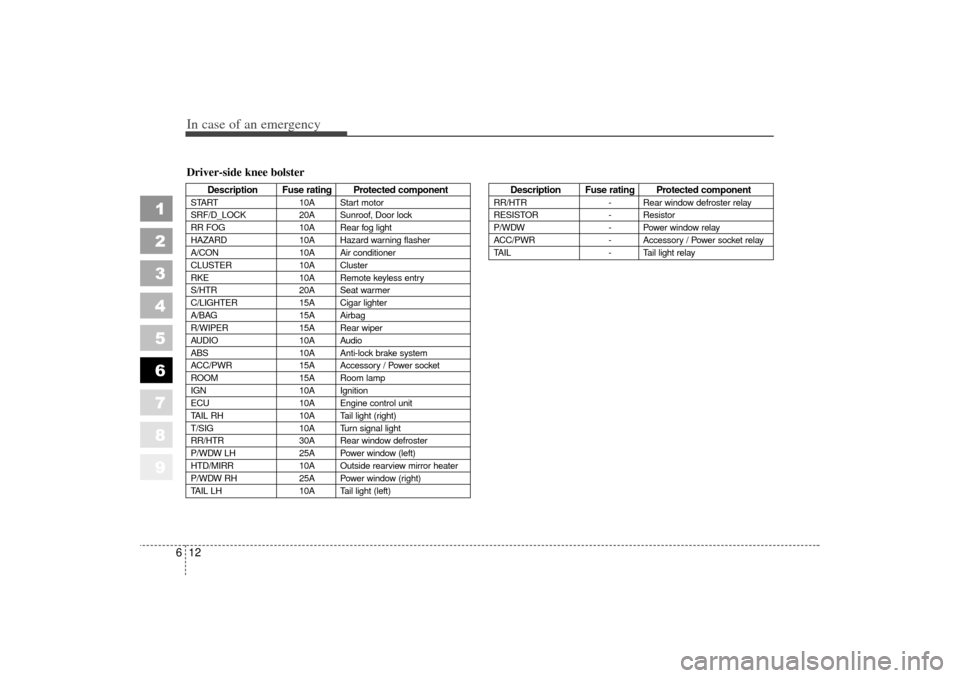
Driver-side knee bolster
Description Fuse rating Protected component
START 10A Start motor
SRF/D_LOCK 20A Sunroof, Door lock
RR FOG 10A Rear fog light
HAZARD 10A Hazard warning flasher
A/CON 10A Air conditioner
CLUSTER 10A Cluster
RKE 10A Remote keyless entry
S/HTR 20A Seat warmer
C/LIGHTER 15A Cigar lighter
A/BAG 15A Airbag
R/WIPER 15A Rear wiper
AUDIO 10A Audio
ABS 10A Anti-lock brake system
ACC/PWR 15A Accessory / Power socket
ROOM 15A Room lamp
IGN 10A Ignition
ECU 10A Engine control unit
TAIL RH 10A Tail light (right)
T/SIG 10A Turn signal light
RR/HTR 30A Rear window defroster
P/WDW LH 25A Power window (left)
HTD/MIRR 10A Outside rearview mirror heater
P/WDW RH 25A Power window (right)
TAIL LH 10A Tail light (left)
Description Fuse rating Protected component
RR/HTR - Rear window defroster relay
RESISTOR - Resistor
P/WDW - Power window relay
ACC/PWR - Accessory / Power socket relay
TAIL - Tail light relay
LD CAN (ENG) 6.qxd 7/29/05 10:20 AM Page 12
Page 272 of 273

93
1
2
3
4
5
6
7
8
9
Index
Label information . . . . . . . . . . . . . . . . . . . . . . . . . . . 5-19
Lighting. . . . . . . . . . . . . . . . . . . . . . . . . . . . . . . . . . . 4-\
40
Lubricant specifications . . . . . . . . . . . . . . . . . . . . . . . 7-37
Lubricants and fluids . . . . . . . . . . . . . . . . . . . . . . . . . 7-22
Luggage net . . . . . . . . . . . . . . . . . . . . . . . . . . . . . . . 3-104
Maintenance schedule . . . . . . . . . . . . . . . . . . . . . . . . . 7-4
Maintenance services. . . . . . . . . . . . . . . . . . . . . . . . . . 7-3
Manual climate control system . . . . . . . . . . . . . . . . . 4-49
Manual transaxle . . . . . . . . . . . . . . . . . . . . . . . . . . . . . 4-5
Mirrors . . . . . . . . . . . . . . . . . . . . . . . . . . . . . . . . . . . 3-\
87
Overheating. . . . . . . . . . . . . . . . . . . . . . . . . . . . . . . . . 6-3
Overloading . . . . . . . . . . . . . . . . . . . . . . . . . . . . . . . . 5-18
Owner maintenance . . . . . . . . . . . . . . . . . . . . . . . . . . . 7-8
Parking brake . . . . . . . . . . . . . . . . . . . . . . . . . . . . . . 7-16
Power steering . . . . . . . . . . . . . . . . . . . . . . . . . . . . . . 7-18
Remote keyless entry . . . . . . . . . . . . . . . . . . . . . . . . . 3-4
Road warning . . . . . . . . . . . . . . . . . . . . . . . . . . . . . . . 6-2Safety belts . . . . . . . . . . . . . . . . . . . . . . . . . . . . . . . . 3-29
Seat . . . . . . . . . . . . . . . . . . . . . . . . . . . . . . . . . . . . \
. . 3-17
Special driving conditions . . . . . . . . . . . . . . . . . . . . . . 5-7
Specifications . . . . . . . . . . . . . . . . . . . . . . . . . . . . . . . 8-2
Starting the engine. . . . . . . . . . . . . . . . . . . . . . . . . . . . 4-4
Steering wheel . . . . . . . . . . . . . . . . . . . . . . . . . . . . . . 4-19
Steering wheel . . . . . . . . . . . . . . . . . . . . . . . . . . . . . . 7-19
Storage compartment . . . . . . . . . . . . . . . . . . . . . . . . . 3-93
Suggestions for economical operation . . . . . . . . . . . . . 5-6
Sunroof . . . . . . . . . . . . . . . . . . . . . . . . . . . . . . . . . . 3-10\
1
Theft-alarm system . . . . . . . . . . . . . . . . . . . . . . . . . . 4-60
Tires and wheels . . . . . . . . . . . . . . . . . . . . . . . . . . . . 7-30
Towing . . . . . . . . . . . . . . . . . . . . . . . . . . . . . . . . . . . 6-\
14
Traction control system . . . . . . . . . . . . . . . . . . . . . . . 4-27
Trailer towing . . . . . . . . . . . . . . . . . . . . . . . . . . . . . . 5-11
Trunk. . . . . . . . . . . . . . . . . . . . . . . . . . . . . . . . . . \
. . . 3-80KLMOP
RST
LD CAN (ENG) 9.qxd 7/29/05 10:24 AM Page 3