seats KIA Sephia 2008 2.G User Guide
[x] Cancel search | Manufacturer: KIA, Model Year: 2008, Model line: Sephia, Model: KIA Sephia 2008 2.GPages: 298, PDF Size: 5.38 MB
Page 59 of 298

349
1
2
3
4
5
6
7
8
9
Knowing your vehicle
ISOFIX anchors have been provided
in your vehicle. The ISOFIX anchors
are located in the left and right out-
board rear seating positions. Their
locations are shown in the illustra-
tion. There is no ISOFIX anchor pro-
vided for the center rear seating
position.
The ISOFIX anchors are located
between the seatback and the seat
cushion of the rear seat left and right
outboard seating positions. Follow
the child seat manufacturer’s instruc-
tions to properly install child restraint
seats with ISOFIX or ISOFIX-com-
patible attachments.Once you have installed the ISOFIX
child restraint, assure that the seat is
properly attached to the ISOFIX and
tether anchors. Also, test the child
restraint seat before you place the
child in it. Tilt the seat from side to
side. Also try to tug the seat forward.
Check to see if the anchors hold the
seat in place.
WARNING
If the child restraint is not
anchored properly, the risk of a
child being seriously injured or
killed in a collision greatly
increases.1LDN3100/SBGQ03102
WARNING
• Do not mount more than one
child restraint to a single teth-
er or to a child restraint lower
anchorage point. The improp-
er increased load may cause
the anchorage points or tether
anchor to break, causing seri-
ous injury or death.
(Continued)
(Continued)
• Do not install a child restraint
seat at the rear center seating
position using the vehicle’s
ISOFIX anchors. The ISOFIX
anchors are only provided for
the left and right outboard rear
seating positions. Do not mis-
use the ISOFIX anchors by
attempting to attach a child
restraint seat in the middle
rear seating position to the
ISOFIX anchors. In a crash,
the child restraint seat ISOFIX
attachments may not be
strong enough to secure the
child restraint seat improperly
in the rear center seating posi-
tion and may break, causing
serious injury or death.
• Attach the ISOFIX or ISOFIX-
compatible child restraint seat
only to the appropriate loca-
tions shown in the illustration.
•Always follow the installation
and use ins
tructions provided
by the manufacturer of the
child restraint.
Page 63 of 298
353
1
2
3
4
5
6
7
8
9
Knowing your vehicle
Air bag system components
The main components of your SRS
are:
• To indicate that your vehicle is
equipped with air bags, the corre-
sponding air bag covers are
marked with “SRS AIR BAG”.
- Driver’s air bag
- Passenger’s air bag
- Side air bag
- Curtain air bag
• A diagnostic system that continual-
ly monitors the system operation.
• An indicator light to warn you of a
possible problem with the system.
• Emergency power backup in case
your car’s electrical system is dis-
connected in a crash.The SRS uses a collection of sen-
sors to gather information about the
driver’s and front passenger’s seat
position, the driver’s and front pas-
senger’s safety belt usage and
impact severity.
The driver’s and front passenger’s
seat position sensors, which are
installed on the seat track, determine
if the seats are fore or aft of a refer-
ence position. Similarly, the safety
belt usage sensors determine if the
driver and front passenger’s safety
belts are fastened. These sensors
provide the ability to control the SRS
deployment based on how close the
driver’s seat is to the steering wheel,
how close the passenger’s seat is to
the instrument panel, whether or not
the safety belts are fastened, and
how severe is the impact.The advanced SRS offers the ability
to control the air bag inflation with
two levels. A first stage level is pro-
vided for moderate-severity impacts.
A second stage level is provided for
more severe impacts.
The SRSCM (SRS Control Module)
controls the air bag inflation in accor-
dance with impact severity, seating
position and safety belt usage.
Additionally, your SRS is equipped
with an occupant classification sys-
tem in the front passenger’s seat.
The occupant classification system
detects the presence of a passenger
in the front passenger’s seat and will
turn off the front passenger’s air bag
under certain conditions. For more
detail, see “Occupant Classification
System” later in this section.
Page 64 of 298
Knowing your vehicle
54 3
1
2
3
4
5
6
7
8
9
CAUTION
If the seat position sensor is not
working properly, the SRS air
bag warning light ( ) on the
instrument panel will illuminate
even if there is no malfunction
of the SRS air bag system,
because the SRS air bag warn-
ing light is connected with the
seat position sensor. If the SRS
air bag warning light does not
illuminate when the ignition key
is turned to the "ON" position, if
it remains illuminated after
blinking for approximately 6
seconds, or if it illuminates
while the vehicle is being driv-
en, have an authorized Kia deal-
er inspect the seat position sen-
sor and the advanced SRS air
bag system as soon as possi-
ble.
WARNING
• Modification to the seat struc-
ture can adversely affect the
seat position sensor and
cause the air bag to deploy at
a different level than should
be provided.
• Failure to properly wear safety
belts can increase the risk or
severity of injury by causing
the air bags to deploy at a dif-
ferent level than should be
provided.
• Do not place any objects
underneath the front seats
which could damage the seat
position sensor or interfere
with the occupant classifica-
tion system.
• Do not place any objects that
may cause magnetic fields
near the front seat. These may
cause a malfunction of the
seat position sensor.
(Continued)
(Continued)
• Ignoring the SRS indicator
light (air bag indicator and
passenger air bag off indica-
tor) can result in serious or
fatal injury if the air bags
occupant classification sys-
tem or pretensioners do not
work properly. Have your car
checked by a dealer as soon
as possible if the SRS warning
light alerts you to a potential
problem.
• Sitting improperly or out of
position can result in serious
or fatal injury in a crash. All
occupants should sit upright
in their seats with their feet on
the floor until the vehicle is
parked and the ignition key is
removed.
Page 71 of 298
361
1
2
3
4
5
6
7
8
9
Knowing your vehicle
✽
NOTICE
• If luggage or other objects are
placed on the front passenger's
seat or if the temperature of the
seat changes while the seat is unoc-
cupied, the "PASSENGER AIR
BAG OFF" indicator may blink.
These conditions do not indicate a
problem.
• Do not put heavy objects on the
front passenger's seat. This may
cause front passenger air bag
deployment in the event of an acci-
dent, thus increasing your repair
costs.WARNING - Front passen-
ger seating
• The front seat passenger air
bag is much larger than the
steering wheel air bag and
inflates with considerably
more force. It can seriously
hurt or kill a passenger who is
not in the proper position and
wearing the safety belt proper-
ly. The front passengers
should always move their seat
as far back as practical and sit
back in their seat.
• It is essential that the front
passengers always wear their
safety belts when vehicle is in
motion, even when the vehicle
is moving in a parking lot or
up a driveway into garage.
(Continued)(Continued)
•
Do not modify or replace the
front passenger seat. This will
disable the OCS unless a prop-
er Kia replacement seat is used.
• Do not place sharp objects on
the front passenger seat.
These can damage the occu-
pant classification system, if
they puncture the seat cush-
ion.
• Do not install accessory seat
covers on the front seats,
since these will interfere with
proper sensor operation.
Page 73 of 298

363
1
2
3
4
5
6
7
8
9
Knowing your vehicle
Curtain air bag (if equipped)
Curtain air bags are located along
both sides of the roof rails above the
front and rear doors.
They are designed to help protect the
heads of the front seat occupants
and the rear outboard seat occupants
in certain side impact collisions.• The curtain air bag deployment
occurs only on the side of the vehi-
cle affected by the impact.
• The side air bags (side and curtain
air bags) are not designed to
deploy during collisions from the
front or rear of the vehicle or in
most rollover situations.
• The curtain air bags are designed
to deploy only during certain side-
impact collisions, depending on the
crash severity, angle, speed and
impact.
WARNING
• Do not use any accessory
seat covers for the vehicle
equipped with side air bags.
Use of seat covers could inter-
fere with side air bag deploy-
ment.
If seat is damaged, have the
vehicle checked and repaired
by an authorized Kia dealer.
Inform them that your vehicle
is equipped with side air bags
and an occupant detection
system.
• Do not make modifications or
additions to the seats as they
may cause the air bag system
to malfunction resulting in
severe personal injury or
death.
1LDA2052
1LDA2057
Page 74 of 298

Knowing your vehicle
64 3
1
2
3
4
5
6
7
8
9
WARNING - Side and cur-
tain air bags
• In order for side and curtain
air bags to provide the best
protection, both front seat
occupants and both outboard
rear occupants should sit in
an upright position with the
safety belts properly fastened.
Importantly, children should
sit in a proper child restraint
system in the rear seat.
• When children are seated in
the rear outboard seats, they
must be seated in the proper
child restraint system. Make
sure to put the child restraint
system as far away from the
door side as possible, and
secure the child restraint sys-
tem in a locked position.
(Continued)(Continued)
• If a small child is seated on
the rear outboard seat cush-
ion, it is probable that they will
below the deployment level of
the side curtain airbag and
thus not protected by that
airbag.
• Do not allow the passengers
to lean their heads or bodies
onto doors, put their arms on
the doors,stretch their arms
out of the window, or place
objects between the doors
and passengers when they are
seated on seats equipped with
side air bags.
• Never try to open or repair any
components of the side cur-
tain air bag system. This
should only be done by an
authorized Kia dealer.
Failure to follow the above men-
tioned instructions can result in
severe injury or death to the
vehicle occupants in an acci-
dent.
Page 82 of 298
Knowing your vehicle
72 3
1
2
3
4
5
6
7
8
9
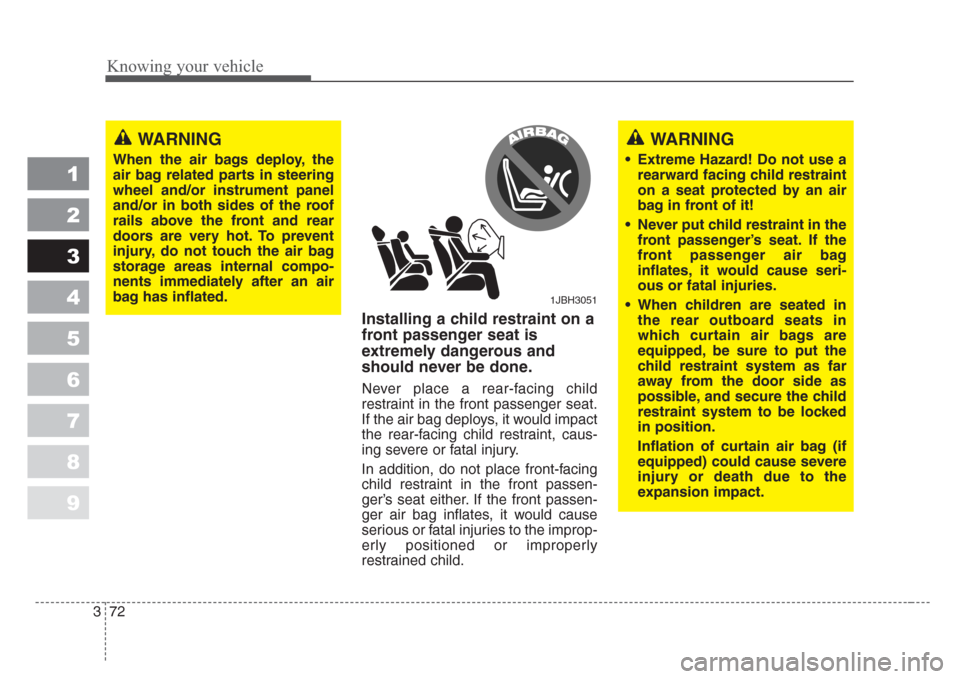
Installing a child restraint on a
front passenger seat is
extremely dangerous and
should never be done.
Never place a rear-facing child
restraint in the front passenger seat.
If the air bag deploys, it would impact
the rear-facing child restraint, caus-
ing severe or fatal injury.
In addition, do not place front-facing
child restraint in the front passen-
ger’s seat either. If the front passen-
ger air bag inflates, it would cause
serious or fatal injuries to the improp-
erly positioned or improperly
restrained child.
WARNING
• Extreme Hazard! Do not use a
rearward facing child restraint
on a seat protected by an air
bag in front of it!
• Never put child restraint in the
front passenger’s seat. If the
front passenger air bag
inflates, it would cause seri-
ous or fatal injuries.
• When children are seated in
the rear outboard seats in
which curtain air bags are
equipped, be sure to put the
child restraint system as far
away from the door side as
possible, and secure the child
restraint system to be locked
in position.
Inflation of curtain air bag (if
equipped) could cause severe
injury or death due to the
expansion impact.
WARNING
When the air bags deploy, the
air bag related parts in steering
wheel and/or instrument panel
and/or in both sides of the roof
rails above the front and rear
doors are very hot. To prevent
injury, do not touch the air bag
storage areas internal compo-
nents immediately after an air
bag has inflated.
1JBH3051
Page 111 of 298
3 101
Knowing your vehicle
1
2
3
4
5
6
7
8
9
Using a cellular phone or a
two-way radio
When a cellular phone is used inside
the vehicle, noise may be produced
from the audio equipment. This does
not mean that something is wrong
with the audio equipment. In such a
case, use the cellular phone at a
place as far as possible from the
audio equipment.
Care of cassette tapes
(if equipped)
• Because the thickness of a
sette tape with the total playback
time of over 60 minutes (C-60) are
too thin, we suggest that you do
not use any of them to avoid hav-
ing tapes being tangled.
• To achieve better sound qu
periodically clean the tape head
using a cotton stick with colorless
alcohol (once per month).
• If a tape is too loose, fasten
reel by winding with objects like a
pencil.
• Because dust or foreign objec
a cassette tape may damage the
playback head, always store tapes
in their cases when not in use.
• Make sure cassette tapes are
away from magnetic devices (TV,
stereo system, etc) in order to
achieve better sound quality.
• Be certain that no objects or
stances other than cassette tapes
are inserted into the cassette tape
player.• Because tape media can be
torted when exposed to direct sun-
light, Do not leave cassette tapes
on the seats, dashboard or near
the back windshield.
WARNING - Cellular
phones
Don’t use a cellular phone when
you are driving. The driver must
stop at a safe place to use a cel-
lular phone.
Page 281 of 298

Maintenance
36 7
1
2
3
4
5
6
7
8
9
Traction - AA, A, B & C
The traction grades, from highest to
lowest, are AA, A, B and C. The
grades represent the tires ability to
stop on wet pavement as measured
under controlled conditions on spec-
ified government test surfaces of
asphalt and concrete. A tire marked
C may have poor traction perform-
ance.
Temperature -A, B & C
The temperature grades are A (the
highest), B and C. The grades repre-
sent the tire’s resistance to the gen-
eration of heat and its ability to dissi-
pate heat when tested under con-
trolled conditions on a specified
indoor laboratory test wheel.
Sustained high temperature can
cause the material of the tires to
degenerate and reduce tires life, and
excessive temperature can lead to
sudden tires failure. Grades A and B
represent higher levels of perform-
ance on the laboratory test wheel than
the minimum required by the law.Tire terminology and defini-
tions
Air Pressure: The amount of air
inside the tire pressing outward on
the tire. Air pressure is expressed in
pounds per square inch (psi) or kilo-
pascal (kPa).
Accessory Weight: This means the
combined weight of optional acces-
sories. Some examples of optional
accessories are, automatic transmis-
sion, power seats, and air condition-
ing.
Aspect Ratio: The relationship of a
tire's height to its width.
Belt:A rubber coated layer of cords
that is located between the plies and
the tread. Cords may be made from
steel or other reinforcing materials.
Bead: The tire bead contains steel
wires wrapped by steel cords that
hold the tire onto the rim.
Bias Ply Tire: A pneumatic tire in
which the plies are laid at alternate
angles less than 90 degrees to the
centerline of the tread.
WARNING- Tire
temperature
The temperature grade for this
tire is established for a tire that
is properly inflated and not
overloaded. Excessive speed,
underinflation, or excessive
loading, either separately or in
combination, can cause heat
build-up and possible sudden
tire failure. This can cause loss
of vehicle control and serious
injury or death.