trailer KIA Sephia 2008 2.G User Guide
[x] Cancel search | Manufacturer: KIA, Model Year: 2008, Model line: Sephia, Model: KIA Sephia 2008 2.GPages: 298, PDF Size: 5.38 MB
Page 212 of 298
Driving tips
22 5
1
2
3
4
5
6
7
8
9
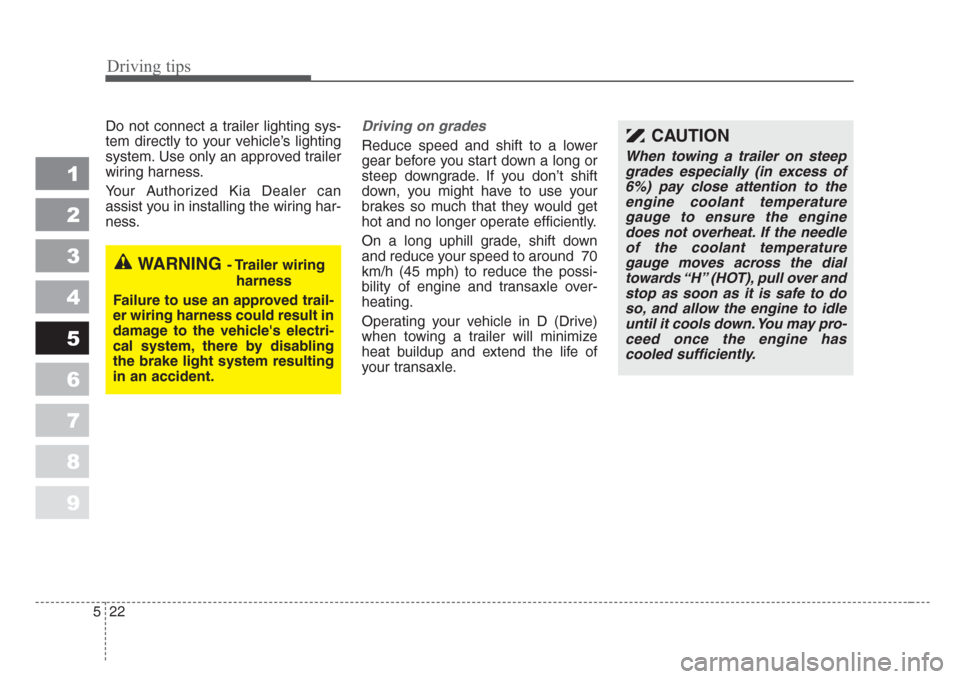
Do not connect a trailer lighting sys-
tem directly to your vehicle’s lighting
system. Use only an approved trailer
wiring harness.
Your Authorized Kia Dealer can
assist you in installing the wiring har-
ness.Driving on grades
Reduce speed and shift to a lower
gear before you start down a long or
steep downgrade. If you don’t shift
down, you might have to use your
brakes so much that they would get
hot and no longer operate efficiently.
On a long uphill grade, shift down
and reduce your speed to around 70
km/h (45 mph) to reduce the possi-
bility of engine and transaxle over-
heating.
Operating your vehicle in D (Drive)
when towing a trailer will minimize
heat buildup and extend the life of
your transaxle.
WARNING - Trailer wiring
harness
Failure to use an approved trail-
er wiring harness could result in
damage to the vehicle's electri-
cal system, there by disabling
the brake light system resulting
in an accident.
CAUTION
When towing a trailer on steep
grades especially (in excess of
6%) pay close attention to the
engine coolant temperature
gauge to ensure the engine
does not overheat. If the needle
of the coolant temperature
gauge moves across the dial
towards “H” (HOT), pull over and
stop as soon as it is safe to do
so, and allow the engine to idle
until it cools down. You may pro-
ceed once the engine has
cooled sufficiently.
Page 213 of 298

523
Driving tips
1
2
3
4
5
6
7
8
9
Parking on hills
Generally, you should not park your
vehicle, with a trailer attached, on a
hill. People can be seriously or fatal-
ly injured, and both your vehicle and
the trailer can be damaged if they
begin to move downhill.However, if you ever have to park
your trailer on a hill, here’s how to do
it:
1. Apply your brakes, but don’t shift
into gear.
2. Have someone place chocks
(blocks of wood or metal intended
for this purpose) under the down-
hill sides of the trailer wheels.
3. When the wheel chocks are in
place, release the brakes until the
chocks absorb the load.
4. Reapply the brakes. Apply your
parking brake, and then shift to R
(Reverse) for a manual transaxle
or P (Park) for an automatic
transaxle.
5. Release the brakes.
When you are ready to leave after
parking on a hill
1. With the manual transaxle in
Neutral or automatic transaxle in P
(Park), apply your brakes and hold
the brake pedal down while you:
• Start your engine;
• Shift into gear; and
• Release the parking brake.
2. Slowly remove your foot from the
brake pedal.
3. Drive slowly forward until the trail-
er is clear of the chocks.
4. Stop and have someone pick up
and store the chocks.
WARNING- Parking brake
It can be dangerous to get out of
your vehicle if the parking brake
is not firmly set or if the engine
is still running. In either case
the vehicle can move suddenly.
You or others could be serious-
ly or fatally injured.
WARNING- Parking on a
hill
Parking your vehicle on a hill
with a trailer attached is danger-
ous. It could cause serious
injury or death, should the trail-
er break lose, or should the trail-
er drag the vehicle downhill.
Page 214 of 298

Driving tips
24 5
1
2
3
4
5
6
7
8
9
Maintenance when trailer tow-
ing
Your vehicle will need service more
often when you regularly pull a trail-
er. Important items to pay particular
attention to include engine oil, auto-
matic transaxle fluid, axle lubricant
and cooling system fluid. Brake con-
dition is another important item to
frequently check. Each item is cov-
ered in this manual, and the Index
will help you find them quickly. If
you’re trailering, it’s a good idea to
review these sections before you
start your trip.
Don’t forget to also maintain your
trailer and hitch. Follow the mainte-
nance schedule that accompanied
your trailer and check it periodically.
Preferably, conduct the check at the
start of each day’s driving. Most
importantly, all hitch nuts and bolts
should be tight.
CAUTION
• Due to higher load during
trailer usage, overheating
might occur in hot days or
during uphill driving. If the
coolant gauge indicates over-
heating, switch off the A/C and
stop the vehicle in a safe area
to cool down the engine.
• When towing check transaxle
fluid more frequently.
• If your vehicle is not equipped
with the air conditioner, you
should install a condenser fan
for engine performance when
towing a trailer.
Page 235 of 298

619
In case of an emergency
1
2
3
4
5
6
7
8
9
TOWING
If emergency towing is necessary,
we recommend having it done by an
authorized Kia dealer or a commer-
cial tow-truck service. Proper lifting
and towing procedures are neces-
sary to prevent damage to the vehi-
cle. The use of wheel dollies or
flatbed is recommended.
For trailer towing guidelines informa-
tion, refer to section 5 “Driving Tips”.
It is acceptable to tow the vehicle
with the rear wheels on the ground
(without dollies) and the front wheels
off the ground.
When being towed by a commercial
tow truck and wheel dollies are not
used, the front of the vehicle should
always be lifted, not the rear.
2GHA41071LDN4023
2LDA40012LDA4002
CAUTION
• Do not tow the vehicle back-
wards with the front wheels on
the ground as this may cause
damage to the vehicle.
• Do not tow with sling-type
equipment. Use wheel lift or
flatbed equipment.
Page 297 of 298
93
1
2
3
4
5
6
7
8
9
Index
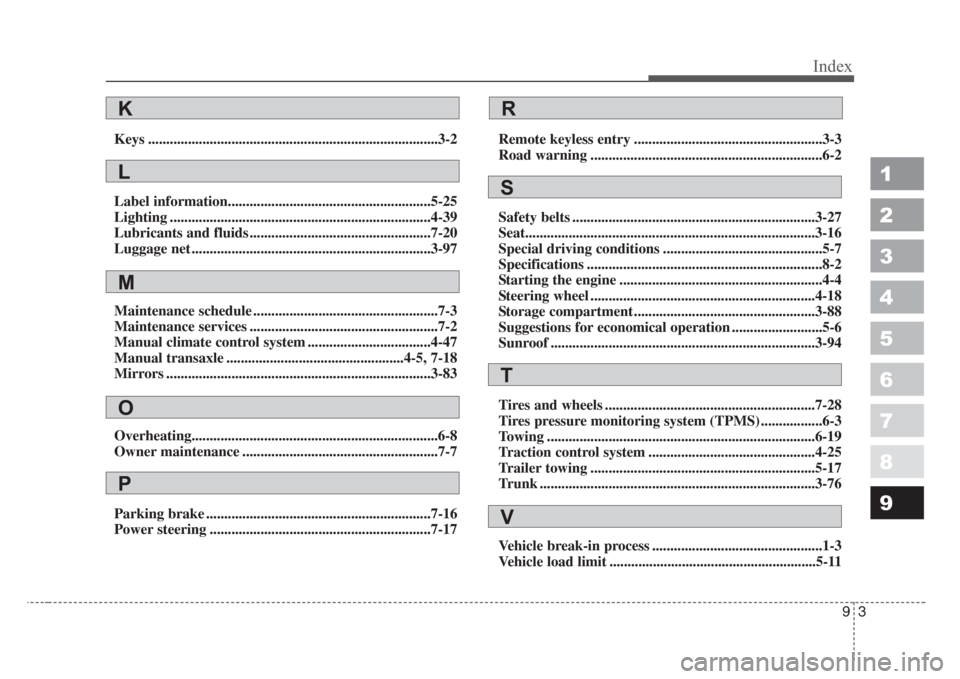
Keys ................................................................................3-2
Label information........................................................5-25
Lighting ........................................................................4-39
Lubricants and fluids ..................................................7-20
Luggage net ..................................................................3-97
Maintenance schedule ...................................................7-3
Maintenance services ....................................................7-2
Manual climate control system ..................................4-47
Manual transaxle .................................................4-5, 7-18
Mirrors .........................................................................3-83
Overheating....................................................................6-8
Owner maintenance ......................................................7-7
Parking brake ..............................................................7-16
Power steering .............................................................7-17Remote keyless entry ....................................................3-3
Road warning ................................................................6-2
Safety belts ...................................................................3-27
Seat................................................................................3-16
Special driving conditions ............................................5-7
Specifications .................................................................8-2
Starting the engine ........................................................4-4
Steering wheel ..............................................................4-18
Storage compartment ..................................................3-88
Suggestions for economical operation .........................5-6
Sunroof .........................................................................3-94
Tires and wheels ..........................................................7-28
Tires pressure monitoring system (TPMS) .................6-3
Towing ..........................................................................6-19
Traction control system ..............................................4-25
Trailer towing ..............................................................5-17
Trunk ............................................................................3-76
Vehicle break-in process ...............................................1-3
Vehicle load limit .........................................................5-11
K
L
M
O
P
R
S
T
V