light KIA Sorento 2006 1.G User Guide
[x] Cancel search | Manufacturer: KIA, Model Year: 2006, Model line: Sorento, Model: KIA Sorento 2006 1.GPages: 312, PDF Size: 5.21 MB
Page 37 of 312
Safety belts provide the best restraint
when:
The seatback is upright
The occupant is sitting upright (not
slouched)
The lap belt is snug across the hips
The shoulder belt is snug across
the chest
The knees are straight forward
To help you remember to fasten your
safety belt, a warning light will come
on and a chime will sound. See
Safety Belt Warning Light and Chime
on page 3-29.KNOWING YOUR VEHICLE3-28
WARNING - After a Collision
Lap/shoulder belt assemblies
may be stretched or damaged
when subjected to the stress
and forces of a collision.
The entire restraint system
should be inspected following
any collision. All belts, retrac-
tors, anchors and hardware
damaged by a collision
should be replaced before the
vehicle is operated again.
WARNING
- Cargo Area
Passengers should never be
allowed to ride in the cargo area
of a vehicle. No safety belts are
provided for the cargo area.
Persons riding in the vehicle
without a fastened safety belt
are much more likely to suffer
serious bodily injury or death
during an accident.
WARNING
- Twisted Belts
A twisted or jammed safety belt
cannot restrain you properly. If
you cannot untwist or unjam
the safety belt, see your Kia
dealer immediately. Never drive
or ride with a twisted or jammed
safety belt.
WARNING
- Belt Use
Safety belts must be used cor-
rectly to work properly in an
accident. Each seating position
in your vehicle has a specific
safety belt assembly that
includes a buckle and tongue
designed to be used together.
For greatest effectiveness, fol-
low these guidelines in using
safety belts:
Use the shoulder portion of
the safety belt on the outside
shoulder only. Never wear the
shoulder portion under the
arm.
Never swing the safety belt
around your neck to fit over
the inside shoulder.
Never wear the shoulder por-
tion of the safety belt across
the neck or face.
(Continued)
BL-ENG (CAN)-3.qxd 7/28/05 5:52 PM Page 28
Page 38 of 312
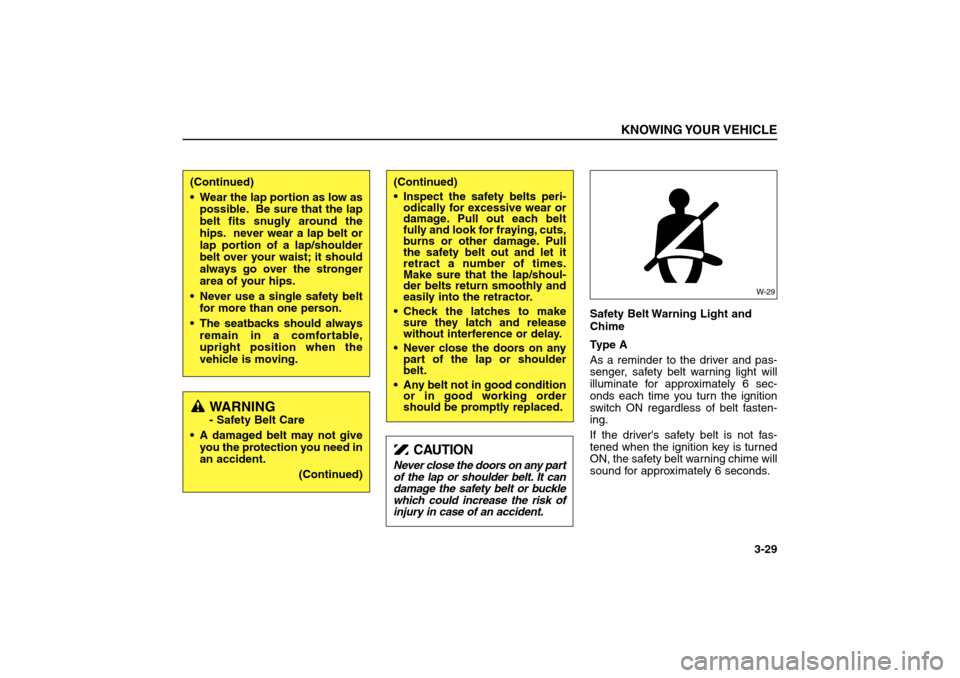
Safety Belt Warning Light and
Chime
Type A
As a reminder to the driver and pas-
senger, safety belt warning light will
illuminate for approximately 6 sec-
onds each time you turn the ignition
switch ON regardless of belt fasten-
ing.
If the driver's safety belt is not fas-
tened when the ignition key is turned
ON, the safety belt warning chime will
sound for approximately 6 seconds.
KNOWING YOUR VEHICLE
3-29
(Continued)
Wear the lap portion as low as
possible. Be sure that the lap
belt fits snugly around the
hips. never wear a lap belt or
lap portion of a lap/shoulder
belt over your waist; it should
always go over the stronger
area of your hips.
Never use a single safety belt
for more than one person.
The seatbacks should always
remain in a comfortable,
upright position when the
vehicle is moving.
(Continued)
Inspect the safety belts peri-
odically for excessive wear or
damage. Pull out each belt
fully and look for fraying, cuts,
burns or other damage. Pull
the safety belt out and let it
retract a number of times.
Make sure that the lap/shoul-
der belts return smoothly and
easily into the retractor.
Check the latches to make
sure they latch and release
without interference or delay.
Never close the doors on any
part of the lap or shoulder
belt.
Any belt not in good condition
or in good working order
should be promptly replaced.
CAUTION
Never close the doors on any part
of the lap or shoulder belt. It can
damage the safety belt or buckle
which could increase the risk of
injury in case of an accident.
WARNING- Safety Belt Care
A damaged belt may not give
you the protection you need in
an accident.
(Continued)
W-29
BL-ENG (CAN)-3.qxd 7/28/05 5:52 PM Page 29
Page 39 of 312
Type B
As a reminder to the driver and pas-
senger, safety belt warning light will
blink for approximately 6 seconds
each time you turn the ignition switch
ON regardless of belt fastening.
If the driver's safety belt is unfastened
after the ignition switch is ON, the
safety belt warning light will blink for
approximately 6 seconds.
If the driver's safety belt is not fas-
tened when the ignition key is turned
ON, the safety belt warning chime will
sound for approximately 6 seconds.Front and Rear Outboard
Lap/Shoulder Belt
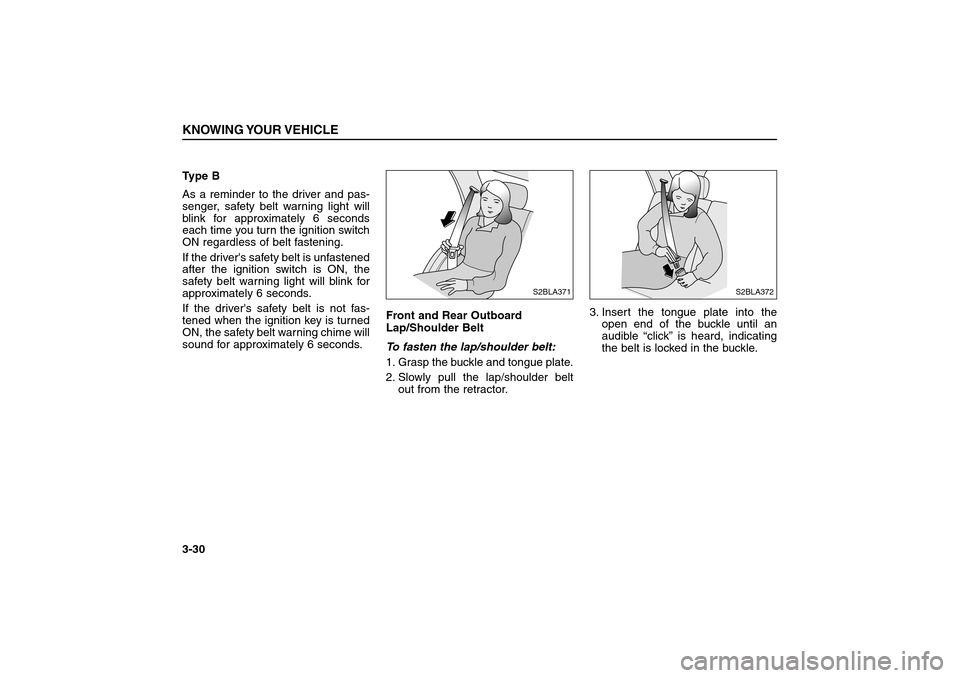
To fasten the lap/shoulder belt:
1. Grasp the buckle and tongue plate.
2. Slowly pull the lap/shoulder belt
out from the retractor.3. Insert the tongue plate into the
open end of the buckle until an
audible “click”is heard, indicating
the belt is locked in the buckle.KNOWING YOUR VEHICLE3-30
S2BLA371
S2BLA372
BL-ENG (CAN)-3.qxd 7/28/05 5:52 PM Page 30
Page 46 of 312
Restraint of Large Children
As children grow, they may need to
use new child restraints, including
larger child seats or booster seats,
which are appropriate for their
increased size.
A child who has outgrown available
child restraint systems should use
the belts provided in the vehicle.
When seated, the child should be
restrained by the lap/shoulder belt.
If the shoulder belt slightly touches
the child’s neck or face, try placing
the child closer to the center of the
vehicle. If the shoulder belt still
touches their face or neck, they may
need to be returned to a child
restraint system. In addition, after-
market devices are available from
independent manufacturers which
help pull the shoulder belt lower and
away from the child’s face or neck.Placement of a Child Restraint
System
We recommend that, whenever pos-
sible, you put the child restraint in the
center position of the rear seat.
If the center rear seat is not available,
or you are using more than one child
restraint system in the vehicle at the
same time, the rear safety belts have
been designed to allow a child
restraint to be used in these posi-
tions. Since those safety belts nor-
mally lock only under extreme or
emergency conditions (emergency
lock mode) you must manually adjust
those belts to the auto lock mode.
KNOWING YOUR VEHICLE
3-37
WARNING
When a child restraint is not in
use, make sure that it is
secured by a safety belt. In a
sudden stop or accident, a
loose child restraint could be
thrown forward and injure
someone.
✽ ✽
NOTICEThe driver’s safety belt incorpo-
rates the emergency lock mode
only.
WARNING- Restraint Instructions
Failure to observe this manuals
instructions regarding child
restraint systems and the
instructions provided with the
child restraint system could
increase the chance and/or
severity of injury in an accident.
BL-ENG (CAN)-3.qxd 7/28/05 5:52 PM Page 37
Page 54 of 312
➀
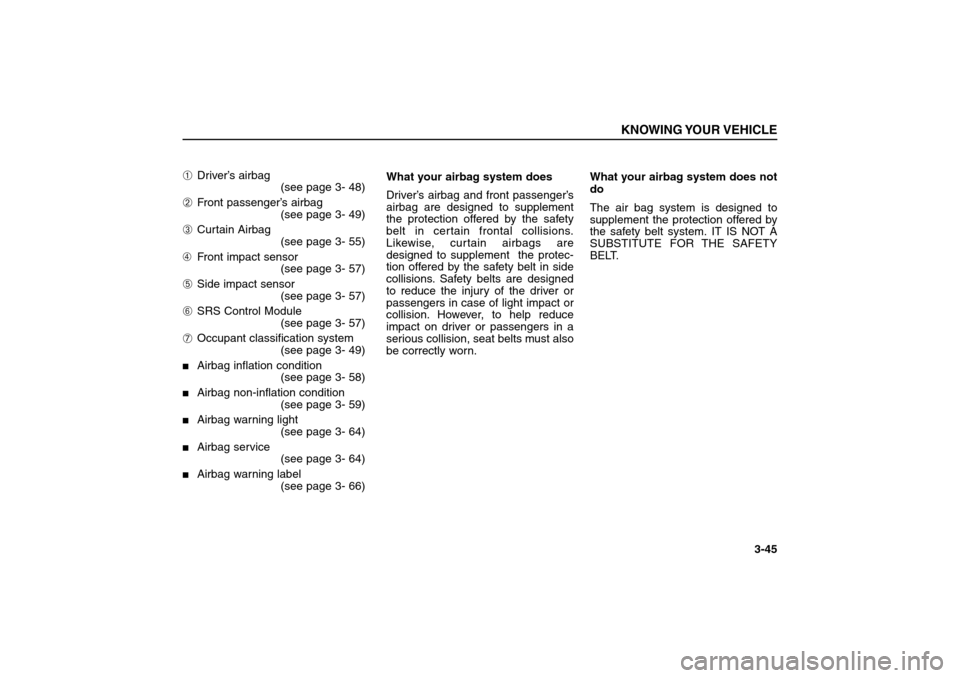
Driver’s airbag
(see page 3- 48)
➁
Front passenger’s airbag
(see page 3- 49)
➂
Curtain Airbag
(see page 3- 55)
➃Front impact sensor
(see page 3- 57)
➄
Side impact sensor
(see page 3- 57)
➅
SRS Control Module
(see page 3- 57)
➆
Occupant classification system
(see page 3- 49)
Airbag inflation condition
(see page 3- 58)
Airbag non-inflation condition
(see page 3- 59)
Airbag warning light
(see page 3- 64)
Airbag service
(see page 3- 64)
Airbag warning label
(see page 3- 66)What your airbag system does
Driver’s airbag and front passenger’s
airbag are designed to supplement
the protection offered by the safety
belt in certain frontal collisions.
Likewise, curtain airbags are
designed to supplement the protec-
tion offered by the safety belt in side
collisions. Safety belts are designed
to reduce the injury of the driver or
passengers in case of light impact or
collision. However, to help reduce
impact on driver or passengers in a
serious collision, seat belts must also
be correctly worn.What your airbag system does not
do
The air bag system is designed to
supplement the protection offered by
the safety belt system. IT IS NOT A
SUBSTITUTE FOR THE SAFETY
BELT.
KNOWING YOUR VEHICLE
3-45
BL-ENG (CAN)-3.qxd 7/28/05 5:52 PM Page 45
Page 56 of 312
Airbag system components
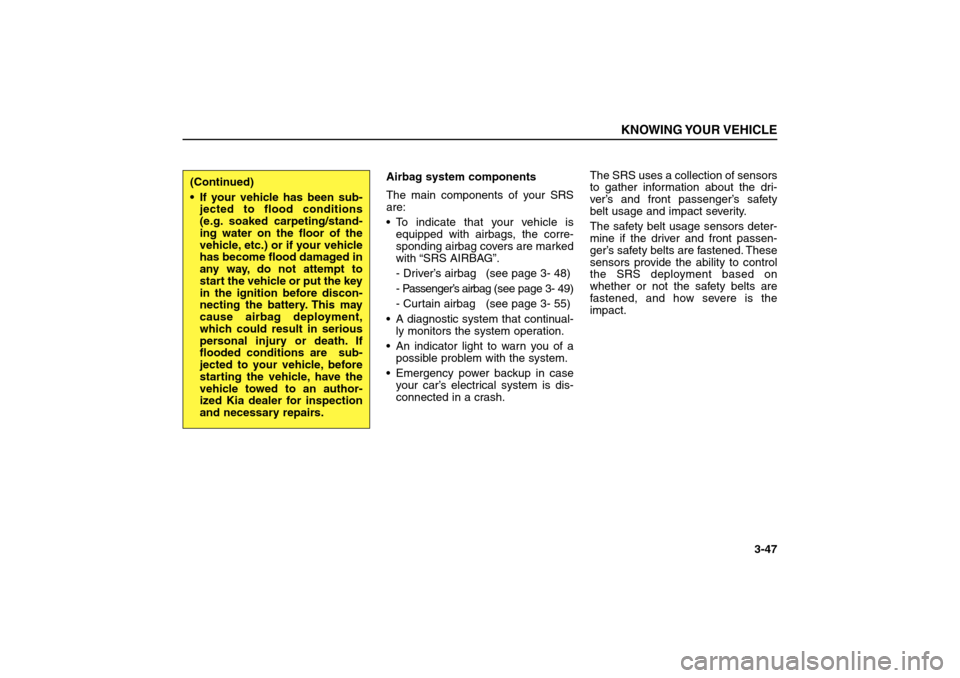
The main components of your SRS
are:
To indicate that your vehicle is
equipped with airbags, the corre-
sponding airbag covers are marked
with “SRS AIRBAG”.
- Driver’s airbag (see page 3- 48)
- Passenger’s airbag(see page 3- 49)
- Curtain airbag (see page 3- 55)
A diagnostic system that continual-
ly monitors the system operation.
An indicator light to warn you of a
possible problem with the system.
Emergency power backup in case
your car’s electrical system is dis-
connected in a crash.The SRS uses a collection of sensors
to gather information about the dri-
ver’s and front passenger’s safety
belt usage and impact severity.
The safety belt usage sensors deter-
mine if the driver and front passen-
ger’s safety belts are fastened. These
sensors provide the ability to control
the SRS deployment based on
whether or not the safety belts are
fastened, and how severe is the
impact.
KNOWING YOUR VEHICLE
3-47
(Continued)
If your vehicle has been sub-
jected to flood conditions
(e.g. soaked carpeting/stand-
ing water on the floor of the
vehicle, etc.) or if your vehicle
has become flood damaged in
any way, do not attempt to
start the vehicle or put the key
in the ignition before discon-
necting the battery. This may
cause airbag deployment,
which could result in serious
personal injury or death. If
flooded conditions are sub-
jected to your vehicle, before
starting the vehicle, have the
vehicle towed to an author-
ized Kia dealer for inspection
and necessary repairs.
BL-ENG (CAN)-3.qxd 7/28/05 5:52 PM Page 47
Page 57 of 312
The advanced SRS offers the ability
to control the airbag inflation with two
levels. A first stage level is provided
for moderate-severity impacts. A sec-
ond stage level is provided for more
severe impacts.
According to the impact severity and
safety belt usage, the SRSCM (SRS
Control Module) controls the airbag
inflation. Failure to properly wear
safety belts can increase the risk or
severity of injury in an accident.
Additionally, your SRS is equipped
with an occupant classification sys-
tem in the front passenger’s seat. The
occupant classification system
detects the presence of a passenger
in the front passenger’s seat and will
turn off the front passenger’s airbag
under certain conditions. For more
detail, see “Occupant Classification
System”later in this section.
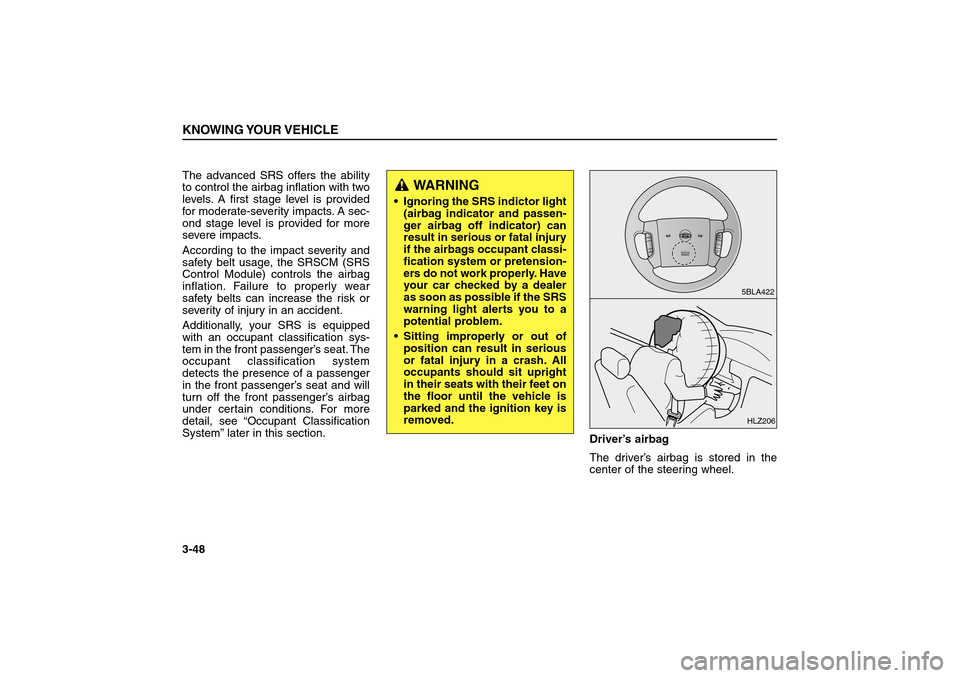
Driver’s airbag
The driver’s airbag is stored in the
center of the steering wheel.KNOWING YOUR VEHICLE3-48
WARNING
Ignoring the SRS indictor light
(airbag indicator and passen-
ger airbag off indicator) can
result in serious or fatal injury
if the airbags occupant classi-
fication system or pretension-
ers do not work properly. Have
your car checked by a dealer
as soon as possible if the SRS
warning light alerts you to a
potential problem.
Sitting improperly or out of
position can result in serious
or fatal injury in a crash. All
occupants should sit upright
in their seats with their feet on
the floor until the vehicle is
parked and the ignition key is
removed.
SRSAIRBAG
R
E
S
A
C
C
E
LCOAST
SET
P
W
RSEEK
C
A
N
C
E
L
5BLA422HLZ206
BL-ENG (CAN)-3.qxd 7/28/05 5:52 PM Page 48
Page 59 of 312
Main components of Occupant
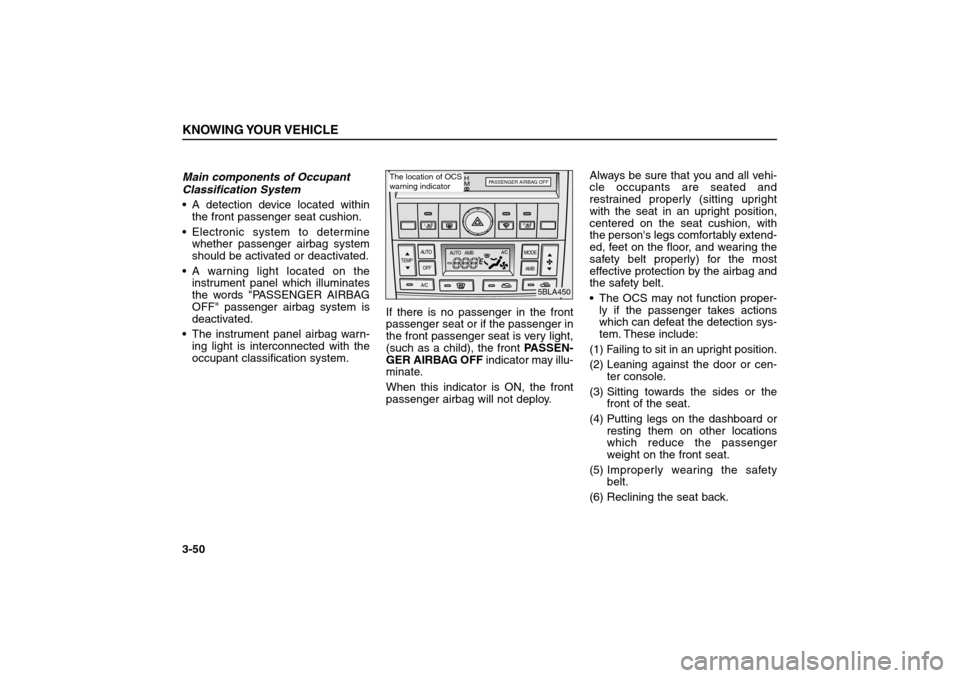
Classification System
A detection device located within
the front passenger seat cushion.
Electronic system to determine
whether passenger airbag system
should be activated or deactivated.
A warning light located on the
instrument panel which illuminates
the words "PASSENGER AIRBAG
OFF" passenger airbag system is
deactivated.
The instrument panel airbag warn-
ing light is interconnected with the
occupant classification system.If there is no passenger in the front
passenger seat or if the passenger in
the front passenger seat is very light,
(such as a child), the front PASSEN-
GER AIRBAG OFFindicator may illu-
minate.
When this indicator is ON, the front
passenger airbag will not deploy.Always be sure that you and all vehi-
cle occupants are seated and
restrained properly (sitting upright
with the seat in an upright position,
centered on the seat cushion, with
the person's legs comfortably extend-
ed, feet on the floor, and wearing the
safety belt properly) for the most
effective protection by the airbag and
the safety belt.
The OCS may not function proper-
ly if the passenger takes actions
which can defeat the detection sys-
tem. These include:
(1) Failing to sit in an upright position.
(2) Leaning against the door or cen-
ter console.
(3) Sitting towards the sides or the
front of the seat.
(4) Putting legs on the dashboard or
resting them on other locations
which reduce the passenger
weight on the front seat.
(5) Improperly wearing the safety
belt.
(6) Reclining the seat back.KNOWING YOUR VEHICLE3-50
AUTO
AUTO AMB
OFF TEMPMODE
AMB
A/C
A/C
H
M
L
R
PASSENGER AIRBAG OFF
5BLA450
The location of OCS
warning indicator
BL-ENG (CAN)-3.qxd 7/28/05 5:52 PM Page 50
Page 60 of 312
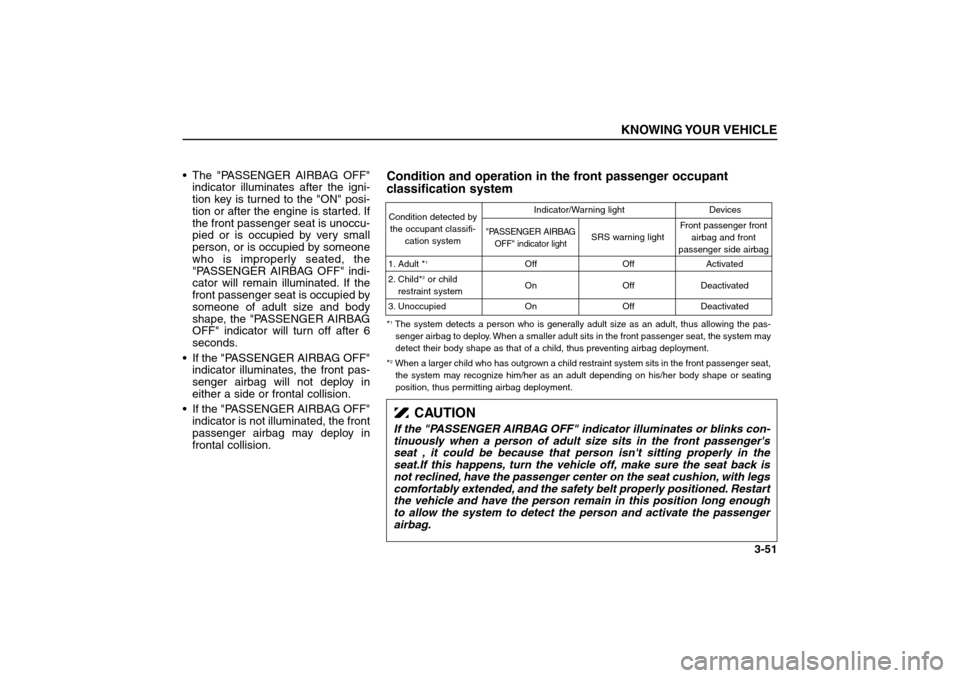
The "PASSENGER AIRBAG OFF"
indicator illuminates after the igni-
tion key is turned to the "ON" posi-
tion or after the engine is started. If
the front passenger seat is unoccu-
pied or is occupied by very small
person, or is occupied by someone
who is improperly seated, the
"PASSENGER AIRBAG OFF" indi-
cator will remain illuminated. If the
front passenger seat is occupied by
someone of adult size and body
shape, the "PASSENGER AIRBAG
OFF" indicator will turn off after 6
seconds.
If the "PASSENGER AIRBAG OFF"
indicator illuminates, the front pas-
senger airbag will not deploy in
either a side or frontal collision.
If the "PASSENGER AIRBAG OFF"
indicator is not illuminated, the front
passenger airbag may deploy in
frontal collision.
KNOWING YOUR VEHICLE
3-51
CAUTION
If the "PASSENGER AIRBAG OFF" indicator illuminates or blinks con-
tinuously when a person of adult size sits in the front passenger's
seat , it could be because that person isn't sitting properly in the
seat.If this happens, turn the vehicle off, make sure the seat back is
not reclined, have the passenger center on the seat cushion, with legs
comfortably extended, and the safety belt properly positioned. Restart
the vehicle and have the person remain in this position long enough
to allow the system to detect the person and activate the passenger
airbag.Condition and operation in the front passenger occupant
classification systemCondition detected by
the occupant classifi-
cation system
1. Adult *
1
2. Child*
2or child
restraint system
3. Unoccupied Off
On
OnOff
Off
OffActivated
Deactivated
Deactivated
"PASSENGER AIRBAG
OFF" indicator light
SRS warning lightFront passenger front
airbag and front
passenger side airbag Indicator/Warning light Devices
*1The system detects a person who is generally adult size as an adult, thus allowing the pas-
senger airbag to deploy. When a smaller adult sits in the front passenger seat, the system may
detect their body shape as that of a child, thus preventing airbag deployment.
*2When a larger child who has outgrown a child restraint system sits in the front passenger seat,
the system may recognize him/her as an adult depending on his/her body shape or seating
position, thus permitting airbag deployment.
BL-ENG (CAN)-3.qxd 7/28/05 5:52 PM Page 51
Page 61 of 312
KNOWING YOUR VEHICLE3-52
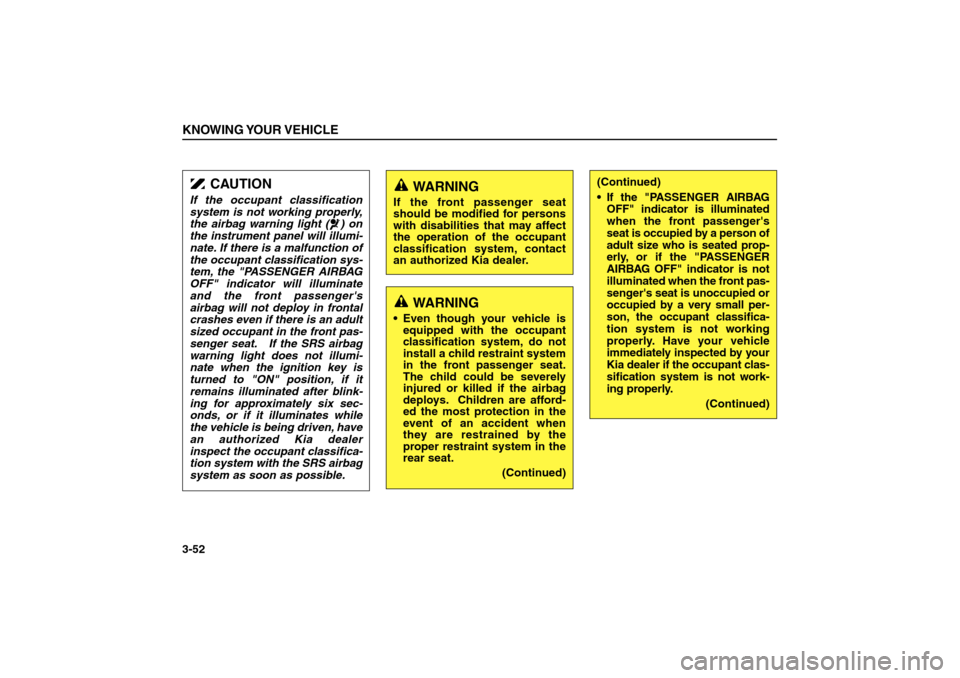
WARNING
If the front passenger seat
should be modified for persons
with disabilities that may affect
the operation of the occupant
classification system, contact
an authorized Kia dealer.
WARNING
Even though your vehicle is
equipped with the occupant
classification system, do not
install a child restraint system
in the front passenger seat.
The child could be severely
injured or killed if the airbag
deploys. Children are afford-
ed the most protection in the
event of an accident when
they are restrained by the
proper restraint system in the
rear seat.
(Continued)
(Continued)
If the "PASSENGER AIRBAG
OFF" indicator is illuminated
when the front passenger's
seat is occupied by a person of
adult size who is seated prop-
erly, or if the "PASSENGER
AIRBAG OFF" indicator is not
illuminated when the front pas-
senger's seat is unoccupied or
occupied by a very small per-
son, the occupant classifica-
tion system is not working
properly. Have your vehicle
immediately inspected by your
Kia dealer if the occupant clas-
sification system is not work-
ing properly.
(Continued)
CAUTION
If the occupant classification
system is not working properly,
the airbag warning light ( ) on
the instrument panel will illumi-
nate. If there is a malfunction of
the occupant classification sys-
tem, the "PASSENGER AIRBAG
OFF" indicator will illuminate
and the front passenger's
airbag will not deploy in frontal
crashes even if there is an adult
sized occupant in the front pas-
senger seat. If the SRS airbag
warning light does not illumi-
nate when the ignition key is
turned to "ON" position, if it
remains illuminated after blink-
ing for approximately six sec-
onds, or if it illuminates while
the vehicle is being driven, have
an authorized Kia dealer
inspect the occupant classifica-
tion system with the SRS airbag
system as soon as possible.
BL-ENG (CAN)-3.qxd 7/28/05 5:52 PM Page 52