mirror KIA Sorento 2006 1.G User Guide
[x] Cancel search | Manufacturer: KIA, Model Year: 2006, Model line: Sorento, Model: KIA Sorento 2006 1.GPages: 312, PDF Size: 5.21 MB
Page 196 of 312
Rocking the Vehicle
If it is necessary to rock the vehicle to
free it from snow, sand, or mud, first
turn the steering wheel right and left
to clear the area around your front
wheels. Then, shift back and forth
between 1 (First) and R (Reverse) in
vehicles equipped with a manual
transmission or R (Reverse) and any
forward gear in vehicles equipped
with an automatic transmission. Do
not race the engine, and spin the
wheels as little as possible. If you are
still stuck after a few tries, have the
vehicle pulled out by a tow vehicle to
avoid engine overheating and possi-
ble damage to the transmission,
transfer case (if equipped), or differ-
ential.Driving at Night
Because night driving presents many
more hazards than driving in the day-
light, here are some important tips to
remember:
Slow down and keep more distance
between you and other vehicles, as
it may be more difficult to see at
night, especially in areas where
there may not be any street lights.
Adjust your mirrors to reduce the
glare from other driver’s headlights.
Keep your headlights clean and
properly aimed. Dirty or improperly
aimed headlights will make it much
more difficult to see at night.
Avoid staring directly at the head-
lights of oncoming vehicles. You
could be temporarily blinded, and it
will take several seconds for your
eyes to readjust to the darkness.
DRIVING TIPS
5-9
✽ ✽
NOTICEProlonged rocking may cause
engine over-heating, transmission
or transfer case (if equipped) dam-
age or failure, and tire damage.
WARNING- Spinning Tires
Do not spin the wheels, espe-
cially at speeds more than 35
mph (56 km/h). Spinning the
wheels at high speeds when the
vehicle is stationary could
cause a tire to overheat,
explode and injure bystanders.
BL-ENG (CAN)-5.qxd 7/28/05 5:56 PM Page 9
Page 221 of 312
TRAILER TOWINGYour vehicle can tow a trailer. To iden-
tify what the vehicle trailering capaci-
ty is for your vehicle, you should read
the information in “Weight of the
Trailer’’ that appears later in this sec-
tion. Remember that trailering is dif-
ferent than just driving your vehicle
by itself. Trailering means changes in
handling, durability, and fuel econo-
my. Successful, safe trailering takes
correct equipment, and it has to be
used properly.This section contains many time-test-
ed, important trailering tips and safe-
ty rules. Many of these are important
for your safety and that of your pas-
sengers. Please read this section
carefully before you pull a trailer.
Load-pulling components such as the
engine, transmission, wheel assem-
blies, and tires are forced to work
harder against the load of the added
weight. The engine is required to
operate at relatively higher speeds
and under greater loads. This addi-
tional burden generates extra heat.
The trailer also adds considerably to
wind resistance, further increasing
the pulling requirements.If You Do Decide to Pull a Trailer
Here are some important points if you
decide to pull a trailer:
State, provincial, county and
municipal government have varying
trailering laws. Make sure your
hitch, mirrors, lights and wiring
arrangements are legal, not only
where you live, but also where
you’ll be driving. A good source for
this information is provincial or local
law enforcement agencies.
Consider using a sway control. You
can ask a hitch dealer about sway
control.
After your odometer indicates 800
km or more, you can tow a trailer.
For the first 800 km that you tow a
trailer, don’t drive over 80 km/h and
don’t make starts at full throttle.
This helps your engine and other
parts of your vehicle “wear” in at the
heavier loads.
Always drive at a safe speed (less
than 100 km/h) commensurate with
road conditions.
Three important considerations
have to do with weight:DRIVING TIPS5-34✽ ✽
NOTICEPulling a trailer improperly can
damage your vehicle and result in
costly repairs not covered by your
warranty. To pull a trailer correct-
ly, follow the advice in this section.
BL-ENG (CAN)-5.qxd 7/28/05 5:56 PM Page 34
Page 225 of 312
Trailer brakes
If your trailer weighs more than 750
kg (1,650 pounds) loaded, then it
needs its own brakes – and they must
be adequate. Be sure to read and fol-
low the instructions for the trailer
brakes so you’ll be able to install,
adjust and maintain them properly.
Don’t tap into your vehicle’s brake
system.
Do not use a trailer with its own
brakes unless you are absolutely
certain that you have properly set
up the brake system. This is not a
task for amateurs. Use an experi-
enced, competent trailer shop for
this work.Driving with a trailer
Towing a trailer requires a certain
amount of experience. Before setting
out for the open road, you must get to
know your trailer. Acquaint yourself
with the feel of handling and braking
with the added weight of the trailer.
And always keep in mind that the
vehicle you are driving is now a good
deal longer and not nearly so respon-
sive as your vehicle is by itself.
Before you start, check the trailer
hitch and platform, safety chains,
electrical connector(s), lights, tires
and mirror adjustment. If the trailer
has electric brakes, start your vehicle
and trailer moving and then apply the
trailer brake controller by hand to be
sure the brakes are working. This lets
you check your electrical connection
at the same time.
During your trip, check occasionally
to be sure that the load is secure, and
that the lights and any trailer brakes
are still working.Following distance
Stay at least twice as far behind the
vehicle ahead as you would when
driving your vehicle without a trailer.
This can help you avoid situations
that require heavy braking and sud-
den turns.
Passing
You’ll need more passing distance up
ahead when you’re towing a trailer.
And, because you’re a good deal
longer, you’ll need to go much farther
beyond the passed vehicle before
you can return to your lane.DRIVING TIPS5-38
BL-ENG (CAN)-5.qxd 7/28/05 5:56 PM Page 38
Page 242 of 312
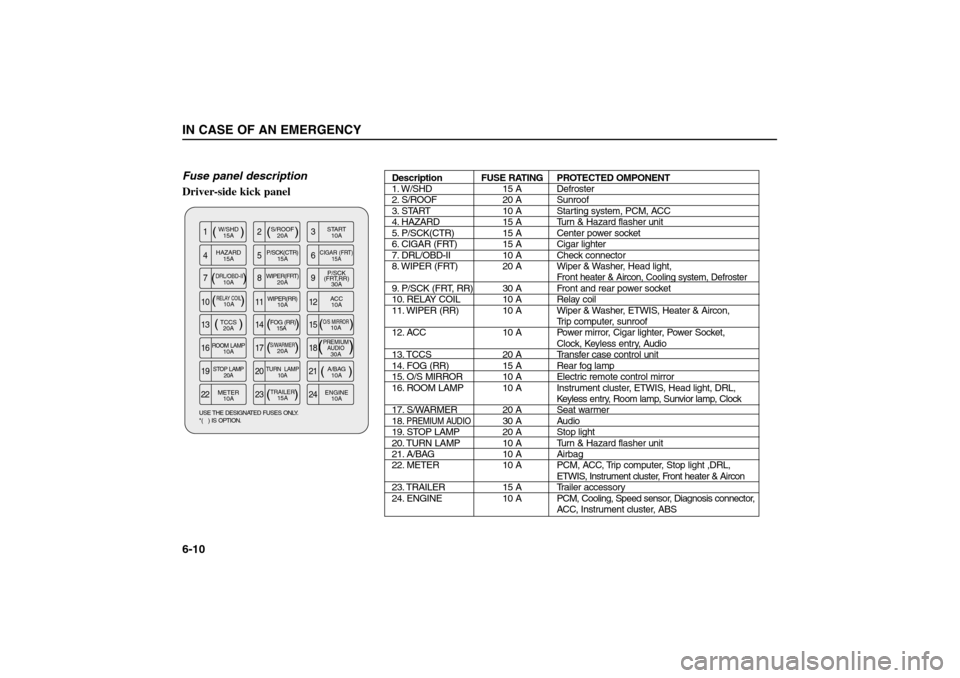
Fuse panel description
Driver-side kick panelIN CASE OF AN EMERGENCY6-10
( )
( ) (
) ( ) ( )
( )
W/SHD
15AS/ROOF
20A
( )PREMIUM
AUDIO30A
( )S/WARMER20A
(
)
O/S MIRROR10A
(
)
RELAY COIL10ASTART
10A
METER
10AENGINE
10A HAZARD
15AP/SCK(CTR)
15A
CIGAR (FRT)
15A
DRL/OBD-II10AWIPER(FRT)
20A
TCCS
20AROOM LAMP10A FOG (RR)
15AP/SCK
(FRT,RR)
30ASTOP LAMP
20ATURN LAMP
10A
A/BAG
10A
( )TRAILER15A WIPER(RR)
10AACC
10A
22 23 24 19 20 21
16 17 18
13 14 15 10 11 12789 456 123USE THE DESIGNATED FUSES ONLY.
*( ) IS OPTION.
Description FUSE RATING PROTECTED OMPONENT
1. W/SHD 15 A Defroster
2. S/ROOF 20 A Sunroof
3. START 10 A Starting system, PCM, ACC
4. HAZARD 15 A Turn & Hazard flasher unit
5. P/SCK(CTR) 15 A Center power socket
6. CIGAR (FRT) 15 A Cigar lighter
7. DRL/OBD-II 10 A Check connector
8. WIPER (FRT) 20 A Wiper & Washer, Head light,
Front
heater & Aircon, Cooling system, Defroster
9. P/SCK (FRT, RR) 30 A Front and rear power socket
10. RELAY COIL 10 A Relay coil
11. WIPER (RR) 10 A Wiper & Washer, ETWIS, Heater & Aircon,
Trip computer, sunroof
12. ACC 10 A Power mirror, Cigar lighter, Power Socket,
Clock, Keyless entry, Audio
13. TCCS 20 A Transfer case control unit
14. FOG (RR) 15 A Rear fog lamp
15. O/S MIRROR 10 A Electric remote control mirror
16. ROOM LAMP 10 A Instrument cluster, ETWIS, Head light, DRL,
Keyless entry, Room lamp, Sunvior lamp, Clock
17. S/WARMER 20 A Seat warmer
18.
PREMIUM AUDIO
30 A Audio
19. STOP LAMP 20 A Stop light
20. TURN LAMP 10 A Turn & Hazard flasher unit
21. A/BAG 10 A Airbag
22. METER 10 A PCM, ACC, Trip computer, Stop light ,DRL,
ETWIS, Instrument cluster, Front heater & Aircon
23. TRAILER 15 A Trailer accessory
24. ENGINE 10 APCM, Cooling, Speed sensor, Diagnosis connector,
ACC, Instrument cluster, ABS
BL-ENG (CAN)-6.qxd 7/28/05 5:57 PM Page 10
Page 295 of 312
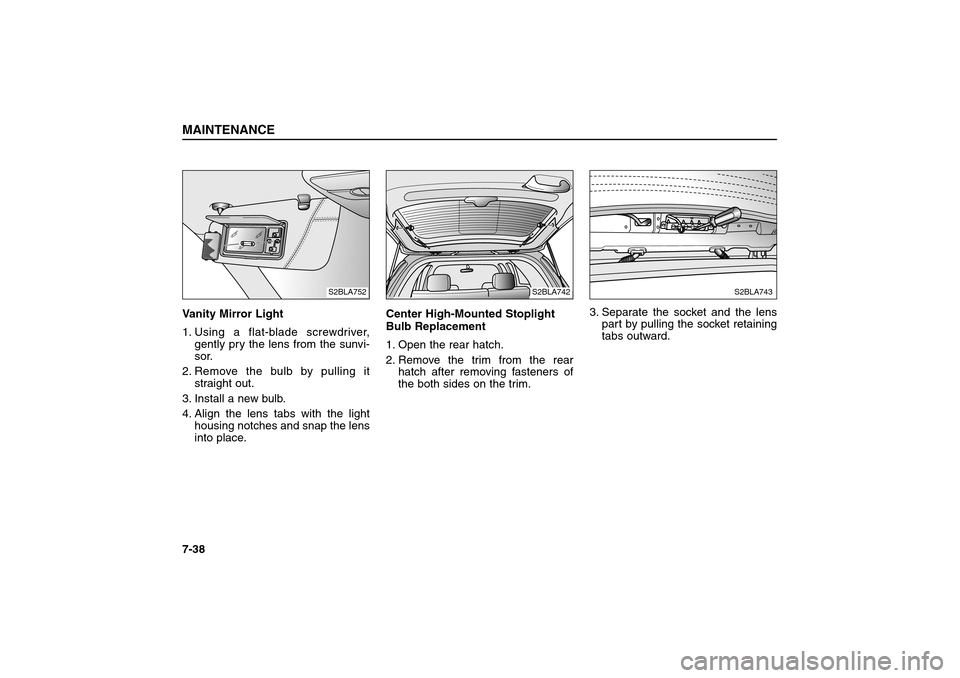
Vanity Mirror Light
1. Using a flat-blade screwdriver,
gently pry the lens from the sunvi-
sor.
2. Remove the bulb by pulling it
straight out.
3. Install a new bulb.
4. Align the lens tabs with the light
housing notches and snap the lens
into place.Center High-Mounted Stoplight
Bulb Replacement
1. Open the rear hatch.
2. Remove the trim from the rear
hatch after removing fasteners of
the both sides on the trim.3. Separate the socket and the lens
part by pulling the socket retaining
tabs outward.MAINTENANCE7-38
S2BLA742
S2BLA743
S2BLA752
BL-ENG (CAN)-7.qxd 7/28/05 5:58 PM Page 38
Page 307 of 312
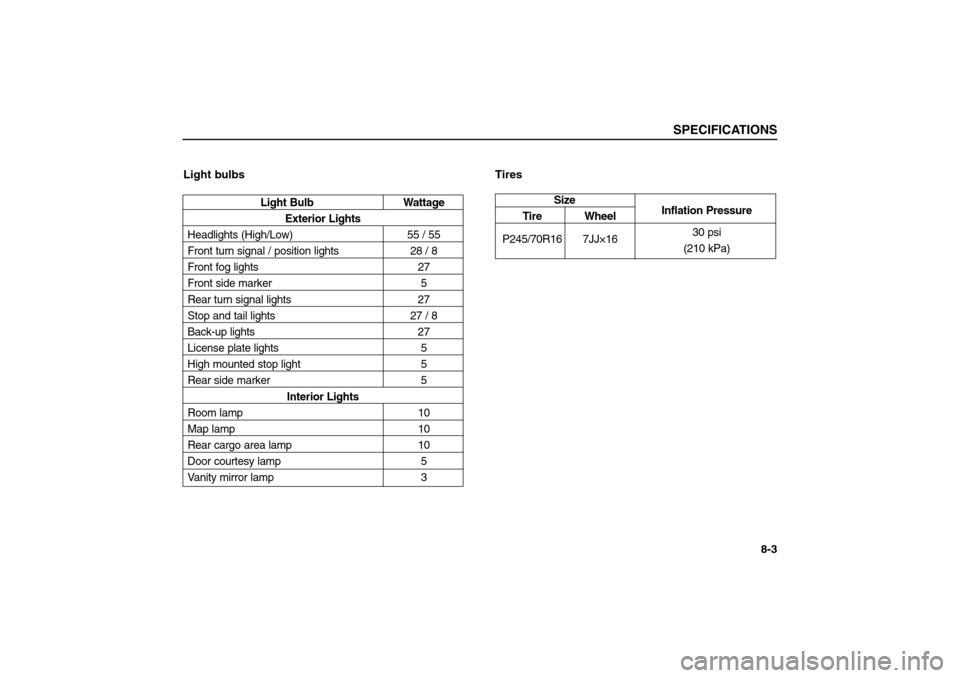
SPECIFICATIONS
8-3
Light bulbs Tires
Light Bulb Wattage
Exterior Lights
Headlights (High/Low) 55 / 55
Front turn signal / position lights 28 / 8
Front fog lights 27
Front side marker 5
Rear turn signal lights 27
Stop and tail lights 27 / 8
Back-up lights 27
License plate lights 5
High mounted stop light 5
Rear side marker 5
Interior Lights
Room lamp 10
Map lamp 10
Rear cargo area lamp 10
Door courtesy lamp 5
Vanity mirror lamp 3
Size
Tire WheelInflation Pressure
P245/70R16 7JJ×1630 psi
(210 kPa)
BL-ENG (CAN)-8.qxd 7/28/05 5:59 PM Page 3
Page 311 of 312
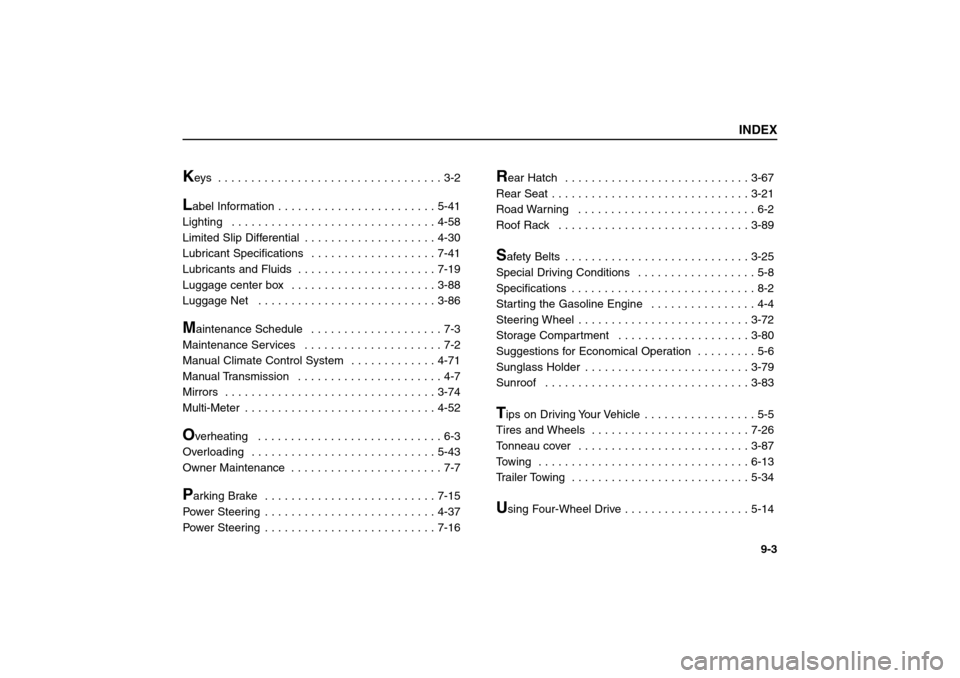
K
eys . . . . . . . . . . . . . . . . . . . . . . . . . . . . . . . . . . 3-2
Label Information . . . . . . . . . . . . . . . . . . . . . . . . 5-41
Lighting . . . . . . . . . . . . . . . . . . . . . . . . . . . . . . . 4-58
Limited Slip Differential . . . . . . . . . . . . . . . . . . . . 4-30
Lubricant Specifications . . . . . . . . . . . . . . . . . . . 7-41
Lubricants and Fluids . . . . . . . . . . . . . . . . . . . . . 7-19
Luggage center box . . . . . . . . . . . . . . . . . . . . . . 3-88
Luggage Net . . . . . . . . . . . . . . . . . . . . . . . . . . . 3-86M
aintenance Schedule . . . . . . . . . . . . . . . . . . . . 7-3
Maintenance Services . . . . . . . . . . . . . . . . . . . . . 7-2
Manual Climate Control System . . . . . . . . . . . . . 4-71
Manual Transmission . . . . . . . . . . . . . . . . . . . . . . 4-7
Mirrors . . . . . . . . . . . . . . . . . . . . . . . . . . . . . . . . 3-74
Multi-Meter . . . . . . . . . . . . . . . . . . . . . . . . . . . . . 4-52
O
verheating . . . . . . . . . . . . . . . . . . . . . . . . . . . . 6-3
Overloading . . . . . . . . . . . . . . . . . . . . . . . . . . . . 5-43
Owner Maintenance . . . . . . . . . . . . . . . . . . . . . . . 7-7
Parking Brake . . . . . . . . . . . . . . . . . . . . . . . . . . 7-15
Power Steering . . . . . . . . . . . . . . . . . . . . . . . . . . 4-37
Power Steering . . . . . . . . . . . . . . . . . . . . . . . . . . 7-16
R
ear Hatch . . . . . . . . . . . . . . . . . . . . . . . . . . . . 3-67
Rear Seat . . . . . . . . . . . . . . . . . . . . . . . . . . . . . . 3-21
Road Warning . . . . . . . . . . . . . . . . . . . . . . . . . . . 6-2
Roof Rack . . . . . . . . . . . . . . . . . . . . . . . . . . . . . 3-89
Safety Belts . . . . . . . . . . . . . . . . . . . . . . . . . . . . 3-25
Special Driving Conditions . . . . . . . . . . . . . . . . . . 5-8
Specifications . . . . . . . . . . . . . . . . . . . . . . . . . . . . 8-2
Starting the Gasoline Engine . . . . . . . . . . . . . . . . 4-4
Steering Wheel . . . . . . . . . . . . . . . . . . . . . . . . . . 3-72
Storage Compartment . . . . . . . . . . . . . . . . . . . . 3-80
Suggestions for Economical Operation . . . . . . . . . 5-6
Sunglass Holder . . . . . . . . . . . . . . . . . . . . . . . . . 3-79
Sunroof . . . . . . . . . . . . . . . . . . . . . . . . . . . . . . . 3-83Tips on Driving Your Vehicle . . . . . . . . . . . . . . . . . 5-5
Tires and Wheels . . . . . . . . . . . . . . . . . . . . . . . . 7-26
Tonneau cover . . . . . . . . . . . . . . . . . . . . . . . . . . 3-87
Towing . . . . . . . . . . . . . . . . . . . . . . . . . . . . . . . . 6-13
Trailer Towing . . . . . . . . . . . . . . . . . . . . . . . . . . . 5-34U
sing Four-Wheel Drive . . . . . . . . . . . . . . . . . . . 5-14
INDEX
9-3
BL-ENG (CAN)-9.qxd 7/28/05 5:59 PM Page 3