change time KIA Sorento 2006 1.G Owner's Manual
[x] Cancel search | Manufacturer: KIA, Model Year: 2006, Model line: Sorento, Model: KIA Sorento 2006 1.GPages: 312, PDF Size: 5.21 MB
Page 2 of 312
Thank you for choosing a Kia vehicle.
When you require service, remember that your dealer
knows your vehicle best. Your dealer has factory-trained
technicians, recommended special tools, genuine Kia
replacement parts and is dedicated to your complete
satisfaction.
Because subsequent owners require this important
information as well, this publication should remain with
the vehicle if it is sold.
This manual will familiarize you with operational, main-
tenance and safety information about your new vehicle.
It is supplemented by a Warranty & Consumer
Information Manual that provides important information
on all warranties regarding your vehicle. If your vehicle is
equipped with an audio system, you will also receive a
Kia Integrated Audio System Manual. We urge you to
read these manuals carefully.
Kia offers a great variety of options, components and
features for its various models.Therefore, the equipment described in this manual,
along with the various illustrations, may not all be appli-
cable to your particular vehicle. The information and
specifications provided in this manual were accurate at
the time of printing. Kia reserves the right to discontinue
or change specifications or design at any time without
notice and without incurring any obligation. If you have
questions, always check with your Kia Dealer.
We assure you of our continuing interest in your motor-
ing pleasure and satisfaction in your Kia vehicle.
© 2005 Kia Motors Corp.
All rights reserved. Reproduction by any means, elec-
tronic or mechanical, including photocopying, recording,
or by any information storage and retrieval system or
translation in whole or part is not permitted without writ-
ten authorization from Kia Motors Corporation.
Printed in KoreaFOREWORDi
BL-ENG (CAN)-foreword.qxd 8/8/2005 10:40 AM Page 2
Page 13 of 312
Limp home (override) procedure
When you turn the ignition key to the
ON position, if the IMMO indicator
remains on continuously after blink-
ing 6 times, the transponder installed
in the ignition key is out of order. You
cannot start the engine without using
the limp home procedure. To start the
engine, you have to input your pass-
word using the ignition switch.The following procedure shows how
to input a sample password of “2345.”
1. Turn the ignition key to the ON
position. The IMMO indicator will
blink 6 times and remain on indi-
cating the beginning of the limp
home procedure.
2. Turn the ignition key to the ACC
position.
3. To enter the first digit (in this exam-
ple “2”), turn the ignition key to the
ON and ACC position twice. Wait 3
seconds but not more than 10 sec-
onds, and perform the same pro-
cedure for the next digits (for
example, for “3”, turn the ignition to
ON and ACC 3 times).
4. If all of the digits have been input
successfully, you have to start the
engine within 10 seconds. If you
attempt to start the engine after 10
seconds, the engine will not start
and you will have to input your
password again.After performing the limp home pro-
cedure, you have to see an author-
ized Kia dealer immediately to
inspect and repair your ignition key or
immobilizer system.KNOWING YOUR VEHICLE3-4
CAUTION
If you cannot start your engine
in spite of the limp home proce-
dure, have your vehicle towed
by an authorized Kia dealer for
inspection and necessary
repairs.
CAUTION
Do not change, alter or adjust
the immobilizer system at your
discretion. It could cause the
malfunction of your immobilizer
system. A malfunction resulting
from the changing, altering
and/or adjusting by persons
other than an authorized Kia
dealer will not be covered by
the Kia Warranty.
BL-ENG (CAN)-3.qxd 7/28/05 5:52 PM Page 4
Page 118 of 312
FOUR WHEEL DRIVE (4WD)For Safe Four-Wheel Drive Operation
Your vehicle allows you to drive in
on-road and off-road conditions.
However, do not try to drive in deep
standing water, mud, or over steep
hills.
When you are driving up or down
hills drive as close to straight up
and down the hill as possible. Use
extreme caution in going up or
down steep hills, since you may flip
your vehicle over depending on the
grade, terrain and water/mud con-
ditions.You must learn how to corner in a
4WD vehicle as soon as possible.
Do not rely on your experience in
conventional 2WD vehicles in
choosing safe cornering speed. You
must drive more slowly.
Drive off-road carefully because
your vehicle may be damaged by
rocks or roots of trees. Become
familiar with the off-road conditions
you are going to drive before you
start.DRIVING YOUR VEHICLE4-20
WARNING- Four Wheel Drive
Driving across the contour of
steep hills can be extremely
dangerous. This danger can
come from slight changes in the
wheel angle which can destabi-
lize the vehicle or, even if the
vehicle is maintaining stability
under power, it can lose that
stability if the vehicle stops its
forward motion. Your vehicle
may roll over without warning
and without time for you to cor-
rect a mistake that could cause
serious injury or death.
CAUTION
Do not grab inside of the steer-
ing wheel when you are driving
off-road. Your arm may be hurt
by a sudden steering maneuver
or from steering wheel rebound
due to impact with objects on
the ground. This may cause you
to lose steering wheel control.
BL-ENG (CAN)-4.qxd 7/28/05 5:55 PM Page 20
Page 124 of 312
For Safe Four-Wheel Drive
Operation
Your vehicle allows you to drive in
on-road and off-road conditions.
However, do not try to drive in deep
standing water, mud, or over steep
hills.
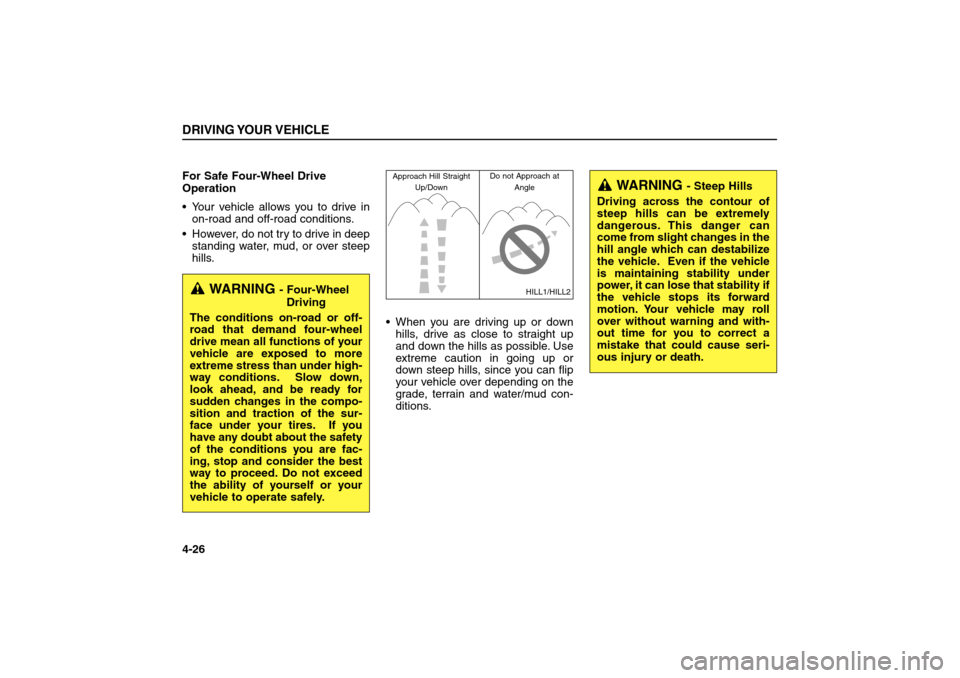
When you are driving up or down
hills, drive as close to straight up
and down the hills as possible. Use
extreme caution in going up or
down steep hills, since you can flip
your vehicle over depending on the
grade, terrain and water/mud con-
ditions.DRIVING YOUR VEHICLE4-26
WARNING
- Four-Wheel
Driving
The conditions on-road or off-
road that demand four-wheel
drive mean all functions of your
vehicle are exposed to more
extreme stress than under high-
way conditions. Slow down,
look ahead, and be ready for
sudden changes in the compo-
sition and traction of the sur-
face under your tires. If you
have any doubt about the safety
of the conditions you are fac-
ing, stop and consider the best
way to proceed. Do not exceed
the ability of yourself or your
vehicle to operate safely.
WARNING
- Steep Hills
Driving across the contour of
steep hills can be extremely
dangerous. This danger can
come from slight changes in the
hill angle which can destabilize
the vehicle. Even if the vehicle
is maintaining stability under
power, it can lose that stability if
the vehicle stops its forward
motion. Your vehicle may roll
over without warning and with-
out time for you to correct a
mistake that could cause seri-
ous injury or death.
HILL1/HILL2 Approach Hill Straight
Up/DownDo not Approach at
Angle
BL-ENG (CAN)-4.qxd 7/28/05 5:55 PM Page 26
Page 154 of 312
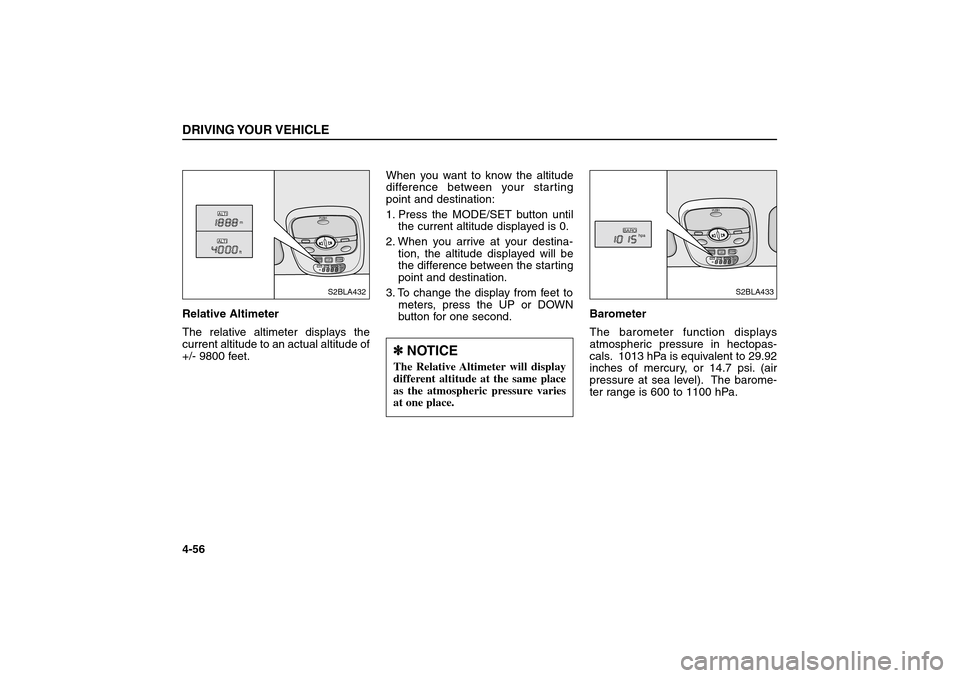
Relative Altimeter
The relative altimeter displays the
current altitude to an actual altitude of
+/- 9800 feet.When you want to know the altitude
difference between your starting
point and destination:
1. Press the MODE/SET button until
the current altitude displayed is 0.
2. When you arrive at your destina-
tion, the altitude displayed will be
the difference between the starting
point and destination.
3. To change the display from feet to
meters, press the UP or DOWN
button for one second.Barometer
The barometer function displays
atmospheric pressure in hectopas-
cals. 1013 hPa is equivalent to 29.92
inches of mercury, or 14.7 psi. (air
pressure at sea level). The barome-
ter range is 600 to 1100 hPa.DRIVING YOUR VEHICLE4-56
DRT ALTI BARO
E
hpa
m
ft
PUSHMODE
/SETUPDOWN
m
ft
ALTIALTI
S2BLA432
DRT ALTI BARO
E
hpa
m
ft
PUSHMODE
/SETUPDOWN
hpa
BARO
S2BLA433
✽ ✽
NOTICEThe Relative Altimeter will display
different altitude at the same place
as the atmospheric pressure varies
at one place.
BL-ENG (CAN)-4.qxd 7/28/05 5:55 PM Page 56
Page 176 of 312
Air Conditioning System
Operation Tips
If the vehicle has been parked in
direct sunlight during hot weather,
open the windows for a short time
to let the hot air inside the vehicle
escape.
To help reduce moisture inside of
windows on rainy humid days,
decrease the humidity inside the
vehicle by operating the air condi-
tioning system.
During air conditioning system
operation, you may occasionally
notice a slight change in engine
speed at idle as the air conditioning
compressor cycles on. This is a
normal system operation charac-
teristics.
Use the air conditioning system
every month if only for a few min-
utes.After the use of the air conditioning
system, you may notice clear water
dripping (or even pudding) on the
ground under the passenger side
of the vehicle. This is a normal sys-
tem operation characteristics.
The air conditioning system
includes a function that will auto-
matically turns the air conditioning
compressor off if engine coolant
temperature approaches an over
heating level. The air conditioning
compressor operation will resume
once engine coolant temperature
returns to the normal range. Also,
the air conditioning compressor is
automatically turned off for a few
seconds when the accelerator is
fully depressed.
When operating the air conditioning
system use the outside (fresh) air
position.Operating the air conditioning sys-
tem in the recirculated air position
does provide maximum cooling,
however, continual operation in this
mode may cause the air inside the
vehicle to become stale.DRIVING YOUR VEHICLE4-78
BL-ENG (CAN)-4.qxd 7/28/05 5:55 PM Page 78
Page 208 of 312
Approaching a hill
When you approach a hill, you need
to decide if it’s one of those hills that’s
just too steep to climb, descend, or
cross. Steepness can be difficult to
judge. On a very small hill, for exam-
ple, there may be a smooth, constant
incline with only a small change in
elevation where you can easily see
all the way to the top. On a large hill,
the incline may get steeper as you
near the top, but you may not see this
because the crest of the hill is hidden
by bushes, grass, or shrubs.
Here are some other things to con-
sider as you approach a hill:
Is there a constant incline, or does
the hill get sharply steeper in
places?
Is there good traction on the hill-
side, or will the surface cause tire
slipping? Is there a straight path up or down
the hill so you won’t have to make
turning maneuvers?
Are there obstructions on the hill
that can block your path (boulders,
trees, logs or ruts)?
What’s beyond the hill? Is there a
cliff, an embankment, a drop-off, or
a fence? Get out of the vehicle and
walk the hill if you are unsure. It’s
the smart way to find out.
Is the hill simply too rough? Steep
hills often have ruts, gullies,
troughs, and exposed rocks
because they are more susceptible
to the effects of erosion.
How have weather conditions
affected the terrain? Is there likely
to be mud, snow or ice on the hill?
What time of day is it? Are temper-
atures dropping so that wet sur-
faces will start to freeze?
DRIVING TIPS
5-21
WARNING- Driving on Hills
Many hills are simply too steep
for any vehicle. If you drive up
them, you will stall. If you drive
down them, you can’t control
your speed. In either case, you
could flip over. If you drive
across them, you will roll over.
You could be seriously or fatal-
ly injured. If you have any doubt
about the steepness, don’t drive
up or down the hill, even if it
means that you have to turn
around and find another route.
Re-tracking is a normal part of
safe off-roading.
BL-ENG (CAN)-5.qxd 7/28/05 5:56 PM Page 21
Page 212 of 312
Driving Downhill
When off-roading takes you downhill,
you’ll want to consider many of the
same things you thought about
before you went uphill. As a brief
reminder, those include:
How steep is the downhill? Will I be
able to maintain vehicle control?
What’s the surface like? Smooth?
Rough? Slippery? Hard-packed
dirt? Gravel?
Are there hidden surface obsta-
cles? Ruts? Logs? Boulders?
What’s at the bottom of the hill? Is
there a hidden creek bank or even
a river bottom with large rocks?
Have changes in the weather con-
ditions and their effect on the ter-
rain since you went uphill made
your task more difficult?Once you have decided that you can
go down a hill safely, try to keep your
vehicle headed straight down, and
use a low gear. This way, engine
braking can help your brakes so they
won’t have to do all the work.
Descend slowly, keeping your vehicle
under control at all times.
DRIVING TIPS
5-25
WARNING- Exiting Vehicle
Getting out on the downhill
(low) side of a vehicle stopped
across an incline is dangerous.
If the vehicle rolls over, you
could be crushed or fatally
injured. Always get out on the
uphill (high) side of the vehicle
and stay well clear of the
rollover path.WARNING - Leaving Vehicle
If you are going to leave your
vehicle, set the parking brake
and shift a manual transmission
to 1(First), or an automatic
transmission to P (Park).
BL-ENG (CAN)-5.qxd 7/28/05 5:56 PM Page 25
Page 221 of 312
TRAILER TOWINGYour vehicle can tow a trailer. To iden-
tify what the vehicle trailering capaci-
ty is for your vehicle, you should read
the information in “Weight of the
Trailer’’ that appears later in this sec-
tion. Remember that trailering is dif-
ferent than just driving your vehicle
by itself. Trailering means changes in
handling, durability, and fuel econo-
my. Successful, safe trailering takes
correct equipment, and it has to be
used properly.This section contains many time-test-
ed, important trailering tips and safe-
ty rules. Many of these are important
for your safety and that of your pas-
sengers. Please read this section
carefully before you pull a trailer.
Load-pulling components such as the
engine, transmission, wheel assem-
blies, and tires are forced to work
harder against the load of the added
weight. The engine is required to
operate at relatively higher speeds
and under greater loads. This addi-
tional burden generates extra heat.
The trailer also adds considerably to
wind resistance, further increasing
the pulling requirements.If You Do Decide to Pull a Trailer
Here are some important points if you
decide to pull a trailer:
State, provincial, county and
municipal government have varying
trailering laws. Make sure your
hitch, mirrors, lights and wiring
arrangements are legal, not only
where you live, but also where
you’ll be driving. A good source for
this information is provincial or local
law enforcement agencies.
Consider using a sway control. You
can ask a hitch dealer about sway
control.
After your odometer indicates 800
km or more, you can tow a trailer.
For the first 800 km that you tow a
trailer, don’t drive over 80 km/h and
don’t make starts at full throttle.
This helps your engine and other
parts of your vehicle “wear” in at the
heavier loads.
Always drive at a safe speed (less
than 100 km/h) commensurate with
road conditions.
Three important considerations
have to do with weight:DRIVING TIPS5-34✽ ✽
NOTICEPulling a trailer improperly can
damage your vehicle and result in
costly repairs not covered by your
warranty. To pull a trailer correct-
ly, follow the advice in this section.
BL-ENG (CAN)-5.qxd 7/28/05 5:56 PM Page 34
Page 226 of 312
Backing up
Hold the bottom of the steering wheel
with one hand. Then, to move the
trailer to the left, just move your hand
to the left. To move the trailer to the
right, move your hand to the right.
Always back up slowly and, if possi-
ble, have someone guide you.
Making turns
When you’re turning with a trailer,
make wider turns than normal. Do
this so your trailer won’t strike soft
shoulders, curbs, road signs, trees,
or other objects. Avoid jerky or sud-
den maneuvers. Signal well in
advance.Turn signals when towing a trailer
When you tow a trailer, your vehicle
has to have a different turn signal
flasher and extra wiring.
The green arrows on your instrument
panel will flash whenever you signal a
turn or lane change. Properly con-
nected, the trailer lights will also flash
to alert other drivers that you’re about
to turn, change lanes, or stop.
When towing a trailer, the green
arrows on your instrument panel will
flash for turns even if the bulbs on the
trailer are burned out. Thus, you may
think drivers behind you are seeing
your signals when, in fact, they are
not. It’s important to check occasion-
ally to be sure the trailer bulbs are still
working. You must also check the
lights every time you disconnect and
then reconnect the wires.Do not connect a trailer lighting sys-
tem directly to your vehicle’s lighting
system.
Use only an approved trailer wiring
harness. Your authorized Kia dealer
can assist you in installing the wiring
harness.
DRIVING TIPS
5-39
WARNING
Using an improper trailer wiring
harness could lead to malfunc-
tioning of your vehicles electri-
cal system and a possible acci-
dent.
BL-ENG (CAN)-5.qxd 7/28/05 5:56 PM Page 39