tires KIA Sorento 2007 1.G User Guide
[x] Cancel search | Manufacturer: KIA, Model Year: 2007, Model line: Sorento, Model: KIA Sorento 2007 1.GPages: 325, PDF Size: 5.01 MB
Page 229 of 325
521
Driving tips
Stalling downhillStalling is much more likely to happen
going uphill. But if it happens going
downhill, here’s what to do.
Stop your vehicle by applying thebrakes. Then apply the parking brake.
Move the shift lever to P (Park) in auto- matic transmission or shift to N
(Neutral) in manual transmission and,
while still braking, restart the engine.
Shift back to a low gear, release the parking brake, and drive straight down.
If the engine won’t start, get out and seek help. Exit on the uphill side of the
vehicle and stay clear of the path the
vehicle would take if it rolled downhill.
Driving across an inclineSooner or later, an off-road trail will prob-
ably go across the incline of a hill. If this
happens, you have to decide whether or
not to try to drive across the incline. Here
are some things to consider:
A hill that can be driven straight up ordown may be too steep to drive across.
When you go straight up or down a hill,
the length of the wheel base (the dis-
tance from the front wheels to the rear
wheels) reduces the likelihood the
vehicle will tumble end over end. But
when you drive across an incline, the
much narrower track width (the dis-
tance between the left and right
wheels) may not prevent the vehicle
from tilting and rolling over. Also, driv-
ing across an incline puts more weight
on the downhill wheels. This could
cause a downhill slide or a rollover.
Surface conditions can be a problem when you drive across a hill. Loose
gravel, muddy spots, or even wet grass
can cause your tires to slip sideways. If
the vehicle slips sideways, it can hit
something that will tip it (a rock, a rut,
etc.) and cause it to roll over. Hidden obstacles can make the steep-
ness of the incline even worse. If you
drive across a rock with the uphill
wheels, or if the downhill wheels drop
into a rut or depression, your vehicle
can tilt even more.
For reasons like these, you need to
decide carefully whether or not to try to
drive across an incline. Just because the
trail goes across the incline doesn’t
mean you have to drive it.
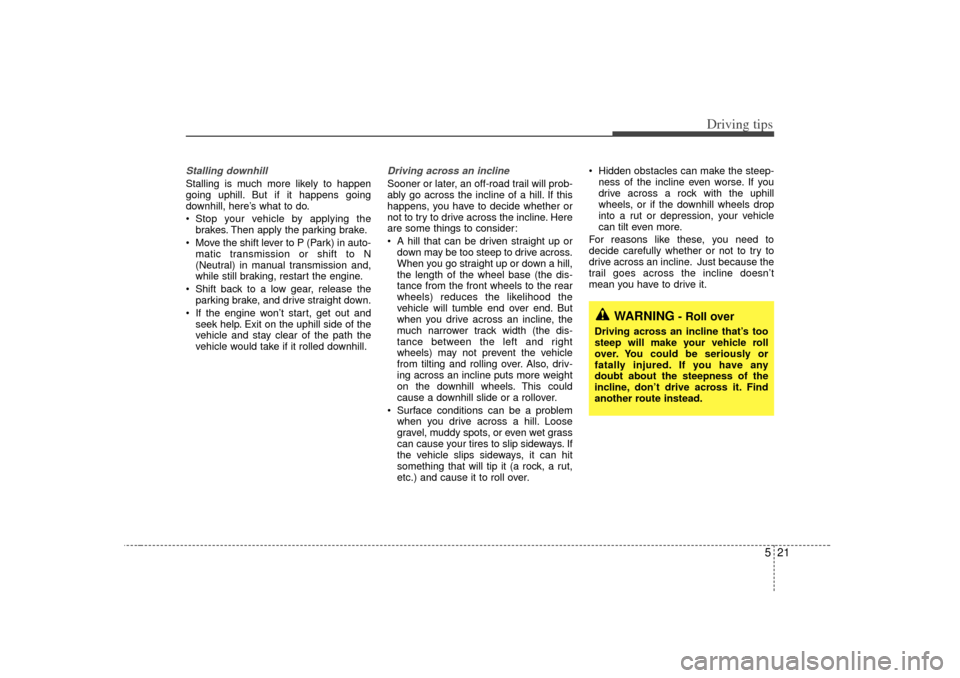
WARNING
- Roll over
Driving across an incline that’s too
steep will make your vehicle roll
over. You could be seriously or
fatally injured. If you have any
doubt about the steepness of the
incline, don’t drive across it. Find
another route instead.
Page 230 of 325
Driving tips22
5If your vehicle slides downhillIf you feel your vehicle starting to slide
sideways, turn downhill immediately. This
should help straighten out the vehicle
and prevent the side slipping. However, a
much better way to prevent this is to get
out and “walk the course” first so you
know what the surface is like before you
drive it.Stalling while crossing an inclineIf your vehicle stalls when you’re crossing
an incline, be sure you (and your pas-
sengers) get out on the uphill side, even
if that door is harder to open. If you get
out on the downhill side and the vehicle
starts to roll over, you’ll be in its path.
If you have to walk down the slope, stay
out of the path the vehicle will take if it
does roll over.
Driving in mud, sand, snow, or iceWhen you drive in mud, sand, snow, or
ice, your wheels won’t get good traction.
You can’t accelerate as quickly, turning is
more difficult, and you’ll need longer
braking distances.
It’s best to use a low gear when you’re in
mud, the deeper the mud, the lower the
gear. In extremely deep mud, the idea is
to keep your vehicle moving so you don’t
get stuck.
When you drive on sand, you’ll sense a
change in wheel traction. But it will
depend upon how loosely packed the
sand is. On loosely packed sand (as on
beaches or sand dunes) your tires will
tend to sink into the sand. This has an
effect on steering, accelerating, and
braking. You may want to reduce the air
pressure in your tires slightly when driv-
ing on sand. This will improve traction.
Remember to re-inflate them the first
chance that you have after you leave the
loosely packed sand.
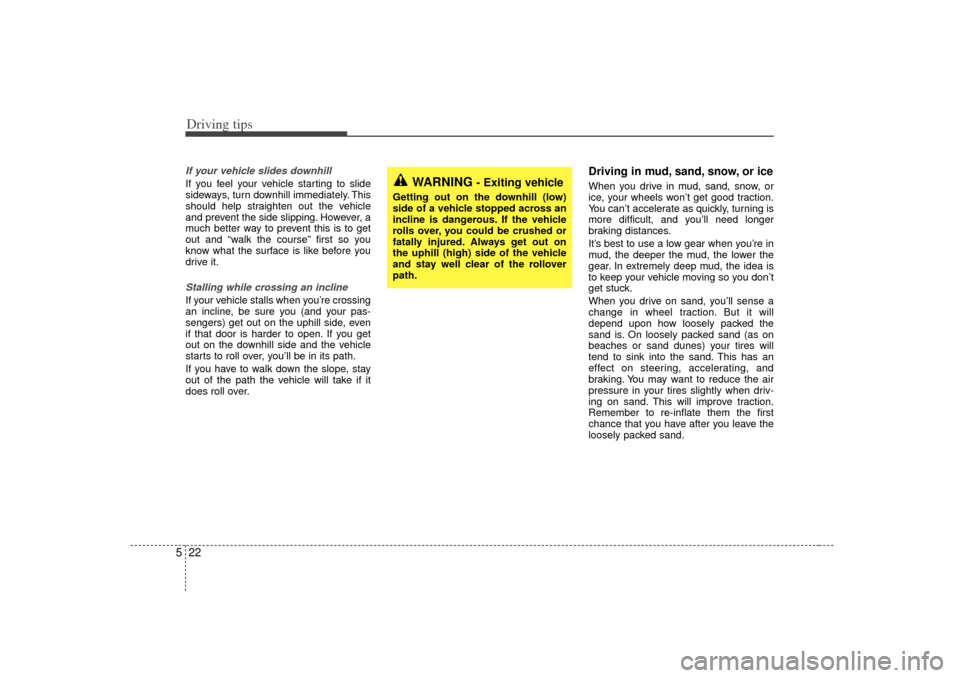
WARNING
- Exiting vehicle
Getting out on the downhill (low)
side of a vehicle stopped across an
incline is dangerous. If the vehicle
rolls over, you could be crushed or
fatally injured. Always get out on
the uphill (high) side of the vehicle
and stay well clear of the rollover
path.
Page 231 of 325
523
Driving tips
Hard-packed snow and ice offer the
worst tire traction. On these surfaces, it’s
very easy to lose control. On wet ice, for
example, the traction is so poor that you
will even have difficulty accelerating. And
if you do get moving, poor steering and
difficult braking can easily cause you to
slide out of control.
Driving in waterLight rain causes no special off-road driv-
ing problems. However, heavy rain can
cause flash flooding, and flood waters
demand extreme caution.
Find out how deep the water is before
you drive through it. If it’s deep enough to
cover your wheel bearing hubs, axles, or
exhaust pipe, don’t try it, You probably
won’t get through. Also, water that deep
can damage your axle and other vehicle
parts.
If the water isn’t too deep, then drive
through slowly. At fast speeds, water can
splash on your ignition system and your
vehicle can stall. Stalling can also occur
if your tailpipe goes underwater. As long
as your tailpipe is underwater, you will
not be able to start your engine. When
you go through water, remember that it
may take you longer to stop when your
brakes are wet.
If you have driven through water that was
deep enough to cover your wheel bear-
ing hubs, it may be a good idea to have
an Authorized Kia dealer or other com-
petent service center repack your front
wheel bearings and examine your rear-
end fluid for evidence of water.
CAUTION
In case of loss of traction in mud,loose soil, or sand, turn the steer-ing wheel rapidly from side-to-side. This can help generate addi- tional traction.
Do not gun the engine. This will cause the tires to spin and digdown, not forward, and couldbury the vehicle to the frame. Smooth, easy power is betterthan too much power.
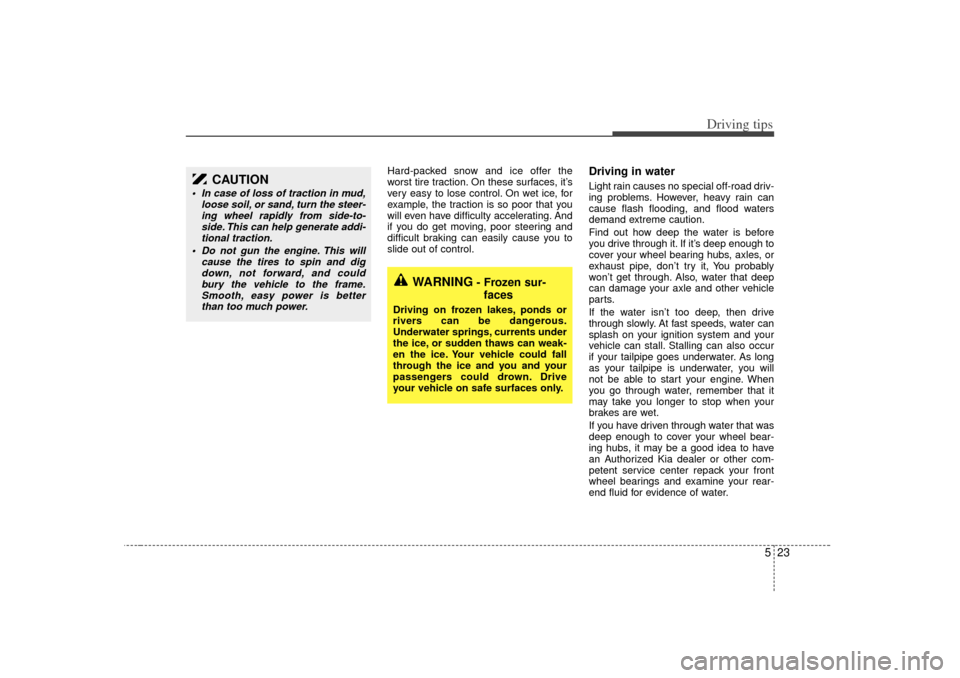
WARNING
- Frozen sur-
faces
Driving on frozen lakes, ponds or
rivers can be dangerous.
Underwater springs, currents under
the ice, or sudden thaws can weak-
en the ice. Your vehicle could fall
through the ice and you and your
passengers could drown. Drive
your vehicle on safe surfaces only.
Page 232 of 325
Driving tips24
5
After off-road drivingRemove any brush or debris that has col-
lected on the underbody, chassis or
under the hood. These accumulations
can be a fire hazard.
After driving in mud or sand, clean and
check the brake linings. Accumulation of
mud or sand can cause glazing and
uneven braking. Check the body struc-
ture, steering, suspension, wheels, tires,
and exhaust system for damage. Also,
check the fuel lines and cooling system
for any leakage. Your vehicle will also
require more frequent service due to off-
road use.
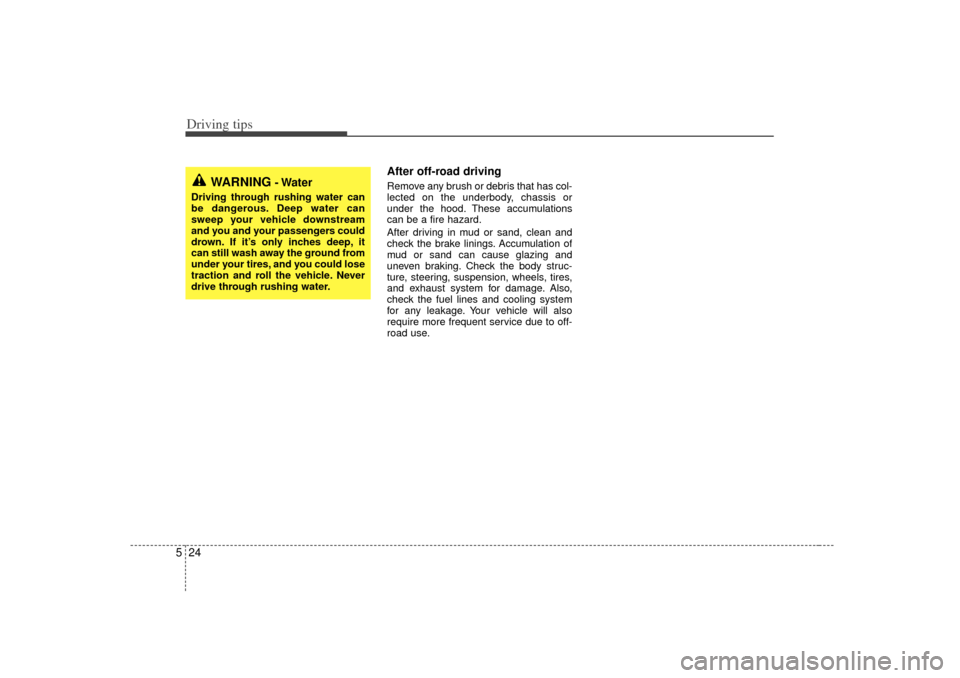
WARNING
- Water
Driving through rushing water can
be dangerous. Deep water can
sweep your vehicle downstream
and you and your passengers could
drown. If it’s only inches deep, it
can still wash away the ground from
under your tires, and you could lose
traction and roll the vehicle. Never
drive through rushing water.
Page 235 of 325
527
Driving tips
Refer to your vehicle’s tire and load-
ing information label for specific
information about your vehicle's
capacity weight and seating posi-
tions. The combined weight of the
driver, passengers and cargo should
never exceed your vehicle's capacity
weight.
Compliance labelThe compliance label is located on
the driver's door sill.
This label shows the maximum
allowable weight of the fully loaded
vehicle. This is called the GVWR
(Gross Vehicle Weight Rating). The
GVWR includes the weight of the
vehicle, all occupants, fuel and
cargo.
This label also tells you the maxi-
mum weight that can be supported
by the front and rear axles, called
Gross Axle Weight Rating (GAWR).
To find out the actual loads on your
front and rear axles, you need to go
to a weigh station and weigh your
vehicle. Your dealer can help you with
this. Be sure to spread out your load
equally on both sides of the center-
line.
WARNING -
Over loading
Never exceed the GVWR for your vehicle, the GAWR for
either the front or rear axle
and vehicle capacity weight.
Exceeding these ratings can
cause an accident or vehicle
damage. You can calculate the
weight of your load by weigh-
ing the items (or people)
before putting them in the
vehicle. Be careful not to over-
load your vehicle.
Do not load your vehicle any heavier than the GVWR, either
the maximum front or rear
GAWR and vehicle capacity
weight. If you do, parts, includ-
ing tires on your vehicle can
break, and it can change the
way your vehicle handles and
braking ability. This could
cause you to lose control and
crash. Also, overloading can
shorten the life of your vehi-
cle.
Page 240 of 325
Driving tips32
5Remember that trailering is different than
just driving your vehicle by itself.
Trailering causes major changes in han-
dling, durability, and fuel economy.
Successful, safe trailering requires cor-
rect equipment, and cautious driving.
This section contains many time-tested,
important trailering tips and safety rules.
Many of these are important for your
safety and that of your passengers.
Please read this section carefully before
you pull a trailer.
Load-pulling components such as the
engine, transmission, wheel assemblies,
and tires are forced to work harder
against the load of the added weight. The
engine is required to operate at relatively
higher speeds and under greater loads.
This additional burden generates extra
heat. The trailer also adds considerably
to wind resistance, increasing the pulling
requirements.
If you do decide to pull a trailerHere are some important points if you
decide to pull a trailer:
State, provincial, county and municipal
government have varying trailering
laws. Make sure your hitch, mirrors,
lights and wiring arrangements are
legal, not only where you live, but also
where you’ll be driving. A good source
for this information is state or local law
enforcement agencies.
Consider using a sway control. You can
ask a hitch dealer about sway control.
After your odometer indicates 800 km
(500 miles) or more, you can tow a
trailer. For the first 800 km (500 miles)
that you tow a trailer, don ’t drive over
80 km/h (50 mph) and don’t make
starts at full throttle. This helps your
engine and other parts of your vehicle
“wear” in at the heavier loads.
Always drive your vehicle at a moder-
ate speed (less than 100 km/h (60
mph)).
On a long uphill grade, do not exceed
70 km/h (45 mph) or the posted towing
speed limit, whichever is lower.
The important considerations have to
do with weight:
Weight of the trailerHow heavy can a trailer safely be? It
should never weigh more than the maxi-
mum trailer weight with trailer brakes. But
even that can be too heavy.
It depends on how you plan to use your
trailer. For example, speed, altitude, road
grades, outside temperature and how
much your vehicle is used to pull a trailer
are all important. The ideal trailer weight
can also depend on any special equip-
ment that you have on your vehicle.
Page 242 of 325
Driving tips34
5Safety chains You should always attach chains
between your vehicle and your trailer.
Cross the safety chains under the tongue
of the trailer so that the tongue will not
drop to the road if it becomes separated
from the hitch.
Instructions about safety chains may be
provided by the hitch manufacturer or by
the trailer manufacturer. Follow the man-
ufacturer’ s recommendation for attaching
safety chains. Always leave just enough
slack so you can turn with your trailer.
And, never allow safety chains to drag on
the ground.
Trailer brakes If your trailer weighs more than the max-
imum trailer weight without trailer brakes
loaded, then it needs its own brakes and
they must be adequate. Be sure to read
and follow the instructions for the trailer
brakes so you’ll be able to install, adjust
and maintain them properly.
Don’t tap into your vehicle's brake sys-
tem.
Driving with a trailer Towing a trailer requires a certain
amount of experience. Before setting out
for the open road, you must get to know
your trailer. Acquaint yourself with the
feel of handling and braking with the
added weight of the trailer. And always
keep in mind that the vehicle you are
driving is now a good deal longer and not
nearly so responsive as your vehicle is
by itself.
Before you start, check the trailer hitch
and platform, safety chains, electrical
connector(s), lights, tires and mirror
adjustment. If the trailer has electric
brakes, start your vehicle and trailer mov-
ing and then apply the trailer brake con-
troller by hand to be sure the brakes are
working. This lets you check your electri-
cal connection at the same time.
During your trip, check occasionally to be
sure that the load is secure, and that the
lights and any trailer brakes are still work-
ing.
WARNING -
Trailer brakes
Do not use a trailer with its own
brakes unless you are absolutely
certain that you have properly set
up the brake system. This is not a
task for amateurs. Use an experi-
enced, competent trailer shop for
this work.
Page 266 of 325

In case of an emergency18
6
than normal since you will have
reduced brake performance.
because the power steering system
will be disabled.
brakes may overheat and brake per-
formance will be reduced. Stop often
and let the brakes cool off.✽ ✽ NOTICETo prevent internal damage to the trans-
mission, never tow your vehicle from the
rear (backwards) with all four tires in
contact with the surface.
Tips for towing a stuck vehicleThe following methods are effective
when your vehicle is stuck in mud, sand
or similar substances that prevent the
vehicle from being driven out under its
own power.
Remove the soil and sand, etc. from
the front and the back of the tires.
Place a stone or wood under the tires.
Page 269 of 325
621
In case of an emergency
Changing tires Jacking instructions The jack is provided for emergency
tire changing only.
Follow jacking instructions to reduce
the possibility of personal injury.
WARNING
- Changingtires
Never attempt vehicle repairs in the traffic lanes of a public
road or highway.
Always move the vehicle com- pletely off the road and onto
the shoulder before trying to
change a tire. If you cannot
find a firm, level place off the
road, call a towing service
company for assistance.
Be sure to use the correct front and rear jacking posi-
tions on the vehicle; never use
the bumpers or any other part
of the vehicle for jack support.
The vehicle can easily roll off the jack causing serious
injury or death. Never allow
any portion of your body to
get beneath the vehicle while
using the jack.
(Continued)
(Continued)
Do not start or run the enginewhile the vehicle is on the
jack.
Do not allow anyone to remain in the vehicle while it is on the
jack.
Make sure any children pres- ent are in a secure place away
from the road and from the
vehicle to be raised with the
jack.
Page 270 of 325

In case of an emergency22
6Tire replacement 1. Park on a level surface and apply
the parking brake firmly.
2. Shift into R (Reverse) with manual transmission or P (Park) with auto-
matic transmission.
3. Activate the hazard warning flash- er. 4. Remove the wheel lug nut wrench,
jack, jack handle, and spare tire
from the vehicle.
5. Block both the front and rear of the wheel that is diagonally opposite
the jack position.
6. Loosen the wheel lug nuts coun-terclockwise one turn each, but do
not remove any nut until the tire
has been raised off the ground.
E2BLA618
E2BLA619A
WARNING
- Changing
tires
To prevent vehicle movements
while changing a tire, always set
the parking brake fully, and
always block the wheel diago-
nally opposite the wheel being
changed.