warning KIA Sorento 2008 1.G Owner's Guide
[x] Cancel search | Manufacturer: KIA, Model Year: 2008, Model line: Sorento, Model: KIA Sorento 2008 1.GPages: 326, PDF Size: 8.63 MB
Page 49 of 326

Knowing your vehicle
40 3
Installing a child restraint system
For safety reasons, we recommend that
the child restraint system be used in the
rear seats.
Never place a rear-facing child
restraint in the front passenger seat,
because of the danger that an inflat-
ing passenger side air bag could
impact the rear-facing child restraint
and kill the child.
Since all passenger safety belts move
freely under normal conditions and only
lock under extreme or emergency condi-
tions (emergency lock mode), you must
manually change these safety belts to
the auto lock mode to secure a child
restraint.(Continued)
• Never allow a child to stand up or
kneel while the vehicle is moving.
• Never use an infant carrier or
child seat that "hooks" over a
seatback. It will not provide ade-
quate protection in an accident.
• Never allow a child to be held
while they are in a moving vehi-
cle, as this could result in serious
injury to the child in the event of
an accident or a sudden stop.
Holding a child in a moving vehi-
cle does not provide the child
with any protection during an
accident, even if the person hold-
ing the child is wearing a seat
belt.WARNING-Child seat
installation
• Before installing the child
restraint system, read the instruc-
tions supplied by the child
restraint system manufacturer.
• If the safety belt does not operate
as described in this section, have
the system checked immediately
by your authorized Kia dealer.
• Failure to observe this manual's
instructions regarding child
restraint system and the instruc-
tions provided with the child
restraint system could increase
the chance and/or severity of
injury in an accident.
Page 52 of 326
343
Knowing your vehicle
7. Double check that the retractor is in
the “Auto Lock” mode by attempting to
pull more of the safety belt out of the
retractor. If you cannot, the retractor is
in the “Auto Lock” mode.
To remove the child restraint, press the
release button on the buckle and then
pull the lap/shoulder belt out of the
restraint and allow the safety belt to
retract fully.
When the safety belt is allowed to
retract to its fully stowed position, the
retractor will automatically switch
from the “Auto Lock” mode to the
emergency lock mode for normal
adult usage.
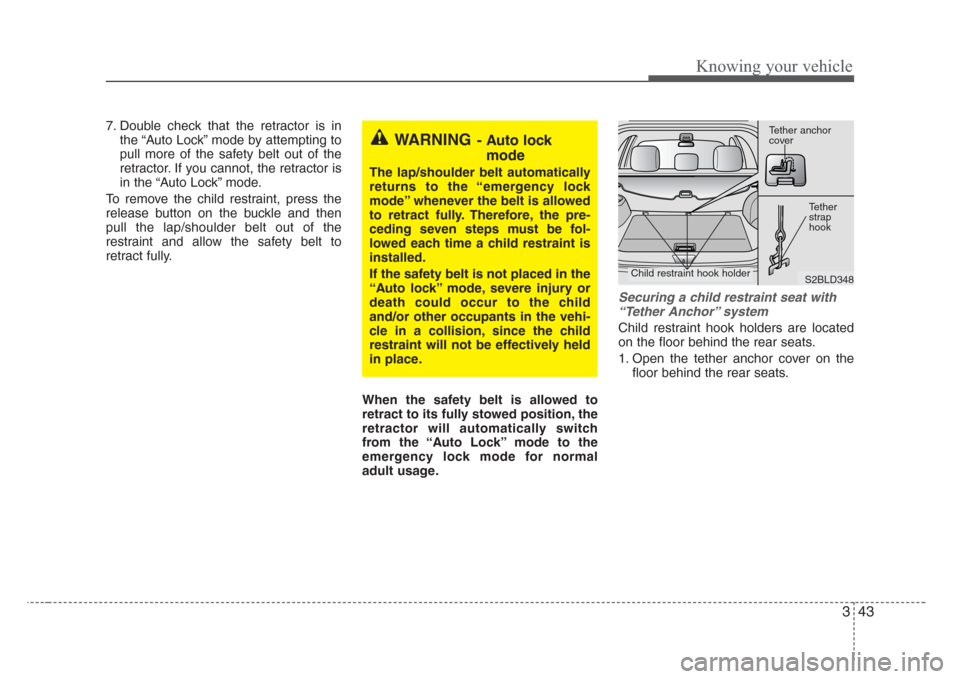
Securing a child restraint seat with
“Tether Anchor”system
Child restraint hook holders are located
on the floor behind the rear seats.
1. Open the tether anchor cover on the
floor behind the rear seats.
WARNING- Auto lock
mode
The lap/shoulder belt automatically
returns to the “emergency lock
mode” whenever the belt is allowed
to retract fully. Therefore, the pre-
ceding seven steps must be fol-
lowed each time a child restraint is
installed.
If the safety belt is not placed in the
“Auto lock” mode,severe injury or
death could occur to the child
and/or other occupants in the vehi-
cle in a collision,since the child
restraint will not be effectively held
in place.
S2BLD348 Tether anchor
cover
Tether
strap
hook
Child restraint hook holder
Page 53 of 326
Knowing your vehicle
44 3
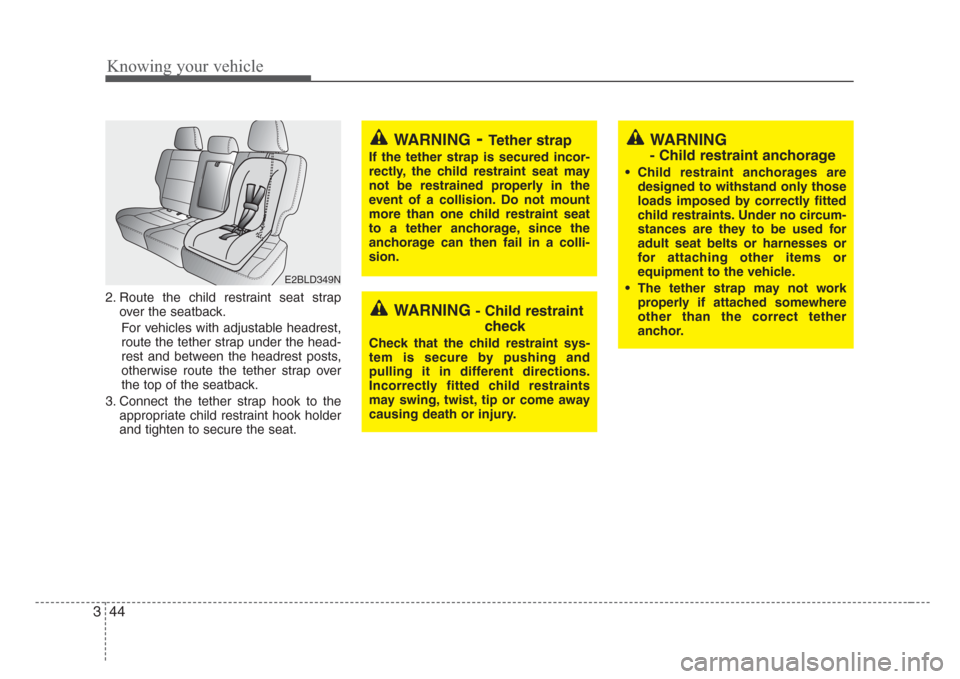
2. Route the child restraint seat strap
over the seatback.
For vehicles with adjustable headrest,
route the tether strap under the head-
rest and between the headrest posts,
otherwise route the tether strap over
the top of the seatback.
3. Connect the tether strap hook to the
appropriate child restraint hook holder
and tighten to secure the seat.
WARNING-Tether strap
If the tether strap is secured incor-
rectly, the child restraint seat may
not be restrained properly in the
event of a collision. Do not mount
more than one child restraint seat
to a tether anchorage,since the
anchorage can then fail in a colli-
sion.
WARNING - Child restraint
check
Check that the child restraint sys-
tem is secure by pushing and
pulling it in different directions.
Incorrectly fitted child restraints
may swing, twist, tip or come away
causing death or injury.
WARNING
- Child restraint anchorage
• Child restraint anchorages are
designed to withstand only those
loads imposed by correctly fitted
child restraints. Under no circum-
stances are they to be used for
adult seat belts or harnesses or
for attaching other items or
equipment to the vehicle.
• The tether strap may not work
properly if attached somewhere
other than the correct tether
anchor.
E2BLD349N
Page 55 of 326
Knowing your vehicle
46 3
WARNING - LATCH
Anchors
If the child restraint is not anchored
properly, the risk of a child being
seriously injured or killed in a colli-
sion greatly increases.
WARNING
When using the vehicle’s “LATCH”
system to install a child restraint
system in the rear seat, all unused
vehicle rear seat belt metal latch
plates or tabs must be latched
securely in their seat belt buckles
and the seat belt webbing must be
retracted behind the child restraint
to prevent the child from reaching
and taking hold of unretracted seat
belts. Unlatched metal latch plates
or tabs may allow the child to reach
the unretracted seat belts which
may result in strangulation and a
serious injury or death to the child
in the child restraint.
WARNING - LATCH lower
anchors
LATCH lower anchors are only to be
used with the left and right rear out-
board seating positions. Never
attempt to attach an LATCH
equipped seat in the center seating
position. You may damage the
anchors or the anchors may fail and
break in a collision.
Page 57 of 326
Knowing your vehicle
48 3
WARNING - Air bags &
safety belts
• Even in vehicles with air bags,
you and your passengers must
always wear the safety belts pro-
vided in order to minimize the risk
and severity of injury in the event
of a collision or rollover.
•Always wear your safety belt. It
can help keep you away from the
air bags during heavy braking
just before a collision. It may also
reduce the risk of occupant ejec-
tion.
• If vehicle occupants are not wear-
ing their seatbelts properly, or are
not seated correctly,serious
injury or death could occur.
• Driver’s and front passenger’s air
bags are designed to inflate only
in certain frontal collisions, and
curtain air bags are designed to
inflate in certain side impacts.
(Continued)
What your air bag system does
Driver’s air bag and front passenger’s air
bag are designed to supplement the pro-
tection offered by the safety belt in cer-
tain frontal collisions. Likewise, curtain air
bags are designed to supplement the
protection offered by the safety belt in
side collisions. Safety belts are designed
to reduce the injury of the driver or pas-
sengers in case of light impact or colli-
sion. However, to help reduce impact on
driver or passengers in a serious colli-
sion, seat belts must also be worn cor-
rectly.
What your air bag system does
not do
The air bag system is designed to sup-
plement the protection offered by the
safety belt system. IT IS NOT A SUBSTI-
TUTE FOR THE SAFETY BELT.
The importance of using safety
belts
There are four very important reasons to
use safety belts even with an air bag
supplemental restraint system. They:
• help keep you in the proper position
(away from the air bag) when it inflates.
• reduce the risk of harm in rollover, side
impact or rear impact collisions,
because an air bag is not designed to
inflate in such situations and even a
side curtain air bag is designed to
inflate only in certain side impact colli-
sions.
• reduce the risk of harm in frontal or
side collisions which are not severe
enough to actuate the air bag supple-
mental restraint system.
• reduce the risk of being thrown from
your vehicle.
Page 59 of 326
Knowing your vehicle
50 3
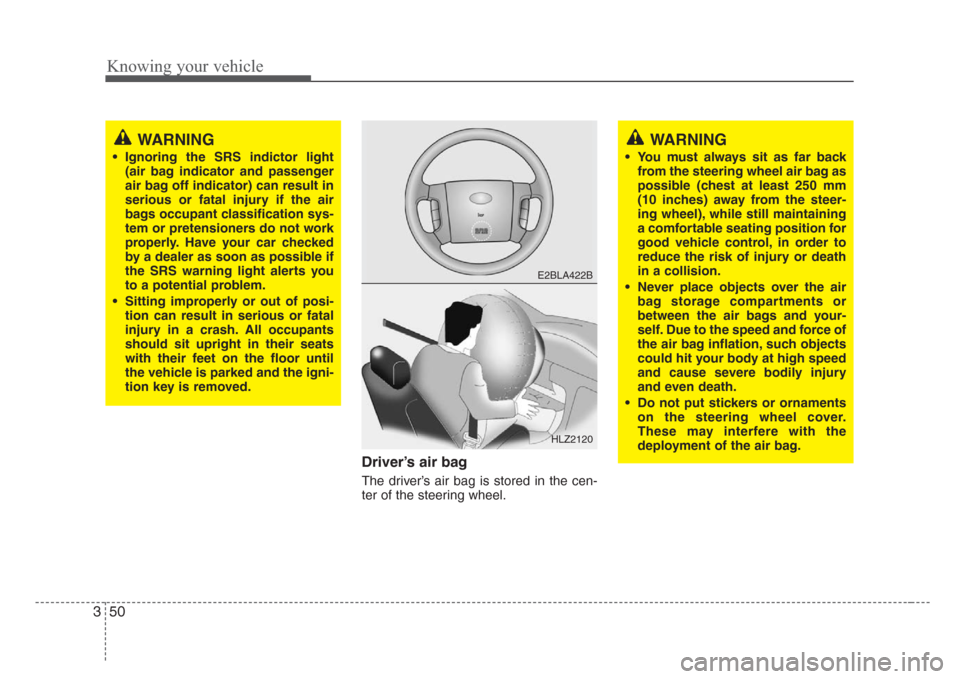
Driver’s air bag
The driver’s air bag is stored in the cen-
ter of the steering wheel.
WARNING
• Ignoring the SRS indictor light
(air bag indicator and passenger
air bag off indicator) can result in
serious or fatal injury if the air
bags occupant classification sys-
tem or pretensioners do not work
properly. Have your car checked
by a dealer as soon as possible if
the SRS warning light alerts you
to a potential problem.
• Sitting improperly or out of posi-
tion can result in serious or fatal
injury in a crash. All occupants
should sit upright in their seats
with their feet on the floor until
the vehicle is parked and the igni-
tion key is removed.
E2BLA422B
HLZ2120
WARNING
• You must always sit as far back
from the steering wheel air bag as
possible (chest at least 250 mm
(10 inches) away from the steer-
ing wheel), while still maintaining
a comfortable seating position for
good vehicle control, in order to
reduce the risk of injury or death
in a collision.
• Never place objects over the air
bag storage compartments or
between the air bags and your-
self. Due to the speed and force of
the air bag inflation,such objects
could hit your body at high speed
and cause severe bodily injury
and even death.
• Do not put stickers or ornaments
on the steering wheel cover.
These may interfere with the
deployment of the air bag.
Page 61 of 326
Knowing your vehicle
52 3
Main components of occupant classi-
fication system
• A detection device located within the
front passenger seat cushion.
• Electronic system to determine
whether passenger air bag system
should be activated or deactivated.
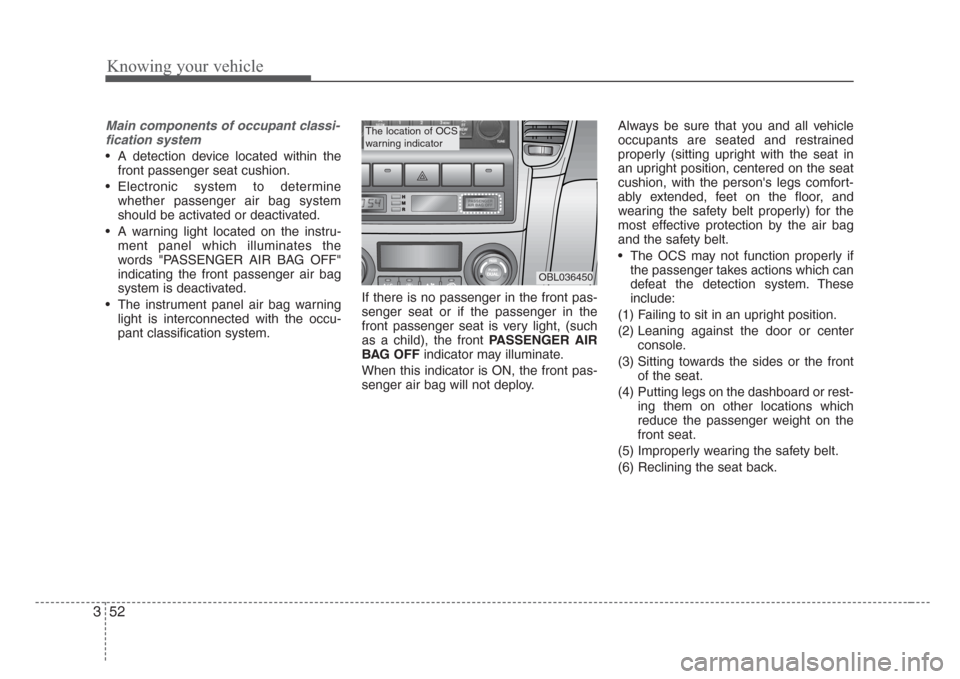
• A warning light located on the instru-
ment panel which illuminates the
words "PASSENGER AIR BAG OFF"
indicating the front passenger air bag
system is deactivated.
• The instrument panel air bag warning
light is interconnected with the occu-
pant classification system.If there is no passenger in the front pas-
senger seat or if the passenger in the
front passenger seat is very light, (such
as a child), the front PASSENGER AIR
BAG OFFindicator may illuminate.
When this indicator is ON, the front pas-
senger air bag will not deploy.Always be sure that you and all vehicle
occupants are seated and restrained
properly (sitting upright with the seat in
an upright position, centered on the seat
cushion, with the person's legs comfort-
ably extended, feet on the floor, and
wearing the safety belt properly) for the
most effective protection by the air bag
and the safety belt.
• The OCS may not function properly if
the passenger takes actions which can
defeat the detection system. These
include:
(1) Failing to sit in an upright position.
(2) Leaning against the door or center
console.
(3) Sitting towards the sides or the front
of the seat.
(4) Putting legs on the dashboard or rest-
ing them on other locations which
reduce the passenger weight on the
front seat.
(5) Improperly wearing the safety belt.
(6) Reclining the seat back.
OBL036450
The location of OCS
warning indicator
Page 62 of 326
353
Knowing your vehicle
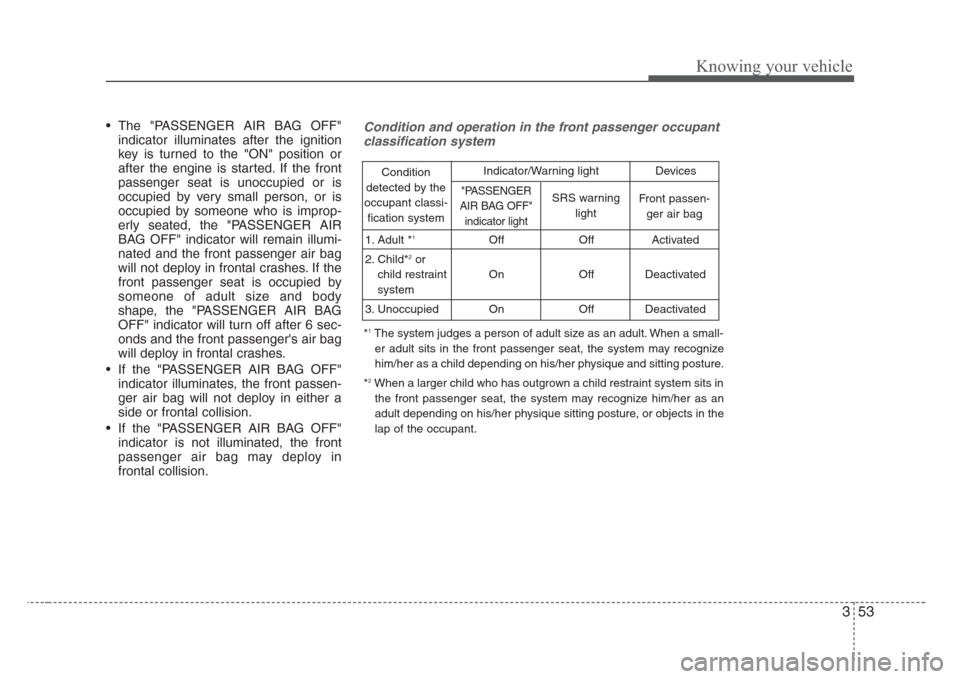
• The "PASSENGER AIR BAG OFF"
indicator illuminates after the ignition
key is turned to the "ON" position or
after the engine is started. If the front
passenger seat is unoccupied or is
occupied by very small person, or is
occupied by someone who is improp-
erly seated, the "PASSENGER AIR
BAG OFF" indicator will remain illumi-
nated and the front passenger air bag
will not deploy in frontal crashes. If the
front passenger seat is occupied by
someone of adult size and body
shape, the "PASSENGER AIR BAG
OFF" indicator will turn off after 6 sec-
onds and the front passenger's air bag
will deploy in frontal crashes.
• If the "PASSENGER AIR BAG OFF"
indicator illuminates, the front passen-
ger air bag will not deploy in either a
side or frontal collision.
• If the "PASSENGER AIR BAG OFF"
indicator is not illuminated, the front
passenger air bag may deploy in
frontal collision.Condition and operation in the front passenger occupant
classification system
*1The system judges a person of adult size as an adult. When a small-
er adult sits in the front passenger seat, the system may recognize
him/her as a child depending on his/her physique and sitting posture.
*
2When a larger child who has outgrown a child restraint system sits in
the front passenger seat, the system may recognize him/her as an
adult depending on his/her physique sitting posture, or objects in the
lap of the occupant.
Condition
detected by the
occupant classi-
fication system
1. Adult *
1
2. Child*2or
child restraint
system
3. Unoccupied Off
On
OnOff
Off
OffActivated
Deactivated
Deactivated
"PASSENGER
AIR BAG OFF"
indicator lightSRS warning
lightFront passen-
ger air bag Indicator/Warning light Devices
Page 63 of 326
Knowing your vehicle
54 3
WARNING
If the front passenger seat should
be modified for persons with dis-
abilities that may affect the opera-
tion of the occupant classification
system, contact an authorized Kia
dealer.
WARNING
If the "PASSENGER AIR BAG OFF"
indicator illuminates or blinks con-
tinuously when a person of adult
size sits in the front passenger's
seat, it could be because that per-
son isn't sitting properly in the seat.
If this happens, turn the vehicle off,
make sure the seat back is not
reclined, have the passenger center
on the seat cushion, with legs com-
fortably extended, and the safety
belt properly positioned. Restart
the vehicle and have the person
remain in this position long enough
to allow the system to detect the
person and activate the passenger
air bag.
WARNING
If the occupant classification sys-
tem is not working properly, the air
bag warning light ( ) on the
instrument panel will illuminate. If
there is a malfunction of the occu-
pant classification system, the
"PASSENGER AIR BAG OFF" indi-
cator will illuminate and the front
passenger's air bag will not deploy
in frontal crashes even if there is an
adult sized occupant in the front
passenger seat. If the SRS air bag
warning light does not illuminate
when the ignition key is turned to
"ON" position, if it remains illumi-
nated after blinking for approxi-
mately six seconds, or if it illumi-
nates while the vehicle is being
driven, have an authorized Kia deal-
er inspect the occupant classifica-
tion system with the SRS air bag
system as soon as possible.
AIR
BAG
WARNING
• Even though your vehicle is
equipped with the occupant clas-
sification system, children aged
12 and under should be seated in
the rear seats. Do not install a
child restraint system in the front
passenger seat. The child could
be severely injured or killed if the
air bag deploys. Children are
afforded the most protection in
the event of an accident when
they are restrained by the proper
restraint system in the rear seat.
(Continued)
Page 66 of 326
357
Knowing your vehicle
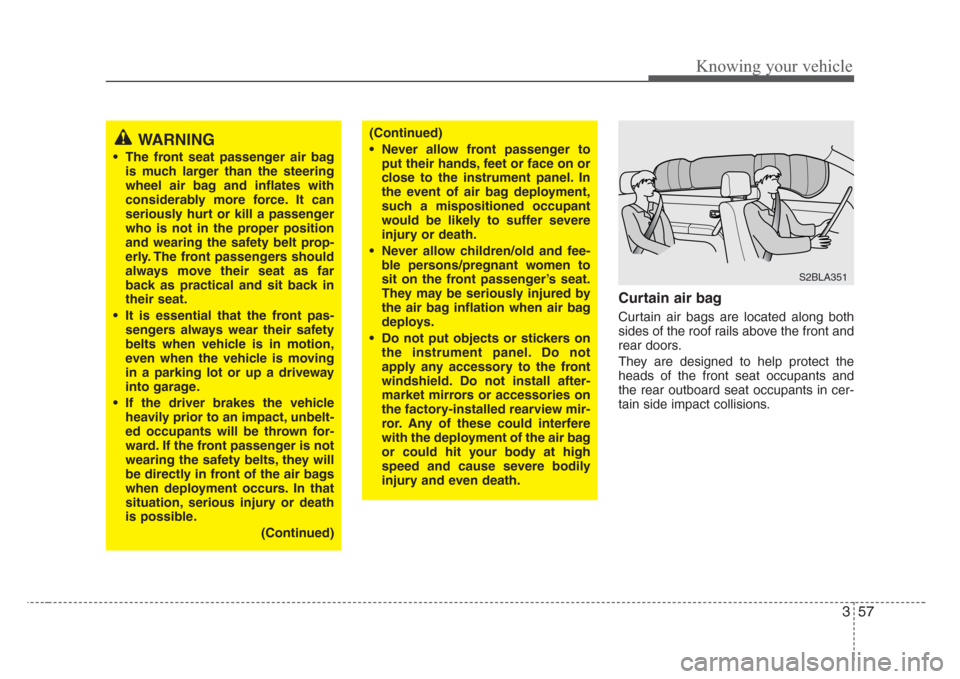
Curtain air bag
Curtain air bags are located along both
sides of the roof rails above the front and
rear doors.
They are designed to help protect the
heads of the front seat occupants and
the rear outboard seat occupants in cer-
tain side impact collisions.
WARNING
• The front seat passenger air bag
is much larger than the steering
wheel air bag and inflates with
considerably more force. It can
seriously hurt or kill a passenger
who is not in the proper position
and wearing the safety belt prop-
erly. The front passengers should
always move their seat as far
back as practical and sit back in
their seat.
• It is essential that the front pas-
sengers always wear their safety
belts when vehicle is in motion,
even when the vehicle is moving
in a parking lot or up a driveway
into garage.
• If the driver brakes the vehicle
heavily prior to an impact, unbelt-
ed occupants will be thrown for-
ward. If the front passenger is not
wearing the safety belts, they will
be directly in front of the air bags
when deployment occurs. In that
situation,seriou
s injury or death
is possible.
(Continued)
(Continued)
• Never allow front passenger to
put their hands, feet or face on or
close to the instrument panel. In
the event of air bag deployment,
such a mispositioned occupant
would be likely to suffer severe
injury or death.
• Never allow children/old and fee-
ble persons/pregnant women to
sit on the front passenger’s seat.
They may be seriously injured by
the air bag inflation when air bag
deploys.
• Do not put objects or stickers on
the instrument panel. Do not
apply any accessory to the front
windshield. Do not install after-
market mirrors or accessories on
the factory-installed rearview mir-
ror. Any of these could interfere
with the deployment of the air bag
or could hit your body at high
speed and cause severe bodily
injury and even death.
S2BLA351