brakes KIA Sorento 2009 2.G User Guide
[x] Cancel search | Manufacturer: KIA, Model Year: 2009, Model line: Sorento, Model: KIA Sorento 2009 2.GPages: 327, PDF Size: 5.03 MB
Page 169 of 327
441
Driving your vehicle
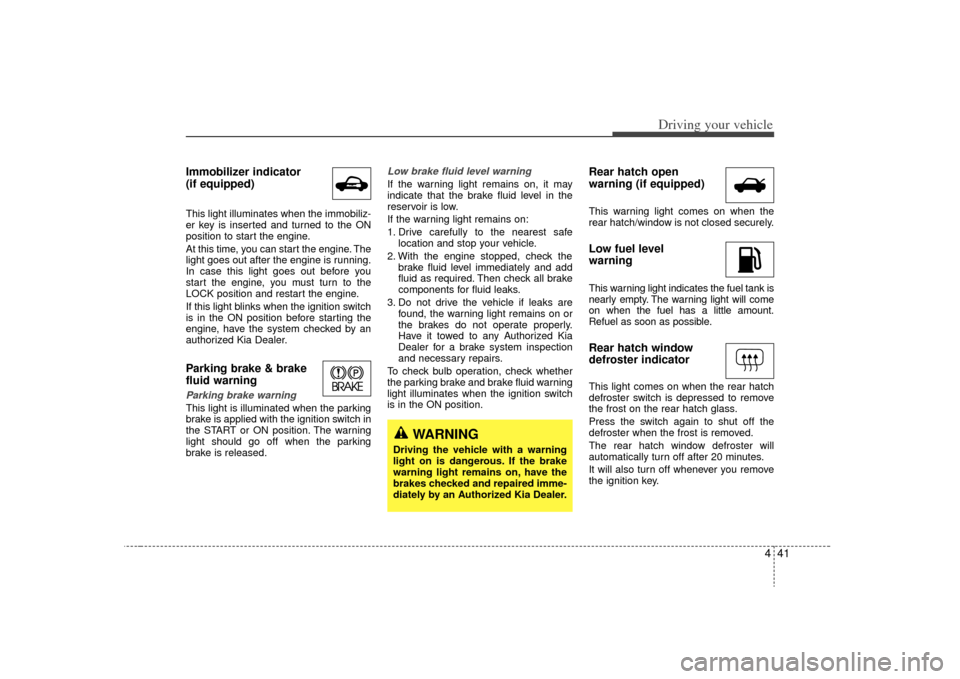
Immobilizer indicator
(if equipped)This light illuminates when the immobiliz-
er key is inserted and turned to the ON
position to start the engine.
At this time, you can start the engine. The
light goes out after the engine is running.
In case this light goes out before you
start the engine, you must turn to the
LOCK position and restart the engine.
If this light blinks when the ignition switch
is in the ON position before starting the
engine, have the system checked by an
authorized Kia Dealer.Parking brake & brake
fluid warning Parking brake warning This light is illuminated when the parking
brake is applied with the ignition switch in
the START or ON position. The warning
light should go off when the parking
brake is released.
Low brake fluid level warningIf the warning light remains on, it may
indicate that the brake fluid level in the
reservoir is low.
If the warning light remains on:
1. Drive carefully to the nearest safelocation and stop your vehicle.
2. With the engine stopped, check the brake fluid level immediately and add
fluid as required. Then check all brake
components for fluid leaks.
3. Do not drive the vehicle if leaks are found, the warning light remains on or
the brakes do not operate properly.
Have it towed to any Authorized Kia
Dealer for a brake system inspection
and necessary repairs.
To check bulb operation, check whether
the parking brake and brake fluid warning
light illuminates when the ignition switch
is in the ON position.
Rear hatch open
warning (if equipped)This warning light comes on when the
rear hatch/window is not closed securely.Low fuel level
warningThis warning light indicates the fuel tank is
nearly empty. The warning light will come
on when the fuel has a little amount.
Refuel as soon as possible.Rear hatch window
defroster indicatorThis light comes on when the rear hatch
defroster switch is depressed to remove
the frost on the rear hatch glass.
Press the switch again to shut off the
defroster when the frost is removed.
The rear hatch window defroster will
automatically turn off after 20 minutes.
It will also turn off whenever you remove
the ignition key.
WARNING
Driving the vehicle with a warning
light on is dangerous. If the brake
warning light remains on, have the
brakes checked and repaired imme-
diately by an Authorized Kia Dealer.
Page 212 of 327
Driving tips65SUGGESTIONS FOR ECONOMICAL OPERATIONYour vehicle's fuel economy depends
mainly on your style of driving, where you
drive and when you drive.
Each of these factors affects how many
kilometers (miles) you can get from a
liter (gallon) of fuel. To operate your vehi-
cle as economically as possible, use the
following driving suggestions to help
save money in both fuel and repairs:
Avoid lengthy warm-up idling. Once theengine is running smoothly, begin driv-
ing. Remember, engine warm-up may
take a little longer on cold days.
Save fuel by accelerating slowly after stopping.
Keep the engine in tune and follow the recommended periodic maintenance
schedule. This will increase the life of
all parts and lower your operating
costs. Do not use the air conditioner unnec-
essarily.
Slow down when driving on rough roads.
For longer tire life and better fuel econ- omy, always keep the tires inflated to
the recommended pressures.
Maintain a safe distance from other vehicles to avoid sudden stops. This
will reduce wear on brake linings and
pads. Driving in such a way will also
save fuel because extra fuel is required
to accelerate back to driving speed.
Do not carry unnecessary weight in the vehicle.
Do not rest your foot on the brake pedal while driving. This can cause
needless wear, possible damage to the
brakes, and poor fuel economy.
Improper wheel alignment results in faster tire wear and lower fuel econo-
my. Open windows at high speeds can
reduce fuel economy.
Fuel economy is less in crosswinds and headwinds. To help offset some of
this loss, slow down when driving in
these conditions.
Keeping a vehicle in good operating con-
dition is important both for economy and
safety. Therefore, have an authorized Kia
dealer perform scheduled inspections
and maintenance.
WARNING
- Engine off dur- ing motion
Never turn the engine off to coast
down hills or anytime the vehicle is
in motion. The power steering and
power brakes will not function with-
out the engine running. Instead,
keep the engine on and downshift
to an appropriate gear for engine
braking effect.
Page 213 of 327
57
Driving tips
SPECIAL DRIVING CONDITIONS Hazardous driving conditions When hazardous driving conditions are
encountered such as water, snow, ice,
mud, sand, or similar hazards, follow
these suggestions:
Drive cautiously and allow extra dis-tance for braking.
Avoid sudden movements in braking or steering.
When braking with non-ABS brakes pump the brake pedal with a light up-
and-down motion until the vehicle is
stopped. If stalled in snow, mud, or sand, use
second gear. Accelerate slowly to
avoid spinning the drive wheels.
Use sand, rock salt, tire chains, or other non-slip material under the drive
wheels to provide traction when stalled
in ice, snow, or mud.
Rocking the vehicle If it is necessary to rock the vehicle to
free it from snow, sand, or mud, first turn
the steering wheel right and left to clear
the area around your drive wheels. Then,
shift back and forth between 1 (First) and
R (Reverse) in vehicles equipped with a
manual transmission or R (Reverse) and
any forward gear in vehicles equipped
with an automatic transmission. Do not
race the engine, and spin the wheels as
little as possible. If you are still stuck after
a few tries, have the vehicle pulled out by
a tow vehicle to avoid engine overheating
and possible damage to the transmis-
sion.
WARNING
- Downshifting
Downshifting with an automatic
transmission, while driving on slip-
pery surfaces can cause an acci-
dent. The sudden change in tire
speed could cause the tires to skid.
Be careful when downshifting on
slippery surfaces.
WARNING
Do not pump the brake pedal on a
vehicle equipped with ABS.
CAUTION
Prolonged rocking may causeengine over-heating, transmissiondamage or failure, and tire damage.
Page 214 of 327

Driving tips85
Driving at night Because night driving presents more
hazards than driving in the daylight, here
are some important tips to remember:
Slow down and keep more distancebetween you and other vehicles, as it
may be more difficult to see at night,
especially in areas where there may
not be any street lights.
Adjust your mirrors to reduce the glare from other driver's headlights.
Keep your headlights clean and prop- erly aimed on vehicles not equipped
with the automatic headlight aiming
feature. Dirty or improperly aimed
headlights will make it much more diffi-
cult to see at night.
Avoid staring directly at the headlights of oncoming vehicles. You could be
temporarily blinded, and it will take
several seconds for your eyes to read-
just to the darkness.
Driving in the rain Rain and wet roads can make driving
dangerous, especially if you’re not pre-
pared for the slick pavement. Here are a
few things to consider when driving in the
rain:
A heavy rainfall will make it harder tosee and will increase the distance
needed to stop your vehicle, so slow
down.
Keep your windshield wiping equip- ment in good shape. Replace your
windshield wiper blades when they
show signs of streaking or missing
areas on the windshield.
If your tires are not in good condition, making a quick stop on wet pavement
can cause a skid and possibly lead to
an accident. Be sure your tires are in
good shape.
Turn on your headlights to make it eas- ier for others to see you.
Driving too fast through large puddles can affect your brakes. If you must go
through puddles, try to drive through
them slowly.
If you believe you may have gotten your brakes wet, apply them lightly
while driving until normal braking oper-
ation returns.
WARNING
- Spinning tires
Do not spin the wheels, especially
at speeds more than 56 km/h (35
mph). Spinning the wheels at high
speeds when the vehicle is station-
ary could cause a tire to overheat,
explode and injure bystanders.
CAUTION
The ESC system (if equipped)should be turned OFF prior to rock- ing the vehicle.
Page 215 of 327

59
Driving tips
Winter driving We recommend that you carry emer-gency equipment, including tire chains,
a window scraper, windshield deicer, a
bag of sand or salt, flares, a small
shovel and jumper cables.
Make sure you have sufficient ethylene glycol coolant in the radiator.
Check the battery condition and cables. Cold temperatures reduce the
capacity of any battery, so it must be in
excellent condition to provide enough
winter starting power.
Make sure the engine oil viscosity is suitable for cold weather.
Check the ignition system for loose connections and damage.
Use antifreeze formulated windshield washer fluid. (Do not use engine
coolant antifreeze.)
Do not use the parking brake if it might freeze. When parking, shift to 1 (First)
or R (Reverse) with a manual trans-
mission or P (Park) with an automatic
transmission and block the rear
wheels.
Snow tires If you mount snow tires on your Kia,
make sure they are radial tires of the
same size and load range as the original
tires. Mount snow tires on all four wheels
to balance your vehicle’s handling in all
weather conditions. Keep in mind that the
traction provided by snow tires on dry
roads may not be as high as your vehi-
cle's original equipment tires. You should
drive cautiously even when the roads are
clear. Check with the tire dealer for max-
imum speed recommendations.Do not install studded tires without firstchecking local, state and municipal regu-lations for possible restrictions againsttheir use.
Driving in flooded areas Avoid driving through flooded areas
unless you are sure the water is no high-
er than the bottom of the wheel hub.
Drive through any water slowly. Allow
adequate stopping distance because
brake performance may be affected.
After driving through water, dry the
brakes by gently applying them several
times while the vehicle is moving slowly.
WARNING
- Snow tire size
Snow tires should be equivalent in
size and type to the vehicle's stan-
dard tires. Otherwise, the safety and
handling of your vehicle may be
adversely affected.
Page 218 of 327

Driving tips12
5Driving on a hill ("4LO" for part-
time 4WD operation or "LOW" for
full-time 4WD operation) Use low gear when going uphill or
downhill and avoid sudden braking.
Do not shift gears or use your clutch when going downhill. Do not coast
downhill in Neutral.
Crossing a ditch ("4LO" for part-
time 4WD operation or "LOW" for
full-time 4WD operation) Avoid driving through ditches if possi-ble, especially if there is water in the
ditch. Your vehicle may stall if the elec-
trical system gets wet. If you must
cross a ditch, select 4LO or LOW
mode.
Avoid driving where the water level is higher than the bottom of the wheel
hub. If the water level rises above this
mark, your vehicle will need to be serv-
iced.
Tap lightly on the brake pedal during and after driving through water. This
will help keep the brakes dry and in
proper working order.
Do not shift gears while crossing a ditch.
Tight corner brake effectThis is called tight corner brake effect.
Tight corner brake effect is a unique
characteristic of four-wheel drive vehicles
caused by the difference in tire rotation at
the four wheels and the zero-degree
alignment of the front wheels and sus-
pension.
Sharp turns at low speeds should be car-
ried out with caution.
WARNING
- 4WD
When turning sharply on a paved
road at low speed while in four-
wheel drive, steering control will be
difficult.
Page 226 of 327

Driving tips20
5Driving downhillGoing downhill can be considerably more
dangerous than driving uphill. When off-
roading takes you downhill, you’ll want to
consider many of the same things you
thought about before you went uphill. As
a brief reminder, those include:
How steep is the downhill? Will I be
able to maintain vehicle control?
What’s the surface like? Smooth? Rough? Slippery? Hard-packed dirt?
Gravel?
Are there hidden surface obstacles? Ruts? Logs? Boulders?
What’s at the bottom of the hill? Is there a hidden creek bank or even a
river bottom with large rocks?
Have changes in the weather condi- tions and their effect on the terrain
since you went uphill made your task
more difficult?
Once you have decided that you can go
down a hill safely, try to keep your vehicle
headed straight down, and use a low
gear. This way, engine braking can help
your brakes so they won’t have to do all
the work. Descend slowly, keeping your
vehicle under control at all times. Avoid turns that take you across the
incline of the hill. A hill that’s not too
steep to drive down may be too steep to
drive across. You could roll over if you
don’t drive straight down.
Never go downhill with the clutch pedal
depressed. This is called “free-wheeling.”
Your brakes will have to do all the work
and could overheat and fade.
If your wheels lock up during downhill
braking, you may feel the vehicle starting
to slide sideways. To regain your direc-
tion, just ease off the brakes and steer to
keep the front of the vehicle pointing
straight downhill.
WARNING
- Braking
Heavy braking when going down a
hill can cause your brakes to over-
heat and fade. This could cause
loss of control and a serious acci-
dent. Apply the brakes lightly when
descending a hill and use a low
gear to keep vehicle speed under
control.
WARNING
- Wheel locking
Avoid braking so hard that you lock
the wheels when going downhill. If
your front wheels are locked, you
can’t steer your vehicle.
WARNING
- Downhill
Before beginning to go downhill, it
is critical that you ensure that no
cargo can shift forward while you
are heading downhill. Such shifting
could either endanger you and your
occupants, or interfere with your
ability to control the vehicle.
Page 227 of 327

521
Driving tips
Stalling downhillStalling is much more likely to happen
going uphill. But if it happens going
downhill, here’s what to do.
Stop your vehicle by applying thebrakes. Then apply the parking brake.
Move the shift lever to P (Park) in auto- matic transmission or shift to N
(Neutral) in manual transmission and,
while still braking, restart the engine.
Shift back to a low gear, release the parking brake, and drive straight down.
If the engine won’t start, get out and seek help. Exit on the uphill side of the
vehicle and stay clear of the path the
vehicle would take if it rolled downhill.
Driving across an inclineSooner or later, an off-road trail will prob-
ably go across the incline of a hill. If this
happens, you have to decide whether or
not to try to drive across the incline. Here
are some things to consider:
A hill that can be driven straight up ordown may be too steep to drive across.
When you go straight up or down a hill,
the length of the wheel base (the dis-
tance from the front wheels to the rear
wheels) reduces the likelihood the
vehicle will tumble end over end. But
when you drive across an incline, the
much narrower track width (the dis-
tance between the left and right
wheels) may not prevent the vehicle
from tilting and rolling over. Also, driv-
ing across an incline puts more weight
on the downhill wheels. This could
cause a downhill slide or a rollover.
Surface conditions can be a problem when you drive across a hill. Loose
gravel, muddy spots, or even wet grass
can cause your tires to slip sideways. If
the vehicle slips sideways, it can hit
something that will tip it (a rock, a rut,
etc.) and cause it to roll over. Hidden obstacles can make the steep-
ness of the incline even worse. If you
drive across a rock with the uphill
wheels, or if the downhill wheels drop
into a rut or depression, your vehicle
can tilt even more.
For reasons like these, you need to
decide carefully whether or not to try to
drive across an incline. Just because the
trail goes across the incline doesn’t
mean you have to drive it.
WARNING
- Roll over
Driving across an incline that’s too
steep will make your vehicle roll
over. You could be seriously or
fatally injured. If you have any
doubt about the steepness of the
incline, don’t drive across it. Find
another route instead.
Page 229 of 327

523
Driving tips
Hard-packed snow and ice offer the
worst tire traction. On these surfaces, it’s
very easy to lose control. On wet ice, for
example, the traction is so poor that you
will even have difficulty accelerating. And
if you do get moving, poor steering and
difficult braking can easily cause you to
slide out of control.
Driving in waterLight rain causes no special off-road driv-
ing problems. However, heavy rain can
cause flash flooding, and flood waters
demand extreme caution.
Find out how deep the water is before
you drive through it. If it’s deep enough to
cover your wheel bearing hubs, axles, or
exhaust pipe, don’t try it, You probably
won’t get through. Also, water that deep
can damage your axle and other vehicle
parts.
If the water isn’t too deep, then drive
through slowly. At fast speeds, water can
splash on your ignition system and your
vehicle can stall. Stalling can also occur
if your tailpipe goes underwater. As long
as your tailpipe is underwater, you will
not be able to start your engine. When
you go through water, remember that it
may take you longer to stop when your
brakes are wet.
If you have driven through water that was
deep enough to cover your wheel bear-
ing hubs, it may be a good idea to have
an Authorized Kia dealer or other com-
petent service center repack your front
wheel bearings and examine your rear-
end fluid for evidence of water.
CAUTION
In case of loss of traction in mud,loose soil, or sand, turn the steer-ing wheel rapidly from side-to-side. This can help generate addi- tional traction.
Do not gun the engine. This will cause the tires to spin and digdown, not forward, and couldbury the vehicle to the frame. Smooth, easy power is betterthan too much power.
WARNING
- Frozen sur-
faces
Driving on frozen lakes, ponds or
rivers can be dangerous.
Underwater springs, currents under
the ice, or sudden thaws can weak-
en the ice. Your vehicle could fall
through the ice and you and your
passengers could drown. Drive
your vehicle on safe surfaces only.
Page 236 of 327

Driving tips30
5GCWR (Gross Combined Weight
Rating)
This is the maximum allowable
weight of the vehicle and the loaded
trailer - including all cargo and pas-
sengers - that the vehicle can handle
without risking damage. (Important :
The towing vehicle's braking system
is rated for operation at GVWR, not
GCWR. Separate functional brakes
should be used for safe control of
towed vehicles and for trailers weigh-
ing an 750kg (1,653 lbs).) The GCW
must never exceed the GCWR. Maximum Trailer Weight
This is the highest possible weight of
a fully loaded trailer the vehicle can
tow. It assumes a vehicle with only
mandatory options, no cargo, and a
driver. The weight of other optional
equipment, passengers and cargo in
your vehicle will reduce the maxi-
mum trailer weight your vehicle can
tow.
Calculating the load your vehicle
can tow
1. Use the appropriate maximum
GCWR chart (in the Weight of the
Trailer section in this chapter) for
your type of drive system and
transmission.
2. Weigh your vehicle.
3. Subtract the weight of your vehicle from the maximum GCWR in the
chart. This is the maximum trailer
weight your vehicle can tow. It
must be below the maximum trail-
er weight shown in the chart. Note
that the maximum trailer weight
your vehicle can tow depends on
the total weight of any cargo, pas-
sengers and available equipment
in the vehicle.