flat tire KIA Sorento 2009 2.G Owner's Manual
[x] Cancel search | Manufacturer: KIA, Model Year: 2009, Model line: Sorento, Model: KIA Sorento 2009 2.GPages: 327, PDF Size: 5.03 MB
Page 37 of 327
Knowing your vehicle28
3The rear safety belts use a special auto-
lock feature designed to allow a child
restraint to be used in these positions
without an added locking clip. They nor-
mally lock only under extreme or emer-
gency conditions (emergency lock
mode). However they can be adjusted so
that they remain fixed and locked when a
child restraint system is placed in these
positions. (Use this auto-lock mode only
to secure a child restraint, never for pas-
sengers restrained by the safety belts.)
Page 3-41 gives instructions on placing
the safety belt in the auto lock mode.
The drivers safety belt can only operate
in the emergency lock mode. Safety belts provide the best restraint
when:
The seatback is upright.
The occupant is sitting upright (not
slouched).
The lap belt is snug across the hips.
The shoulder belt is snug across the chest.
The knees are straight forward.
To help you remember to fasten your
safety belt, a warning light will blink. See
“Safety belt warning light and chime” on
page 3-30.
WARNING
- Child restraint
in front seat
Never install a child restraint sys-
tem in the front passenger position,
as an inflating air bag could cause
serious or fatal injury to a child in
that position.
WARNING
- After a colli- sion
Lap/shoulder belt assemblies
may be stretched or damaged
when subjected to the stress and
forces of a collision.
The entire restraint system should be inspected following
any collision. All belts, retractors,
anchors and hardware damaged
by a collision should be replaced
before the vehicle is operated
again.
WARNING -
Cargo area
Passengers should never be
allowed to ride in the cargo area of
a vehicle. No safety belts are pro-
vided for the cargo area. Persons
riding in the vehicle without a fas-
tened safety belt are much more
likely to suffer serious bodily injury
or death during an accident.
Page 141 of 327
413
Driving your vehicle
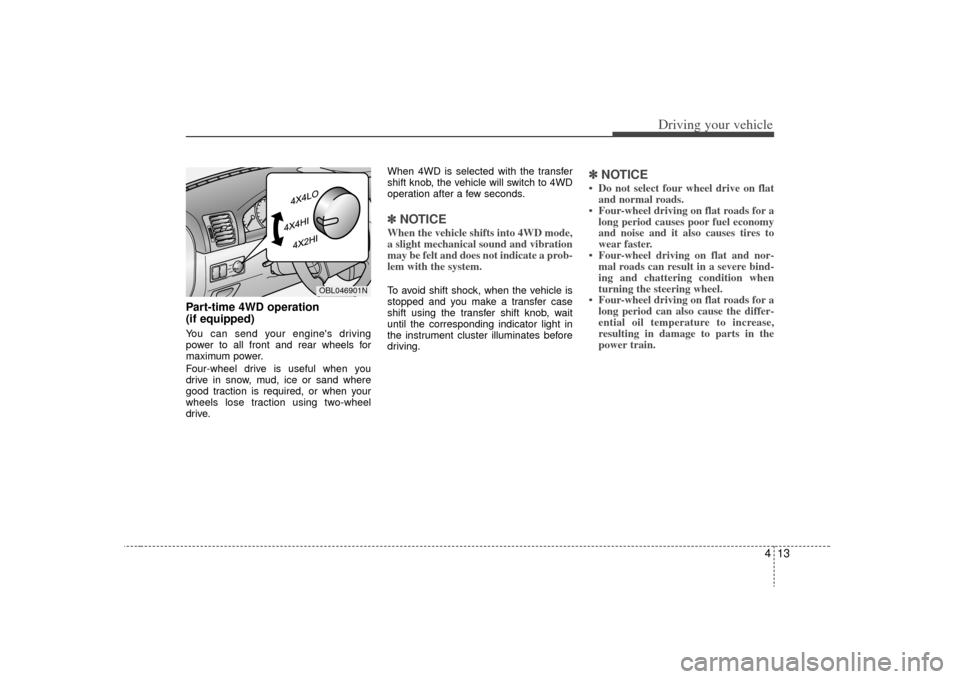
Part-time 4WD operation
(if equipped) You can send your engine's driving
power to all front and rear wheels for
maximum power.
Four-wheel drive is useful when you
drive in snow, mud, ice or sand where
good traction is required, or when your
wheels lose traction using two-wheel
drive.When 4WD is selected with the transfer
shift knob, the vehicle will switch to 4WD
operation after a few seconds.
✽ ✽
NOTICEWhen the vehicle shifts into 4WD mode,
a slight mechanical sound and vibration
may be felt and does not indicate a prob-
lem with the system.To avoid shift shock, when the vehicle is
stopped and you make a transfer case
shift using the transfer shift knob, wait
until the corresponding indicator light in
the instrument cluster illuminates before
driving.
✽ ✽NOTICE• Do not select four wheel drive on flat
and normal roads.
• Four-wheel driving on flat roads for a long period causes poor fuel economy
and noise and it also causes tires to
wear faster.
• Four-wheel driving on flat and nor- mal roads can result in a severe bind-
ing and chattering condition when
turning the steering wheel.
• Four-wheel driving on flat roads for a long period can also cause the differ-
ential oil temperature to increase,
resulting in damage to parts in the
power train.
OBL046901N
Page 212 of 327
Driving tips65SUGGESTIONS FOR ECONOMICAL OPERATIONYour vehicle's fuel economy depends
mainly on your style of driving, where you
drive and when you drive.
Each of these factors affects how many
kilometers (miles) you can get from a
liter (gallon) of fuel. To operate your vehi-
cle as economically as possible, use the
following driving suggestions to help
save money in both fuel and repairs:
Avoid lengthy warm-up idling. Once theengine is running smoothly, begin driv-
ing. Remember, engine warm-up may
take a little longer on cold days.
Save fuel by accelerating slowly after stopping.
Keep the engine in tune and follow the recommended periodic maintenance
schedule. This will increase the life of
all parts and lower your operating
costs. Do not use the air conditioner unnec-
essarily.
Slow down when driving on rough roads.
For longer tire life and better fuel econ- omy, always keep the tires inflated to
the recommended pressures.
Maintain a safe distance from other vehicles to avoid sudden stops. This
will reduce wear on brake linings and
pads. Driving in such a way will also
save fuel because extra fuel is required
to accelerate back to driving speed.
Do not carry unnecessary weight in the vehicle.
Do not rest your foot on the brake pedal while driving. This can cause
needless wear, possible damage to the
brakes, and poor fuel economy.
Improper wheel alignment results in faster tire wear and lower fuel econo-
my. Open windows at high speeds can
reduce fuel economy.
Fuel economy is less in crosswinds and headwinds. To help offset some of
this loss, slow down when driving in
these conditions.
Keeping a vehicle in good operating con-
dition is important both for economy and
safety. Therefore, have an authorized Kia
dealer perform scheduled inspections
and maintenance.
WARNING
- Engine off dur- ing motion
Never turn the engine off to coast
down hills or anytime the vehicle is
in motion. The power steering and
power brakes will not function with-
out the engine running. Instead,
keep the engine on and downshift
to an appropriate gear for engine
braking effect.
Page 219 of 327
513
Driving tips
Off-road driving with your four-
wheel drive vehicleOff-road driving can be great fun. But it
has definite hazards. The greatest of
these is the terrain itself.
“Off-roading” means you’ve left the paved
road system behind. Traffic lanes are not
marked. Curves are not banked.
There are no carefully engineered road
signs to warn you of dangerous condi-
tions or to advise you of a safe speed.
You have to assess the environment
yourself. Surfaces can be slippery, rough,
uphill or downhill.
Off-road driving involves learning new
skills. That’s why it’s important that you
read and understand this section. You’ll
find useful driving information and sug-
gestions. These will help make your off-
road driving safer and more enjoyable.
Before you go off-roadingThere are some things to do before you
leave the paved roads. Be sure to have
all necessary maintenance and service
work done beforehand. Be sure to read
all the information about your four-wheel
drive vehicle in this manual. Is there
enough fuel? Is the spare tire fully inflat-
ed? Are the fluid levels at the proper lev-
els? What are the local laws that apply to
off-roading where you’ll be driving? If you
don’t know, you should check with law
enforcement people in the area. Will you
be on someone’s private land? If so, be
sure to get the necessary permission.
Loading your vehicle for off-roaddrivingThere are some important items to
remember about how to properly load
your vehicle.
The heaviest things should be in the cargo area and forward of your rear
axle. Place heavier items as far forward
as you can.
Be sure the load is properly secured, so driving over off-road terrain doesn’t
shift your load or throw items toward
the driver or passengers.
Page 228 of 327
Driving tips22
5If your vehicle slides downhillIf you feel your vehicle starting to slide
sideways, turn downhill immediately. This
should help straighten out the vehicle
and prevent the side slipping. However, a
much better way to prevent this is to get
out and “walk the course” first so you
know what the surface is like before you
drive it.Stalling while crossing an inclineIf your vehicle stalls when you’re crossing
an incline, be sure you (and your pas-
sengers) get out on the uphill side, even
if that door is harder to open. If you get
out on the downhill side and the vehicle
starts to roll over, you’ll be in its path.
If you have to walk down the slope, stay
out of the path the vehicle will take if it
does roll over.
Driving in mud, sand, snow, or iceWhen you drive in mud, sand, snow, or
ice, your wheels won’t get good traction.
You can’t accelerate as quickly, turning is
more difficult, and you’ll need longer
braking distances.
It’s best to use a low gear when you’re in
mud, the deeper the mud, the lower the
gear. In extremely deep mud, the idea is
to keep your vehicle moving so you don’t
get stuck.
When you drive on sand, you’ll sense a
change in wheel traction. But it will
depend upon how loosely packed the
sand is. On loosely packed sand (as on
beaches or sand dunes) your tires will
tend to sink into the sand. This has an
effect on steering, accelerating, and
braking. You may want to reduce the air
pressure in your tires slightly when driv-
ing on sand. This will improve traction.
Remember to re-inflate them the first
chance that you have after you leave the
loosely packed sand.
WARNING
- Exiting vehicle
Getting out on the downhill (low)
side of a vehicle stopped across an
incline is dangerous. If the vehicle
rolls over, you could be crushed or
fatally injured. Always get out on
the uphill (high) side of the vehicle
and stay well clear of the rollover
path.
Page 247 of 327
6
Road warning / 6-2
In case of an emergency while driving / 6-2
Overheating / 6-3
Emergency starting / 6-4
Electrical circuit protection / 6-7
Towing / 6-14
If you have a flat tire / 6-19
In case of an emergency
Page 248 of 327
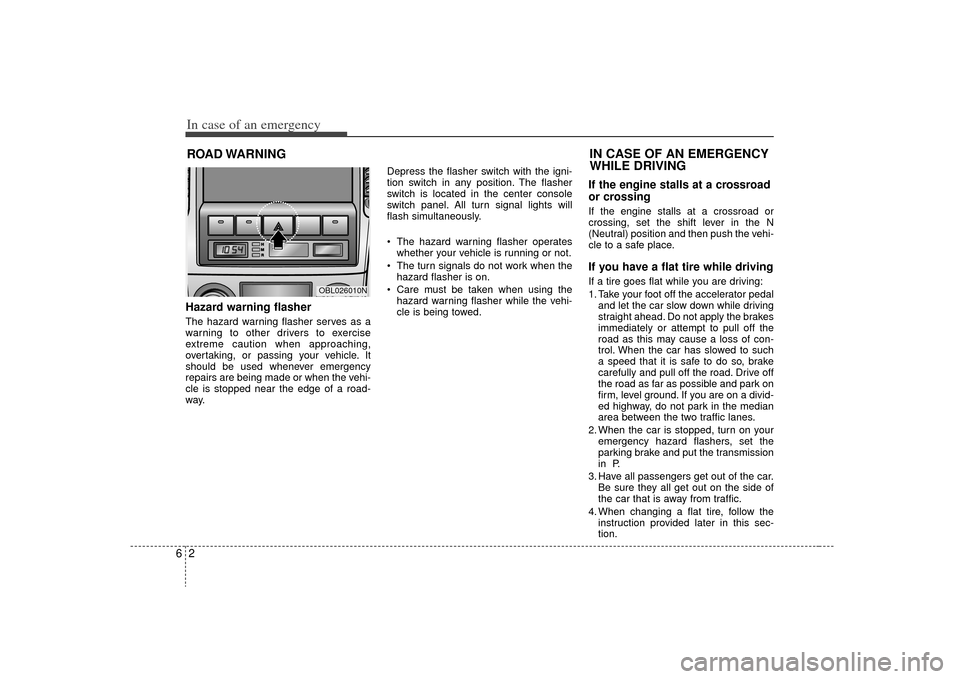
In case of an emergency26ROAD WARNING Hazard warning flasher The hazard warning flasher serves as a
warning to other drivers to exercise
extreme caution when approaching,
overtaking, or passing your vehicle. It
should be used whenever emergency
repairs are being made or when the vehi-
cle is stopped near the edge of a road-
way.Depress the flasher switch with the igni-
tion switch in any position. The flasher
switch is located in the center console
switch panel. All turn signal lights will
flash simultaneously.
• The hazard warning flasher operates
whether your vehicle is running or not.
The turn signals do not work when the hazard flasher is on.
Care must be taken when using the hazard warning flasher while the vehi-
cle is being towed.
If the engine stalls at a crossroad
or crossingIf the engine stalls at a crossroad or
crossing, set the shift lever in the N
(Neutral) position and then push the vehi-
cle to a safe place.If you have a flat tire while drivingIf a tire goes flat while you are driving:
1. Take your foot off the accelerator pedaland let the car slow down while driving
straight ahead. Do not apply the brakes
immediately or attempt to pull off the
road as this may cause a loss of con-
trol. When the car has slowed to such
a speed that it is safe to do so, brake
carefully and pull off the road. Drive off
the road as far as possible and park on
firm, level ground. If you are on a divid-
ed highway, do not park in the median
area between the two traffic lanes.
2. When the car is stopped, turn on your emergency hazard flashers, set the
parking brake and put the transmission
in P.
3. Have all passengers get out of the car. Be sure they all get out on the side of
the car that is away from traffic.
4. When changing a flat tire, follow the instruction provided later in this sec-
tion.
OBL026010N
IN CASE OF AN EMERGENCY
WHILE DRIVING
Page 265 of 327
619
In case of an emergency
IF YOU HAVE A FLAT TIRE Storing the jack and tools
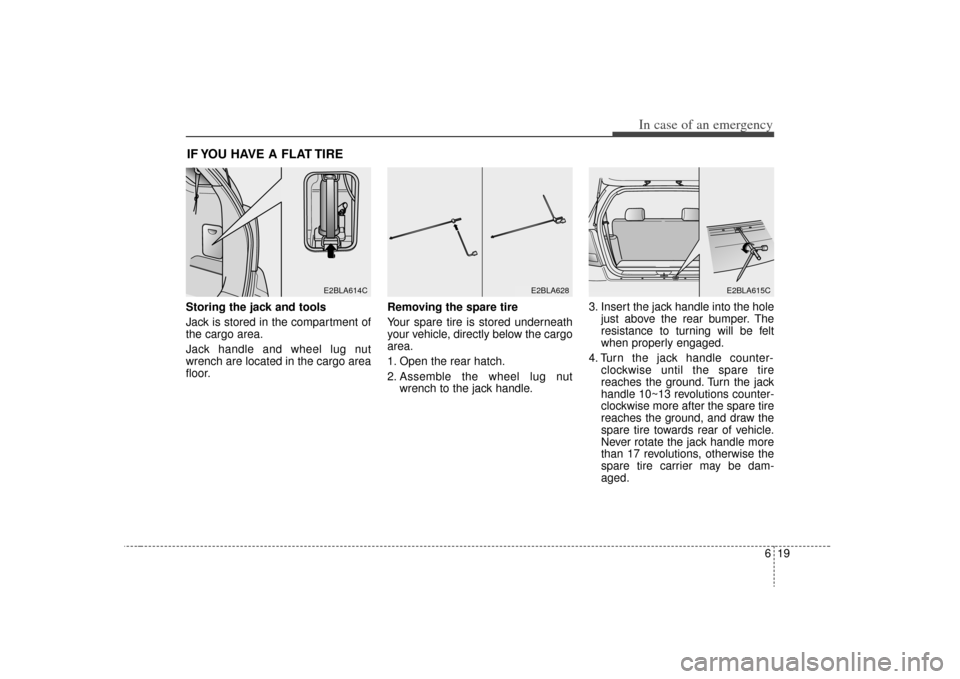
Jack is stored in the compartment of
the cargo area.
Jack handle and wheel lug nut
wrench are located in the cargo area
floor.Removing the spare tire
Your spare tire is stored underneath
your vehicle, directly below the cargo
area.
1. Open the rear hatch.
2. Assemble the wheel lug nut
wrench to the jack handle. 3. Insert the jack handle into the hole
just above the rear bumper. The
resistance to turning will be felt
when properly engaged.
4. Turn the jack handle counter- clockwise until the spare tire
reaches the ground. Turn the jack
handle 10~13 revolutions counter-
clockwise more after the spare tire
reaches the ground, and draw the
spare tire towards rear of vehicle.
Never rotate the jack handle more
than 17 revolutions, otherwise the
spare tire carrier may be dam-
aged.
E2BLA614C
E2BLA628
E2BLA615C
Page 267 of 327
621
In case of an emergency
Important - use of compact spare
tire (if equipped)
your vehicle is equipped with a com-
pact spare tire. This compact spare
tire takes up less space than a regu-
lar-size tire. This tire is smaller than a
conventional tire and is designed for
temporary use only.The compact spare should be inflat-
ed to 420 kPa (60 psi).
✽ ✽NOTICECheck the inflation pressure after
installing the spare tire. Adjust it to
the specified pressure, as necessary.
When using a compact spare tire,
observe the following precautions:
Under no circumstances should
you exceed 80 km/h (50 mph); a
higher speed could damage the
tire.
Ensure that you drive slowly enough for the road conditions to
avoid all hazards. Any road hazard,
such as a pothole or debris, could
seriously damage the compact
spare.
Any continuous road use of this tire could result in tire failure, loss of
vehicle control, and possible per-
sonal injury.
Do not exceed the vehicle’s maxi- mum load rating or the load-carry-
ing capacity shown on the sidewall
of the compact spare tire.
Avoid driving over obstacles. The compact spare tire diameter is
smaller than the diameter of a con-
ventional tire and reduces the
ground clearance approximately
25 mm (1 inch), which could result
in damage to the vehicle.
CAUTION
You should drive carefully when the compact spare is inuse. The compact spareshould be replaced by theproper conventional tire andrim at the first opportunity.
The operation of this vehicle is not recommended withmore than one compact sparetire in use at the same time.
CAUTION
This spare tire should be usedonly for VERY short distances.Compact spares should NEVERbe used for long drives orextended distances.
Page 272 of 327
In case of an emergency26
6
To prevent the jack, jack handle,
wheel lug nut, wrench and spare tire
from rattling while the vehicle is in
motion, store them properly. To store
the flat fire, refer to “Storing the
spare
CAUTION
Your vehicle has metric threads
on the wheel studs and nuts.Make certain during wheelremoval that the same nutsremoved are reinstalled - or, ifreplaced, that nuts with metricthreads and the same chamferconfiguration are used.Installation of a non-metricthread nut on a metric stud orvice-versa will not secure thewheel to the hub properly andwill damage the stud so that itmust be replaced.
Note that most lug nuts do nothave metric threads. Be sure touse extreme care in checkingfor thread style before installingaftermarket lug nuts or wheels.If in doubt, consult anAuthorized Kia Dealer.
WARNING
- Wheel Studs
If the studs are damaged, they
may lose their ability to retain
the wheel. This could lead to the
loss of the wheel and a colli-
sion.
WARNING
Check the inflation pressures as
soon as possible after installing
the spare tire. Adjust it to the
specified pressure, if necessary.
Refer to Section 8, Specifications.