fuel filter KIA SORENTO 2010 User Guide
[x] Cancel search | Manufacturer: KIA, Model Year: 2010, Model line: SORENTO, Model: KIA SORENTO 2010Pages: 399, PDF Size: 40.44 MB
Page 338 of 399
Maintenance
32
7
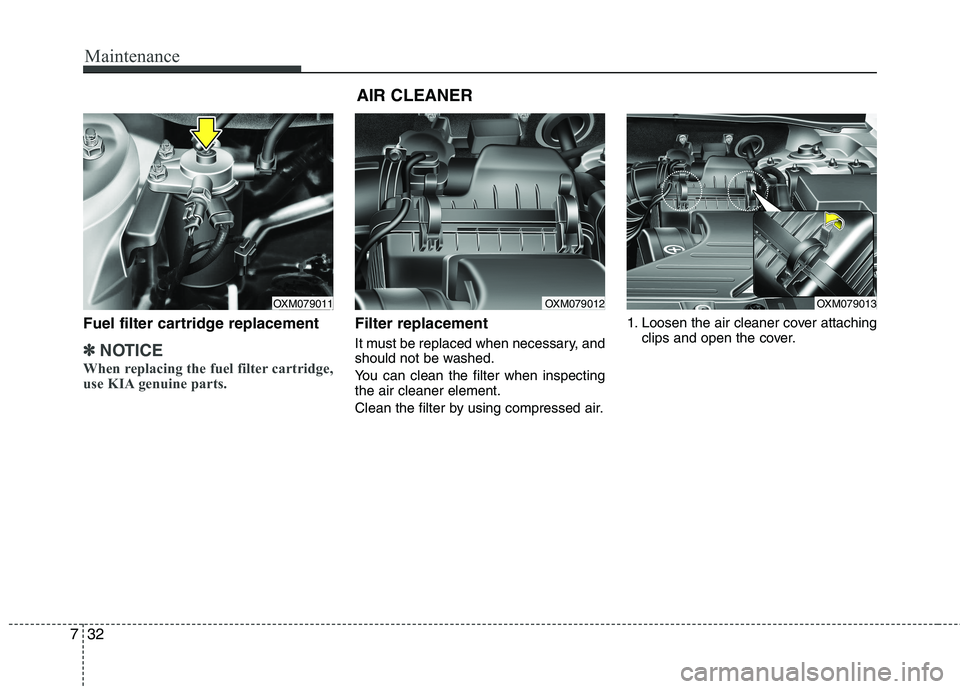
Fuel filter cartridge replacement
✽✽
NOTICE
When replacing the fuel filter cartridge,
use KIA genuine parts.
Filter replacement
It must be replaced when necessary, and
should not be washed.
You can clean the filter when inspecting the air cleaner element.
Clean the filter by using compressed air. 1. Loosen the air cleaner cover attaching
clips and open the cover.
OXM079011 AIR CLEANEROXM079012OXM079013
Page 368 of 399
Maintenance
62
7
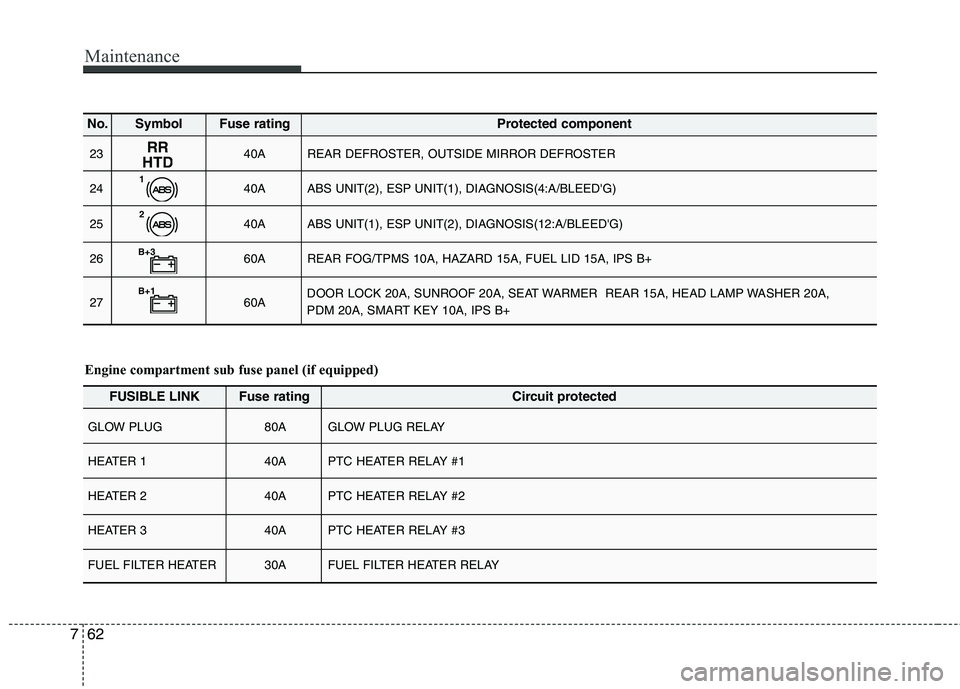
23 40A REAR DEFROSTER, OUTSIDE MIRROR DEFROSTER
24 40A ABS UNIT(2), ESP UNIT(1), DIAGNOSIS(4:A/BLEED'G)
25 40A ABS UNIT(1), ESP UNIT(2), DIAGNOSIS(12:A/BLEED'G)
26 60A REAR FOG/TPMS 10A, HAZARD 15A, FUEL LID 15A, IPS B+
27 60A DOOR LOCK 20A, SUNROOF 20A, SEAT WARMER REAR 15A, HEAD LAMP WASHER 20A,
PDM 20A, SMART KEY 10A, IPS B+
No. Symbol Fuse rating Protected component
GLOW PLUG 80A GLOW PLUG RELAY
HEATER 1 40A PTC HEATER RELAY #1
HEATER 2 40A PTC HEATER RELAY #2
HEATER 3 40A PTC HEATER RELAY #3
FUEL FILTER HEATER 30A FUEL FILTER HEATER RELAY
FUSIBLE LINK Fuse rating Circuit protected
RR
HTD1
2
B+3
B+1
Engine compartment sub fuse panel (if equipped)
Page 384 of 399
Maintenance
78
7
EMISSION CONTROL SYSTEM (IF EQUIPPED)
The emission control system of your
vehicle is covered by a written limited
warranty. Please see the warranty infor-
mation contained in the Warr anty &
Maintenance book in y our vehicle.
Your vehicle is equipped with an emis-
sion control system to meet all applicable
emission regulations. There are three emission control sys-
tems, as follows.
(1) Crankcase emission control system
(2) Evaporative emission control system(3) Exhaust emission control system In order to assure the proper function of
the emission control systems, it is rec-
ommended that you have your vehicle
inspected and maintained by an author-
ized KIA dealer in accordance with the
maintenance schedule in this manual. Caution for the Inspection and
Maintenance Test (With Electronic
Stability Program (ESP) system)
To prevent the vehicle from misfir-
ing during dynamometer testing,
turn the Electronic Stability
Program (ESP) system off by press-
ing the ESP switch.
After dynamometer testing is com- pleted, turn the ESP system back on
by pressing the ESP switch again. 1. Crankcase emission control
system
The positive crankcase ventilation sys-
tem is employed to prevent air pollution
caused by blow-by gases being emitted
from the crankcase. This system supplies
fresh filtered air to the crankcase through
the air intake hose. Inside the crankcase,
the fresh air mixes with blow-by gases,
which then pass through the PCV valveinto the induction system.
2. Evaporative emission control
The Evaporative Emission Control
System is designed to prevent fuel
vapors from escaping into the atmos-
phere.
Page 387 of 399
781
Maintenance
Diesel Particulate Filter (if equipped)
The Diesel Particulate Filter (DPF) sys-
tem removes the soot emitted from the
vehicle.
Unlike a disposable air filter, the DPF
system automatically burns (oxidizes)
and removes the accumulated soot
according to the driving condition. In
other words, the active burning by engine
control system and high exhaust gas
temperature caused by normal/high driv-
ing condition burns and removes the
accumulated soot.
However, if the vehicle continues to be
driven at low speed for long time, the
accumulated soot may not be automati-
cally removed because of low exhaust
gas temperature. In this particular case,the amount of soot is out of detection
limit, the soot oxidation process by
engine control system may not happen
and the malfunction indicator light may
blink. When the malfunction indicator light
blinks, it may stop blinking by driving the
vehicle at more than 60 km/h (37 mph) orat more than second gear with 1500 ~
2000 engine rpm for a certain time (for
about 25 minutes).If the malfunction indicator light contin-
ues to be blinked in spite of the proce-
dure, please visit an authorized KIA deal-
er and then check the DPF system.
If you continue to drive with the malfunc-
tion indicator light blinking for a long time,the DPF system can be damaged and
fuel consumption can be worsen.
Page 392 of 399
85
Specifications & Consumer information
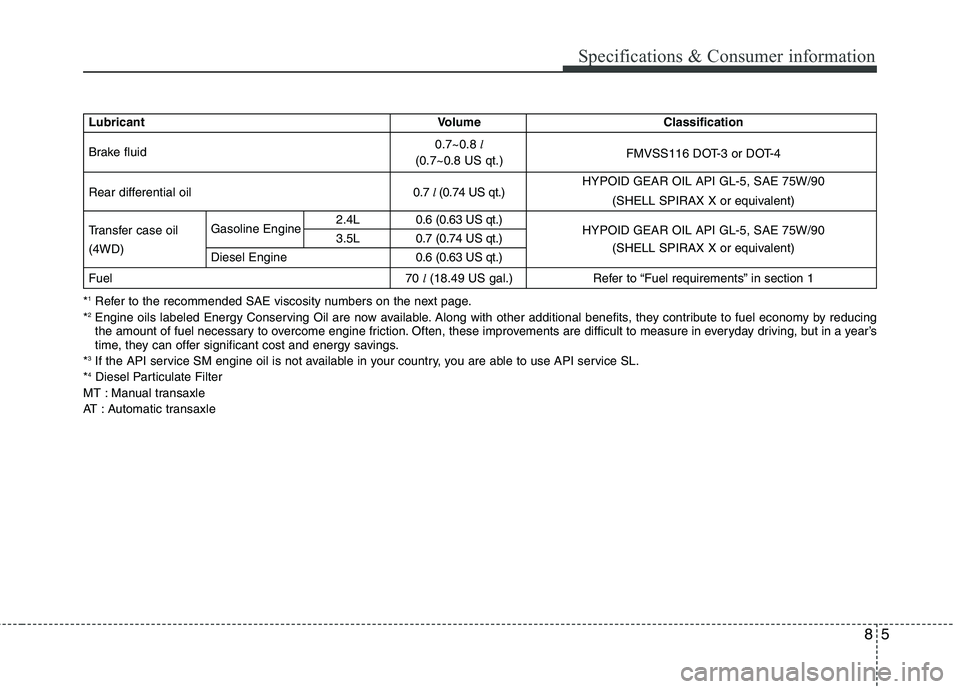
LubricantVolume Classification
Brake fluid 0.7~0.8
l
FMVSS116 DOT-3 or DOT-4
(0.7~0.8 US qt.)
Rear differential oil 0.7 l (0.74 US qt.) HYPOID GEAR OIL API GL-5, SAE 75W/90
(SHELL SPIRAX X or equivalent)
Transfer case oil Gasoline Engine 2.4L
0.6 (0.63 US qt.)
HYPOID GEAR OIL API GL-5, SAE 75W/90
(4WD) 3.5L
0.7 (0.74 US qt.)
Diesel Engine 0.6 (0.63 US qt.)(SHELL SPIRAX X or equivalent)
Fuel 70 l (18.49 US gal.) Refer to “Fuel requirements” in section 1
*1
Refer to the recommended SAE viscosity numbers on the next page.
* 2
Engine oils labeled Energy Conserving Oil are now available. Along with other additional benefits, they contribute to fuel economy by reducing
the amount of fuel necessary to overcome engine friction. Often, these improvements are difficult to measure in everyday driving, but in a year’s
time, they can offer significant cost and energy savings.
* 3
If the API service SM engine oil is not available in your country, you are able to use API service SL.
* 4
Diesel Particulate Filter
MT : Manual transaxle
AT : Automatic transaxle
Page 397 of 399
Index
2
I
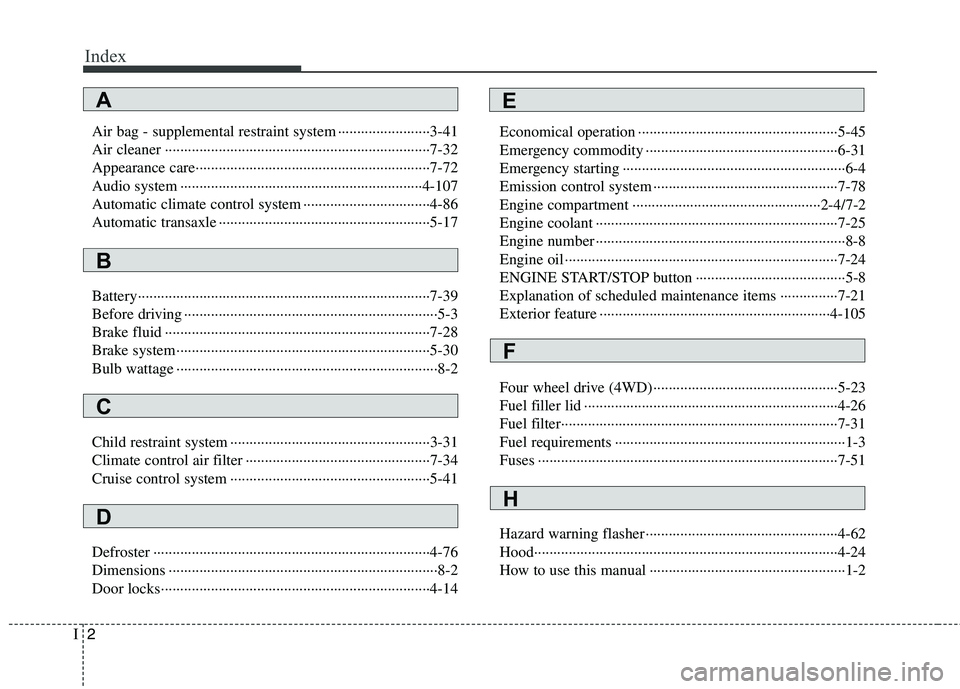
Air bag - supplemental restraint system ························3-41
Air cleaner ·····································································7-32
Appearance care·····························································7-72
Audio system ·······························································4-107
Automatic climate control system ·································4-86
Automatic transaxle ·······················································5-17
Battery············································································7-39
Before driving ··································································5-3
Brake fluid ·····································································7-28
Brake system··································································5-30
Bulb wattage ····································································8-2
Child restraint system ····················································3-31
Climate control air filter ················································7-34
Cruise control system ····················································5-41
Defroster ········································································4-76
Dimensions ······································································8-2
Door locks······································································4-14 Economical operation ····················································5-45
Emergency commodity ··················································6-31
Emergency starting ··························································6-4
Emission control system ················································7-78
Engine compartment ·················································2-4/7-2
Engine coolant ·······························································7-25
Engine number ·································································8-8
Engine oil ·······································································7-24
ENGINE START/STOP button ·······································5-8
Explanation of scheduled maintenance items ···············7-21
Exterior feature ····························································4-105
Four wheel drive (4WD)················································5-23
Fuel filler lid ··································································4-26
Fuel filter········································································7-31
Fuel requirements ····························································1-3
Fuses ··············································································7-51
Hazard warning flasher ··················································4-62
Hood···············································································4-24
How to use this manual ···················································1-2
A
B
C
D
E
F
H