coolant KIA SORENTO 2010 Owner's Manual
[x] Cancel search | Manufacturer: KIA, Model Year: 2010, Model line: SORENTO, Model: KIA SORENTO 2010Pages: 399, PDF Size: 40.44 MB
Page 333 of 399
727
Maintenance
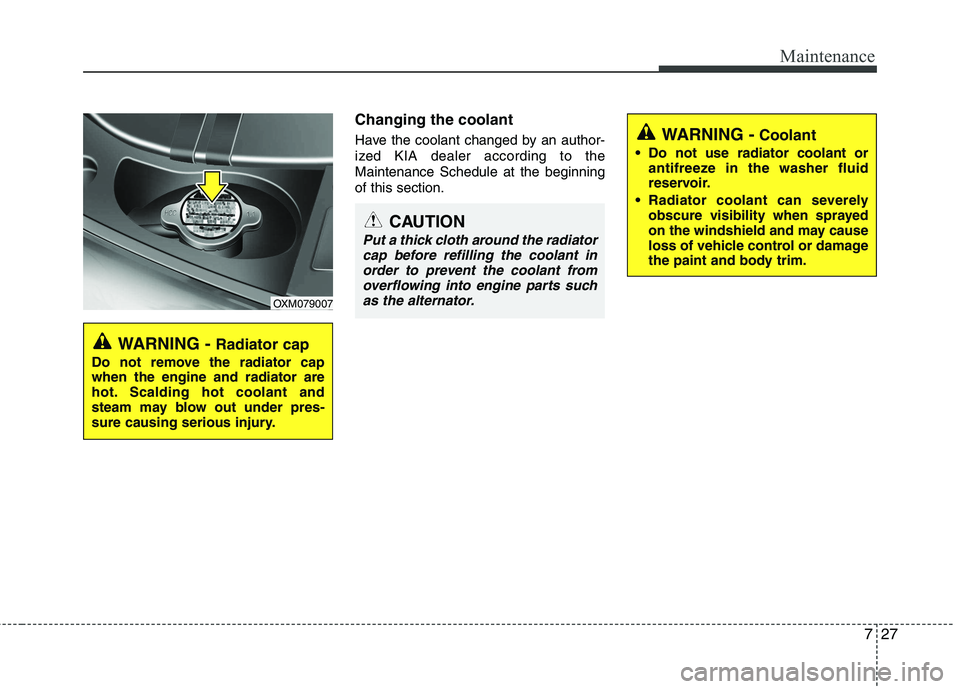
Changing the coolant
Have the coolant changed by an author-
ized KIA dealer according to theMaintenance Schedule at the beginningof this section.
WARNING - Radiator cap
Do not remove the radiator cap when the engine and radiator are
hot. Scalding hot coolant and
steam may blow out under pres-
sure causing serious injury.
OXM079007
CAUTION
Put a thick cloth around the radiator cap before refilling the coolant in order to prevent the coolant from
overflowing into engine parts suchas the alternator.
WARNING - Coolant
Do not use radiator coolant or antifreeze in the washer fluid
reservoir.
Radiator coolant can severely obscure visibility when sprayed
on the windshield and may cause
loss of vehicle control or damage
the paint and body trim.
Page 336 of 399
Maintenance
30
7
WASHER FLUID
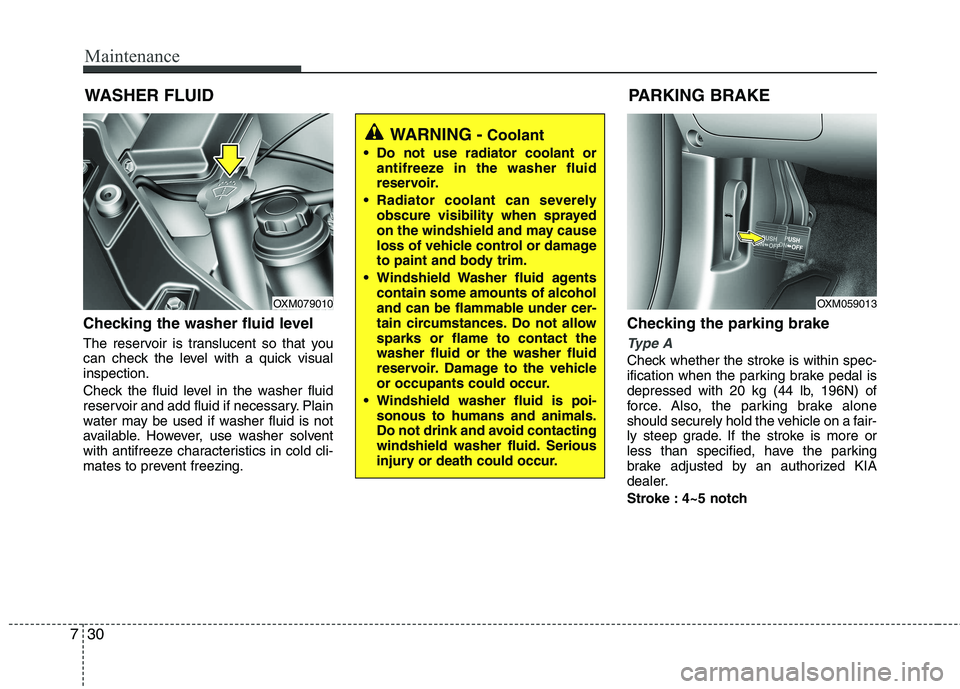
Checking the washer fluid level
The reservoir is translucent so that you
can check the level with a quick visualinspection.
Check the fluid level in the washer fluid
reservoir and add fluid if necessary. Plain
water may be used if washer fluid is not
available. However, use washer solvent
with antifreeze characteristics in cold cli-
mates to prevent freezing. Checking the parking brake
Type A
Check whether the stroke is within spec-
ification when the parking brake pedal is
depressed with 20 kg (44 lb, 196N) of
force. Also, the parking brake alone
should securely hold the vehicle on a fair-
ly steep grade. If the stroke is more or
less than specified, have the parking
brake adjusted by an authorized KIA
dealer.
Stroke : 4~5 notch
WARNING -
Coolant
Do not use radiator coolant or antifreeze in the washer fluid
reservoir.
Radiator coolant can severely obscure visibility when sprayed
on the windshield and may cause
loss of vehicle control or damage
to paint and body trim.
Windshield Washer fluid agents contain some amounts of alcohol
and can be flammable under cer-
tain circumstances. Do not allowsparks or flame to contact thewasher fluid or the washer fluid
reservoir. Damage to the vehicle
or occupants could occur.
Windshield washer fluid is poi- sonous to humans and animals.
Do not drink and avoid contacting
windshield washer fluid. Serious
injury or death could occur.
OXM079010 PARKING BRAKE OXM059013
Page 385 of 399
779
Maintenance
Canister
Fuel vapors generated inside the fuel tank are absorbed and stored in the
onboard canister. When the engine is
running, the fuel vapors absorbed in the
canister are drawn into the surge tank
through the purge control solenoid valve.
Purge Control Solenoid Valve (PCSV)
The purge control solenoid valve is con-
trolled by the Engine Control Module
(ECM); when the engine coolant temper-
ature is low during idling, the PCSV clos-
es so that evaporated fuel is not taken
into the engine. After the engine warms
up during ordinary driving, the PCSV
opens to introduce evaporated fuel to the
engine.3. Exhaust emission control
system
The Exhaust Emission Control System is
a highly effective system which controls
exhaust emissions while maintaining
good vehicle performance.
Vehicle modifications
This vehicle should not be modified.
Modification of your vehicle could affect
its performance, safety or durability and
may even violate governmental safety
and emissions regulations.
In addition, damage or performance
problems resulting from any modification
may not be covered under warranty.
Engine exhaust gas precautions (carbon monoxide)
Carbon monoxide can be present with other exhaust fumes. Therefore, if you
smell exhaust fumes of any kind inside
your vehicle, have it inspected and
repaired immediately. If you ever sus-
pect exhaust fumes are coming into
your vehicle, drive it only with all the
windows fully open. Have your vehicle
checked and repaired immediately.
WARNING - Exhaust
Engine exhaust gases contain car-
bon monoxide (CO). Though color-
less and odorless, it is dangerousand could be lethal if inhaled.
Follow the instructions on this
page to avoid CO poisoning.
Page 391 of 399
Specifications & Consumer information
4
8
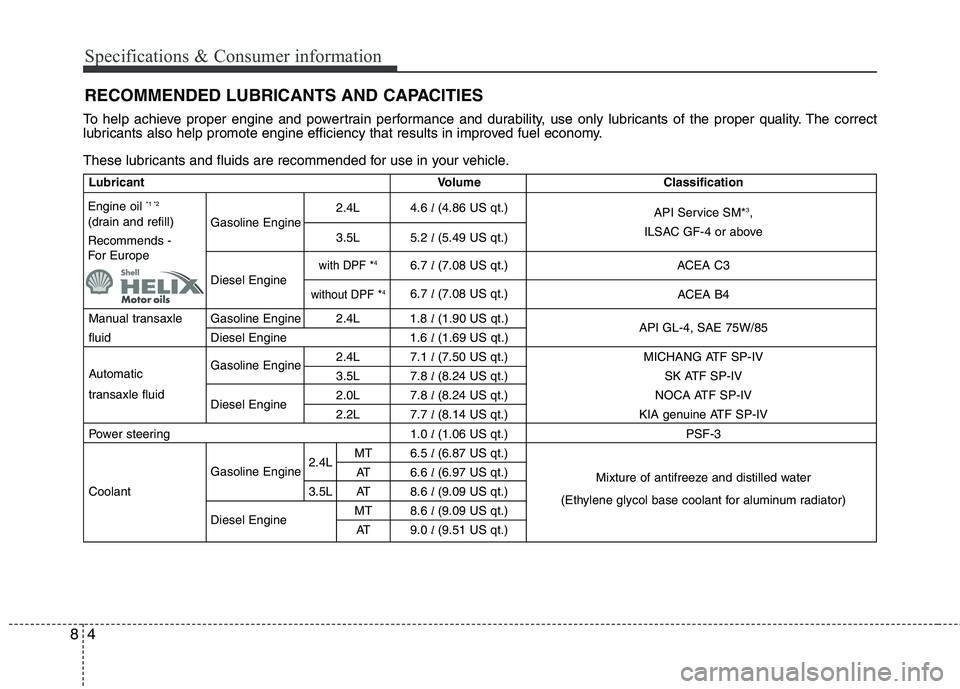
RECOMMENDED LUBRICANTS AND CAPACITIES
To help achieve proper engine and powertrain performance and durability, use only lubricants of the proper quality. The correct
lubricants also help promote engine efficiency that results in improved fuel economy.
These lubricants and fluids are recommended for use in your vehicle.
Lubricant Volume Classification
2.4L 4.6 l (4.86 US qt.)
API Service SM*3
,
Gasoline Engine
3.5L 5.2 l (5.49 US qt.) ILSAC GF-4 or above
with DPF *
46.7
l (7.08 US qt.) ACEA C3
Diesel Engine 6.7 l (7.08 US qt.)
without DPF * 4ACEA B4
Manual transaxle Gasoline Engine 2.4L 1.8 l(1.90 US qt.)
API GL-4, SAE 75W/85
fluid Diesel Engine 1.6 l(1.69 US qt.)
Automatic 2.4L 7.1
l (7.50 US qt.) MICHANG ATF SP-IV
transaxle fluid Gasoline Engine
3.5L 7.8 l (8.24 US qt.) SK ATF SP-IV
Diesel Engine 2.0L 7.8
l (8.24 US qt.) NOCA ATF SP-IV
2.2L 7.7 l (8.14 US qt.) KIA genuine ATF SP-IV
Power steering 1.0 l (1.06 US qt.) PSF-3
Gasoline Engine 2.4LMT 6.5
l (6.87 US qt.)
Mixture of antifreeze and distilled water
AT 6.6
l (6.97 US qt.)
Coolant 3.5L AT 8.6 l (9.09 US qt.)
Diesel Engine MT 8.6
l (9.09 US qt.) (Ethylene glycol base coolant for aluminum radiator)
AT 9.0 l (9.51 US qt.)
Engine oil *1 *2
(drain and refill) Recommends -
For Europe
Page 397 of 399
Index
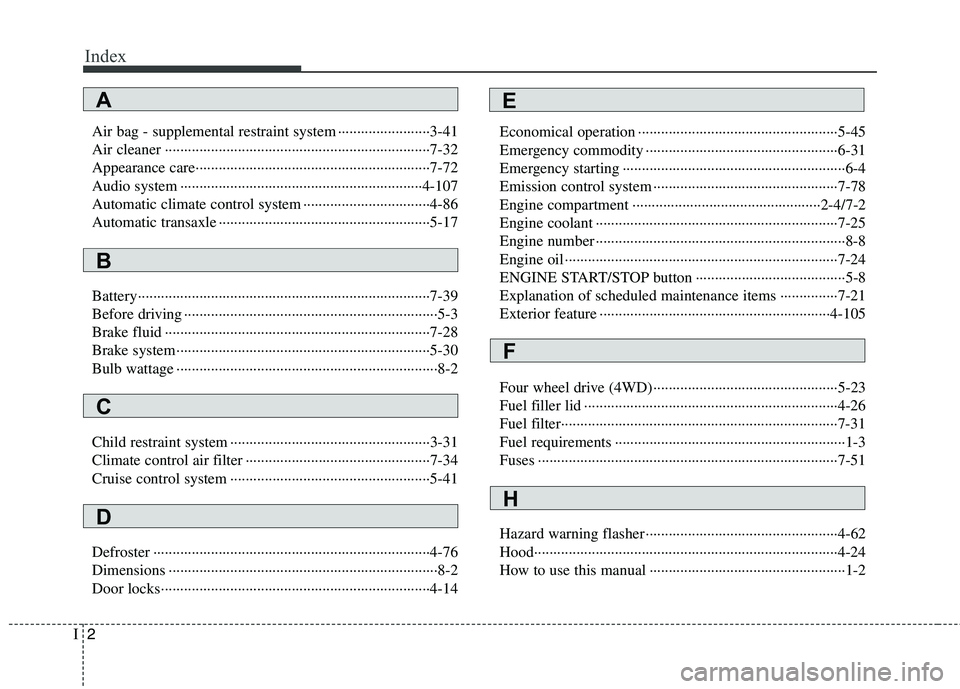
2
I
Air bag - supplemental restraint system ························3-41
Air cleaner ·····································································7-32
Appearance care·····························································7-72
Audio system ·······························································4-107
Automatic climate control system ·································4-86
Automatic transaxle ·······················································5-17
Battery············································································7-39
Before driving ··································································5-3
Brake fluid ·····································································7-28
Brake system··································································5-30
Bulb wattage ····································································8-2
Child restraint system ····················································3-31
Climate control air filter ················································7-34
Cruise control system ····················································5-41
Defroster ········································································4-76
Dimensions ······································································8-2
Door locks······································································4-14 Economical operation ····················································5-45
Emergency commodity ··················································6-31
Emergency starting ··························································6-4
Emission control system ················································7-78
Engine compartment ·················································2-4/7-2
Engine coolant ·······························································7-25
Engine number ·································································8-8
Engine oil ·······································································7-24
ENGINE START/STOP button ·······································5-8
Explanation of scheduled maintenance items ···············7-21
Exterior feature ····························································4-105
Four wheel drive (4WD)················································5-23
Fuel filler lid ··································································4-26
Fuel filter········································································7-31
Fuel requirements ····························································1-3
Fuses ··············································································7-51
Hazard warning flasher ··················································4-62
Hood···············································································4-24
How to use this manual ···················································1-2
A
B
C
D
E
F
H