door lock KIA SORENTO 2010 Owners Manual
[x] Cancel search | Manufacturer: KIA, Model Year: 2010, Model line: SORENTO, Model: KIA SORENTO 2010Pages: 399, PDF Size: 40.44 MB
Page 10 of 399
17
Introduction
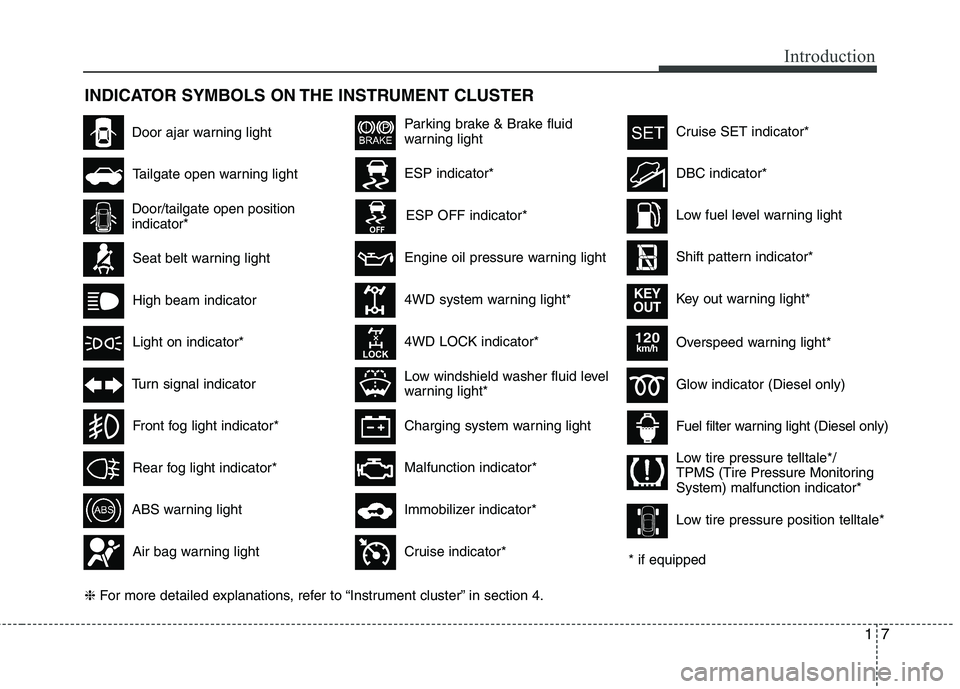
INDICATOR SYMBOLS ON THE INSTRUMENT CLUSTER
Seat belt warning light
Door/tailgate open position indicator*
Tailgate open warning light
High beam indicator
Light on indicator*
Turn signal indicator
Front fog light indicator*
ABS warning light
Parking brake & Brake fluid
warning light
Engine oil pressure warning light
4WD system warning light* 4WD LOCK indicator*
Malfunction indicator*
Air bag warning light
Cruise SET indicator*
Low fuel level warning light
Shift pattern indicator*
DBC indicator*
❈ For more detailed explanations, refer to “Instrument cluster” in section 4.
Charging system warning light
Low windshield washer fluid level
warning light*
Door ajar warning light
Overspeed warning light*
120km/h
Key out warning light*KEY
OUT
* if equipped
Glow indicator (Diesel only)
Fuel filter warning light (Diesel only)
Cruise indicator*
Rear fog light indicator*
ESP indicator*
ESP OFF indicator*
Immobilizer indicator*
Low tire pressure telltale*/
TPMS (Tire Pressure MonitoringSystem) malfunction indicator*
Low tire pressure position telltale*
Page 12 of 399

Your vehicle at a glance
2
2
INTERIOR OVERVIEW
1. Door lock/unlock button ....................4-14
2. Outside rearview mirror folding
button*...............................................4-38
3. Outside rearview mirror control switch ................................................4-37
4. Central door lock switch* ..................4-14
5. Power window lock button* ...............4-23
6. Power window switches ....................4-20
7. Fuel filler lid release button...............4-26
8. Head lamp leveling device*...............4-67
9. 4WD lock button* ..............................5-23
10. ESP OFF button* ...........................5-35
11. Headlight washer button*................4-68
12. DBC button* ....................................5-38
13. Instrument panel illumination control switch*.............................................4-41
14. Steering wheel tilt control* ..............4-34
15. Steering wheel ................................4-33
16. Fuse box .........................................7-51
17. Hood release lever ..........................4-24
18. Seat...................................................3-2
19. Air vent ............................................4-78
* : if equipped
OXM019001L
Page 34 of 399
Safety features of your vehicle
20
3
Lap/shoulder belt
To fasten your seat belt:
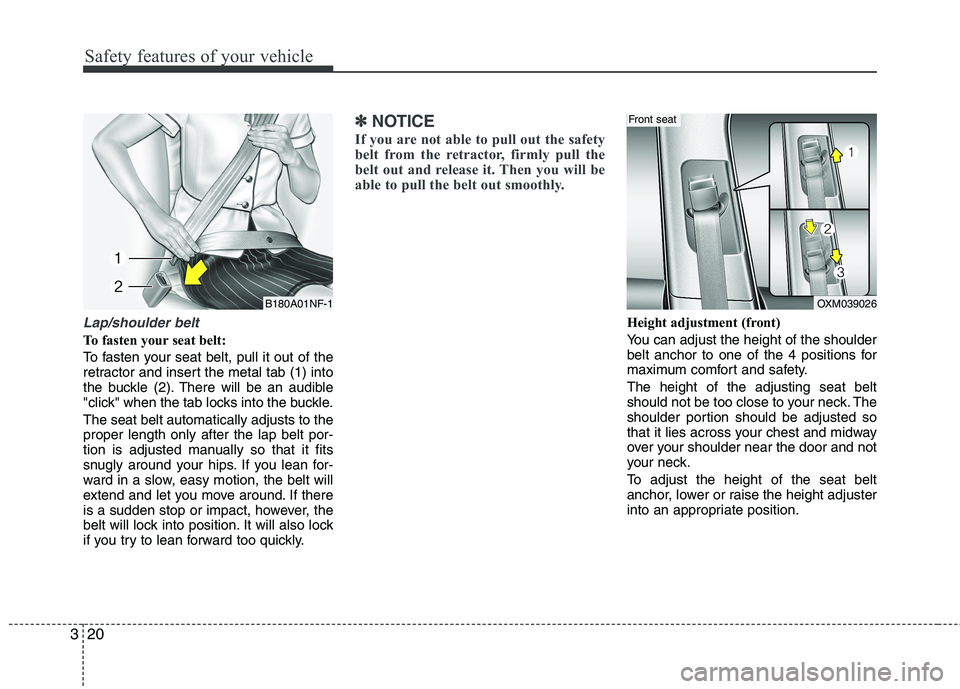
To fasten your seat belt, pull it out of the
retractor and insert the metal tab (1) into
the buckle (2). There will be an audible
"click" when the tab locks into the buckle. The seat belt automatically adjusts to the proper length only after the lap belt por-
tion is adjusted manually so that it fits
snugly around your hips. If you lean for-
ward in a slow, easy motion, the belt will
extend and let you move around. If there
is a sudden stop or impact, however, the
belt will lock into position. It will also lock
if you try to lean forward too quickly.
✽✽
NOTICE
If you are not able to pull out the safety
belt from the retractor, firmly pull the
belt out and release it. Then you will be
able to pull the belt out smoothly.
Height adjustment (front)
You can adjust the height of the shoulder
belt anchor to one of the 4 positions for
maximum comfort and safety. The height of the adjusting seat belt
should not be too close to your neck. The
shoulder portion should be adjusted so
that it lies across your chest and midway
over your shoulder near the door and not
your neck.
To adjust the height of the seat belt
anchor, lower or raise the height adjuster
into an appropriate position.
B180A01NF-1OXM039026
Front seat
Page 35 of 399
321
Safety features of your vehicle
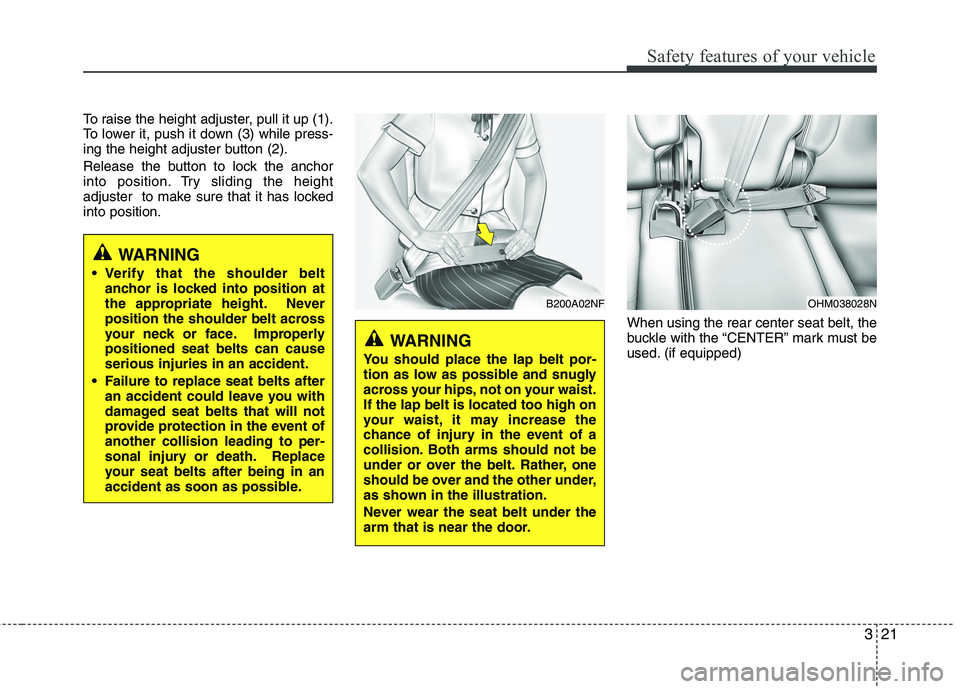
To raise the height adjuster, pull it up (1).
To lower it, push it down (3) while press-
ing the height adjuster button (2).
Release the button to lock the anchor
into position. Try sliding the height
adjuster to make sure that it has lockedinto position.When using the rear center seat belt, the
buckle with the “CENTER” mark must be
used. (if equipped)
WARNING
Verify that the shoulder belt anchor is locked into position at
the appropriate height. Never
position the shoulder belt across
your neck or face. Improperlypositioned seat belts can causeserious injuries in an accident.
Failure to replace seat belts after an accident could leave you with
damaged seat belts that will not
provide protection in the event ofanother collision leading to per-
sonal injury or death. Replace
your seat belts after being in an
accident as soon as possible.
B200A02NF
WARNING
You should place the lap belt por-
tion as low as possible and snugly
across your hips, not on your waist.If the lap belt is located too high on
your waist, it may increase the
chance of injury in the event of a
collision. Both arms should not be
under or over the belt. Rather, one
should be over and the other under,
as shown in the illustration.
Never wear the seat belt under the
arm that is near the door.
OHM038028N
Page 57 of 399

343
Safety features of your vehicle
Noise and smoke
When the air bags inflate, they make a
loud noise and they leave smoke and
powder in the air inside of the vehicle.
This is normal and is a result of the igni-
tion of the air bag inflator. After the air
bag inflates, you may feel substantial dis-
comfort in breathing due to the contact of
your chest with both the seat belt and the
air bag, as well as from breathing the
smoke and powder.Open your doors
and/or windows as soon as possible
after the impact in order to reduce dis-
comfort and prevent prolonged expo-
sure to smoke and powder.
Though the smoke and powder are non-
toxic, they may cause irritation to the skin
(eyes, nose and throat, etc). If this is the
case, wash and rinse with cold waterimmediately and consult a doctor if the
symptom persists.
Do not install a child restraint on the
front passenger’s seat.
Never place a rear-facing child restraint
in the front passenger’s seat. If the air
bag deploys, it would impact the rear-fac-
ing child restraint, causing serious or
fatal injury.
In addition, do not place front-facing child
restraints in the front passenger’s seat
either. If the front passenger air bag
inflates, it could cause serious or fatal
injuries to the child.
If your vehicle is equipped with the pas-
senger’s front air bag ON/OFF switch,
you can activate or deactivate the front
passenger’s air bag when necessary.
For more details, please refer to 3-49
page.
1JBH3051
WARNING
When the air bags deploy, the air
bag related parts in the steering
wheel, instrument panel, front seats
and/or in both sides of the roof rails
above the front and rear doors are
very hot. To prevent injury, do not
touch the air bag storage area’s
internal components immediately
after an air bag has inflated.
WARNING
Extreme Hazard! Do not use a rearward facing child restraint on
a seat protected by an air bag in
front of it!
Never put a child restraint in the front passenger’s seat. If the front
passenger air bag inflates, it cancause serious or fatal injuries.
When children are seated in the rear outboard seats of a vehicle
equipped with side and/or curtain
air bags, be sure to install the
child restraint system as far away
from the door side as possible,
and securely lock the childrestraint system in position.
Inflation of side and/or curtain air
bags could cause serious injury
or death to an infant or child.
Page 67 of 399
353
Safety features of your vehicle
Curtain air bag (if equipped)
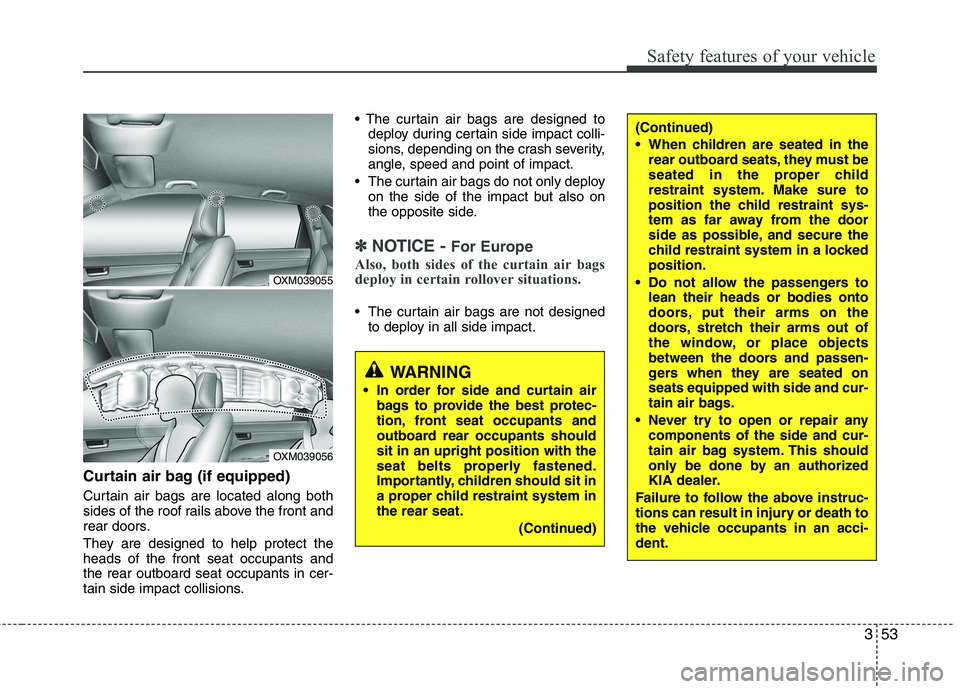
Curtain air bags are located along both
sides of the roof rails above the front and
rear doors.
They are designed to help protect the heads of the front seat occupants andthe rear outboard seat occupants in cer-
tain side impact collisions.
deploy during certain side impact colli-
sions, depending on the crash severity,
angle, speed and point of impact.
The curtain air bags do not only deploy on the side of the impact but also on
the opposite side.
✽✽ NOTICE - For Europe
Also, both sides of the curtain air bags
deploy in certain rollover situations.
The curtain air bags are not designed to deploy in all side impact.
WARNING
In order for side and curtain air bags to provide the best protec-
tion, front seat occupants and
outboard rear occupants shouldsit in an upright position with the
seat belts properly fastened.
Importantly, children should sit in
a proper child restraint system inthe rear seat.
(Continued)
(Continued)
When children are seated in therear outboard seats, they must be
seated in the proper child
restraint system. Make sure to
position the child restraint sys-
tem as far away from the door
side as possible, and secure the
child restraint system in a lockedposition.
Do not allow the passengers to lean their heads or bodies onto
doors, put their arms on the
doors, stretch their arms out of
the window, or place objects
between the doors and passen-
gers when they are seated onseats equipped with side and cur-
tain air bags.
Never try to open or repair any components of the side and cur-
tain air bag system. This should
only be done by an authorized
KIA dealer.
Failure to follow the above instruc-
tions can result in injury or death to
the vehicle occupants in an acci-dent.
OXM039055
OXM039056
Page 76 of 399
4
Keys / 4-3
Remote keyless entry / 4-6
Smart key / 4-9
Theft-alarm system / 4-12
Door locks / 4-14
Tailgate / 4-18
Windows / 4-20
Hood / 4-24
Fuel filler lid / 4-26
Panorama sunroof / 4-29
Steering wheel / 4-33
Mirrors / 4-35
Instrument cluster / 4-39
Rear parking assist system / 4-59
Rearview camera / 4-62
Hazard warning flasher / 4-62
Lighting / 4-63
Wipers and washers / 4-69
Interior light / 4-73
Defroster / 4-76
Manual climate control system / 4-77
Automatic climate control system / 4-86
Windshield defrosting and defogging / 4-94
Features of your vehicle
Page 78 of 399
43
Features of your vehicle
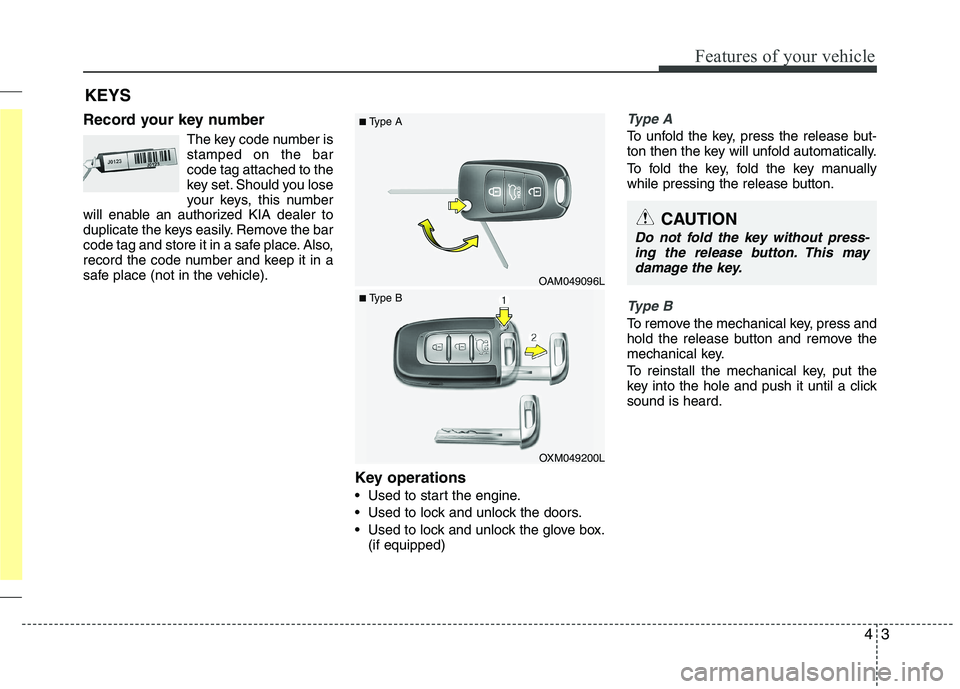
Record your key numberThe key code number is stamped on the barcode tag attached to the
key set. Should you lose
your keys, this number
will enable an authorized KIA dealer to
duplicate the keys easily. Remove the bar
code tag and store it in a safe place. Also,
record the code number and keep it in a
safe place (not in the vehicle).
Key operations
• Used to start the engine.
Used to lock and unlock the doors.
Used to lock and unlock the glove box.(if equipped)Type A
To unfold the key, press the release but-
ton then the key will unfold automatically.
To fold the key, fold the key manually
while pressing the release button.
Type B
To remove the mechanical key, press and
hold the release button and remove the
mechanical key.
To reinstall the mechanical key, put the
key into the hole and push it until a clicksound is heard.
KEYS
OAM049096L
OXM049200L
■
Type A
■ Type B
CAUTION
Do not fold the key without press-
ing the release button. This may damage the key.
Page 81 of 399
Features of your vehicle
6
4
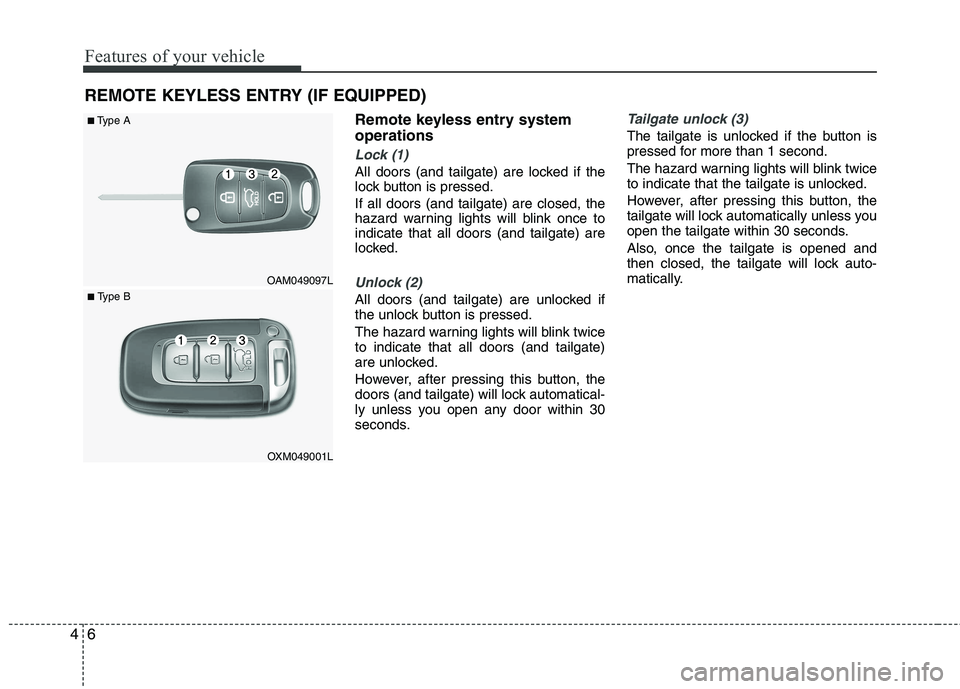
Remote keyless entry system operations
Lock (1)
All doors (and tailgate) are locked if the
lock button is pressed. If all doors (and tailgate) are closed, the
hazard warning lights will blink once toindicate that all doors (and tailgate) are
locked.
Unlock (2)
All doors (and tailgate) are unlocked if
the unlock button is pressed.
The hazard warning lights will blink twice to indicate that all doors (and tailgate)
are unlocked.
However, after pressing this button, the
doors (and tailgate) will lock automatical-
ly unless you open any door within 30
seconds.
Tailgate unlock (3)
The tailgate is unlocked if the button is
pressed for more than 1 second.
The hazard warning lights will blink twice
to indicate that the tailgate is unlocked.
However, after pressing this button, the
tailgate will lock automatically unless you
open the tailgate within 30 seconds.
Also, once the tailgate is opened and
then closed, the tailgate will lock auto-
matically.
REMOTE KEYLESS ENTRY (IF EQUIPPED)
OAM049097L
OXM049001L
■
Type A
■ Type B
Page 82 of 399
47
Features of your vehicle
Transmitter precautions
✽✽NOTICE
The transmitter will not work if any of
the following occurs:
The ignition key is in the ignition switch.
You exceed the operating distance
limit (about 10 m [30 feet]).
The battery in the transmitter is
weak.
Other vehicles or objects may be
blocking the signal.
The weather is extremely cold.
The transmitter is close to a radio transmitter such as a radio station or
an airport which can interfere with
normal operation of the transmitter.
When the transmitter does not work
properly, open and close the door with
the ignition key. If you have a problem
with the transmitter, contact an author-
ized KIA dealer.
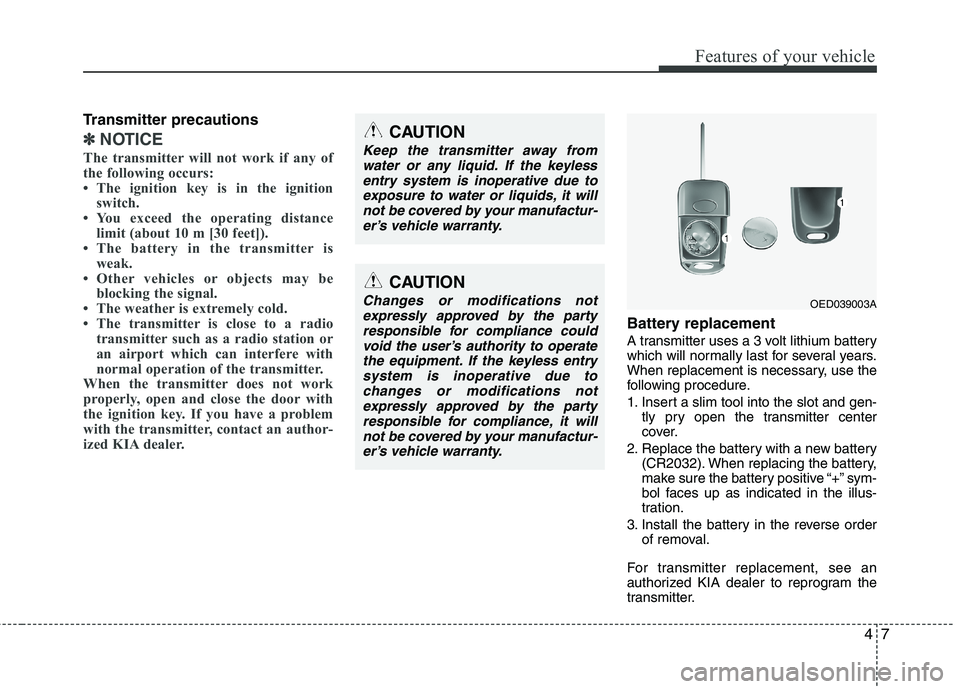
Battery replacement
A transmitter uses a 3 volt lithium battery
which will normally last for several years.
When replacement is necessary, use the
following procedure.
1. Insert a slim tool into the slot and gen- tly pry open the transmitter center
cover.
2. Replace the battery with a new battery (CR2032). When replacing the battery,
make sure the battery positive “+” sym-
bol faces up as indicated in the illus-
tration.
3. Install the battery in the reverse order of removal.
For transmitter replacement, see an
authorized KIA dealer to reprogram the
transmitter.
CAUTION
Changes or modifications not expressly approved by the partyresponsible for compliance could
void the user’s authority to operatethe equipment. If the keyless entrysystem is inoperative due tochanges or modifications not
expressly approved by the partyresponsible for compliance, it will not be covered by your manufactur-er’s vehicle warranty.
CAUTION
Keep the transmitter away fromwater or any liquid. If the keyless
entry system is inoperative due toexposure to water or liquids, it willnot be covered by your manufactur- er’s vehicle warranty.
OED039003A