Eco KIA Sorento 2011 2.G User Guide
[x] Cancel search | Manufacturer: KIA, Model Year: 2011, Model line: Sorento, Model: KIA Sorento 2011 2.GPages: 377, PDF Size: 7.51 MB
Page 33 of 377
Safety features of your vehicle20
3If the driver's seat belt is not fastened
when the ignition switch is turned on, the
seat belt warning light and the seat belt
warning chime will operate for approxi-
mately 6 seconds. But if it is fastened
within the 6 seconds, the warning light
will blink until the 6 seconds are up. The
warning chime will turn off immediately.
If the driver's seat belt is disconnected
after the ignition switch is turned to the
ON position, the seat belt warning light
and chime will operate for approximately
6 seconds. But if it is fastened within the
6 seconds, the warning light and chime
will turn off immediately. If the driver's
seat belt is not fastened when the vehicle
speed exceeds 10 km/h (6 mph), the
seat belt warning light and chime will
operate for approximately 11 times with a
pattern of 6 seconds on and 24 seconds
off until the belt is fastened or the vehicle
speed decreases below 5 km/h (3 mph).
C020102AAM-EUSeat belt - Driver's 3-point system
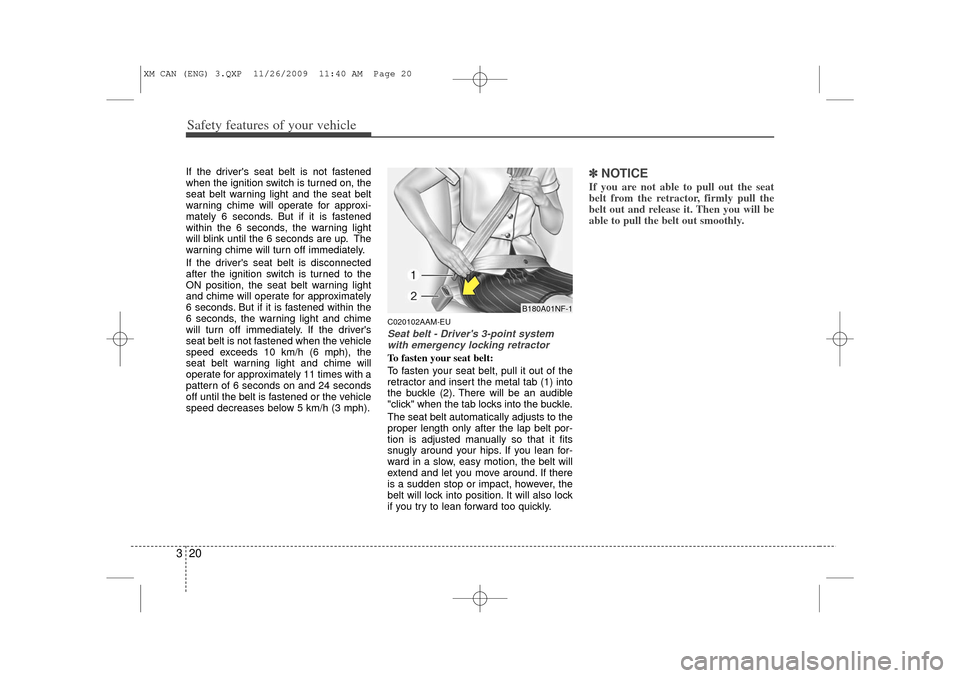
with emergency locking retractorTo fasten your seat belt:
To fasten your seat belt, pull it out of the
retractor and insert the metal tab (1) into
the buckle (2). There will be an audible
"click" when the tab locks into the buckle.
The seat belt automatically adjusts to the
proper length only after the lap belt por-
tion is adjusted manually so that it fits
snugly around your hips. If you lean for-
ward in a slow, easy motion, the belt will
extend and let you move around. If there
is a sudden stop or impact, however, the
belt will lock into position. It will also lock
if you try to lean forward too quickly.
✽ ✽ NOTICEIf you are not able to pull out the seat
belt from the retractor, firmly pull the
belt out and release it. Then you will be
able to pull the belt out smoothly.
B180A01NF-1
XM CAN (ENG) 3.QXP 11/26/2009 11:40 AM Page 20
Page 35 of 377
Safety features of your vehicle22
3C020106AUNSeat belts - Front passenger and rear
seat 3-point system with combination locking retractorTo fasten your seat belt:
Combination retractor type seat belts are
installed in the rear seat positions to help
accommodate the installation of child
restraint systems. Although a combina-
tion retractor is also installed in the front
passenger seat position, it is strongly
recommended that children always be
seated in the rear seat. NEVER place
any infant restraint system in the front
seat of the vehicle.
This type of seat belt combines the fea-
tures of both an emergency locking
retractor seat belt and an automatic lock-
ing retractor seat belt. To fasten your seat
belt, pull it out of the retractor and insert
the metal tab into the buckle. There will
be an audible "click" when the tab locks
into the buckle. When not securing a
child restraint, the seat belt operates in
the same way as the driver's seat belt
(Emergency Locking Retractor Type). It
automatically adjusts to the proper length
only after the lap belt portion of the seat
belt is adjusted manually so that it fits
snugly around your hips. When the seat belt is fully extended from
the retractor to allow the installation of a
child restraint system, the seat belt oper-
ation changes to allow the belt to retract,
but not to extend (Automatic Locking
Retractor Type). Refer to “Using a child
restraint system” in this section.
✽ ✽
NOTICEAlthough the combination retractor
provides the same level of protection for
seated passengers in either emergency
or automatic locking modes, have the
seated passengers use the emergency
locking feature for improved conven-
ience. The automatic locking function is
intended to facilitate child restraint
installation. To convert from the auto-
matic locking feature to the emergency
locking operation mode, allow the
unbuckled seat belt to fully retract.
CAUTION
Do NOT fold down the left portion of
the rear seat back when the rearcenter seat belt is buckled. ALWAYS UNBUCKLE the rear center seatbelt before folding down the leftportion of the rear seat back. If the rear center seat belt is buckledwhen the left portion of the rear seat back is folded down, distortionand damage to the top portion ofthe seat back and seat belt garnish may result, causing the seat back tolock into the folded down position.
XM CAN (ENG) 3.QXP 11/26/2009 11:41 AM Page 22
Page 39 of 377
Safety features of your vehicle26
3✽
✽
NOTICE• Both the driver's and front passen-
ger's pre-tensioner seat belts may be
activated in certain frontal collisions.
The pre-tensioners will not be activat-
ed if the seat belts are not being worn
at the time of the collision.
• When the pre-tensioner seat belts are activated, a loud noise may be heard
and fine dust, which may appear to be
smoke, may be visible in the passenger
compartment. These are normal oper-
ating conditions and are not haz-
ardous.
• Although it is harmless, the fine dust may cause skin irritation and should
not be breathed for prolonged peri-
ods. Wash all exposed skin areas thor-
oughly after an accident in which the
pre-tensioner seat belts were activat-
ed.
✽ ✽ NOTICEBecause the sensor that activates the
SRS air bag is connected with the pre-
tensioner seat belt, the SRS air bag
warning light ( ) on the instrument
panel will illuminate for approximately
6 seconds after the ignition switch has
been turned to the ON position, and
then it should turn off.
CAUTION
If the pre-tensioner seat belt is not
working properly, this warning lightwill illuminate even if there is no malfunction of the SRS air bag. Ifthe SRS air bag warning light doesnot illuminate when the ignitionswitch is turned ON, or if it remains illuminated after illuminating forapproximately 6 seconds, or if it illuminates while the vehicle isbeing driven, please have an authorized KIA dealer inspect thepre-tensioner seat belt and SRS airbag system as soon as possible.
WARNING
Pre-tensioners are designed to operate only one time. After acti-
vation, pre-tensioner seat belts
must be replaced. All seat belts,
of any type, should always be
replaced after they have been
worn during a collision.
The pre-tensioner seat belt assembly mechanisms become
hot during activation. Do not
touch the pre-tensioner seat belt
assemblies for several minutes
after they have been activated.
Do not attempt to inspect or replace the pre-tensioner seat
belts yourself. This must be done
by an authorized KIA dealer.
Do not strike the pre-tensioner seat belt assemblies.
Do not attempt to service or repair the pre-tensioner seat belt
system in any manner.
Do not put anything near the buckle. Placing objects near the
buckle can adversely affect the
buckle pretensioner and may
increase the risk of personal
injury in the event of a collision.
(Continued)
XM CAN (ENG) 3.QXP 11/26/2009 11:41 AM Page 26
Page 42 of 377
329
Safety features of your vehicle
C020302AKMRestraint of pregnant women Pregnant women should wear lap/shoul-
der belt assemblies whenever possible
according to specific recommendations
by their doctors. The lap portion of the
belt should be worn AS SECURELY AND
LOW AS POSSIBLE.
C020303AUNInjured personA seat belt should be used when an
injured person is being transported.
When this is necessary, you should con-
sult a physician for recommendations.C020304AUNOne person per beltTwo people (including children) should
never attempt to use a single seat belt.
This could increase the severity of
injuries in case of an accident.C020305AAMDo not lie downTo reduce the chance of injuries in the
event of an accident and to achieve max-
imum effectiveness of the restraint sys-
tem, all passengers should be sitting up
and the front and rear seats should be in
an upright position when the vehicle is
moving. A seat belt cannot provide prop-
er protection if the person is lying down in
the rear seat or if the front and rear seats
are in a reclined position.
WARNING
Riding with a reclined seatback
increases your chance of serious
or fatal injuries in the event of a col-
lision or sudden stop. The protec-
tion of your restraint system (seat
belts and air bags) is greatly
reduced by reclining your seat.
Seat belts must be secured against
your hips and chest to work proper-
ly. The more the seatback is
reclined, the greater the chance an
occupant's hips will slide under the
lap belt causing serious internal
injuries. Also, the shoulder belt
may strike the occupant's neck.
Drivers and passengers should
always sit well back in their seats,
properly belted, and with the seat-
backs upright.
WARNING
- Pregnantwomen
Pregnant women must never place
the lap portion of the safety belt
over the area of the abdomen
where the fetus is located or above
the abdomen where the belt could
crush the fetus during an impact.
XM CAN (ENG) 3.QXP 11/26/2009 11:41 AM Page 29
Page 43 of 377
Safety features of your vehicle30
3C020400AENCare of seat beltsSeat belt systems should never be disas-
sembled or modified. In addition, care
should be taken to assure that seat belts
and belt hardware are not damaged by
seat hinges, doors or other abuse.
C020401AENPeriodic inspectionAll seat belts should be inspected peri-
odically for wear or damage of any kind.
Any damaged parts should be replaced
as soon as possible.C020402AUNKeep belts clean and drySeat belts should be kept clean and dry.
If belts become dirty, they can be
cleaned by using a mild soap solution
and warm water. Bleach, dye, strong
detergents or abrasives should not be
used because they may damage and
weaken the fabric.C020403ASAWhen to replace seat beltsThe entire in-use seat belt assembly or
assemblies should be replaced if the
vehicle has been involved in an accident.
This should be done even if no damage
is visible. Additional questions concern-
ing seat belt operation should be directed
to an authorized KIA dealer.
WARNING
When you return the rear seatback
to its upright position after the rear
seatback has been folded down, be
careful not to damage the seat belt
webbing or buckle. Be sure that the
webbing or buckle does not get
caught or pinched in the rear seat.
A seat belt with damaged webbing
or buckle could possibly fail during
a collision or sudden stop, result-
ing in serious injury. If the webbing
or buckles are damaged, get them
replaced immediately.
XM CAN (ENG) 3.QXP 11/26/2009 11:41 AM Page 30
Page 44 of 377
331
Safety features of your vehicle
CHILD RESTRAINT SYSTEMC030000AHM-EUChildren riding in the car should sit in the
rear seat and must always be properly
restrained to minimize the risk of injury in
an accident, sudden stop or sudden
maneuver. According to accident statis-
tics, children are safer when properly
restrained in the rear seats than in the
front seat. Larger children not in a child
restraint should use one of the seat belts
provided.
You should be aware of the specific
requirements in your country. Child and/or
infant safety seats must be properly
placed and installed in the rear seat. You
must use a commercially available child
restraint system that meets the require-
ments of the safety standards of your
country.
Child restraint systems are designed to be
secured in vehicle seats by seat belt, or by
a tether anchor and/or LATCH anchors (if
equipped).Children could be injured or killed in a
crash if their restraints are not properly
secured. For small children and babies, a
child seat or infant seat must be used.
Before buying a particular child restraint
system, make sure it fits your car seat
and seat belts, and fits your child.
Follow all the instructions provided by the
manufacturer when installing the child
restraint system.
WARNING
A child restraint system must be
placed in the rear seat. Never
install a child or infant seat on the
front passenger's seat. Should an
accident occur and cause the
passenger-side air bag to deploy,
it could severely injure or kill an
infant or child seated in an infant
or child seat. Thus only use a
child restraint in the rear seat of
your vehicle.
(Continued)
(Continued)
A seat belt or child restraint sys-tem can become very hot if it is
left in a closed vehicle on a sunny
day, even if the outside tempera-
ture does not feel hot. Be sure to
check the seat cover and buckles
before placing a child there.
When the child restraint system is not in use, store it in the cargo
area or fasten it with a seat belt
so that it will not be thrown for-
ward in case of a sudden stop or
an accident.
Children may be seriously injured or killed by an inflating air bag.
All children, even those too large
for child restraints, must ride in
the rear seat.
XM CAN (ENG) 3.QXP 11/26/2009 11:41 AM Page 31
Page 45 of 377
Safety features of your vehicle32
3
WARNING
To reduce the chance of serious or
fatal injuries:
Children of all ages are safer
when restrained in the rear seat.
A child riding in the front passen-
ger seat can be forcefully struck
by an inflating air bag resulting in
serious or fatal injuries.
Always follow the child restraint system manufacturer’s instruc-
tions for installation and use of
the child restraint.
Always make sure the child seat is secured properly in the car and
your child is securely restrained
in the child seat.
Never hold a child in your arms or lap when riding in a vehicle. The
violent forces created during a
crash will tear the child from your
arms and throw the child against
the car’s interior.
Never put a seat belt over your- self and a child. During a crash,
the belt could press deep into the
child causing serious internal
injuries.
(Continued)
(Continued)
Never leave children unattendedin a vehicle – not even for a short
time. The car can heat up very
quickly, resulting in serious
injuries to children inside. Even
very young children may inadver-
tently cause the vehicle to move,
entangle themselves in the win-
dows, or lock themselves or oth-
ers inside the vehicle.
Never allow two children, or any two persons, to use the same
seat belt.
Children often squirm and repo- sition themselves improperly.
Never let a child ride with the
shoulder belt under their arm or
behind their back. Always proper-
ly position and secure children in
the rear seat.
Never allow a child to stand-up or kneel on the seat or floor of a
moving vehicle. During a colli-
sion or sudden stop, the child
can be violently thrown against
the vehicle’s interior, resulting in
serious injury.
(Continued)
(Continued)
Never use an infant carrier or achild safety seat that "hooks"
over a seatback, it may not pro-
vide adequate security in an acci-
dent.
Seat belts can become very hot, especially when the car is parked
in direct sunlight. Always check
the seat belt buckles before fas-
tening them over a child.
XM CAN (ENG) 3.QXP 11/26/2009 11:41 AM Page 32
Page 46 of 377
333
Safety features of your vehicle
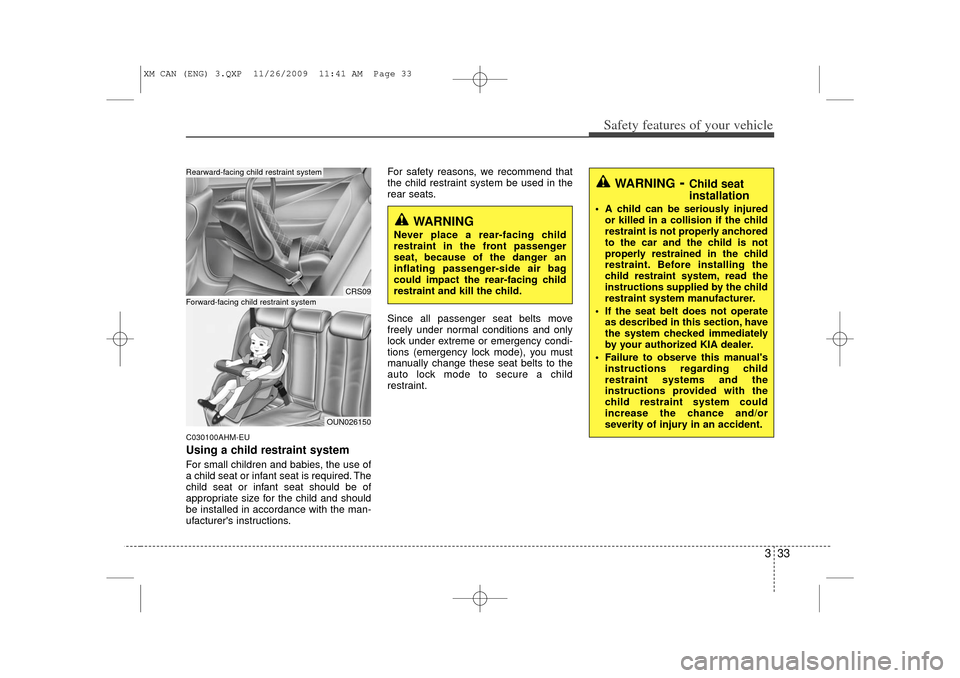
C030100AHM-EUUsing a child restraint systemFor small children and babies, the use of
a child seat or infant seat is required. The
child seat or infant seat should be of
appropriate size for the child and should
be installed in accordance with the man-
ufacturer's instructions.For safety reasons, we recommend that
the child restraint system be used in the
rear seats.
Since all passenger seat belts move
freely under normal conditions and only
lock under extreme or emergency condi-
tions (emergency lock mode), you must
manually change these seat belts to the
auto lock mode to secure a child
restraint.
CRS09
OUN026150
Forward-facing child restraint systemRearward-facing child restraint system
WARNING
Never place a rear-facing child
restraint in the front passenger
seat, because of the danger an
inflating passenger-side air bag
could impact the rear-facing child
restraint and kill the child.
WARNING
- Child seat
installation
A child can be seriously injured
or killed in a collision if the child
restraint is not properly anchored
to the car and the child is not
properly restrained in the child
restraint. Before installing the
child restraint system, read the
instructions supplied by the child
restraint system manufacturer.
If the seat belt does not operate as described in this section, have
the system checked immediately
by your authorized KIA dealer.
Failure to observe this manual's instructions regarding child
restraint systems and the
instructions provided with the
child restraint system could
increase the chance and/or
severity of injury in an accident.
XM CAN (ENG) 3.QXP 11/26/2009 11:41 AM Page 33
Page 55 of 377
Safety features of your vehicle42
3
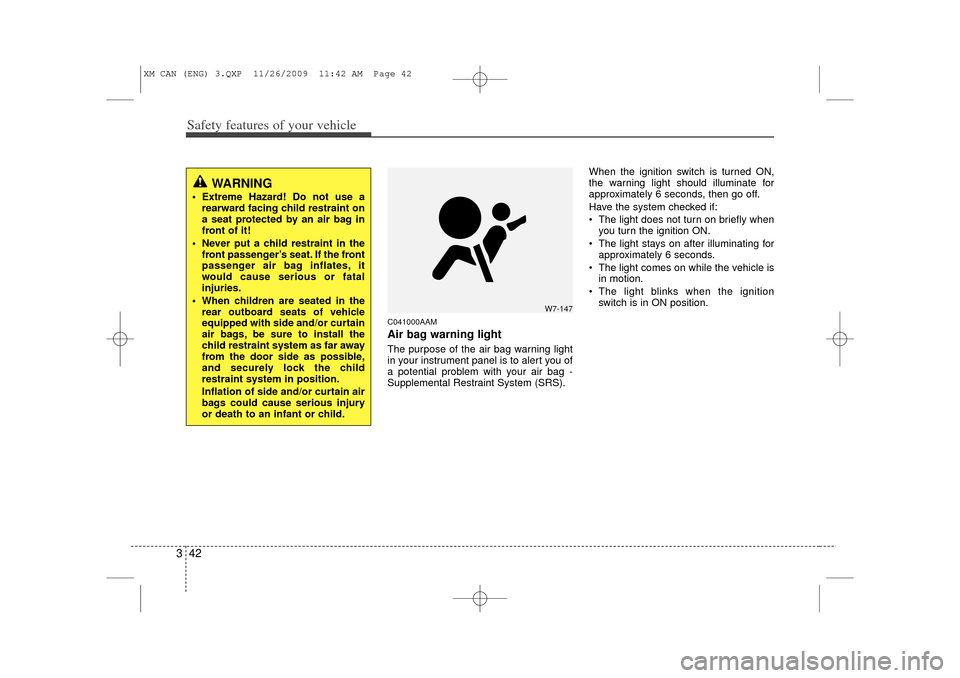
C041000AAMAir bag warning lightThe purpose of the air bag warning light
in your instrument panel is to alert you of
a potential problem with your air bag -
Supplemental Restraint System (SRS). When the ignition switch is turned ON,
the warning light should illuminate for
approximately 6 seconds, then go off.
Have the system checked if:
The light does not turn on briefly when
you turn the ignition ON.
The light stays on after illuminating for approximately 6 seconds.
The light comes on while the vehicle is in motion.
The light blinks when the ignition switch is in ON position.
WARNING
Extreme Hazard! Do not use arearward facing child restraint on
a seat protected by an air bag in
front of it!
Never put a child restraint in the front passenger’s seat. If the front
passenger air bag inflates, it
would cause serious or fatal
injuries.
When children are seated in the rear outboard seats of vehicle
equipped with side and/or curtain
air bags, be sure to install the
child restraint system as far away
from the door side as possible,
and securely lock the child
restraint system in position.
Inflation of side and/or curtain air
bags could cause serious injury
or death to an infant or child.
W7-147
XM CAN (ENG) 3.QXP 11/26/2009 11:42 AM Page 42
Page 56 of 377
343
Safety features of your vehicle
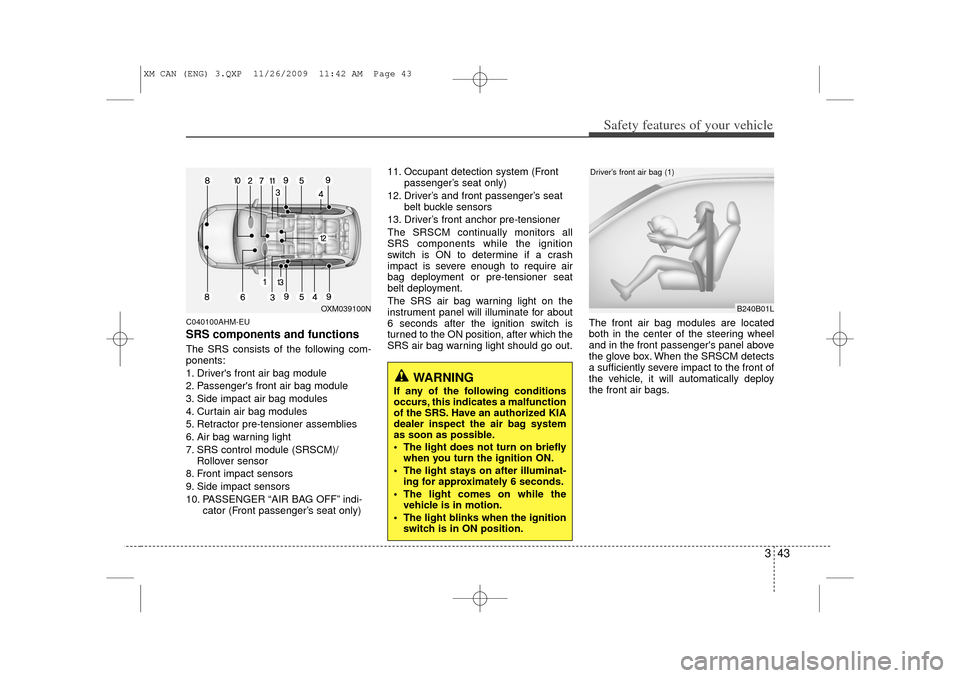
C040100AHM-EUSRS components and functionsThe SRS consists of the following com-
ponents:
1. Driver's front air bag module
2. Passenger's front air bag module
3. Side impact air bag modules
4. Curtain air bag modules
5. Retractor pre-tensioner assemblies
6. Air bag warning light
7. SRS control module (SRSCM)/Rollover sensor
8. Front impact sensors
9. Side impact sensors
10. PASSENGER “AIR BAG OFF” indi- cator (Front passenger’s seat only) 11. Occupant detection system (Front
passenger’s seat only)
12. Driver’s and front passenger’s seat belt buckle sensors
13. Driver’s front anchor pre-tensioner
The SRSCM continually monitors all
SRS components while the ignition
switch is ON to determine if a crash
impact is severe enough to require air
bag deployment or pre-tensioner seat
belt deployment.
The SRS air bag warning light on the
instrument panel will illuminate for about
6 seconds after the ignition switch is
turned to the ON position, after which the
SRS air bag warning light should go out. The front air bag modules are located
both in the center of the steering wheel
and in the front passenger's panel above
the glove box. When the SRSCM detects
a sufficiently severe impact to the front of
the vehicle, it will automatically deploy
the front air bags.
B240B01L
Driver’s front air bag (1)
OXM039100N
WARNING
If any of the following conditions
occurs, this indicates a malfunction
of the SRS. Have an authorized KIA
dealer inspect the air bag system
as soon as possible.
The light does not turn on briefly
when you turn the ignition ON.
The light stays on after illuminat- ing for approximately 6 seconds.
The light comes on while the vehicle is in motion.
The light blinks when the ignition switch is in ON position.
XM CAN (ENG) 3.QXP 11/26/2009 11:42 AM Page 43