body KIA Sorento 2011 2.G Owner's Manual
[x] Cancel search | Manufacturer: KIA, Model Year: 2011, Model line: Sorento, Model: KIA Sorento 2011 2.GPages: 377, PDF Size: 7.51 MB
Page 21 of 377
Safety features of your vehicle83
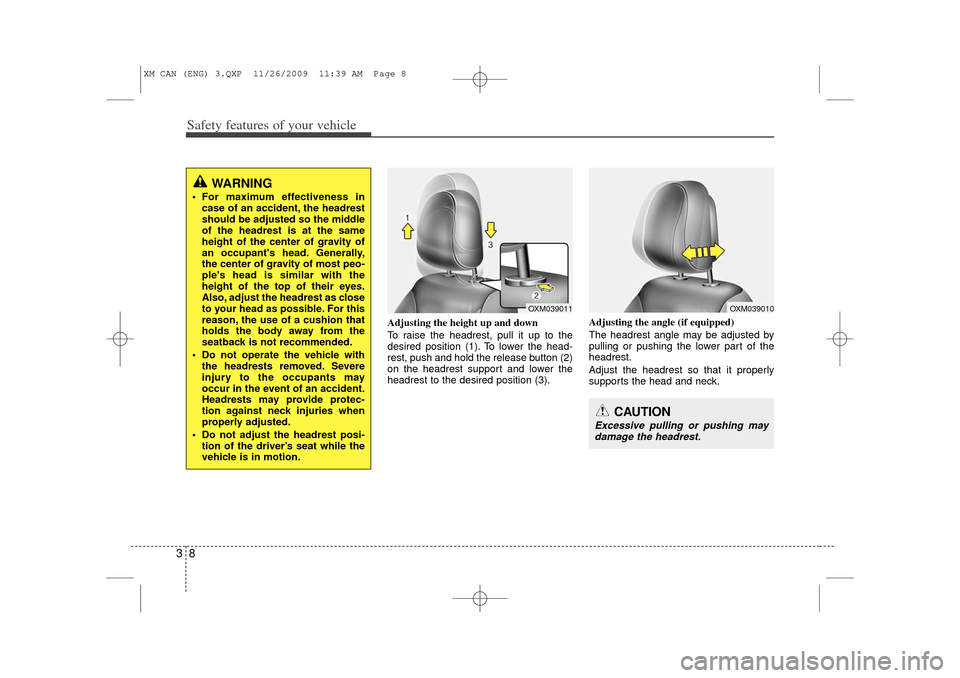
Adjusting the height up and down
To raise the headrest, pull it up to the
desired position (1). To lower the head-
rest, push and hold the release button (2)
on the headrest support and lower the
headrest to the desired position (3).Adjusting the angle (if equipped)
The headrest angle may be adjusted by
pulling or pushing the lower part of the
headrest.
Adjust the headrest so that it properly
supports the head and neck.
WARNING
For maximum effectiveness in
case of an accident, the headrest
should be adjusted so the middle
of the headrest is at the same
height of the center of gravity of
an occupant's head. Generally,
the center of gravity of most peo-
ple's head is similar with the
height of the top of their eyes.
Also, adjust the headrest as close
to your head as possible. For this
reason, the use of a cushion that
holds the body away from the
seatback is not recommended.
Do not operate the vehicle with the headrests removed. Severe
injury to the occupants may
occur in the event of an accident.
Headrests may provide protec-
tion against neck injuries when
properly adjusted.
Do not adjust the headrest posi- tion of the driver’s seat while the
vehicle is in motion.
OXM039011
OXM039010
CAUTION
Excessive pulling or pushing maydamage the headrest.
XM CAN (ENG) 3.QXP 11/26/2009 11:39 AM Page 8
Page 29 of 377
Safety features of your vehicle16
3C010303AHMHeadrestThe rear seat(s) is equipped with head-
rests in all the seating positions for the
occupant's safety and comfort.
The headrest not only provides comfort
for passengers, but also helps protect the
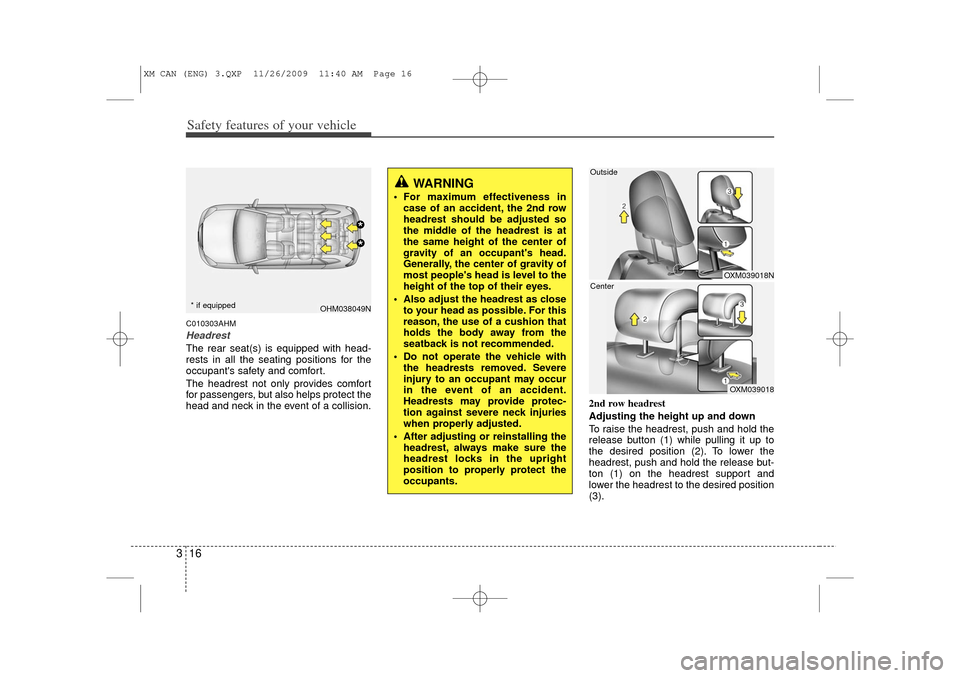
head and neck in the event of a collision. 2nd row headrest
Adjusting the height up and down
To raise the headrest, push and hold the
release button (1) while pulling it up to
the desired position (2). To lower the
headrest, push and hold the release but-
ton (1) on the headrest support and
lower the headrest to the desired position
(3).
WARNING
For maximum effectiveness in
case of an accident, the 2nd row
headrest should be adjusted so
the middle of the headrest is at
the same height of the center of
gravity of an occupant's head.
Generally, the center of gravity of
most people's head is level to the
height of the top of their eyes.
Also adjust the headrest as close to your head as possible. For this
reason, the use of a cushion that
holds the body away from the
seatback is not recommended.
Do not operate the vehicle with the headrests removed. Severe
injury to an occupant may occur
in the event of an accident.
Headrests may provide protec-
tion against severe neck injuries
when properly adjusted.
After adjusting or reinstalling the headrest, always make sure the
headrest locks in the upright
position to properly protect the
occupants.
OHM038049N
**
* if equipped
OutsideCenter
OXM039018OXM039018N
XM CAN (ENG) 3.QXP 11/26/2009 11:40 AM Page 16
Page 32 of 377
319
Safety features of your vehicle
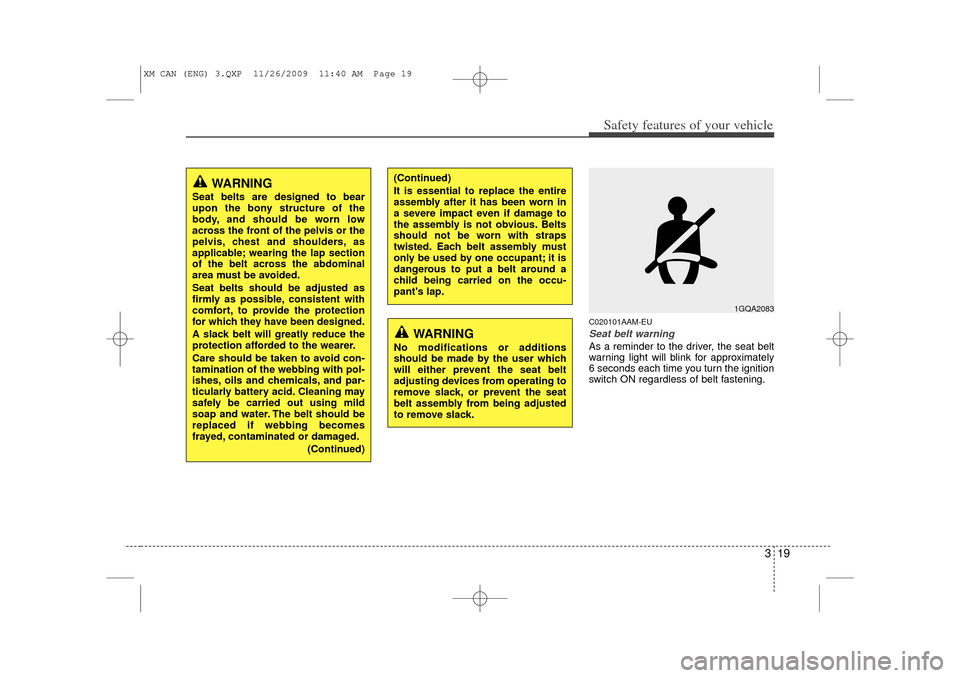
C020101AAM-EUSeat belt warningAs a reminder to the driver, the seat belt
warning light will blink for approximately
6 seconds each time you turn the ignition
switch ON regardless of belt fastening.
1GQA2083
(Continued)
It is essential to replace the entire
assembly after it has been worn in
a severe impact even if damage to
the assembly is not obvious. Belts
should not be worn with straps
twisted. Each belt assembly must
only be used by one occupant; it is
dangerous to put a belt around a
child being carried on the occu-
pant's lap.
WARNING
No modifications or additions
should be made by the user which
will either prevent the seat belt
adjusting devices from operating to
remove slack, or prevent the seat
belt assembly from being adjusted
to remove slack.
WARNING
Seat belts are designed to bear
upon the bony structure of the
body, and should be worn low
across the front of the pelvis or the
pelvis, chest and shoulders, as
applicable; wearing the lap section
of the belt across the abdominal
area must be avoided.
Seat belts should be adjusted as
firmly as possible, consistent with
comfort, to provide the protection
for which they have been designed.
A slack belt will greatly reduce the
protection afforded to the wearer.
Care should be taken to avoid con-
tamination of the webbing with pol-
ishes, oils and chemicals, and par-
ticularly battery acid. Cleaning may
safely be carried out using mild
soap and water. The belt should be
replaced if webbing becomes
frayed, contaminated or damaged.(Continued)
XM CAN (ENG) 3.QXP 11/26/2009 11:40 AM Page 19
Page 37 of 377
Safety features of your vehicle24
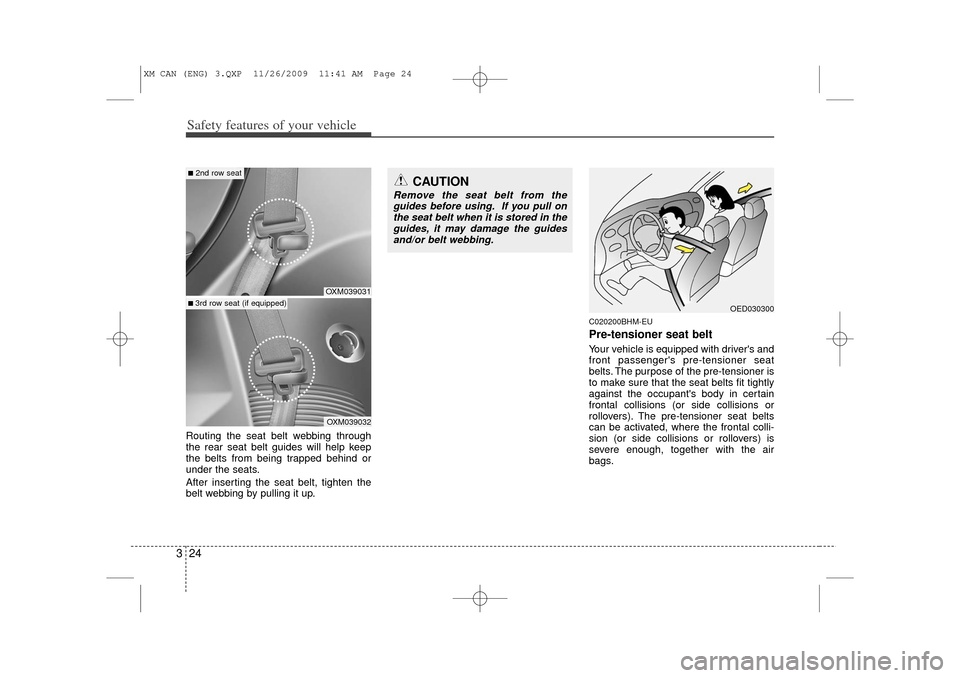
3Routing the seat belt webbing through
the rear seat belt guides will help keep
the belts from being trapped behind or
under the seats.
After inserting the seat belt, tighten the
belt webbing by pulling it up.
C020200BHM-EUPre-tensioner seat beltYour vehicle is equipped with driver's and
front passenger's pre-tensioner seat
belts. The purpose of the pre-tensioner is
to make sure that the seat belts fit tightly
against the occupant's body in certain
frontal collisions (or side collisions or
rollovers). The pre-tensioner seat belts
can be activated, where the frontal colli-
sion (or side collisions or rollovers) is
severe enough, together with the air
bags.
OED030300
CAUTION
Remove the seat belt from the
guides before using. If you pull onthe seat belt when it is stored in theguides, it may damage the guides and/or belt webbing.
OXM039031OXM039032
■2nd row seat ■ 3rd row seat (if equipped)
XM CAN (ENG) 3.QXP 11/26/2009 11:41 AM Page 24
Page 38 of 377
325
Safety features of your vehicle
When the vehicle stops suddenly, or if
the occupant tries to lean forward too
quickly, the seat belt retractor will lock
into position. In certain frontal collisions
(or side collisions or rollovers), the pre-
tensioner will activate and pull the seat
belt into tighter contact against the occu-
pant's body.
If the system senses excessive seat belt
tension on the driver or passenger's seat
belt when the pre-tensioner activates, the
load limiter inside the pre-tensioner will
release some of the pressure on the
affected seat belt.✽ ✽NOTICE The pre-tensioner will activate not only
in a frontal collision but also in a side
collision or rollover, if the vehicle is
equipped with a side or curtain air bag.
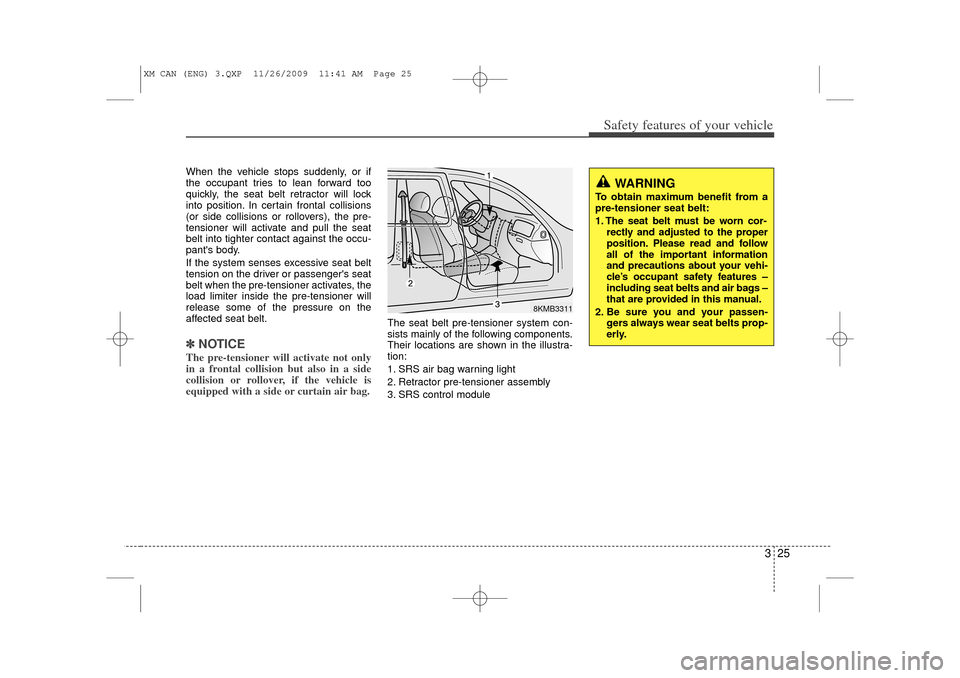
The seat belt pre-tensioner system con-
sists mainly of the following components.
Their locations are shown in the illustra-
tion:
1. SRS air bag warning light
2. Retractor pre-tensioner assembly
3. SRS control module
WARNING
To obtain maximum benefit from a
pre-tensioner seat belt:
1. The seat belt must be worn cor-
rectly and adjusted to the proper
position. Please read and follow
all of the important information
and precautions about your vehi-
cle’s occupant safety features –
including seat belts and air bags –
that are provided in this manual.
2. Be sure you and your passen- gers always wear seat belts prop-
erly.
8KMB3311
XM CAN (ENG) 3.QXP 11/26/2009 11:41 AM Page 25
Page 72 of 377
359
Safety features of your vehicle
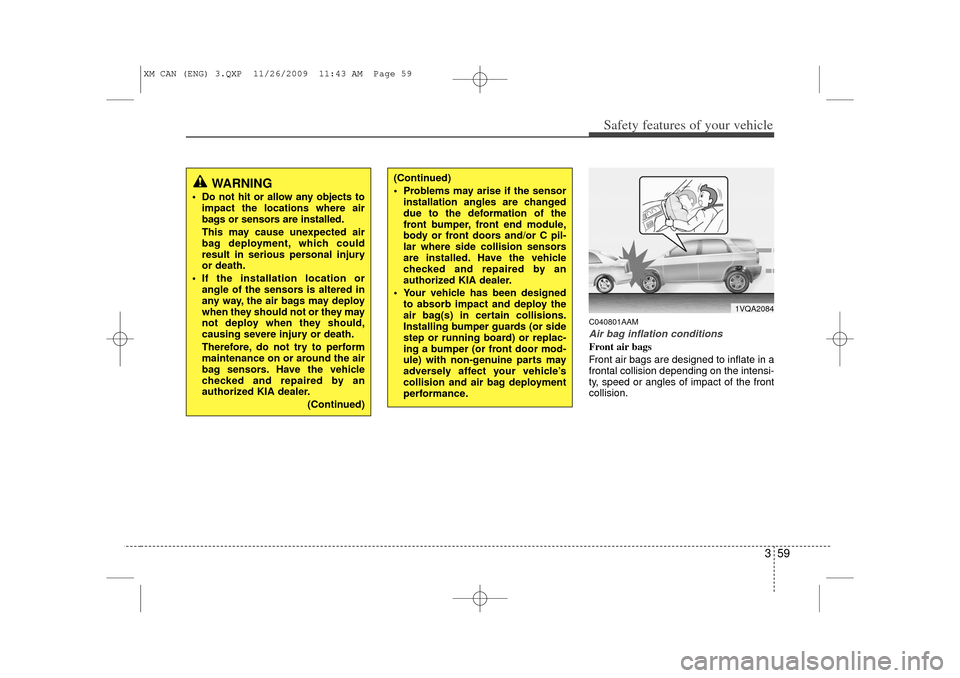
C040801AAMAir bag inflation conditionsFront air bags
Front air bags are designed to inflate in a
frontal collision depending on the intensi-
ty, speed or angles of impact of the front
collision.
1VQA2084
WARNING
Do not hit or allow any objects toimpact the locations where air
bags or sensors are installed.
This may cause unexpected air
bag deployment, which could
result in serious personal injury
or death.
If the installation location or angle of the sensors is altered in
any way, the air bags may deploy
when they should not or they may
not deploy when they should,
causing severe injury or death.
Therefore, do not try to perform
maintenance on or around the air
bag sensors. Have the vehicle
checked and repaired by an
authorized KIA dealer.
(Continued)
(Continued)
Problems may arise if the sensorinstallation angles are changed
due to the deformation of the
front bumper, front end module,
body or front doors and/or C pil-
lar where side collision sensors
are installed. Have the vehicle
checked and repaired by an
authorized KIA dealer.
Your vehicle has been designed to absorb impact and deploy the
air bag(s) in certain collisions.
Installing bumper guards (or side
step or running board) or replac-
ing a bumper (or front door mod-
ule) with non-genuine parts may
adversely affect your vehicle’s
collision and air bag deployment
performance.
XM CAN (ENG) 3.QXP 11/26/2009 11:43 AM Page 59
Page 76 of 377
363
Safety features of your vehicle
C041100AUNSRS CareThe SRS is virtually maintenance-free
and so there are no parts you can safely
service by yourself. If the SRS air bag
warning light does not illuminate, or con-
tinuously remains on, have your vehicle
immediately inspected by an authorized
KIA dealer.
Any work on the SRS system, such as
removing, installing, repairing, or any
work on the steering wheel, the front
passenger’s panel, front seats and roof
rails must be performed by an authorized
KIA dealer. Improper handling of the SRS
system may result in serious personal
injury.
WARNING
Modification to SRS componentsor wiring, including the addition
of any kind of badges to the pad
covers or modifications to the
body structure, can adversely
affect SRS performance and lead
to possible injury.
For cleaning the air bag pad cov- ers, use only a soft, dry cloth or
one which has been moistened
with plain water. Solvents or
cleaners could adversely affect
the air bag covers and proper
deployment of the system.
No objects should be placed over
or near the air bag modules on the
steering wheel, instrument panel,
and the front passenger's panel
above the glove box, because any
such object could cause harm if the
vehicle is in a crash severe enough
to cause the air bags to inflate.
(Continued)
(Continued)
If the air bags inflate, they must be replaced by an authorized KIA
dealer.
Do not tamper with or disconnect SRS wiring, or other components
of the SRS system. Doing so
could result in injury, due to acci-
dental inflation of the air bags or
by rendering the SRS inopera-
tive.
If components of the air bag sys- tem must be discarded, or if the
vehicle must be scrapped, certain
safety precautions must be
observed. An authorized KIA
dealer knows these precautions
and can give you the necessary
information. Failure to follow
these precautions and proce-
dures could increase the risk of
personal injury.
If your car was flooded and has soaked carpeting or water on
flooring, you shouldn't try to start
the engine; have the car towed to
an authorized KIA dealer.
XM CAN (ENG) 3.QXP 11/26/2009 11:43 AM Page 63
Page 97 of 377
419
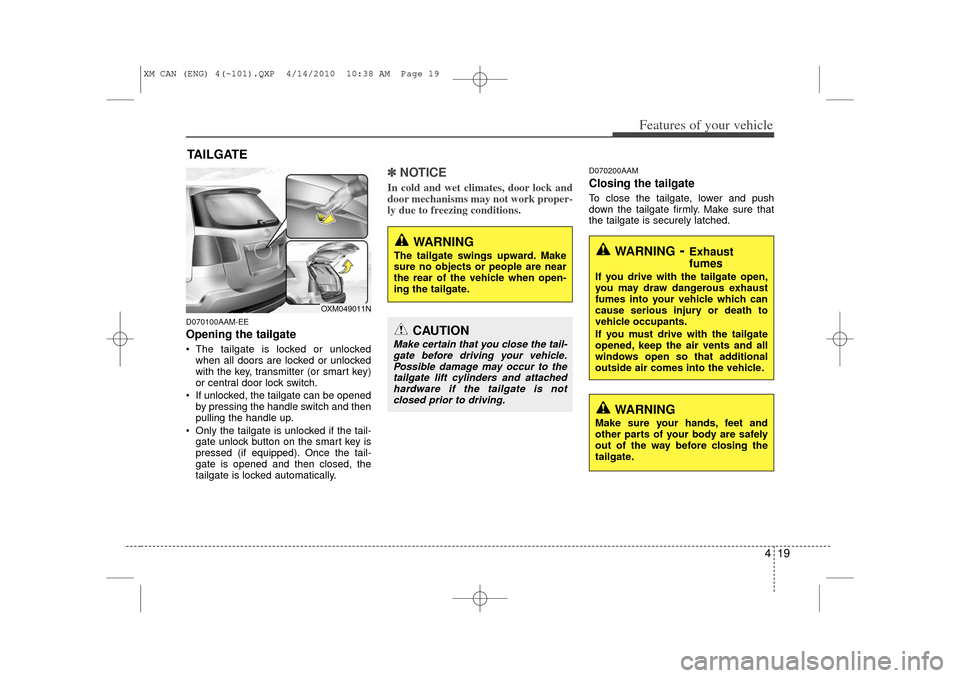
Features of your vehicle
D070100AAM-EEOpening the tailgate The tailgate is locked or unlockedwhen all doors are locked or unlocked
with the key, transmitter (or smart key)
or central door lock switch.
If unlocked, the tailgate can be opened by pressing the handle switch and then
pulling the handle up.
Only the tailgate is unlocked if the tail- gate unlock button on the smart key is
pressed (if equipped). Once the tail-
gate is opened and then closed, the
tailgate is locked automatically.
✽ ✽ NOTICEIn cold and wet climates, door lock and
door mechanisms may not work proper-
ly due to freezing conditions.
D070200AAMClosing the tailgateTo close the tailgate, lower and push
down the tailgate firmly. Make sure that
the tailgate is securely latched.
TAILGATE
WARNING
The tailgate swings upward. Make
sure no objects or people are near
the rear of the vehicle when open-
ing the tailgate.
CAUTION
Make certain that you close the tail-
gate before driving your vehicle. Possible damage may occur to thetailgate lift cylinders and attachedhardware if the tailgate is notclosed prior to driving.
WARNING
Make sure your hands, feet and
other parts of your body are safely
out of the way before closing the
tailgate.
WARNING
- Exhaust
fumes
If you drive with the tailgate open,
you may draw dangerous exhaust
fumes into your vehicle which can
cause serious injury or death to
vehicle occupants.
If you must drive with the tailgate
opened, keep the air vents and all
windows open so that additional
outside air comes into the vehicle.
OXM049011N
XM CAN (ENG) 4(~101).QXP 4/14/2010 10:38 AM Page 19
Page 101 of 377
423
Features of your vehicle
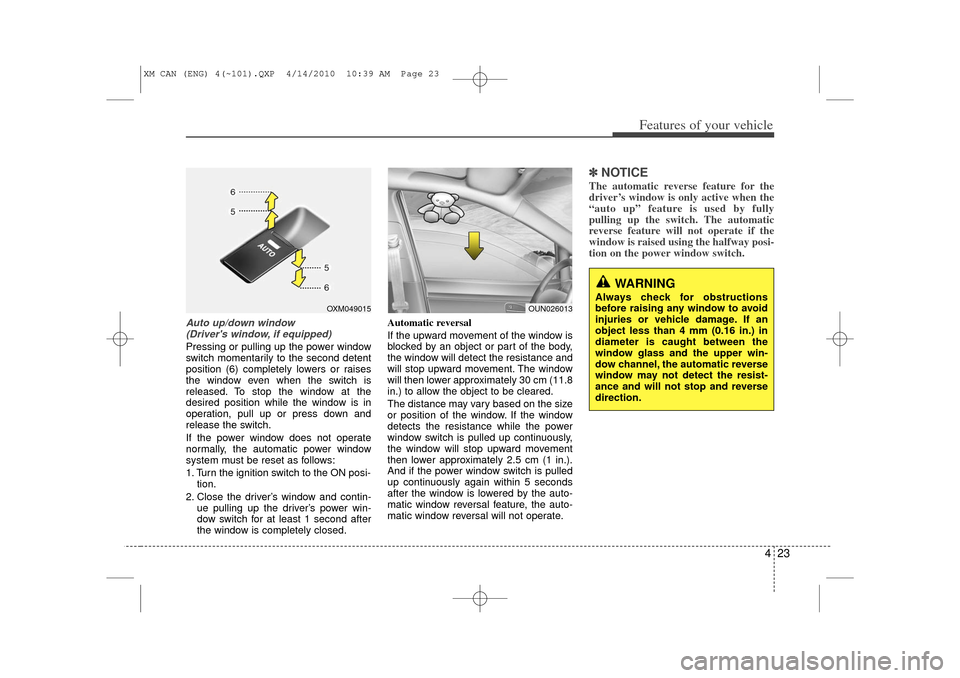
Auto up/down window (Driver's window, if equipped) Pressing or pulling up the power window
switch momentarily to the second detent
position (6) completely lowers or raises
the window even when the switch is
released. To stop the window at the
desired position while the window is in
operation, pull up or press down and
release the switch.
If the power window does not operate
normally, the automatic power window
system must be reset as follows:
1. Turn the ignition switch to the ON posi- tion.
2. Close the driver’s window and contin- ue pulling up the driver’s power win-
dow switch for at least 1 second after
the window is completely closed. Automatic reversal
If the upward movement of the window is
blocked by an object or part of the body,
the window will detect the resistance and
will stop upward movement. The window
will then lower approximately 30 cm (11.8
in.) to allow the object to be cleared.
The distance may vary based on the size
or position of the window. If the window
detects the resistance while the power
window switch is pulled up continuously,
the window will stop upward movement
then lower approximately 2.5 cm (1 in.).
And if the power window switch is pulled
up continuously again within 5 seconds
after the window is lowered by the auto-
matic window reversal feature, the auto-
matic window reversal will not operate.
✽ ✽
NOTICEThe automatic reverse feature for the
driver’s window is only active when the
“auto up” feature is used by fully
pulling up the switch. The automatic
reverse feature will not operate if the
window is raised using the halfway posi-
tion on the power window switch.
OXM049015
WARNING
Always check for obstructions
before raising any window to avoid
injuries or vehicle damage. If an
object less than 4 mm (0.16 in.) in
diameter is caught between the
window glass and the upper win-
dow channel, the automatic reverse
window may not detect the resist-
ance and will not stop and reverse
direction.
OUN026013
XM CAN (ENG) 4(~101).QXP 4/14/2010 10:39 AM Page 23
Page 109 of 377
431
Features of your vehicle
Sliding the sunroof Before opening or closing the sunroof,
open the roller blind (refer to the following
page for instructions on how to use the
roller blind).
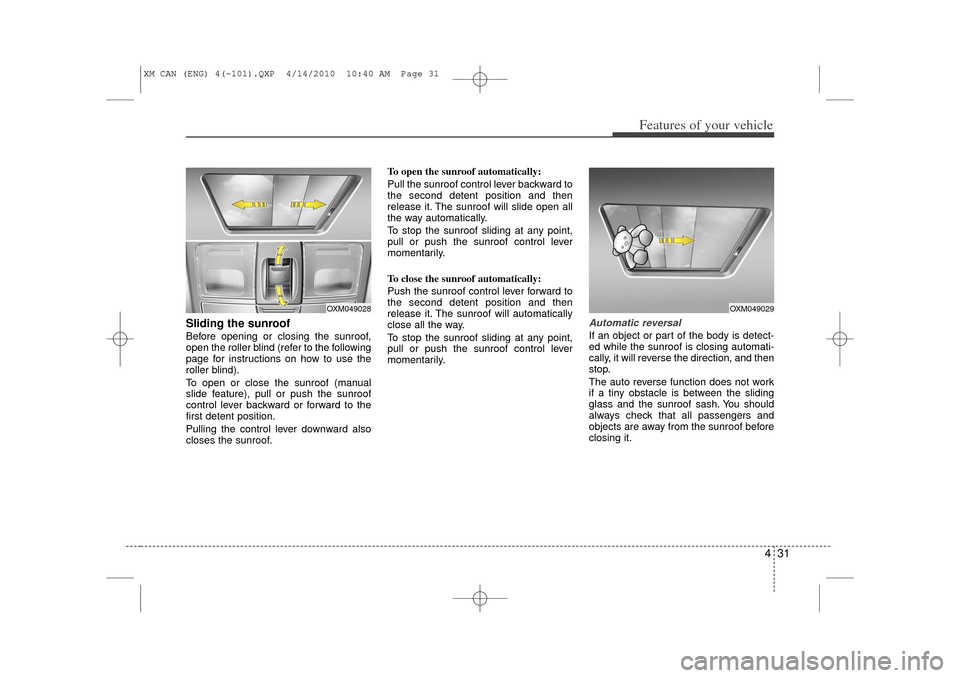
To open or close the sunroof (manual
slide feature), pull or push the sunroof
control lever backward or forward to the
first detent position.
Pulling the control lever downward also
closes the sunroof.To open the sunroof automatically:
Pull the sunroof control lever backward to
the second detent position and then
release it. The sunroof will slide open all
the way automatically.
To stop the sunroof sliding at any point,
pull or push the sunroof control lever
momentarily.
To close the sunroof automatically:
Push the sunroof control lever forward to
the second detent position and then
release it. The sunroof will automatically
close all the way.
To stop the sunroof sliding at any point,
pull or push the sunroof control lever
momentarily.
Automatic reversalIf an object or part of the body is detect-
ed while the sunroof is closing automati-
cally, it will reverse the direction, and then
stop.
The auto reverse function does not work
if a tiny obstacle is between the sliding
glass and the sunroof sash. You should
always check that all passengers and
objects are away from the sunroof before
closing it.
OXM049028
OXM049029
XM CAN (ENG) 4(~101).QXP 4/14/2010 10:40 AM Page 31