seats KIA Sorento 2012 2.G User Guide
[x] Cancel search | Manufacturer: KIA, Model Year: 2012, Model line: Sorento, Model: KIA Sorento 2012 2.GPages: 388, PDF Size: 7.56 MB
Page 40 of 388
317
Safety features of your vehicle
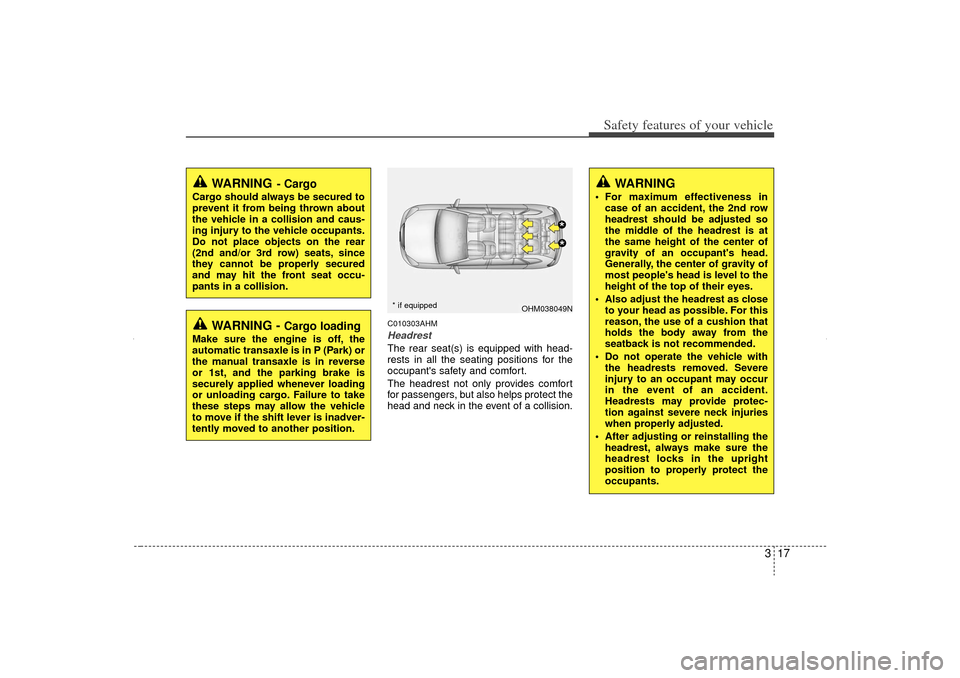
C010303AHMHeadrestThe rear seat(s) is equipped with head-
rests in all the seating positions for the
occupant's safety and comfort.
The headrest not only provides comfort
for passengers, but also helps protect the
head and neck in the event of a collision.
WARNING
- Cargo
Cargo should always be secured to
prevent it from being thrown about
the vehicle in a collision and caus-
ing injury to the vehicle occupants.
Do not place objects on the rear
(2nd and/or 3rd row) seats, since
they cannot be properly secured
and may hit the front seat occu-
pants in a collision.
WARNING -
Cargo loading
Make sure the engine is off, the
automatic transaxle is in P (Park) or
the manual transaxle is in reverse
or 1st, and the parking brake is
securely applied whenever loading
or unloading cargo. Failure to take
these steps may allow the vehicle
to move if the shift lever is inadver-
tently moved to another position.
WARNING
For maximum effectiveness incase of an accident, the 2nd row
headrest should be adjusted so
the middle of the headrest is at
the same height of the center of
gravity of an occupant's head.
Generally, the center of gravity of
most people's head is level to the
height of the top of their eyes.
Also adjust the headrest as close to your head as possible. For this
reason, the use of a cushion that
holds the body away from the
seatback is not recommended.
Do not operate the vehicle with the headrests removed. Severe
injury to an occupant may occur
in the event of an accident.
Headrests may provide protec-
tion against severe neck injuries
when properly adjusted.
After adjusting or reinstalling the headrest, always make sure the
headrest locks in the upright
position to properly protect the
occupants.
OHM038049N
**
* if equipped
XM CAN (ENG) 3.QXP 4/19/2011 10:27 AM Page 17
Page 49 of 388
Safety features of your vehicle26
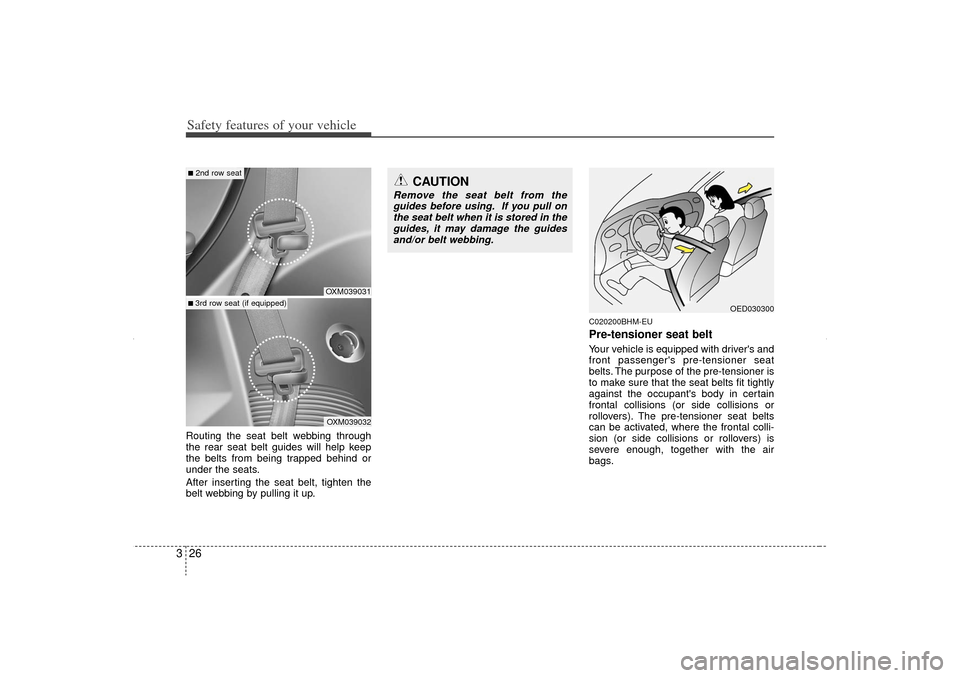
3Routing the seat belt webbing through
the rear seat belt guides will help keep
the belts from being trapped behind or
under the seats.
After inserting the seat belt, tighten the
belt webbing by pulling it up.
C020200BHM-EUPre-tensioner seat beltYour vehicle is equipped with driver's and
front passenger's pre-tensioner seat
belts. The purpose of the pre-tensioner is
to make sure that the seat belts fit tightly
against the occupant's body in certain
frontal collisions (or side collisions or
rollovers). The pre-tensioner seat belts
can be activated, where the frontal colli-
sion (or side collisions or rollovers) is
severe enough, together with the air
bags.
OED030300
CAUTION
Remove the seat belt from the
guides before using. If you pull onthe seat belt when it is stored in theguides, it may damage the guides and/or belt webbing.
OXM039031OXM039032
■2nd row seat ■ 3rd row seat (if equipped)
XM CAN (ENG) 3.QXP 4/19/2011 10:28 AM Page 26
Page 52 of 388

329
Safety features of your vehicle
C020300AUN-EUSeat belt precautions
C020306AUN-ECInfant or small childYou should be aware of the specific
requirements in your country. Child
and/or infant seats must be properly
placed and installed in the rear seat. For
more information about the use of these
restraints, refer to “Child restraint sys-
tem” in this section.
WARNING
All occupants of the vehicle must
wear their seat belts at all times.
Seat belts and child restraints
reduce the risk of serious or fatal
injuries for all occupants in the
event of a collision or sudden stop.
Without a seat belt, occupants
could be shifted too close to a
deploying air bag, strike the interior
structure or be thrown from the
vehicle. Properly worn seat belts
greatly reduce these hazards.
Even with advanced air bags,
unbelted occupants can be severe-
ly injured by a deploying air bag.
Always follow the precautions
about seat belts, air bags and occu-
pant seating contained in this man-
ual.
WARNING
Every person in your vehicle needs
to be properly restrained at all
times, including infants and chil-
dren. Never hold a child in your
arms or lap when riding in a vehi-
cle. The violent forces created dur-
ing a crash will tear the child from
your arms and throw the child
against the interior. Always use a
child restraint appropriate for your
child's height and weight.
(Continued)
Improper handling of the pre-ten-sioner seat belt assemblies, and
failure to heed the warnings not
to strike, modify, inspect, replace,
service or repair the pre-tension-
er seat belt assemblies may lead
to improper operation or inadver-
tent activation and serious injury.
Always wear the seat belts when driving or riding in a motor vehi-
cle.
If the vehicle or pre-tensioner seat belt must be discarded, con-
tact an authorized KIA dealer.
XM CAN (ENG) 3.QXP 4/19/2011 10:28 AM Page 29
Page 54 of 388

331
Safety features of your vehicle
C020302AKMRestraint of pregnant women Pregnant women should wear lap/shoul-
der belt assemblies whenever possible
according to specific recommendations
by their doctors. The lap portion of the
belt should be worn AS SECURELY AND
LOW AS POSSIBLE.
C020303AUNInjured personA seat belt should be used when an
injured person is being transported.
When this is necessary, you should con-
sult a physician for recommendations.C020304AUNOne person per beltTwo people (including children) should
never attempt to use a single seat belt.
This could increase the severity of
injuries in case of an accident.C020305AAMDo not lie downTo reduce the chance of injuries in the
event of an accident and to achieve max-
imum effectiveness of the restraint sys-
tem, all passengers should be sitting up
and the front and rear seats should be in
an upright position when the vehicle is
moving. A seat belt cannot provide prop-
er protection if the person is lying down in
the rear seat or if the front and rear seats
are in a reclined position.
WARNING
Riding with a reclined seatback
increases your chance of serious
or fatal injuries in the event of a col-
lision or sudden stop. The protec-
tion of your restraint system (seat
belts and air bags) is greatly
reduced by reclining your seat.
Seat belts must be secured against
your hips and chest to work proper-
ly. The more the seatback is
reclined, the greater the chance an
occupant's hips will slide under the
lap belt causing serious internal
injuries. Also, the shoulder belt
may strike the occupant's neck.
Drivers and passengers should
always sit well back in their seats,
properly belted, and with the seat-
backs upright.
WARNING
- Pregnantwomen
Pregnant women must never place
the lap portion of the safety belt
over the area of the abdomen
where the fetus is located or above
the abdomen where the belt could
crush the fetus during an impact.
XM CAN (ENG) 3.QXP 4/19/2011 10:28 AM Page 31
Page 56 of 388

333
Safety features of your vehicle
CHILD RESTRAINT SYSTEMC030000AHM-EUChildren riding in the car should sit in the
rear seat and must always be properly
restrained to minimize the risk of injury in
an accident, sudden stop or sudden
maneuver. According to accident statis-
tics, children are safer when properly
restrained in the rear seats than in the
front seat. Larger children not in a child
restraint should use one of the seat belts
provided.
You should be aware of the specific
requirements in your country. Child and/or
infant safety seats must be properly
placed and installed in the rear seat. You
must use a commercially available child
restraint system that meets the require-
ments of the safety standards of your
country.
Child restraint systems are designed to be
secured in vehicle seats by seat belt, or by
a tether anchor and/or LATCH anchors (if
equipped).Children could be injured or killed in a
crash if their restraints are not properly
secured. For small children and babies, a
child seat or infant seat must be used.
Before buying a particular child restraint
system, make sure it fits your car seat
and seat belts, and fits your child.
Follow all the instructions provided by the
manufacturer when installing the child
restraint system.
WARNING
A child restraint system must be
placed in the rear seat. Never
install a child or infant seat on the
front passenger's seat. Should an
accident occur and cause the
passenger-side air bag to deploy,
it could severely injure or kill an
infant or child seated in an infant
or child seat. Thus only use a
child restraint in the rear seat of
your vehicle.
(Continued)
(Continued)
A seat belt or child restraint sys-tem can become very hot if it is
left in a closed vehicle on a sunny
day, even if the outside tempera-
ture does not feel hot. Be sure to
check the seat cover and buckles
before placing a child there.
When the child restraint system is not in use, store it in the cargo
area or fasten it with a seat belt
so that it will not be thrown for-
ward in case of a sudden stop or
an accident.
Children may be seriously injured or killed by an inflating air bag.
All children, even those too large
for child restraints, must ride in
the rear seat.
XM CAN (ENG) 3.QXP 4/19/2011 10:28 AM Page 33
Page 58 of 388

335
Safety features of your vehicle
C030100AHM-EUUsing a child restraint systemFor small children and babies, the use of
a child seat or infant seat is required. The
child seat or infant seat should be of
appropriate size for the child and should
be installed in accordance with the man-
ufacturer's instructions.For safety reasons, we recommend that
the child restraint system be used in the
rear seats.
Since all passenger seat belts move
freely under normal conditions and only
lock under extreme or emergency condi-
tions (emergency lock mode), you must
manually change these seat belts to the
auto lock mode to secure a child
restraint.
CRS09
OUN026150
Forward-facing child restraint systemRearward-facing child restraint system
WARNING
Never place a rear-facing child
restraint in the front passenger
seat, because of the danger an
inflating passenger-side air bag
could impact the rear-facing child
restraint and kill the child.
WARNING
- Child seat
installation
A child can be seriously injured
or killed in a collision if the child
restraint is not properly anchored
to the car and the child is not
properly restrained in the child
restraint. Before installing the
child restraint system, read the
instructions supplied by the child
restraint system manufacturer.
If the seat belt does not operate as described in this section, have
the system checked immediately
by your authorized KIA dealer.
Failure to observe this manual's instructions regarding child
restraint systems and the
instructions provided with the
child restraint system could
increase the chance and/or
severity of injury in an accident.
XM CAN (ENG) 3.QXP 4/19/2011 10:28 AM Page 35
Page 59 of 388

Safety features of your vehicle36
3C030102AAM-EUPlacing a passenger seat belt into
the auto lock mode The auto lock mode will help prevent the
normal movement of the child in the vehi-
cle from causing the seat belt to loosen
and compromise the child restraint sys-
tem. To secure a child restraint system,
use the following procedure. To install a child restraint system on the
outboard or center rear seats, do the fol-
lowing:
1. Place the child restraint system in the
seat and route the lap/shoulder belt
around or through the restraint, follow-
ing the restraint manufacturer’s
instructions. Be sure the seat belt web-
bing is not twisted.
2. Fasten the lap/shoulder belt latch into the buckle. Listen for the distinct “click”
sound.
Position the release button so that it iseasy to access in case of an emergency.
3. Pull the shoulder portion of the seat belt all the way out. When the shoulder
portion of the seat belt is fully extend-
ed, it will shift the retractor to the “Auto
Lock” (child restraint) mode.
E2MS103005
OEN036101
OEN036102
XM CAN (ENG) 3.QXP 4/19/2011 10:28 AM Page 36
Page 61 of 388
Safety features of your vehicle38
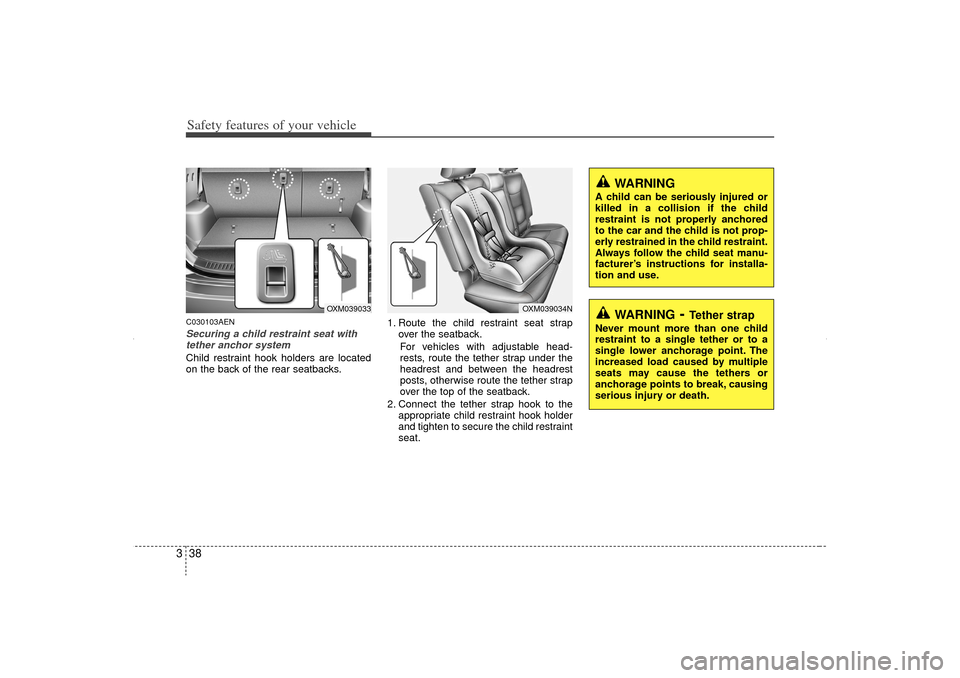
3C030103AENSecuring a child restraint seat with
tether anchor system Child restraint hook holders are located
on the back of the rear seatbacks. 1. Route the child restraint seat strap
over the seatback.
For vehicles with adjustable head-
rests, route the tether strap under the
headrest and between the headrest
posts, otherwise route the tether strap
over the top of the seatback.
2. Connect the tether strap hook to the appropriate child restraint hook holder
and tighten to secure the child restraint
seat.
WARNING
- Tether strap
Never mount more than one child
restraint to a single tether or to a
single lower anchorage point. The
increased load caused by multiple
seats may cause the tethers or
anchorage points to break, causing
serious injury or death.
WARNING
A child can be seriously injured or
killed in a collision if the child
restraint is not properly anchored
to the car and the child is not prop-
erly restrained in the child restraint.
Always follow the child seat manu-
facturer’s instructions for installa-
tion and use.
OXM039033
OXM039034N
XM CAN (ENG) 3.QXP 4/19/2011 10:29 AM Page 38
Page 62 of 388
339
Safety features of your vehicle
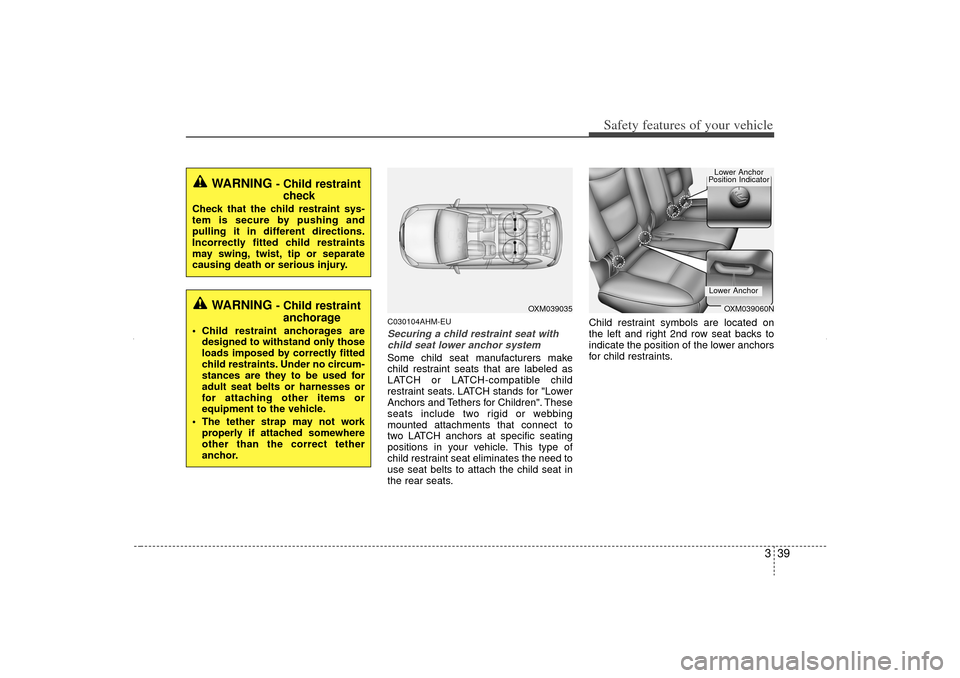
C030104AHM-EUSecuring a child restraint seat withchild seat lower anchor systemSome child seat manufacturers make
child restraint seats that are labeled as
LATCH or LATCH-compatible child
restraint seats. LATCH stands for "Lower
Anchors and Tethers for Children". These
seats include two rigid or webbing
mounted attachments that connect to
two LATCH anchors at specific seating
positions in your vehicle. This type of
child restraint seat eliminates the need to
use seat belts to attach the child seat in
the rear seats. Child restraint symbols are located on
the left and right 2nd row seat backs to
indicate the position of the lower anchors
for child restraints.
WARNING
- Child restraint
check
Check that the child restraint sys-
tem is secure by pushing and
pulling it in different directions.
Incorrectly fitted child restraints
may swing, twist, tip or separate
causing death or serious injury.
WARNING
- Child restraintanchorage
Child restraint anchorages are
designed to withstand only those
loads imposed by correctly fitted
child restraints. Under no circum-
stances are they to be used for
adult seat belts or harnesses or
for attaching other items or
equipment to the vehicle.
The tether strap may not work properly if attached somewhere
other than the correct tether
anchor.
OXM039035
OXM039060N
Lower AnchorLower Anchor
Position Indicator
XM CAN (ENG) 3.QXP 4/19/2011 10:29 AM Page 39
Page 63 of 388
Safety features of your vehicle40
3
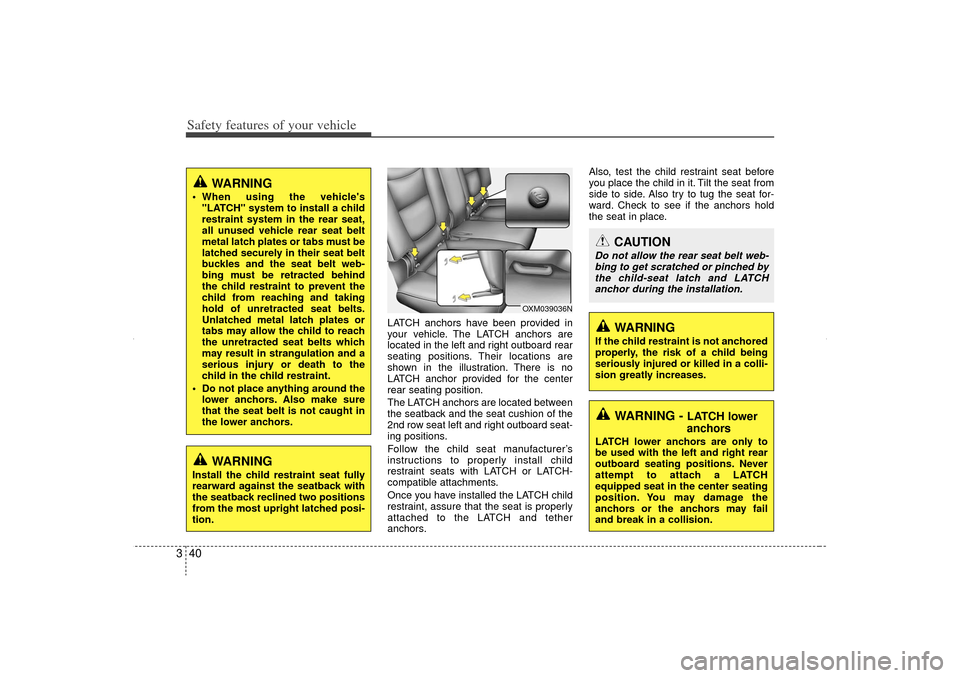
LATCH anchors have been provided in
your vehicle. The LATCH anchors are
located in the left and right outboard rear
seating positions. Their locations are
shown in the illustration. There is no
LATCH anchor provided for the center
rear seating position.
The LATCH anchors are located between
the seatback and the seat cushion of the
2nd row seat left and right outboard seat-
ing positions.
Follow the child seat manufacturer’s
instructions to properly install child
restraint seats with LATCH or LATCH-
compatible attachments.
Once you have installed the LATCH child
restraint, assure that the seat is properly
attached to the LATCH and tether
anchors. Also, test the child restraint seat before
you place the child in it. Tilt the seat from
side to side. Also try to tug the seat for-
ward. Check to see if the anchors hold
the seat in place.
WARNING
If the child restraint is not anchored
properly, the risk of a child being
seriously injured or killed in a colli-
sion greatly increases.
WARNING -
LATCH lower
anchors
LATCH lower anchors are only to
be used with the left and right rear
outboard seating positions. Never
attempt to attach a LATCH
equipped seat in the center seating
position. You may damage the
anchors or the anchors may fail
and break in a collision.
CAUTION
Do not allow the rear seat belt web-
bing to get scratched or pinched by the child-seat latch and LATCHanchor during the installation.
WARNING
When using the vehicle's "LATCH" system to install a child
restraint system in the rear seat,
all unused vehicle rear seat belt
metal latch plates or tabs must be
latched securely in their seat belt
buckles and the seat belt web-
bing must be retracted behind
the child restraint to prevent the
child from reaching and taking
hold of unretracted seat belts.
Unlatched metal latch plates or
tabs may allow the child to reach
the unretracted seat belts which
may result in strangulation and a
serious injury or death to the
child in the child restraint.
Do not place anything around the lower anchors. Also make sure
that the seat belt is not caught in
the lower anchors.
WARNING
Install the child restraint seat fully
rearward against the seatback with
the seatback reclined two positions
from the most upright latched posi-
tion.
OXM039036N
XM CAN (ENG) 3.QXP 4/19/2011 10:29 AM Page 40