Cool KIA Sorento 2012 2.G Owner's Manual
[x] Cancel search | Manufacturer: KIA, Model Year: 2012, Model line: Sorento, Model: KIA Sorento 2012 2.GPages: 388, PDF Size: 7.56 MB
Page 6 of 388

I3
Index
ChainsSafety chains ··················\
··················\
··················\
·······5-54
Checking tire inflation pressure··················\
··················\
·7-37
Child restraint system ··················\
··················\
················3-33 Auto lock mode (Passenger seat belt) ··················\
·····3-36
Lower anchor system ··················\
··················\
············3-39
Tether anchor system ··················\
··················\
············3-38
Child-protector rear door lock ··················\
··················\
···4-18
Climate control system (Automatic) ··················\
···········4-87 Air conditioning ··················\
··················\
··················\
··4-93
Automatic heating and air conditioning··················\
··4-88
Manual heating and air conditioning ··················\
······4-89
3rd row air conditioning··················\
··················\
········4-83
Climate control system (Manual) ··················\
···············4-78 Air conditioning ··················\
··················\
··················\
··4-83
Heating and air conditioning··················\
··················\
·4-79
3rd row air conditioning··················\
··················\
········4-83
Climate control air filter··················\
··················\
···4-86, 7-27
Clock (Digital) ··················\
··················\
··················\
·······4-102
Combined instrument, see instrument cluster ···············4-48
Compact spare tire ··················\
··················\
··················\
···6-14
Compact spare tire replacement ··················\
··················\
7-41
Coolant ··················\
··················\
··················\
··················\
···7-19
Cooling fluid, see engine coolant ··················\
················7-19
Crankcase emission control system ··················\
·············7-64
Cruise control system ··················\
··················\
················5-39
Cup holder ··················\
··················\
··················\
·············4-100
Curtain air bag ··················\
··················\
··················\
·········3-59 Dashboard, see instrument cluster ··················\
···············4-48
Dashboard illumination, see instrument
panel illumination··················\
··················\
··················\
4-49
Defogging (Windshield) ··················\
··················\
············4-95
Defogging logic (Windshield) ··················\
··················\
···4-96
Defroster (Rear window) ··················\
··················\
···········4-77
Defrosting (Windshield) ··················\
··················\
············4-95
Digital clock··················\
··················\
··················\
···········4-102
Dimensions ··················\
··················\
··················\
················8-2
Display illumination, see instrument panel illumination··················\
··················\
··················\
4-49
Displays, see instrument cluster ··················\
··················\
4-48
Door locks··················\
··················\
··················\
················4-15 Central door lock switch ··················\
··················\
·······4-17
Child-protector rear door lock ··················\
················4-18
Drinks holders, see cup holders··················\
·················4-10\
0
Driver position memory system ··················\
··················\
4-34
Driver's air bag··············\
··················\
··················\
·············3-53
Driving at night··················\
··················\
··················\
········5-47
Driving in flooded areas ··················\
··················\
············5-48
Driving in the rain ··················\
··················\
··················\
···5-48
Economical operation ··················\
··················\
················5-43
Electric chromic mirror (ECM) ··················\
··················\
·4-39
DE
XM CAN (ENG) INDEX.QXP 4/19/2011 10:59 AM Page 3
Page 7 of 388

Index4I
Emergency starting ··················\
··················\
··················\
····6-4Jump starting ··················\
··················\
··················\
·········6-4
Push starting ··················\
··················\
··················\
··········6-5
Emergency tailgate safety release ··················\
···············4-20
Emergency towing ··················\
··················\
··················\
···6-17
Emergency while driving··················\
··················\
·············6-2
Emission control system ··················\
··················\
············7-64 Crankcase emission control system ··················\
········7-64
Evaporative emission control (including ORVR) System ··················\
··················\
··················\
··············7-64
Exhaust emission control system ··················\
············7-65
Engine compartment ··················\
··················\
············2-4, 7-2
Engine coolant ··················\
··················\
··················\
·········7-19
Engine number ··················\
··················\
··················\
···········8-8
Engine oil ··················\
··················\
··················\
·················7-18\
Engine overheats··················\
··················\
··················\
········6-6
Engine start/stop button ··················\
··················\
···············5-7
Engine temperature gauge ··················\
··················\
·········4-50
Engine will not start··················\
··················\
··················\
···6-3
Evaporative emission control (including ORVR) System ··················\
··················\
··················\
·················7-64\
Exhaust emission control system··················\
·················7-65\
Explanation of scheduled maintenance items ···············7-15
Exterior care··················\
··················\
··················\
·············7-58
Exterior features··················\
··················\
··················\
·····4-105 Roof rack ··················\
··················\
··················\
···········4-105 Flat tire ··················\
··················\
··················\
··················\
·····6-7
Changing tires ··················\
··················\
··················\
·······6-9
Compact spare tire ··················\
··················\
················6-14
Jack and tools ··················\
··················\
··················\
········6-7
Removing and storing the spare tire ··················\
·········6-8
Floor mat anchor(s) ··················\
··················\
·················4-10\
3
Fluid Brake/clutch fluid ··················\
··················\
··················\
7-22
Power steering fluid ··················\
··················\
··············7-23
Washer fluid ··················\
··················\
··················\
········7-24
Folding the rear seat ··················\
··················\
··················\
3-13
Four wheel drive (4WD) ··················\
··················\
···········5-21
Front seat adjustment - manual ··················\
··················\
···3-4
Front seat adjustment - power ··················\
··················\
·····3-5
Fuel filler lid ··················\
··················\
··················\
············4-27
Fuel gauge··················\
··················\
··················\
················4-51
Fuel requirements ··················\
··················\
··················\
······1-3
Fuses ··················\
··················\
··················\
··················\
······7-49 Fuse/relay panel description··················\
··················\
··7-53
Memory fuse ··················\
··················\
··················\
·······7-51
Multi fuse ··················\
··················\
··················\
············7-52
F
XM CAN (ENG) INDEX.QXP 4/19/2011 10:59 AM Page 4
Page 23 of 388
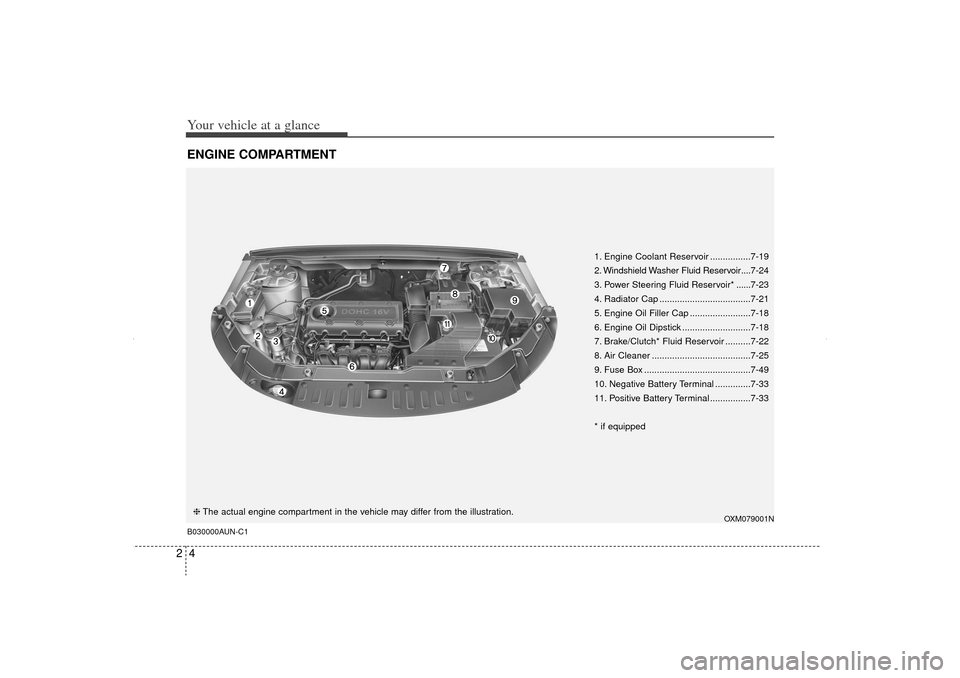
Your vehicle at a glance42ENGINE COMPARTMENTB030000AUN-C1
OXM079001N
❈The actual engine compartment in the vehicle may differ from the illustration. 1. Engine Coolant Reservoir ................7-19
2. Windshield Washer Fluid Reservoir....7-24
3. Power Steering Fluid Reservoir*
......7-23
4. Radiator Cap ....................................7-21
5. Engine Oil Filler Cap ........................7-18
6. Engine Oil Dipstick ...........................7-18
7. Brake/Clutch* Fluid Reservoir ..........7-22
8. Air Cleaner .......................................7-25
9. Fuse Box ..........................................7-49
10. Negative Battery Terminal ..............7-33
11. Positive Battery Terminal ................7-33
* if equipped
XM CAN (ENG) 2.QXP 4/19/2011 10:25 AM Page 4
Page 34 of 388
311
Safety features of your vehicle
The temperature setting of the seat
changes according to the switch position.
If you want to warm your seat cushion,press the right side of the switch (red
color).
If you want to cool your seat cushion, press the left side of the switch (blue
color).
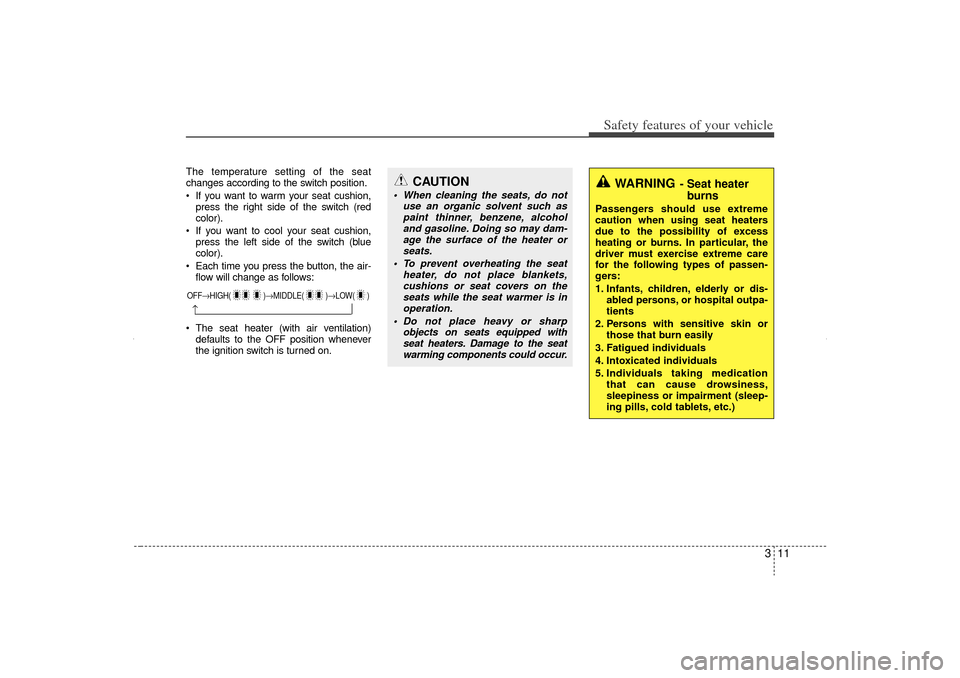
Each time you press the button, the air- flow will change as follows:
The seat heater (with air ventilation) defaults to the OFF position whenever
the ignition switch is turned on.OFF→ HIGH( )→ MIDDLE( )→LOW( )→
WARNING
- Seat heater
burns
Passengers should use extreme
caution when using seat heaters
due to the possibility of excess
heating or burns. In particular, the
driver must exercise extreme care
for the following types of passen-
gers:
1. Infants, children, elderly or dis-
abled persons, or hospital outpa-
tients
2. Persons with sensitive skin or those that burn easily
3. Fatigued individuals
4. Intoxicated individuals
5. Individuals taking medication that can cause drowsiness,
sleepiness or impairment (sleep-
ing pills, cold tablets, etc.)
CAUTION
When cleaning the seats, do not use an organic solvent such aspaint thinner, benzene, alcohol and gasoline. Doing so may dam-age the surface of the heater orseats.
To prevent overheating the seat heater, do not place blankets,cushions or seat covers on the seats while the seat warmer is inoperation.
Do not place heavy or sharp objects on seats equipped withseat heaters. Damage to the seat warming components could occur.
XM CAN (ENG) 3.QXP 4/19/2011 10:26 AM Page 11
Page 140 of 388
Features of your vehicle50
4When the door is opened, or if the engine
is not started within 1 minute, the
tachometer pointer may move slightly in
the ON position with the engine OFF.
This movement is normal and will not
affect the accuracy of the tachometer
once the engine is running.
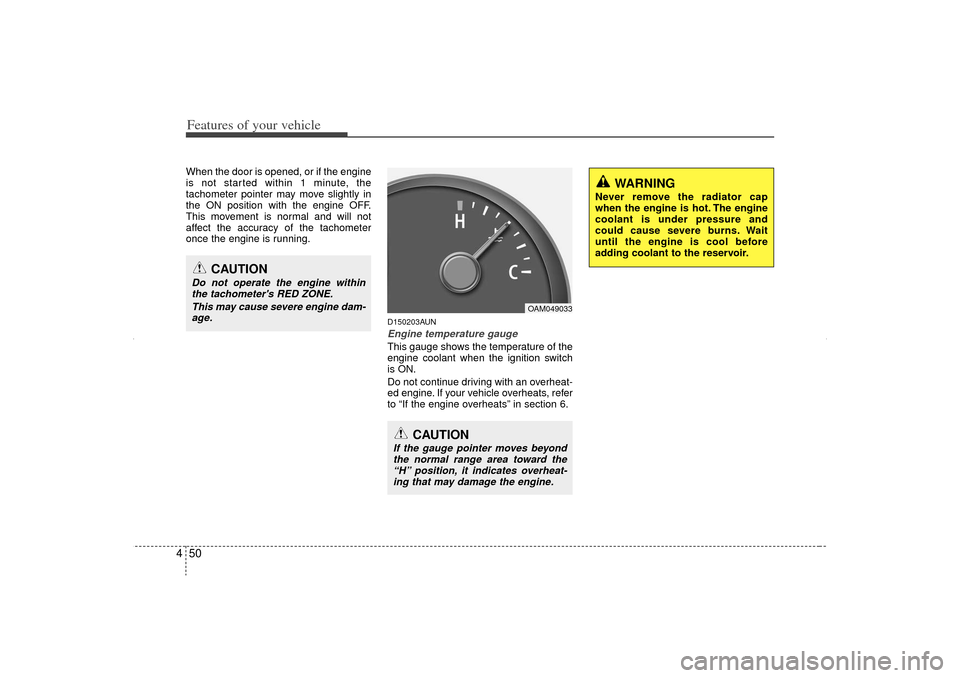
D150203AUNEngine temperature gauge This gauge shows the temperature of the
engine coolant when the ignition switch
is ON.
Do not continue driving with an overheat-
ed engine. If your vehicle overheats, refer
to “If the engine overheats” in section 6.
OAM049033
CAUTION
If the gauge pointer moves beyond
the normal range area toward the“H” position, it indicates overheat- ing that may damage the engine.
CAUTION
Do not operate the engine withinthe tachometer's RED ZONE.
This may cause severe engine dam-age.
WARNING
Never remove the radiator cap
when the engine is hot. The engine
coolant is under pressure and
could cause severe burns. Wait
until the engine is cool before
adding coolant to the reservoir.
XM CAN (ENG) 4(~105).QXP 4/19/2011 10:38 AM Page 50
Page 169 of 388
479
Features of your vehicle
Heating and air conditioning1. Start the engine.
2. Set the mode to the desired position.For improving the effectiveness of
heating and cooling;
- Heating:
- Cooling:
3. Set the temperature control to the desired position.
4. Set the air intake control to the outside (fresh) air position (if equipped).
5. Set the fan speed control to the desired speed.
6. If air conditioning is desired, turn the air conditioning system (if equipped)
on.
❈ ❈
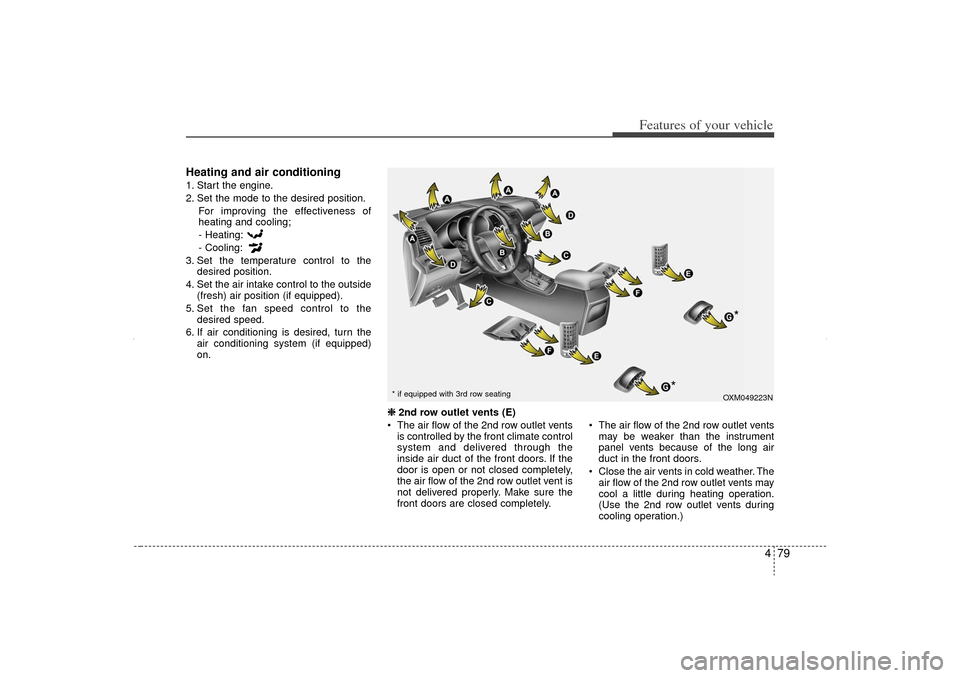
2nd row outlet vents (E)
The air flow of the 2nd row outlet vents is controlled by the front climate control
system and delivered through the
inside air duct of the front doors. If the
door is open or not closed completely,
the air flow of the 2nd row outlet vent is
not delivered properly. Make sure the
front doors are closed completely. The air flow of the 2nd row outlet vents
may be weaker than the instrument
panel vents because of the long air
duct in the front doors.
Close the air vents in cold weather. The air flow of the 2nd row outlet vents may
cool a little during heating operation.
(Use the 2nd row outlet vents during
cooling operation.)
OXM049223N
* *
* if equipped with 3rd row seating
XM CAN (ENG) 4(~105).QXP 4/19/2011 10:40 AM Page 79
Page 170 of 388
Features of your vehicle80
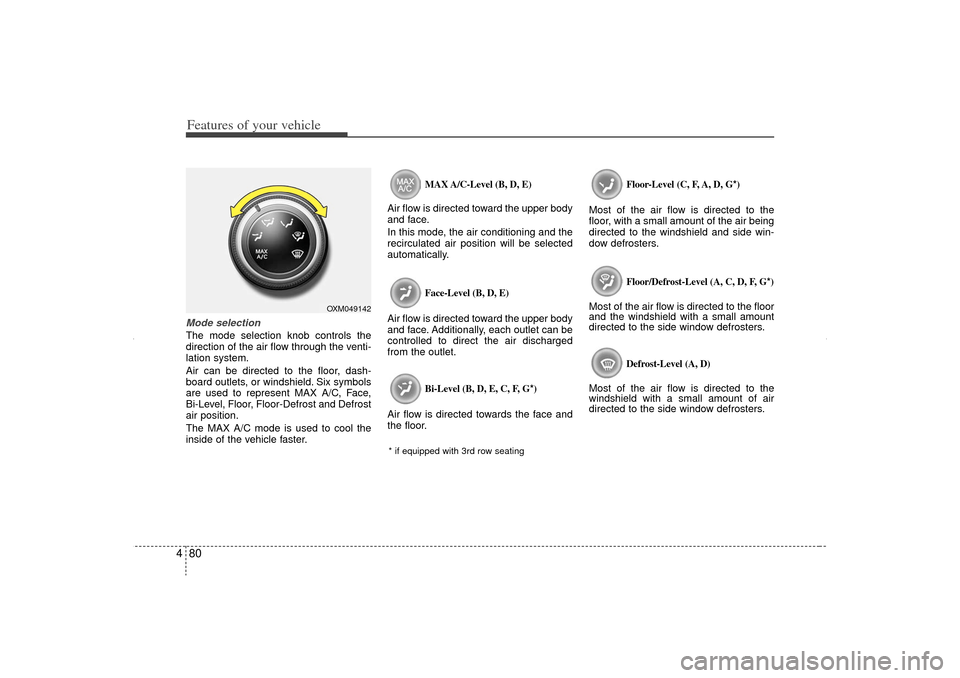
4Mode selectionThe mode selection knob controls the
direction of the air flow through the venti-
lation system.
Air can be directed to the floor, dash-
board outlets, or windshield. Six symbols
are used to represent MAX A/C, Face,
Bi-Level, Floor, Floor-Defrost and Defrost
air position.
The MAX A/C mode is used to cool the
inside of the vehicle faster.
MAX A/C-Level (B, D, E)
Air flow is directed toward the upper body
and face.
In this mode, the air conditioning and the
recirculated air position will be selected
automatically.
Face-Level (B, D, E)
Air flow is directed toward the upper body
and face. Additionally, each outlet can be
controlled to direct the air discharged
from the outlet.
Bi-Level (B, D, E, C, F, G *)
Air flow is directed towards the face and
the floor.
Floor-Level (C, F, A, D, G *)
Most of the air flow is directed to the
floor, with a small amount of the air being
directed to the windshield and side win-
dow defrosters.
Floor/Defrost-Level (A, C, D, F, G *)
Most of the air flow is directed to the floor
and the windshield with a small amount
directed to the side window defrosters.
Defrost-Level (A, D)
Most of the air flow is directed to the
windshield with a small amount of air
directed to the side window defrosters.
OXM049142
* if equipped with 3rd row seating
XM CAN (ENG) 4(~105).QXP 4/19/2011 10:40 AM Page 80
Page 171 of 388
481
Features of your vehicle
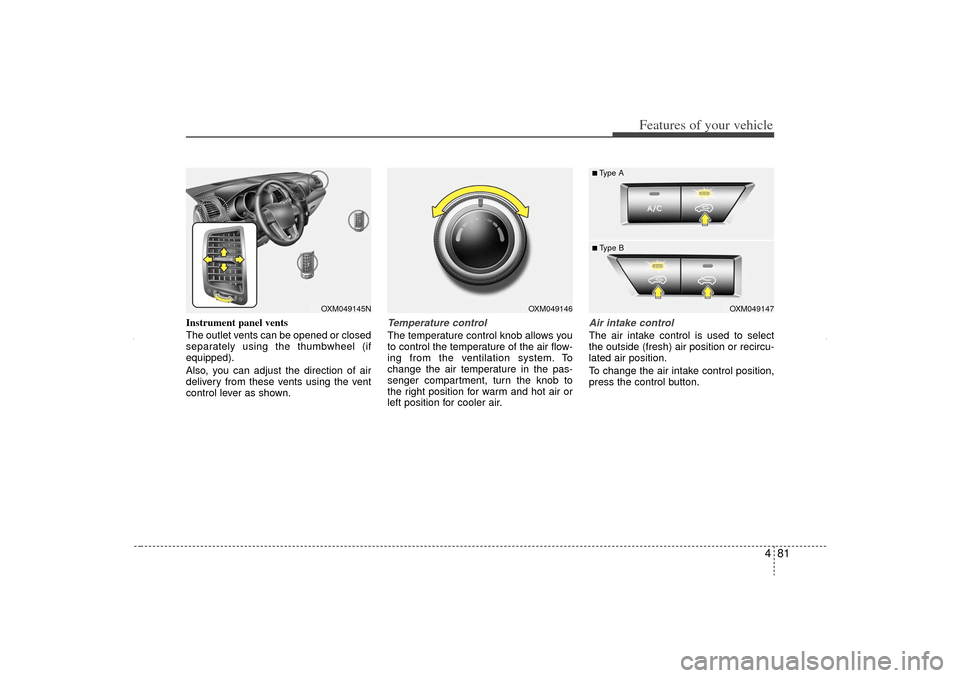
Instrument panel vents
The outlet vents can be opened or closed
separately using the thumbwheel (if
equipped).
Also, you can adjust the direction of air
delivery from these vents using the vent
control lever as shown.
Temperature controlThe temperature control knob allows you
to control the temperature of the air flow-
ing from the ventilation system. To
change the air temperature in the pas-
senger compartment, turn the knob to
the right position for warm and hot air or
left position for cooler air.
Air intake control The air intake control is used to select
the outside (fresh) air position or recircu-
lated air position.
To change the air intake control position,
press the control button.
OXM049146
OXM049145N
OXM049147
■Type A■ Type B
XM CAN (ENG) 4(~105).QXP 4/19/2011 10:40 AM Page 81
Page 172 of 388
Features of your vehicle82
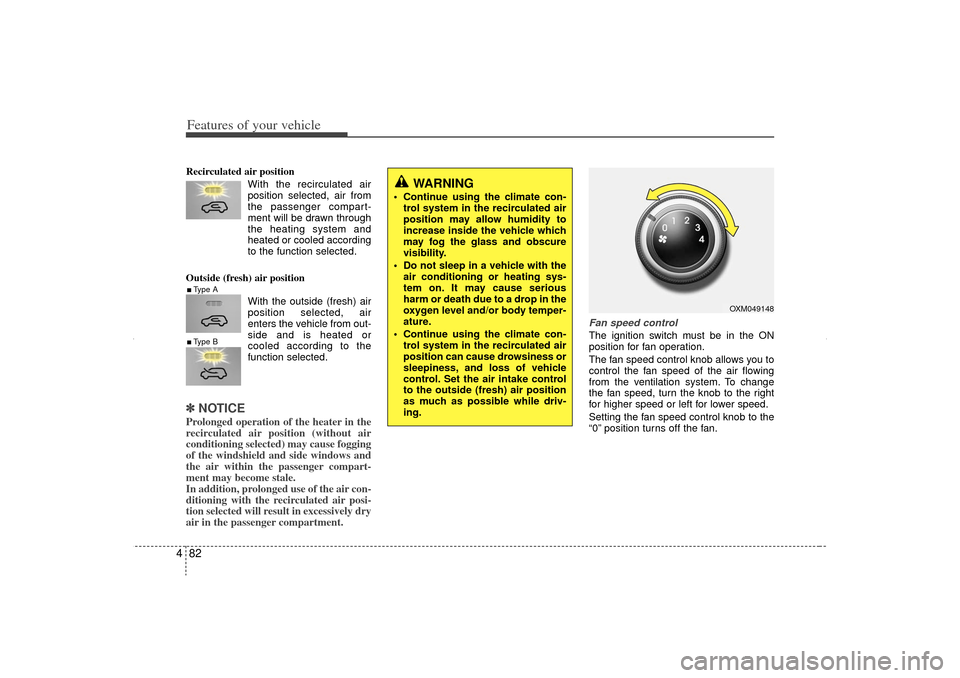
4Recirculated air position
With the recirculated airposition selected, air from
the passenger compart-
ment will be drawn through
the heating system and
heated or cooled according
to the function selected.
Outside (fresh) air position With the outside (fresh) air
position selected, air
enters the vehicle from out-
side and is heated or
cooled according to the
function selected.✽ ✽NOTICEProlonged operation of the heater in the
recirculated air position (without air
conditioning selected) may cause fogging
of the windshield and side windows and
the air within the passenger compart-
ment may become stale.
In addition, prolonged use of the air con-
ditioning with the recirculated air posi-
tion selected will result in excessively dry
air in the passenger compartment.
Fan speed controlThe ignition switch must be in the ON
position for fan operation.
The fan speed control knob allows you to
control the fan speed of the air flowing
from the ventilation system. To change
the fan speed, turn the knob to the right
for higher speed or left for lower speed.
Setting the fan speed control knob to the
“0” position turns off the fan.
WARNING
Continue using the climate con-
trol system in the recirculated air
position may allow humidity to
increase inside the vehicle which
may fog the glass and obscure
visibility.
Do not sleep in a vehicle with the air conditioning or heating sys-
tem on. It may cause serious
harm or death due to a drop in the
oxygen level and/or body temper-
ature.
Continue using the climate con- trol system in the recirculated air
position can cause drowsiness or
sleepiness, and loss of vehicle
control. Set the air intake control
to the outside (fresh) air position
as much as possible while driv-
ing.
OXM049148
■Type A■Type B
XM CAN (ENG) 4(~105).QXP 4/19/2011 10:40 AM Page 82
Page 174 of 388
Features of your vehicle84
4System operationVentilation1. Set the mode to the position.
2. Set the air intake control to the outside
(fresh) air position.
3. Set the temperature control to the desired position.
4. Set the fan speed control to the desired speed.Heating1. Set the mode to the position.
2. Set the air intake control to the outside(fresh) air position.
3. Set the temperature control to the desired position.
4. Set the fan speed control to the desired speed.
5. If dehumidified heating is desired, turn the air conditioning system (if
equipped) on.
If the windshield fogs up, set the mode to the
or
position. Operation Tips
To keep dust or unpleasant fumes from
entering the vehicle through the venti-
lation system, temporarily set the air
intake control to the recirculated air
position. Be sure to return the control
to the fresh air position when the irrita-
tion has passed to keep fresh air in the
vehicle. This will help keep the driver
alert and comfortable.
Air for the heating/cooling system is drawn in through the grilles just ahead
of the windshield. Care should be
taken that these are not blocked by
leaves, snow, ice or other obstructions.
To prevent interior fog on the wind- shield, set the air intake control to the
fresh air position and fan speed to the
desired position, turn on the air condi-
tioning system, and adjust the temper-
ature control to desired temperature.
Air conditioningAll KIA Air Conditioning Systems are
filled with environmentally friendly
R-134a refrigerant which does not dam-
age the ozone layer.
1. Start the engine. Press the air condi- tioning button.
2. Set the mode to the position.
3. Set the air intake control to the outside air or recirculated air position.
4. Adjust the fan speed control and tem- perature control to maintain maximum
comfort.
When maximum cooling is desired, set the temperature control to the extreme
left position, set the mode control to
the MAX A/C position, then set the fan
speed control to the highest speed.
XM CAN (ENG) 4(~105).QXP 4/19/2011 10:40 AM Page 84