Gas KIA Sorento 2017 3.G Owner's Guide
[x] Cancel search | Manufacturer: KIA, Model Year: 2017, Model line: Sorento, Model: KIA Sorento 2017 3.GPages: 576, PDF Size: 7.82 MB
Page 501 of 576
749
Maintenance
BATTERY
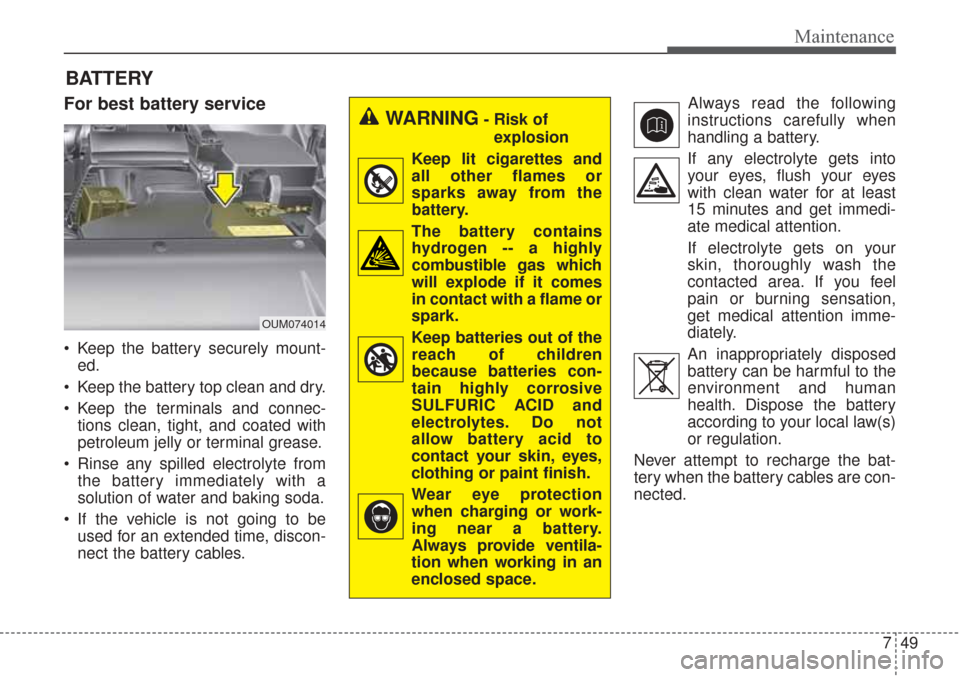
For best battery service
Keep the battery securely mount-ed.
Keep the battery top clean and dry.
Keep the terminals and connec- tions clean, tight, and coated with
petroleum jelly or terminal grease.
Rinse any spilled electrolyte from the battery immediately with a
solution of water and baking soda.
If the vehicle is not going to be used for an extended time, discon-
nect the battery cables. Always read the following
instructions carefully when
handling a battery.
If any electrolyte gets into your eyes, flush your eyes
with clean water for at least
15 minutes and get immedi-
ate medical attention.
If electrolyte gets on your
skin, thoroughly wash the
contacted area. If you feel
pain or burning sensation,
get medical attention imme-
diately.
An inappropriately disposed battery can be harmful to the
environment and human
health. Dispose the battery
according to your local law(s)
or regulation.
Never attempt to recharge the bat-
tery when the battery cables are con-
nected.
WARNING- Risk of explosion
Keep lit cigarettes and
all other flames or
sparks away from the
battery.
The battery contains hydrogen -- a highly
combustible gas which
will explode if it comes
in contact with a flame or
spark.
Keep batteries out of the reach of children
because batteries con-
tain highly corrosive
SULFURIC ACID and
electrolytes. Do not
allow battery acid to
contact your skin, eyes,
clothing or paint finish.
Wear eye protection when charging or work-
ing near a battery.
Always provide ventila-
tion when working in an
enclosed space.
OUM074014
Page 503 of 576
751
Maintenance
Recharging battery
When recharging the battery,
observe the following precautions:
The battery must be removed fromthe vehicle and placed in an area
with good ventilation.
Do not allow cigarettes, sparks, or flame near the battery.
Watch the battery during charging, and stop or reduce the charging
rate if the battery cells begin
gassing (boiling) violently or if the
temperature of the electrolyte of
any cell exceeds 49°C (120°F).
Wear eye protection when check- ing the battery during charging.
Disconnect the battery charger in the following order.
1. Turn off the battery charger main switch.
2. Unhook the negative clamp from the negative battery terminal.
3. Unhook the positive clamp from the positive battery terminal. Before performing maintenance or
recharging the battery, turn off all
accessories and stop the engine.
The negative battery cable must be removed first and installed last
when the battery is disconnected.
Reset items
Items should be reset after the bat-
tery has been discharged or the bat-
tery has been disconnected.
Auto up/down window (See chapter 4)
Sunroof (See chapter 4)
Trip computer (See chapter 4)
Climate control system (See chapter 4)
Integrated Memory System (See chapter 3)
Audio (See chapter 4)
Page 515 of 576
763
Maintenance
Ply:A layer of rubber-coated parallel
cords
Pneumatic tire: A mechanical
device made of rubber, chemicals,
fabric and steel or other materials,
that, when mounted on an automo-
tive wheel provides the traction and
contains the gas or fluid that sustains
the load.
Production options weight: The
combined weight of installed regular
production options weighing over 2.3
kg (5 lb.) in excess of the standard
items which they replace, not previ-
ously considered in curb weight or
accessory weight, including heavy
duty breaks, ride levelers, roof rack,
heavy duty battery, and special trim.
Recommended Inflation Pressure:
Vehicle manufacturer's recommend-
ed tire inflation pressure and shown
on the tire placard. Radial Ply Tire:
A pneumatic tire in
which the ply cords that extend to the
beads are laid at 90 degrees to the
centerline of the tread.
Rim: A metal support for a tire and
upon which the tire beads are seat-
ed.
Sidewall: The portion of a tire
between the tread and the bead.
Speed Rating: An alphanumeric
code assigned to a tire indicating the
maximum speed at which a tire can
operate.
Traction: The friction between the
tire and the road surface. The
amount of grip provided.
Tread: The portion of a tire that
comes into contact with the road.
Treadwear Indicators: Narrow
bands, sometimes called "wear
bars," that show across the tread of a
tire when only 1/16 inch of tread
remains. UTQGS:
Uniform Tire Quality
Grading Standards, a tire information
system that provides consumers with
ratings for a tire's traction, tempera-
ture and treadwear. Ratings are
determined by tire manufacturers
using government testing proce-
dures. The ratings are molded into
the sidewall of the tire.
Vehicle Capacity Weight: The num-
ber of designated seating positions
multiplied by 68 kg (150 lbs.) plus the
rated cargo and luggage load.
Vehicle Maximum Load on the
Tire: Load on an individual tire due
to curb and accessory weight plus
maximum occupant and cargo
weight.
Vehicle Normal Load on the Tire:
Load on an individual tire that is
determined by distributing to each
axle its share of the curb weight,
accessory weight, and normal occu-
pant weight and driving by 2.
Vehicle Placard: A label permanent-
ly attached to a vehicle showing the
original equipment tire size and rec-
ommended inflation pressure.
Page 536 of 576
Maintenance
84
7
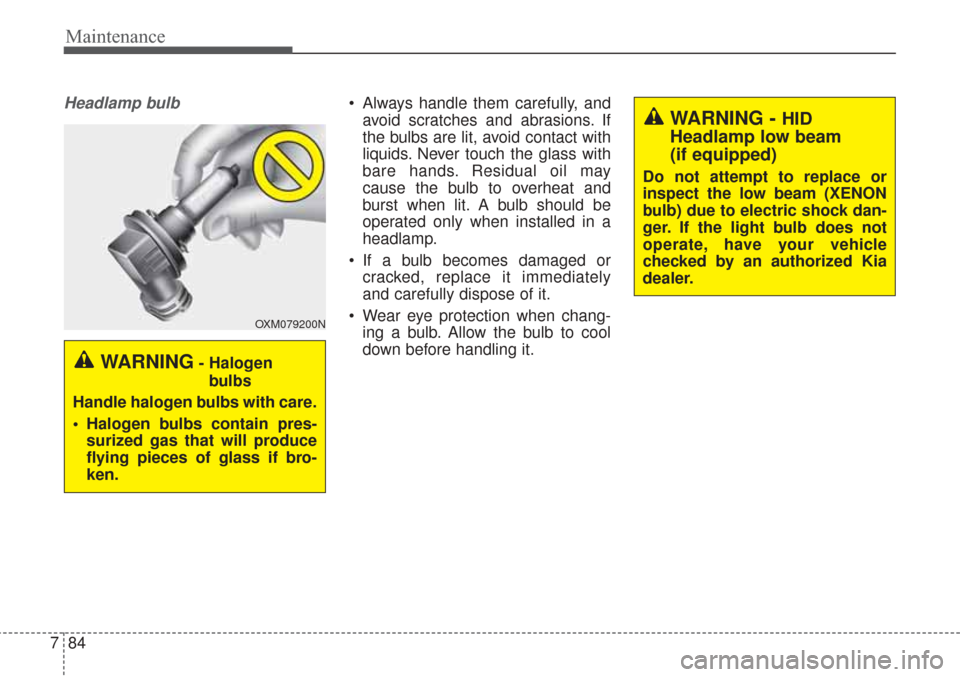
Headlamp bulb Always handle them carefully, and
avoid scratches and abrasions. If
the bulbs are lit, avoid contact with
liquids. Never touch the glass with
bare hands. Residual oil may
cause the bulb to overheat and
burst when lit. A bulb should be
operated only when installed in a
headlamp.
If a bulb becomes damaged or cracked, replace it immediately
and carefully dispose of it.
Wear eye protection when chang- ing a bulb. Allow the bulb to cool
down before handling it.
WARNING - HID
Headlamp low beam
(if equipped)
Do not attempt to replace or
inspect the low beam (XENON
bulb) due to electric shock dan-
ger. If the light bulb does not
operate, have your vehicle
checked by an authorized Kia
dealer.
OXM079200N
WARNING- Halogen
bulbs
Handle halogen bulbs with care.
Halogen bulbs contain pres- surized gas that will produce
flying pieces of glass if bro-
ken.
Page 553 of 576
7101
Maintenance
EMISSION CONTROL SYSTEM
The emission control system of your
vehicle is covered by a written limited
warranty. Please see the warranty
information contained in the
Warranty & Maintenance booklet in
your vehicle.
Your vehicle is equipped with an
emission control system to meet all
applicable emission regulations.
There are three emission control
systems, as follows.
(1) Crankcase emission control sys-tem
(2) Evaporative emission control sys- tem
(3) Exhaust emission control system
In order to assure the proper function
of the emission control systems, it is
recommended that you have your
vehicle inspected and maintained by
an authorized Kia dealer in accor-
dance with the maintenance sched-
ule in this manual. Caution for the Inspection and
Maintenance Test (With Electronic
Stability Control (ESC) system)
To prevent the vehicle from mis-
firing during dynamometer test-
ing, turn the Electronic Stability
Control (ESC) system off by
pressing the ESC switch.
After dynamometer testing is completed, turn the ESC system
back on by pressing the ESC
switch again.1. Crankcase emission control system
The positive crankcase ventilation
system is employed to prevent air
pollution caused by blow-by gases
being emitted from the crankcase.
This system supplies fresh filtered air
to the crankcase through the air
intake hose. Inside the crankcase,
the fresh air mixes with blow-by
gases, which then pass through the
PCV valve into the induction system.
2. Evaporative emission con-trol (including ORVR:
Onboard Refueling Vapor
Recovery)
system
The Evaporative Emission Control
System is designed to prevent fuel
vapors from escaping into the atmos-
phere.
(The ORVR system is designed to
allow the vapors from the fuel tank to
be loaded into a canister while refu-
eling at the gas station, preventing
the escape of fuel vapors into the
atmosphere.)
Page 554 of 576
Maintenance
102
7
Canister
Fuel vapors generated inside the fuel
tank are absorbed and stored in the
onboard canister. When the engine is
running, the fuel vapors absorbed in
the canister are drawn into the surge
tank through the purge control sole-
noid valve.
Purge Control Solenoid Valve
(PCSV)
The purge control solenoid valve is
controlled by the Engine Control
Module (ECM); when the engine
coolant temperature is low during
idling, the PCSV closes so that evap-
orated fuel is not taken into the
engine. After the engine warms up
during ordinary driving, the PCSV
opens to introduce evaporated fuel to
the engine.
3. Exhaust emission control system
The Exhaust Emission Control
System is a highly effective system
which controls exhaust emissions
while maintaining good vehicle per-
formance.
Vehicle modifications
This vehicle should not be modified.
Modification of your vehicle could
affect its performance, safety or
durability and may even violate gov-
ernmental safety and emissions reg-
ulations.
In addition, damage or performance
problems resulting from any modifi-
cation may not be covered under
warranty.
If you use unauthorized electronic
devices, it may cause the vehicle to
operate abnormally, wire damage,
battery discharge and fire. For your
safety, do not use unauthorized
electronic devices.
Engine exhaust gas precautions
(carbon monoxide)
Carbon monoxide can be present with other exhaust fumes.
Therefore, if you smell exhaust
fumes of any kind inside your vehi-
cle, have it inspected and repaired
immediately. If you ever suspect
exhaust fumes are coming into
your vehicle, drive it only with all
the windows fully open. Have your
vehicle checked and repaired
immediately.
WARNING - Exhaust
Engine exhaust gases contain
carbon monoxide (CO). Though
colorless and odorless, it is
dangerous and could be lethal if
inhaled. Follow the instructions
on this page to avoid CO poi-
soning.
Page 556 of 576
Your vehicle is equipped with a cat-
alytic converter emission control
device.
Therefore, the following precautions
must be observed:
Use only UNLEADED FUEL forgasoline engines.
Do not operate the vehicle when there are signs of engine malfunc-
tion, such as misfire or a noticeable
loss of performance.
Do not misuse or abuse the engine. Examples of misuse are
coasting with the ignition off and
descending steep grades in gear
with the ignition off.
Do not operate the engine at high idle speed for extended periods (5
minutes or more).
Do not modify or tamper with any part of the engine or emission con-
trol system. All inspections and
adjustments must be made by an
authorized Kia dealer.
Avoid driving with an extremely low fuel level. Running out of fuel could
cause the engine to misfire, dam-
aging the catalytic converter. Failure to observe these precautions
could result in damage to the catalyt-
ic converter and to your vehicle.
Additionally, such actions could void
your warranties.
7104
Maintenance
Page 558 of 576
![KIA Sorento 2017 3.G Owners Guide 2 8
DIMENSIONS Specifications & Consumer information
ENGINE
ITEM5 Seats7 Seats
Overall length [mm (in.)]4,760 (187.4)←
Overall width [mm (in.)]1,890 (74.4)←
Overall height
[mm (in.)]Without Roof r](/img/2/2983/w960_2983-557.png "KIA Sorento 2017 3.G Owners Guide 2 8
DIMENSIONS Specifications & Consumer information
ENGINE
ITEM5 Seats7 Seats
Overall length [mm (in.)]4,760 (187.4)←
Overall width [mm (in.)]1,890 (74.4)←
Overall height
[mm (in.)]Without Roof r")
2 8
DIMENSIONS Specifications & Consumer information
ENGINE
ITEM5 Seats7 Seats
Overall length [mm (in.)]4,760 (187.4)←
Overall width [mm (in.)]1,890 (74.4)←
Overall height
[mm (in.)]Without Roof rack1,685 (66.3)←
With Roof rack1,690 (66.5)←
Tread
[mm (in.)]
Front
235/65 R171,633 (64.2)←
235/60 R181,628 (64.0)←
235/55 R191,628 (64.0)←
Rear
235/65 R171,644 (64.7)←
235/60 R181,639 (64.5)←
235/55 R191,639 (64.5)←
Wheelbase [mm (in.)]2,780 (109.4)←
ITEMGasoline
Theta II 2.0 T-GDIGasoline
Theta II 2.4Gasoline
Lambda II 3.3
Displacement
[cc (cu. in)]1,998 (121.92)2,359 (143.95)3,342 (203.94)
Bore x Stroke
[mm (in.)]86x86 (3.39x3.39)88x97 (3.46X3.81)92x83.8
(3.62X3.29)
Firing order 1-3-4-2 1-3-4-2 1-2-3-4-5-6
No. of cylinders 4. In-line 4. In-line V - type
Page 562 of 576
6 8
Specifications & Consumer information
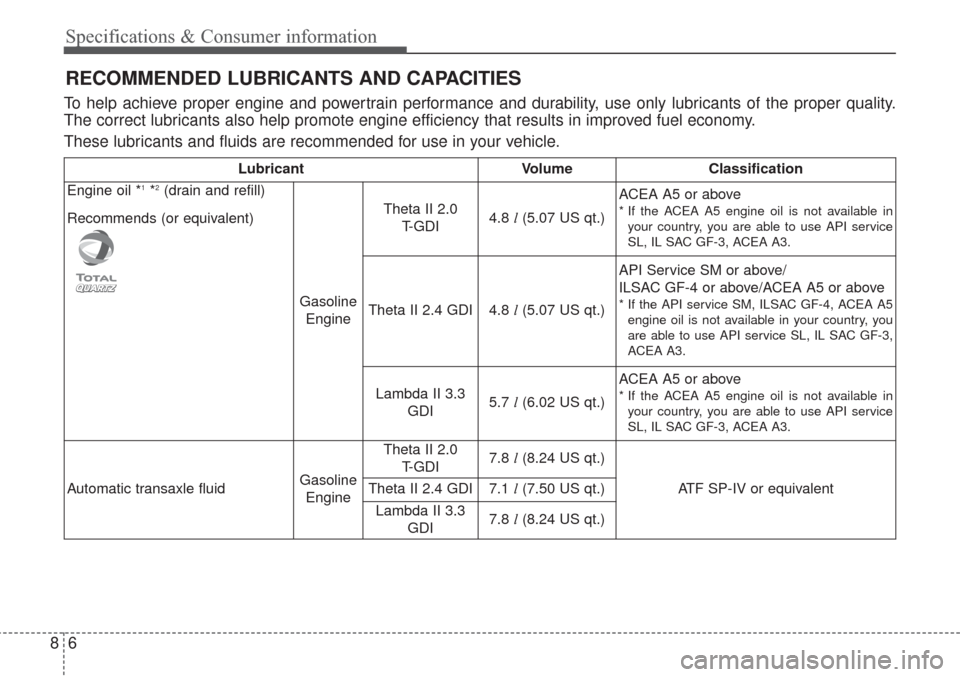
RECOMMENDED LUBRICANTS AND CAPACITIES
To help achieve proper engine and powertrain performance and durability, use only lubricants of the proper quality.
The correct lubricants also help promote engine efficiency that results in improved fuel economy.
These lubricants and fluids are recommended for use in your vehicle.
Lubricant VolumeClassification
Engine oil *1*2(drain and refill)
Recommends (or equivalent)
Gasoline
Engine
Theta II 2.0
T-GDI4.8 l(5.07 US qt.)
ACEA A5 or above
* If the ACEA A5 engine oil is not available in
your country, you are able to use API service
SL, IL SAC GF-3, ACEA A3.
Theta II 2.4 GDI4.8 l(5.07 US qt.)
API Service SM or above/
ILSAC GF-4 or above/ACEA A5 or above
* If the API service SM, ILSAC GF-4, ACEA A5
engine oil is not available in your country, you
are able to use API service SL, IL SAC GF-3,
ACEA A3.
Lambda II 3.3
GDI5.7 l(6.02 US qt.)
ACEA A5 or above
* If the ACEA A5 engine oil is not available in
your country, you are able to use API service
SL, IL SAC GF-3, ACEA A3.
Automatic transaxle fluidGasoline
Engine
Theta II 2.0
T-GDI7.8 l(8.24 US qt.)
ATF SP-IV or equivalentTheta II 2.4 GDI7.1 l(7.50 US qt.)
Lambda II 3.3
GDI7.8 l(8.24 US qt.)
Page 563 of 576
87
Specifications & Consumer information
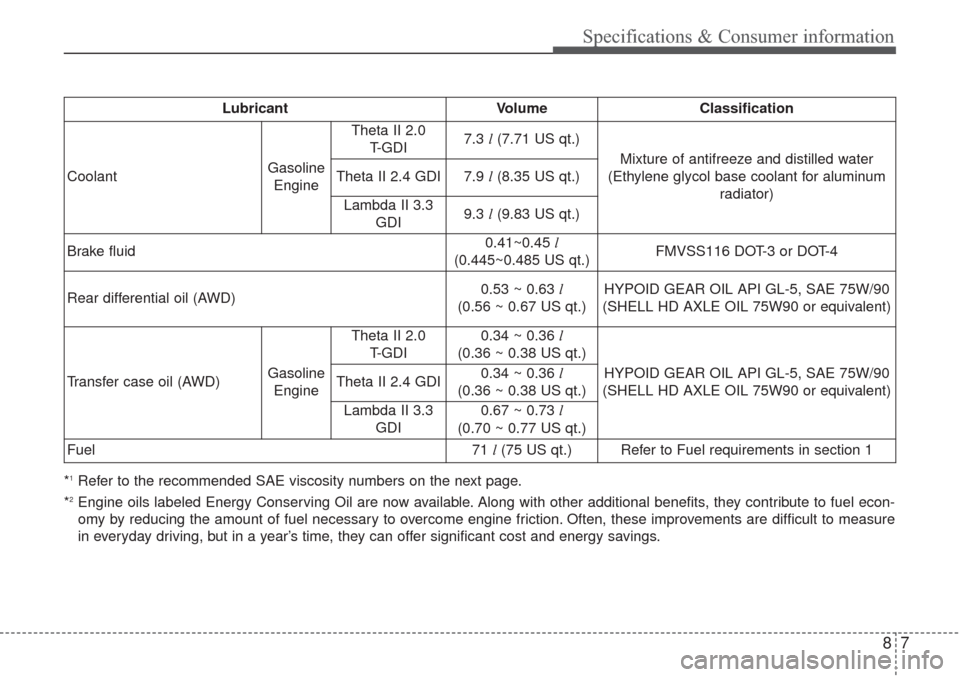
*1Refer to the recommended SAE viscosity numbers on the next page.
*
2Engine oils labeled Energy Conserving Oil are now available. Along with other additional benefits, they contribute to fuel econ-
omy by reducing the amount of fuel necessary to overcome engine friction. Often, these improvements are difficult to measure
in everyday driving, but in a year’s time, they can offer significant cost and energy savings.
Lubricant VolumeClassification
CoolantGasoline
Engine
Theta II 2.0
T-GDI7.3 l(7.71 US qt.)
Mixture of antifreeze and distilled water
(Ethylene glycol base coolant for aluminum
radiator)
Theta II 2.4 GDI7.9 l(8.35 US qt.)
Lambda II 3.3
GDI9.3 l(9.83 US qt.)
Brake fluid0.41~0.45 l
(0.445~0.485 US qt.)FMVSS116 DOT-3 or DOT-4
Rear differential oil (AWD)0.53 ~ 0.63 l
(0.56 ~ 0.67 US qt.)HYPOID GEAR OIL API GL-5, SAE 75W/90
(SHELL HD AXLE OIL 75W90 or equivalent)
Transfer case oil (AWD)Gasoline
Engine
Theta II 2.0
T-GDI0.34 ~ 0.36 l
(0.36 ~ 0.38 US qt.)
HYPOID GEAR OIL API GL-5, SAE 75W/90
(SHELL HD AXLE OIL 75W90 or equivalent)Theta II 2.4 GDI0.34 ~ 0.36 l
(0.36 ~ 0.38 US qt.)
Lambda II 3.3
GDI0.67 ~ 0.73 l
(0.70 ~ 0.77 US qt.)
Fuel71 l(75 US qt.)Refer to Fuel requirements in section 1