seats KIA SORENTO 2018 Owner's Manual
[x] Cancel search | Manufacturer: KIA, Model Year: 2018, Model line: SORENTO, Model: KIA SORENTO 2018Pages: 536, PDF Size: 13.42 MB
Page 250 of 536
4165
Features of your vehicle
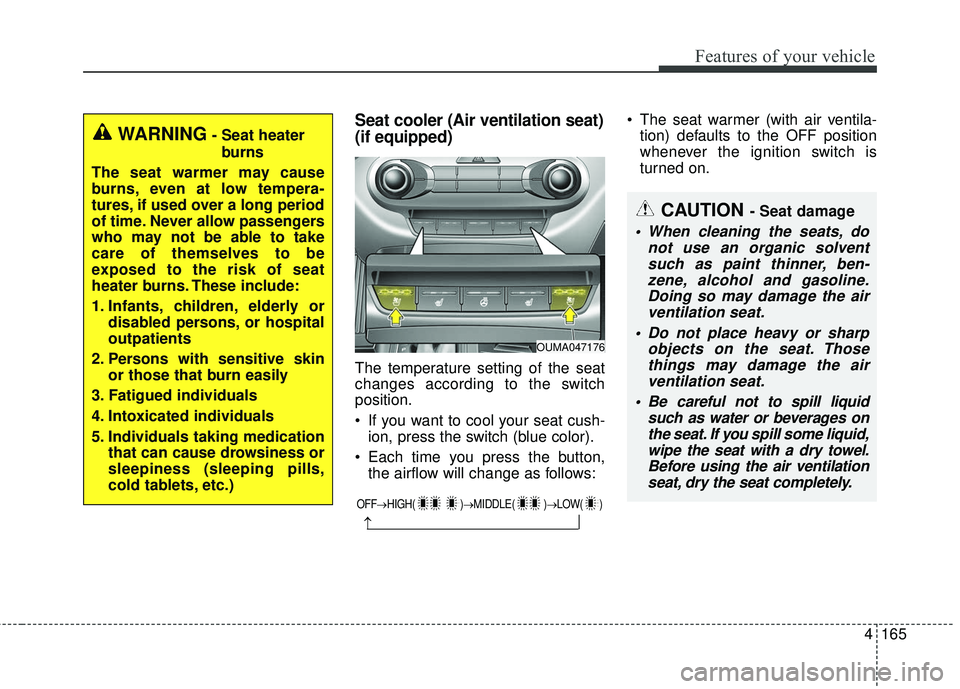
Seat cooler (Air ventilation seat)
(if equipped)
The temperature setting of the seat
changes according to the switch
position.
If you want to cool your seat cush-ion, press the switch (blue color).
Each time you press the button, the airflow will change as follows: The seat warmer (with air ventila-
tion) defaults to the OFF position
whenever the ignition switch is
turned on.
OUMA047176
OFF→ HIGH( )→ MIDDLE( )→LOW( )
→
WARNING- Seat heater
burns
The seat warmer may cause
burns, even at low tempera-
tures, if used over a long period
of time. Never allow passengers
who may not be able to take
care of themselves to be
exposed to the risk of seat
heater burns. These include:
1. Infants, children, elderly or disabled persons, or hospital
outpatients
2. Persons with sensitive skin or those that burn easily
3. Fatigued individuals
4. Intoxicated individuals
5. Individuals taking medication that can cause drowsiness or
sleepiness (sleeping pills,
cold tablets, etc.)
CAUTION - Seat damage
When cleaning the seats, donot use an organic solventsuch as paint thinner, ben-zene, alcohol and gasoline.Doing so may damage the airventilation seat.
Do not place heavy or sharp objects on the seat. Thosethings may damage the airventilation seat.
Be careful not to spill liquid such as water or beverages onthe seat. If you spill some liquid,wipe the seat with a dry towel.Before using the air ventilationseat, dry the seat completely.
Page 391 of 536
5121
Driving your vehicle
✽ ✽NOTICE
Overloading your vehicle may cause
damage. Repairs would not be cov-
ered by your warranty. Do not over-
load your vehicle.
WARNING- Loose cargo
Do not travel with unsecured
blunt objects in the passenger
compartment of your vehicle
(e.g. suit cases or unsecured
child seats). These items may
strike occupant during a sud-
den stop or crash.WARNING- Over loading
Do not overload your vehicle.
Overloading your vehicle can
cause heat buildup in your vehi-
cle's tires and possible tire fail-
ure, increased stopping dis-
tances and poor vehicle han-
dling all of which may result in a
crash.
Page 472 of 536
761
Maintenance
Traction - AA, A, B & C
The traction grades, from highest to
lowest, are AA, A, B and C. Those
grades represent the tire’s ability to
stop on wet pavement as measured
under controlled conditions on spec-
ified government test surfaces of
asphalt and concrete. A tire marked
C may have poor traction perform-
ance.
The traction grade assigned to this
tire is based on straight-ahead brak-
ing traction tests, and does not
include acceleration, cornering,
hydroplaning, or peak traction char-
acteristics.Temperature -A, B & C
The temperature grades are A (the
highest), B and C representing the
tire’s resistance to the generation of
heat and its ability to dissipate heat
when tested under controlled condi-
tions on a specified indoor laboratory
test wheel.
Sustained high temperature can
cause the material of the tire to
degenerate and reduce tire life, and
excessive temperature can lead to
sudden tire failure. Grades B and A
represent higher levels of perform-
ance on the laboratory test wheel
than the minimum required by law.
Tire terminology and definitions
Air Pressure:
The amount of air
inside the tire pressing outward on
the tire. Air pressure is expressed in
pounds per square inch (psi) or kilo-
pascal (kPa).
Accessory Weight: This means the
combined weight of optional acces-
sories. Some examples of optional
accessories are, automatic
transaxle, power seats, and air con-
ditioning.
Aspect Ratio: The relationship of a
tire's height to its width.
Belt: A rubber coated layer of cords
that is located between the plies and
the tread. Cords may be made from
steel or other reinforcing materials.
Bead: The tire bead contains steel
wires wrapped by steel cords that
hold the tire onto the rim.
Bias Ply Tire: A pneumatic tire in
which the plies are laid at alternate
angles less than 90 degrees to the
centerline of the tread.
Page 509 of 536
Maintenance
98
7
Keep paint and trim in good con-
dition
Scratches or chips in the finish
should be covered with "touch-up"
paint as soon as possible to reduce
the possibility of corrosion. If bare
metal is showing through, the atten-
tion of a qualified body and paint
shop is recommended.
Bird droppings : Bird droppings are
highly corrosive and may damage
painted surfaces in just a few hours.
Always remove bird droppings as
soon as possible.
Don't neglect the interior
Moisture can collect under the floor
mats and carpeting and cause corro-
sion. Check under the mats periodi-
cally to be sure the carpeting is dry.
Use particular care if you carry fertil-
izers, cleaning materials or chemi-
cals in the vehicle.
These should be carried only in
proper containers and any spills or
leaks should be cleaned up, flushed
with clean water and thoroughly
dried.Interior care
Interior general precautions
Prevent chemicals such as perfume,
cosmetic oil, sun cream, hand clean-
er, and air freshener from contacting
the interior parts because they may
cause damage or discoloration. If
they do contact the interior parts,
wipe them off immediately. If neces-
sary, use a vinyl cleaner, see product
instructions for correct usage.
CAUTION - Electrical
components
Never allow water or other liq-
uids to come in contact withelectrical/electronic compo-nents inside the vehicle as thismay damage them.
CAUTION - Leather
When cleaning leather products(steering wheel, seats etc.), useneutral detergents or low alco-hol content solutions. If you usehigh alcohol content solutionsor acid/alkaline detergents, thecolor of the leather may fade orthe surface may get stripped off.
Page 510 of 536
799
Maintenance
Taking care of leather seats
• Vacuum the seat periodically toremove dust and sand on the seat.
It will prevent abrasion or damage of
the leather and maintain its quality.
Wipe the natural leather seat cover often with dry or soft cloth.
Sufficient use of a leather protec- tive may prevent abrasion of the
cover and helps maintain the color.
Be sure to read the instructions
and consult a specialist when
using leather coating or protective
agents.
Leather with bright colors(beige, cream beige) is easily contaminat-
ed and clear in appearance. Clean
the seats frequently.
Avoid wiping with wet cloth. It may cause the surface to crack.
Cleaning the leather seats
Remove all contaminates instantly.Refer to instructions below for
removal of each contaminant.
Cosmetic products(sunscreen, foundation, etc.)
- Apply cleansing cream on a clothand wipe the contaminated point.
Wipe off the cream with a wet
cloth and remove water with a dry
cloth.
Beverages(coffee, soft drink, etc.) - Apply a small amount of neutraldetergent and wipe until contami-
nations do not smear.
Oil - Remove oil instantly withabsorbable cloth and wipe with
stain remover for natural leather
only.
Chewing gum - Harden the gum with ice andremove gradually.
Fabric seat cover using precau-
tions (If equipped)
Please clean the fabric seats regu-
larly with a vacuum cleaner in con-
sideration of fabric material charac-
teristics. If they are heavily soiled
with beverage stains, etc., use a suit-
able interior cleaner. To prevent dam-
age to seat covers, wipe off the seat
covers down to the seams with a
large wiping motion and moderate
pressure using a soft sponge or
microfiber cloth.
Velcro closures on clothing or sharp
objects may cause snagging or
scratches on the surface of the
seats. Make sure not to rub such
objects against the surface.
Page 517 of 536
![KIA SORENTO 2018 Owners Manual 28
DIMENSIONS Specifications & Consumer information
ENGINE
ITEM5 Seats7 Seats
Overall length [mm (in.)]4,760 (187.4)←
Overall width [mm (in.)]1,890 (74.4)←
Overall height[mm (in.)]Without Roof rac](/img/2/40477/w960_40477-516.png "KIA SORENTO 2018 Owners Manual 28
DIMENSIONS Specifications & Consumer information
ENGINE
ITEM5 Seats7 Seats
Overall length [mm (in.)]4,760 (187.4)←
Overall width [mm (in.)]1,890 (74.4)←
Overall height[mm (in.)]Without Roof rac")
28
DIMENSIONS Specifications & Consumer information
ENGINE
ITEM5 Seats7 Seats
Overall length [mm (in.)]4,760 (187.4)←
Overall width [mm (in.)]1,890 (74.4)←
Overall height[mm (in.)]Without Roof rack1,685 (66.3)←
With Roof rack1,690 (66.5)←
Tread [mm (in.)]
Front
235/65 R171,633 (64.3)←
235/60 R181,628 (64.1)←
235/55 R191,628 (64.1)←
Rear
235/65 R171,644 (64.7)←
235/60 R181,639 (64.5)←
235/55 R191,639 (64.5)←
Wheelbase [mm (in.)]2,780 (109.4)←
ITEMGasoline
Theta II 2.0 T-GDIGasoline
Theta II 2.4Gasoline
Lambda II 3.3
Displacement [cc (cu. in)]1,998 (121.92)2,359 (143.95)3,342 (203.94)
Bore x Stroke [mm (in.)]86x86 (3.39x3.39)88x97 (3.46X3.81)92x83.8
(3.62X3.29)
Firing order 1-3-4-2 1-3-4-2 1-2-3-4-5-6
No. of cylinders 4. In-line 4. In-line V - type
Page 521 of 536
68
Specifications & Consumer information
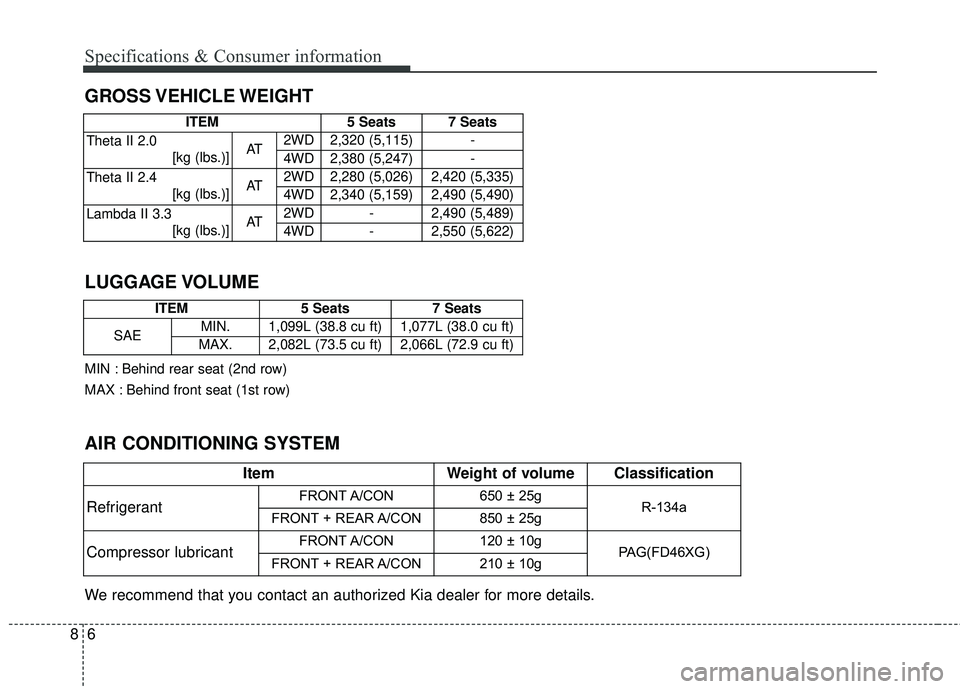
GROSS VEHICLE WEIGHT
AIR CONDITIONING SYSTEM LUGGAGE VOLUME
ItemWeight of volume Classification
Refrigerant
FRONT A/CON650 ± 25g R-134a
FRONT + REAR A/CON850 ± 25g
Compressor lubricantFRONT A/CON120 ± 10gPAG(FD46XG)FRONT + REAR A/CON210 ± 10g
We recommend that you contact an authorized Kia dealer for more details.
ITEM5 Seats7 Seats
Theta II 2.0
[kg (lbs.)]AT2WD2,320 (5,115)-
4WD2,380 (5,247)-
Theta II 2.4[kg (lbs.)]AT2WD2,280 (5,026)2,420 (5,335)
4WD2,340 (5,159)2,490 (5,490)
Lambda II 3.3[kg (lbs.)]AT2WD-2,490 (5,489)
4WD-2,550 (5,622)
ITEM5 Seats7 Seats
SAEMIN.1,099L (38.8 cu ft)1,077L (38.0 cu ft)
MAX.2,082L (73.5 cu ft)2,066L (72.9 cu ft)
MIN : Behind rear seat (2nd row)
MAX : Behind front seat (1st row)
Page 533 of 536
I7
Index
Heating and air conditioning . . . . . . . . . . . . . . . . . 4-131
System operation . . . . . . . . . . . . . . . . . . . . . . . . . . 4-137
Mirrors . . . . . . . . . . . . . . . . . . . . . . . . . . . . . . . . . . . . \
. 4-59 Inside rearview mirror . . . . . . . . . . . . . . . . . . . . . . . 4-59
Outside rearview mirror . . . . . . . . . . . . . . . . . . . . . . 4-69
Owner maintenance . . . . . . . . . . . . . . . . . . . . . . . . . . . . 7-8 Owner maintenance schedule. . . . . . . . . . . . . . . . . . . 7-8
Panoramic sunroof . . . . . . . . . . . . . . . . . . . . . . . . . . . . 4-49 Closing the sunroof . . . . . . . . . . . . . . . . . . . . . . . . . 4-54
Resetting the sunroof . . . . . . . . . . . . . . . . . . . . . . . . 4-54
Sliding the sunroof . . . . . . . . . . . . . . . . . . . . . . . . . 4-52
Sunroof open warning . . . . . . . . . . . . . . . . . . . . . . . 4-50
Sunshade. . . . . . . . . . . . . . . . . . . . . . . . . . . . . . . . . . 4-51\
Tilting the sunroof . . . . . . . . . . . . . . . . . . . . . . . . . . 4-53
Parking brake . . . . . . . . . . . . . . . . . . . . . . . . . . . . . . . . 7-40 Checking the parking brake . . . . . . . . . . . . . . . . . . . 7-40
Power liftgate . . . . . . . . . . . . . . . . . . . . . . . . . . . . . . . . 4-28 Closing the liftgate . . . . . . . . . . . . . . . . . . . . . . . . . . 4-30
Emergency liftgate safety release . . . . . . . . . . . . . . 4-38
Opening the liftgate . . . . . . . . . . . . . . . . . . . . . . . . . 4-29
Smart power liftgate . . . . . . . . . . . . . . . . . . . . . . . . . 4-34 Rear parking assist system . . . . . . . . . . . . . . . . . . . . . 4-109
Non-operational conditions of rearparking assist system . . . . . . . . . . . . . . . . . . . . . . 4-110
Operation of the rear parking assist system . . . . . . 4-109
Rear parking assist system precautions . . . . . . . . . 4-111
Self-diagnosis . . . . . . . . . . . . . . . . . . . . . . . . . . . . . 4-112
Rearview camera. . . . . . . . . . . . . . . . . . . . . . . . . . . . . 4-113
Recommended lubricants and capacities . . . . . . . . . . . . 8-7 Recommended SAE viscosity number. . . . . . . . . . . . 8-9
Road warning . . . . . . . . . . . . . . . . . . . . . . . . . . . . . . . . . 6-2 Hazard warning flasher . . . . . . . . . . . . . . . . . . . . . . . 6-2
Scheduled maintenance service . . . . . . . . . . . . . . . . . . 7-10
Seat belts . . . . . . . . . . . . . . . . . . . . . . . . . . . . . . . . . . . . \
3-25 Care of seat belts . . . . . . . . . . . . . . . . . . . . . . . . . . . 3-35
Pre-tensioner seat belt . . . . . . . . . . . . . . . . . . . . . . . 3-31
Seat belt precautions . . . . . . . . . . . . . . . . . . . . . . . . 3-33
Seat belt restraint system . . . . . . . . . . . . . . . . . . . . . 3-25
Seats . . . . . . . . . . . . . . . . . . . . . . . . . . . . . . . . . . . . \
. . . . 3-2 Driver position memory system (for power seat) . . . 3-9
Front seat adjustment - manual . . . . . . . . . . . . . . . . . 3-5
Front seat adjustment - power . . . . . . . . . . . . . . . . . . 3-6
Headrest (for front seat) . . . . . . . . . . . . . . . . . . . . . . 3-11
Headrest (for rear seat) . . . . . . . . . . . . . . . . . . . . . . 3-22
P
R
S
O