oil KIA SORENTO 2018 Workshop Manual
[x] Cancel search | Manufacturer: KIA, Model Year: 2018, Model line: SORENTO, Model: KIA SORENTO 2018Pages: 536, PDF Size: 13.42 MB
Page 491 of 536
![KIA SORENTO 2018 Workshop Manual Maintenance
80
7
DescriptionFuse ratingProtected component
POWER
OUTLET 3 20ARear Power Outlet
SENSOR 1 20A[G4KJ/G4KH] Ignition Coil #1/#2/#3/#4 [G6DF] Ignition Coil #1/#2/#3/#4/#\
5/#6, Condecser #](/img/2/40477/w960_40477-490.png "KIA SORENTO 2018 Workshop Manual Maintenance
80
7
DescriptionFuse ratingProtected component
POWER
OUTLET 3 20ARear Power Outlet
SENSOR 1 20A[G4KJ/G4KH] Ignition Coil #1/#2/#3/#4 [G6DF] Ignition Coil #1/#2/#3/#4/#\
5/#6, Condecser #")
Maintenance
80
7
DescriptionFuse ratingProtected component
POWER
OUTLET 3 20ARear Power Outlet
SENSOR 1 20A[G4KJ/G4KH] Ignition Coil #1/#2/#3/#4 [G6DF] Ignition Coil #1/#2/#3/#4/#\
5/#6, Condecser #1/#2
SENSOR 3 10A[G4KJ/G4KH] Fuel Pump Relay [G6DF] Fuel Pump Relay, PCM
POWER
OUTLET 4 20ALuggage Power Outlet
REAR
HEATED 40ARear Defogger Relay
SENSOR 2 10A
[G4KJ/G4KH] E/R Junction Block (Cooling Fan 1 Relay), Oil Control Valve (Exhaust), Purge Control Solenoid Valve, Canister Close Valve, Variable Intake Solenoid Valve, RCV Control Solenoid Valve (G4KH)
[G6DH] E/R Junction Block (Cooling Fan 1 Relay), Variable Intake Solenoid Valve #1/#2, Purge Control Solenoid Valve, Oil Control Valve #1/#2/#3/#4 (Intake/Exhaust), PCM, Canister close valve
FUEL PUMP 20AFuel Pump Relay
HORN 15AHorn Relay
B/ALARMHORN 10ABurglar Alarm Horn Relay
Page 495 of 536
Maintenance
84
7
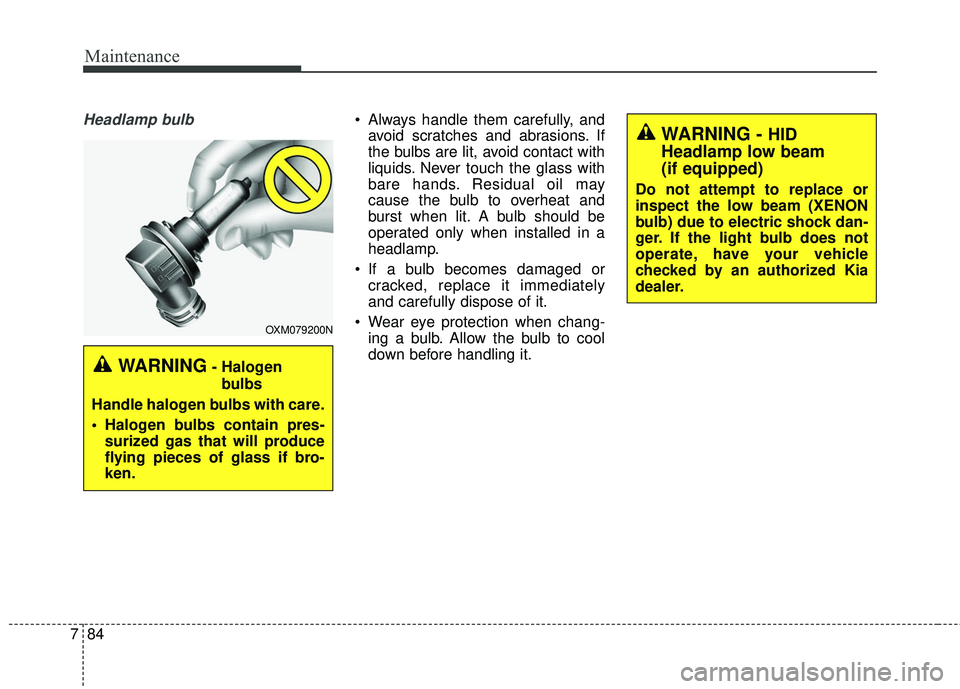
Headlamp bulb Always handle them carefully, and
avoid scratches and abrasions. If
the bulbs are lit, avoid contact with
liquids. Never touch the glass with
bare hands. Residual oil may
cause the bulb to overheat and
burst when lit. A bulb should be
operated only when installed in a
headlamp.
If a bulb becomes damaged or cracked, replace it immediately
and carefully dispose of it.
Wear eye protection when chang- ing a bulb. Allow the bulb to cool
down before handling it.
WARNING - HID
Headlamp low beam
(if equipped)
Do not attempt to replace or
inspect the low beam (XENON
bulb) due to electric shock dan-
ger. If the light bulb does not
operate, have your vehicle
checked by an authorized Kia
dealer.
OXM079200N
WARNING- Halogen
bulbs
Handle halogen bulbs with care.
Halogen bulbs contain pres- surized gas that will produce
flying pieces of glass if bro-
ken.
Page 501 of 536
Maintenance
90
7
1. Open the liftgate.
2. Remove the service cover.
3. Remove the socket from the
assembly by turning the socket
counterclockwise until the tabs on
the socket align with the slots on
the assembly.
4. Remove the bulb from the socket by pressing it in and rotating it
counterclockwise until the tabs on
the bulb align with the slots in the
socket. Pull the bulb out of the
socket.
5. Insert a new bulb by inserting it into the socket and rotating it until
it locks into place.
6. Install the socket in the assembly by aligning the tabs on the socket
with the slots in the assembly.
Push the socket into the assembly
and turn the socket clockwise.
7. Install the service cover by putting it into the service hole.
* If your vehicle is equipped with LED type stop and tail lamps replace
with LED assembled units. Please
contact an authorized Kia dealer.High mounted stop lamp
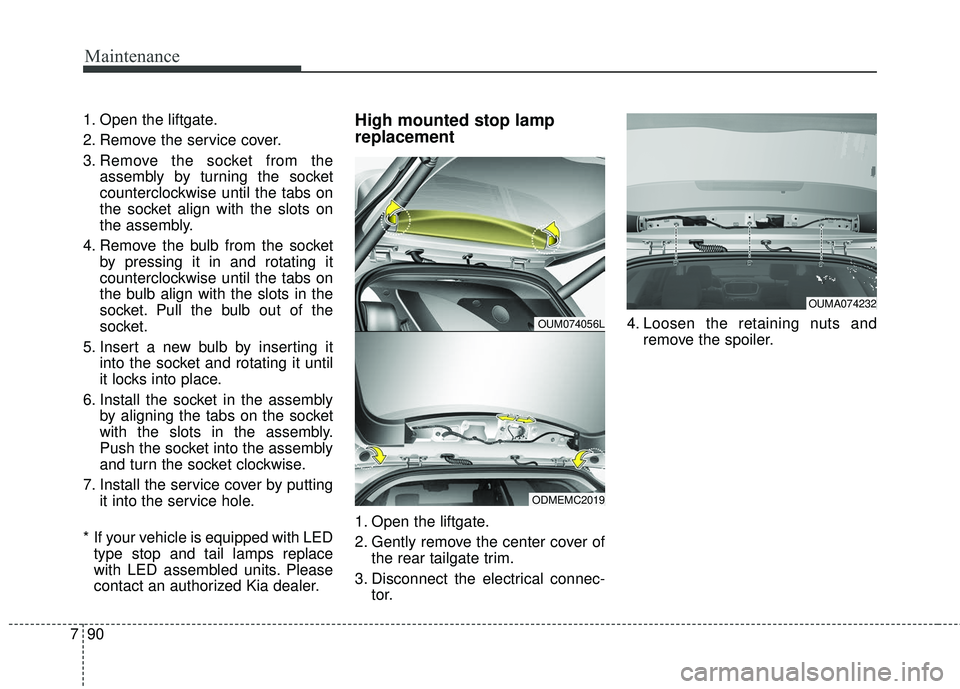
replacement
1. Open the liftgate.
2. Gently remove the center cover of the rear tailgate trim.
3. Disconnect the electrical connec- tor. 4. Loosen the retaining nuts and
remove the spoiler.
OUM074056L
ODMEMC2019
OUMA074232
Page 505 of 536
Maintenance
94
7
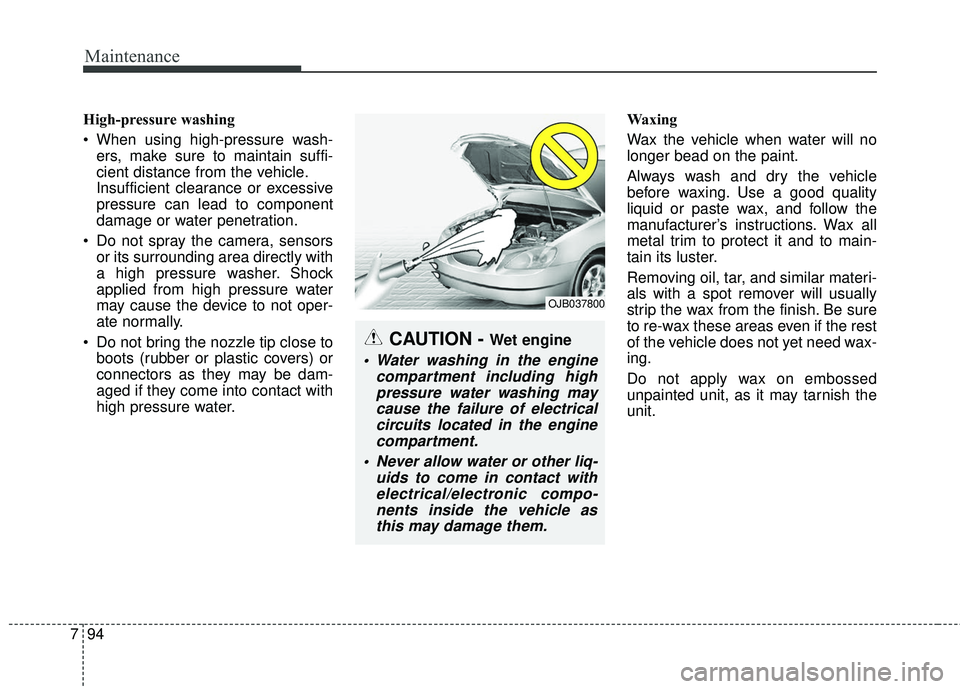
High-pressure washing
When using high-pressure wash-
ers, make sure to maintain suffi-
cient distance from the vehicle.
Insufficient clearance or excessive
pressure can lead to component
damage or water penetration.
Do not spray the camera, sensors or its surrounding area directly with
a high pressure washer. Shock
applied from high pressure water
may cause the device to not oper-
ate normally.
Do not bring the nozzle tip close to boots (rubber or plastic covers) or
connectors as they may be dam-
aged if they come into contact with
high pressure water. Waxing
Wax the vehicle when water will no
longer bead on the paint.
Always wash and dry the vehicle
before waxing. Use a good quality
liquid or paste wax, and follow the
manufacturer’s instructions. Wax all
metal trim to protect it and to main-
tain its luster.
Removing oil, tar, and similar materi-
als with a spot remover will usually
strip the wax from the finish. Be sure
to re-wax these areas even if the rest
of the vehicle does not yet need wax-
ing.
Do not apply wax on embossed
unpainted unit, as it may tarnish the
unit.
CAUTION - Wet engine
Water washing in the engine
compartment including highpressure water washing maycause the failure of electricalcircuits located in the enginecompartment.
Never allow water or other liq- uids to come in contact withelectrical/electronic compo-nents inside the vehicle asthis may damage them.
OJB037800
Page 509 of 536
Maintenance
98
7
Keep paint and trim in good con-
dition
Scratches or chips in the finish
should be covered with "touch-up"
paint as soon as possible to reduce
the possibility of corrosion. If bare
metal is showing through, the atten-
tion of a qualified body and paint
shop is recommended.
Bird droppings : Bird droppings are
highly corrosive and may damage
painted surfaces in just a few hours.
Always remove bird droppings as
soon as possible.
Don't neglect the interior
Moisture can collect under the floor
mats and carpeting and cause corro-
sion. Check under the mats periodi-
cally to be sure the carpeting is dry.
Use particular care if you carry fertil-
izers, cleaning materials or chemi-
cals in the vehicle.
These should be carried only in
proper containers and any spills or
leaks should be cleaned up, flushed
with clean water and thoroughly
dried.Interior care
Interior general precautions
Prevent chemicals such as perfume,
cosmetic oil, sun cream, hand clean-
er, and air freshener from contacting
the interior parts because they may
cause damage or discoloration. If
they do contact the interior parts,
wipe them off immediately. If neces-
sary, use a vinyl cleaner, see product
instructions for correct usage.
CAUTION - Electrical
components
Never allow water or other liq-
uids to come in contact withelectrical/electronic compo-nents inside the vehicle as thismay damage them.
CAUTION - Leather
When cleaning leather products(steering wheel, seats etc.), useneutral detergents or low alco-hol content solutions. If you usehigh alcohol content solutionsor acid/alkaline detergents, thecolor of the leather may fade orthe surface may get stripped off.
Page 510 of 536
799
Maintenance
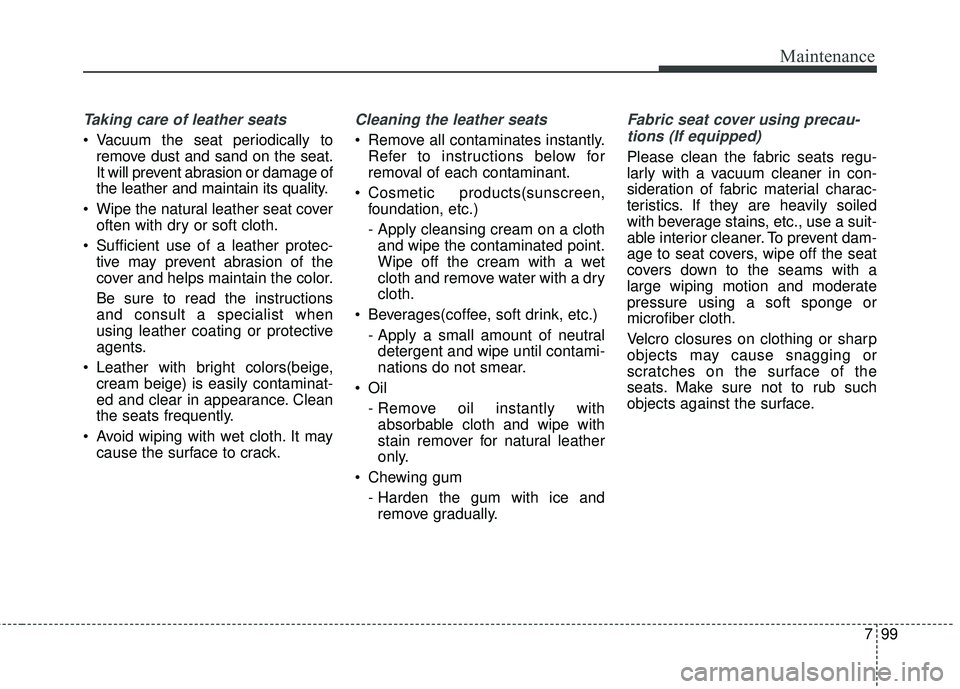
Taking care of leather seats
• Vacuum the seat periodically toremove dust and sand on the seat.
It will prevent abrasion or damage of
the leather and maintain its quality.
Wipe the natural leather seat cover often with dry or soft cloth.
Sufficient use of a leather protec- tive may prevent abrasion of the
cover and helps maintain the color.
Be sure to read the instructions
and consult a specialist when
using leather coating or protective
agents.
Leather with bright colors(beige, cream beige) is easily contaminat-
ed and clear in appearance. Clean
the seats frequently.
Avoid wiping with wet cloth. It may cause the surface to crack.
Cleaning the leather seats
Remove all contaminates instantly.Refer to instructions below for
removal of each contaminant.
Cosmetic products(sunscreen, foundation, etc.)
- Apply cleansing cream on a clothand wipe the contaminated point.
Wipe off the cream with a wet
cloth and remove water with a dry
cloth.
Beverages(coffee, soft drink, etc.) - Apply a small amount of neutraldetergent and wipe until contami-
nations do not smear.
Oil - Remove oil instantly withabsorbable cloth and wipe with
stain remover for natural leather
only.
Chewing gum - Harden the gum with ice andremove gradually.
Fabric seat cover using precau-
tions (If equipped)
Please clean the fabric seats regu-
larly with a vacuum cleaner in con-
sideration of fabric material charac-
teristics. If they are heavily soiled
with beverage stains, etc., use a suit-
able interior cleaner. To prevent dam-
age to seat covers, wipe off the seat
covers down to the seams with a
large wiping motion and moderate
pressure using a soft sponge or
microfiber cloth.
Velcro closures on clothing or sharp
objects may cause snagging or
scratches on the surface of the
seats. Make sure not to rub such
objects against the surface.
Page 511 of 536
Maintenance
100
7
Cleaning the upholstery and inte-
rior trim
Vinyl
Remove dust and loose dirt from
vinyl with a whisk broom or vacuum
cleaner. Clean vinyl surfaces with a
vinyl cleaner.
Fabric
Remove dust and loose dirt from fab-
ric with a whisk broom or vacuum
cleaner. Clean with a mild soap solu-
tion recommended for upholstery or
carpets. Remove fresh spots imme-
diately with a fabric spot cleaner. If
fresh spots do not receive immediate
attention, the fabric can be stained
and its color can be affected. Also, its
fire-resistant properties can be
reduced if the material is not proper-
ly maintained.
Using anything but recommended
cleaners and procedures may affect
the fabric’s appearance and fire-
resistant properties.
Cleaning the lap/shoulder beltwebbing
Clean the belt webbing with any mild
soap solution recommended for
cleaning upholstery or carpet. Follow
the instructions provided with the
soap. Do not bleach or re-dye the
webbing because this may weaken
it.
Cleaning the interior windowglass
If the interior glass surfaces of the
vehicle become fogged (that is, cov-
ered with an oily, greasy or waxy
film), they should be cleaned with a
glass cleaner. Follow the directions
on the glass cleaner container.
CAUTION - Rear window
Do not scrape or scratch theinside of the rear window. Thismay result in damage of the rearwindow defroster grid.
Page 522 of 536
87
Specifications & Consumer information
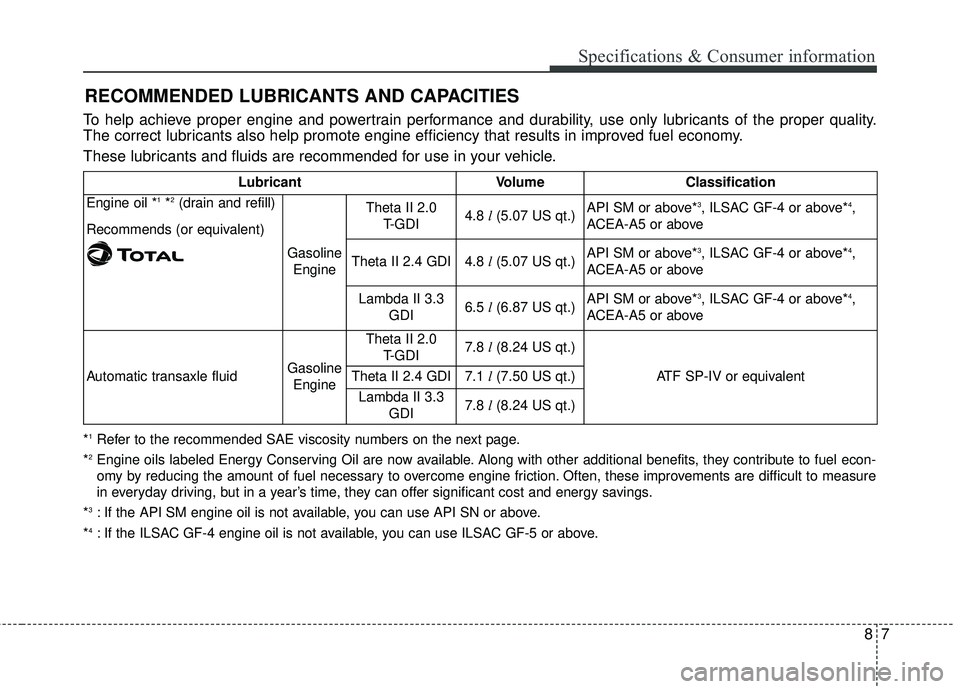
RECOMMENDED LUBRICANTS AND CAPACITIES
To help achieve proper engine and powertrain performance and durability, use only lubricants of the proper quality.
The correct lubricants also help promote engine efficiency that results in improved fuel economy.
These lubricants and fluids are recommended for use in your vehicle.
Lubricant VolumeClassification
Engine oil *1*2(drain and refill)
Recommends (or equivalent)
Gasoline Engine
Theta II 2.0 T-GDI4.8 l(5.07 US qt.)API SM or above*3, ILSAC GF-4 or above*4,
ACEA-A5 or above
Theta II 2.4 GDI4.8 l(5.07 US qt.)API SM or above*3, ILSAC GF-4 or above*4,
ACEA-A5 or above
Lambda II 3.3 GDI6.5 l(6.87 US qt.)API SM or above*3, ILSAC GF-4 or above*4,
ACEA-A5 or above
Automatic transaxle fluidGasoline Engine
Theta II 2.0 T-GDI7.8 l(8.24 US qt.)
ATF SP-IV or equivalentTheta II 2.4 GDI7.1 l(7.50 US qt.)
Lambda II 3.3
GDI7.8 l(8.24 US qt.)
*1Refer to the recommended SAE viscosity numbers on the next page.
*
2Engine oils labeled Energy Conserving Oil are now available. Along with other additional benefits, they contribute to fuel econ-
omy by reducing the amount of fuel necessary to overcome engine friction. Often, these improvements are difficult to measure
in everyday driving, but in a year’s time, they can offer significant cost and energy savings.
*
3: If the API SM engine oil is not available, you can use API SN or above.
*
4: If the ILSAC GF-4 engine oil is not available, you can use ILSAC GF-5 or above.
Page 523 of 536
88
Specifications & Consumer information
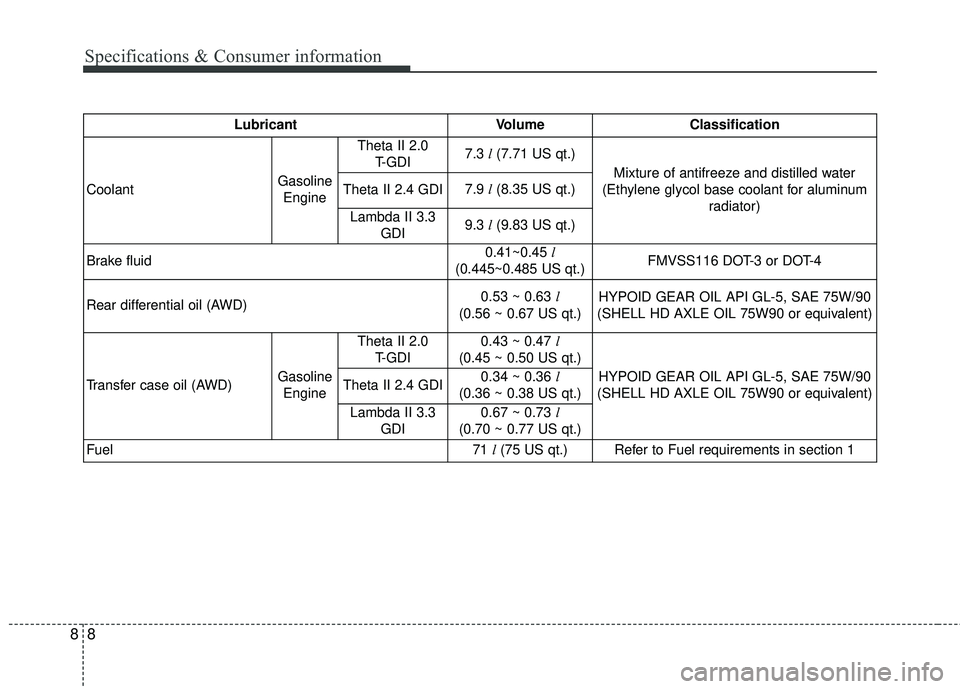
Lubricant VolumeClassification
CoolantGasolineEngine
Theta II 2.0 T-GDI7.3 l(7.71 US qt.)
Mixture of antifreeze and distilled water
(Ethylene glycol base coolant for aluminum radiator)
Theta II 2.4 GDI7.9 l(8.35 US qt.)
Lambda II 3.3
GDI9.3 l(9.83 US qt.)
Brake fluid0.41~0.45 l
(0.445~0.485 US qt.)FMVSS116 DOT-3 or DOT-4
Rear differential oil (AWD)0.53 ~ 0.63 l
(0.56 ~ 0.67 US qt.)HYPOID GEAR OIL API GL-5, SAE 75W/90
(SHELL HD AXLE OIL 75W90 or equivalent)
Transfer case oil (AWD)Gasoline Engine
Theta II 2.0 T-GDI0.43 ~ 0.47 l
(0.45 ~ 0.50 US qt.)
HYPOID GEAR OIL API GL-5, SAE 75W/90
(SHELL HD AXLE OIL 75W90 or equivalent)Theta II 2.4 GDI0.34 ~ 0.36 l
(0.36 ~ 0.38 US qt.)
Lambda II 3.3 GDI0.67 ~ 0.73 l
(0.70 ~ 0.77 US qt.)
Fuel71 l(75 US qt.)Refer to Fuel requirements in section 1
Page 524 of 536
89
Specifications & Consumer information
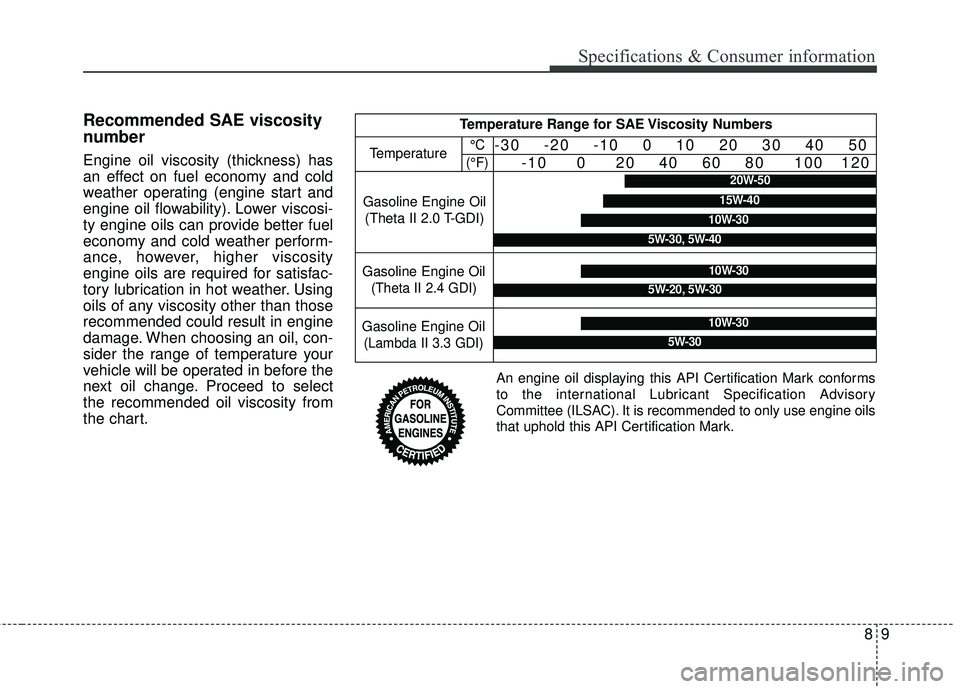
Recommended SAE viscosity
number
Engine oil viscosity (thickness) has
an effect on fuel economy and cold
weather operating (engine start and
engine oil flowability). Lower viscosi-
ty engine oils can provide better fuel
economy and cold weather perform-
ance, however, higher viscosity
engine oils are required for satisfac-
tory lubrication in hot weather. Using
oils of any viscosity other than those
recommended could result in engine
damage. When choosing an oil, con-
sider the range of temperature your
vehicle will be operated in before the
next oil change. Proceed to select
the recommended oil viscosity from
the chart.
Temperature Range for SAE Viscosity Numbers
Temperature°C
(°F)-30 -20 -10 0 10 20 30 40 50 -10 0 20 40 60 80 100 120
Gasoline Engine Oil
(Theta II 2.0 T-GDI)
20W-50
10W-30
15W-40
5W-30, 5W-40
An engine oil displaying this API Certification Mark conforms
to the international Lubricant Specification Advisory
Committee (ILSAC). It is recommended to only use engine oils
that uphold this API Certification Mark.
Gasoline Engine Oil (
Theta II 2.4 GDI)
10W-30
5W-20, 5W-30
Gasoline Engine Oil(
Lambda II 3.3 GDI)
10W-30
5W-30