belt KIA SORENTO 2018 Repair Manual
[x] Cancel search | Manufacturer: KIA, Model Year: 2018, Model line: SORENTO, Model: KIA SORENTO 2018Pages: 536, PDF Size: 13.42 MB
Page 433 of 536
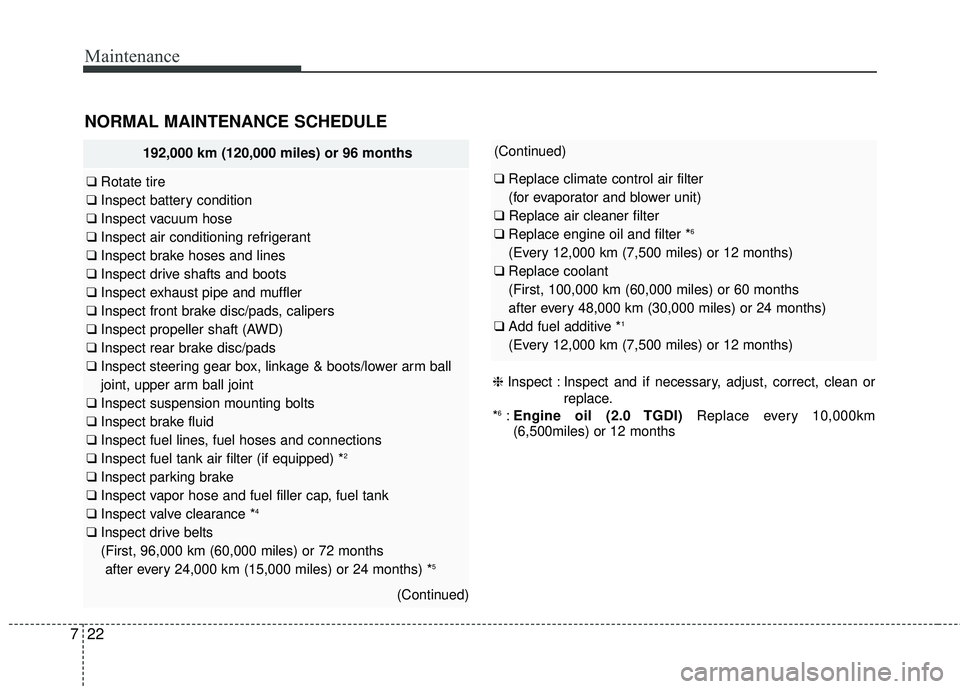
Maintenance
22
7
(Continued)
❑ Replace climate control air filter
(for evaporator and blower unit)
❑ Replace air cleaner filter
❑ Replace engine oil and filter *
6
(Every 12,000 km (7,500 miles) or 12 months)
❑ Replace coolant
(First, 100,000 km (60,000 miles) or 60 months
after every 48,000 km (30,000 miles) or 24 months)
❑ Add fuel additive *
1
(Every 12,000 km (7,500 miles) or 12 months)
❈ Inspect : Inspect and if necessary, adjust, correct, clean or
replace.
*
6: Engine oil (2.0 TGDI) Replace every 10,000km
(6,500miles) or 12 months
192,000 km (120,000 miles) or 96 months
❑ Rotate tire
❑ Inspect battery condition
❑ Inspect vacuum hose
❑ Inspect air conditioning refrigerant
❑ Inspect brake hoses and lines
❑ Inspect drive shafts and boots
❑ Inspect exhaust pipe and muffler
❑ Inspect front brake disc/pads, calipers
❑ Inspect propeller shaft (AWD)
❑ Inspect rear brake disc/pads
❑ Inspect steering gear box, linkage & boots/lower arm ball
joint, upper arm ball joint
❑ Inspect suspension mounting bolts
❑ Inspect brake fluid
❑ Inspect fuel lines, fuel hoses and connections
❑ Inspect fuel tank air filter (if equipped) *
2
❑Inspect parking brake
❑ Inspect vapor hose and fuel filler cap, fuel tank
❑ Inspect valve clearance *
4
❑Inspect drive belts
(First, 96,000 km (60,000 miles) or 72 months
after every 24,000 km (15,000 miles) or 24 months) *
5
(Continued)
NORMAL MAINTENANCE SCHEDULE
Page 435 of 536
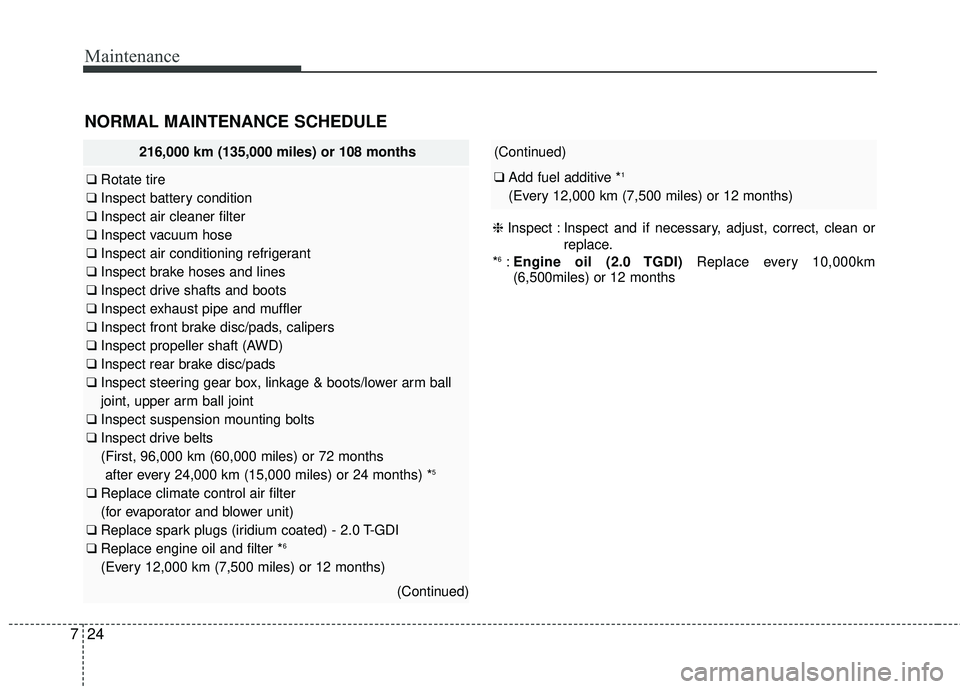
Maintenance
24
7
(Continued)
❑ Add fuel additive *1
(Every 12,000 km (7,500 miles) or 12 months)
❈ Inspect : Inspect and if necessary, adjust, correct, clean or
replace.
*
6: Engine oil (2.0 TGDI) Replace every 10,000km
(6,500miles) or 12 months
NORMAL MAINTENANCE SCHEDULE
216,000 km (135,000 miles) or 108 months
❑ Rotate tire
❑ Inspect battery condition
❑ Inspect air cleaner filter
❑ Inspect vacuum hose
❑ Inspect air conditioning refrigerant
❑ Inspect brake hoses and lines
❑ Inspect drive shafts and boots
❑ Inspect exhaust pipe and muffler
❑ Inspect front brake disc/pads, calipers
❑ Inspect propeller shaft (AWD)
❑ Inspect rear brake disc/pads
❑ Inspect steering gear box, linkage & boots/lower arm ball
joint, upper arm ball joint
❑ Inspect suspension mounting bolts
❑ Inspect drive belts
(First, 96,000 km (60,000 miles) or 72 months
after every 24,000 km (15,000 miles) or 24 months) *
5
❑ Replace climate control air filter
(for evaporator and blower unit)
❑ Replace spark plugs (iridium coated) - 2.0 T-GDI
❑ Replace engine oil and filter *
6
(Every 12,000 km (7,500 miles) or 12 months)
(Continued)
Page 437 of 536
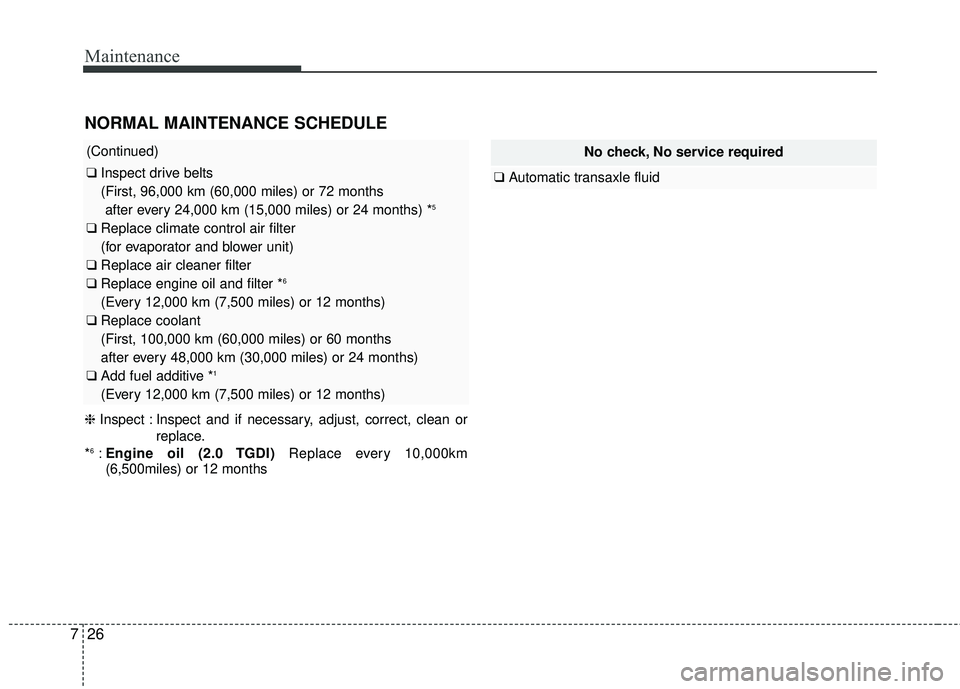
Maintenance
26
7
NORMAL MAINTENANCE SCHEDULE
No check, No service required
❑ Automatic transaxle fluid
(Continued)
❑Inspect drive belts
(First, 96,000 km (60,000 miles) or 72 months
after every 24,000 km (15,000 miles) or 24 months) *
5
❑ Replace climate control air filter
(for evaporator and blower unit)
❑ Replace air cleaner filter
❑ Replace engine oil and filter *
6
(Every 12,000 km (7,500 miles) or 12 months)
❑ Replace coolant
(First, 100,000 km (60,000 miles) or 60 months
after every 48,000 km (30,000 miles) or 24 months)
❑ Add fuel additive *
1
(Every 12,000 km (7,500 miles) or 12 months)
❈ Inspect : Inspect and if necessary, adjust, correct, clean or
replace.
*
6: Engine oil (2.0 TGDI) Replace every 10,000km
(6,500miles) or 12 months
Page 440 of 536
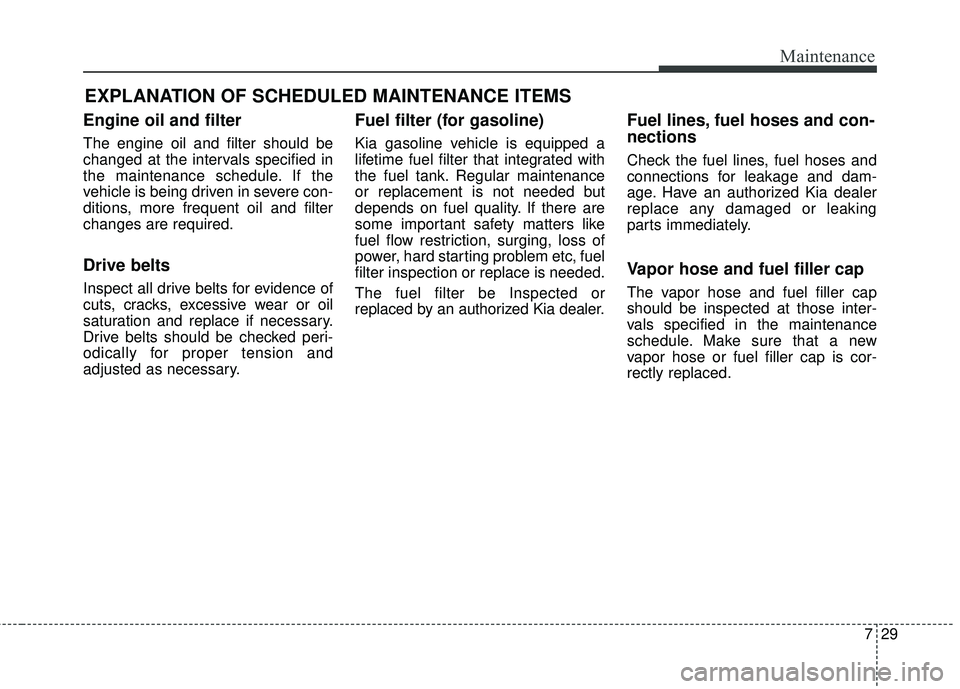
729
Maintenance
EXPLANATION OF SCHEDULED MAINTENANCE ITEMS
Engine oil and filter
The engine oil and filter should be
changed at the intervals specified in
the maintenance schedule. If the
vehicle is being driven in severe con-
ditions, more frequent oil and filter
changes are required.
Drive belts
Inspect all drive belts for evidence of
cuts, cracks, excessive wear or oil
saturation and replace if necessary.
Drive belts should be checked peri-
odically for proper tension and
adjusted as necessary.
Fuel filter (for gasoline)
Kia gasoline vehicle is equipped a
lifetime fuel filter that integrated with
the fuel tank. Regular maintenance
or replacement is not needed but
depends on fuel quality. If there are
some important safety matters like
fuel flow restriction, surging, loss of
power, hard starting problem etc, fuel
filter inspection or replace is needed.
The fuel filter be Inspected or
replaced by an authorized Kia dealer.
Fuel lines, fuel hoses and con-
nections
Check the fuel lines, fuel hoses and
connections for leakage and dam-
age. Have an authorized Kia dealer
replace any damaged or leaking
parts immediately.
Vapor hose and fuel filler cap
The vapor hose and fuel filler cap
should be inspected at those inter-
vals specified in the maintenance
schedule. Make sure that a new
vapor hose or fuel filler cap is cor-
rectly replaced.
Page 444 of 536
733
Maintenance
Power steering pump, belt and
hoses (if equipped)
Check the power steering pump and
hoses for leakage and damage.
Replace any damaged or leaking
parts immediately. Inspect the power
steering belt (or drive belt) for evi-
dence of cuts, cracks, excessive
wear, oiliness and proper tension.
Replace or adjust it if necessary.
Drive shafts and boots
Check the drive shafts, boots and
clamps for cracks, deterioration, or
damage. Replace any damaged
parts and, if necessary, repack the
grease.
Air conditioning refrigerant
Check the air conditioning lines and
connections for leakage and dam-
age.When checking engine oil, engine
coolant, brake fluid, and washer fluid,
always be sure to clean the area
around any filler plug, drain plug, or
dipstick before checking or draining
any lubricant or fluid. This is espe-
cially important in dusty or sandy
areas and when the vehicle is used
on unpaved roads. Cleaning the plug
and dipstick areas will prevent dirt
and grit from entering the engine and
other mechanisms that could be
damaged.
CHECKING FLUID LEVELS
Page 471 of 536
Maintenance
60
7
4. Tire ply composition and mate-
rial
The number of layers or plies of rub-
ber-coated fabric in the tire. Tire
manufacturers also must indicate the
materials in the tire, which include
steel, nylon, polyester, and others.
The letter "R" means radial ply con-
struction; the letter "D" means diago-
nal or bias ply construction; and the
letter "B" means belted-bias ply con-
struction.
5. Maximum permissible inflationpressure
This number is the greatest amount
of air pressure that should be put in
the tire. Do not exceed the maximum
permissible inflation pressure. Refer
to the Tire and Loading Information
label for recommended inflation
pressure.
6. Maximum load rating
This number indicates the maximum
load in kilograms and pounds that
can be carried by the tire. When
replacing the tires on the vehicle,
always use a tire that has the same
load rating as the factory installed
tire.
7. Uniform tire quality grading
Quality grades can be found where
applicable on the tire sidewall
between tread shoulder and maxi-
mum chapter width.
For example:
TREADWEAR 200
TRACTION AA
TEMPERATURE A
Tires degrade over time, even when
they are not being used. Regardless
of the remaining tread, we recom-
mend that tires be replaced after
approximately six (6) years of normal
service. Heat caused by hot climates
or frequent high loading conditions
can accelerate the aging process. Tread wear
The tread wear grade is a compara-
tive rating based on the wear rate of
the tire when tested under controlled
conditions on a specified govern-
ment test course. For example, a tire
graded 150 would wear one-and-a-
half times (1½) as well on the gov-
ernment course as a tire graded 100.
The relative performance of tires
depends upon the actual conditions
of their use, however, and may
depart significantly from the norm
due to variations in driving habits,
service practices and differences in
road characteristics and climate.
These grades are molded on the
side-walls of passenger vehicle tires.
The tires available as standard or
optional equipment on your vehicle
may vary with respect to grade.
Page 472 of 536
761
Maintenance
Traction - AA, A, B & C
The traction grades, from highest to
lowest, are AA, A, B and C. Those
grades represent the tire’s ability to
stop on wet pavement as measured
under controlled conditions on spec-
ified government test surfaces of
asphalt and concrete. A tire marked
C may have poor traction perform-
ance.
The traction grade assigned to this
tire is based on straight-ahead brak-
ing traction tests, and does not
include acceleration, cornering,
hydroplaning, or peak traction char-
acteristics.Temperature -A, B & C
The temperature grades are A (the
highest), B and C representing the
tire’s resistance to the generation of
heat and its ability to dissipate heat
when tested under controlled condi-
tions on a specified indoor laboratory
test wheel.
Sustained high temperature can
cause the material of the tire to
degenerate and reduce tire life, and
excessive temperature can lead to
sudden tire failure. Grades B and A
represent higher levels of perform-
ance on the laboratory test wheel
than the minimum required by law.
Tire terminology and definitions
Air Pressure:
The amount of air
inside the tire pressing outward on
the tire. Air pressure is expressed in
pounds per square inch (psi) or kilo-
pascal (kPa).
Accessory Weight: This means the
combined weight of optional acces-
sories. Some examples of optional
accessories are, automatic
transaxle, power seats, and air con-
ditioning.
Aspect Ratio: The relationship of a
tire's height to its width.
Belt: A rubber coated layer of cords
that is located between the plies and
the tread. Cords may be made from
steel or other reinforcing materials.
Bead: The tire bead contains steel
wires wrapped by steel cords that
hold the tire onto the rim.
Bias Ply Tire: A pneumatic tire in
which the plies are laid at alternate
angles less than 90 degrees to the
centerline of the tread.
Page 475 of 536
Maintenance
64
7
All season tires
Kia specifies all season tires on
some models to provide good per-
formance for use all year round,
including snowy and icy road condi-
tions. All season tires are identified
by ALL SEASON and/or M+S (Mud
and Snow) on the tire sidewall. Snow
tires have better snow traction than
all season tires and may be more
appropriate in some areas.
Summer tires
Kia specifies summer tires on some
models to provide superior perform-
ance on dry roads. Summer tire per-
formance is substantially reduced in
snow and ice. Summer tires do not
have the tire traction rating M+S
(Mud and Snow) on the tire side wall.
if you plan to operate your vehicle in
snowy or icy conditions, Kia recom-
mends the use of snow tires or all
season tires on all four wheels.
Snow tires
If you equip your vehicle with snow
tires, they should be the same size
and have the same load capacity as
the original tires. Snow tires should
be installed on all four wheels; other-
wise, poor handling may result.
Snow tires should carry 28 kPa (4 psi
) more air pressure than the pressure
recommended for the standard tires
on the tire label on the driver's side of
the center pillar, or up to the maxi-
mum pressure shown on the tire
sidewall, whichever is less.
Do not drive faster than 120 km/h (75
mph) when your vehicle is equipped
with snow tires.
Radial-ply tires
Radial-ply tires provide improved
tread life, road hazard resistance and
smoother high speed ride. The radi-
al-ply tires used on this vehicle are of
belted construction, and are selected
to complement the ride and handling
characteristics of your vehicle.
Radial-ply tires have the same load
carrying capacity, as bias-ply or bias
belted tires of the same size, and use
the same recommended inflation
pressure. Mixing of radial-ply tires
with bias-ply or bias belted tires is
not recommended. Any combina-
tions of radial-ply and bias-ply or bias
belted tires when used on the same
vehicle will seriously deteriorate
vehicle handling. The best rule to fol-
low is: Identical radial-ply tires should
always be used as a set of four.
Page 511 of 536
Maintenance
100
7
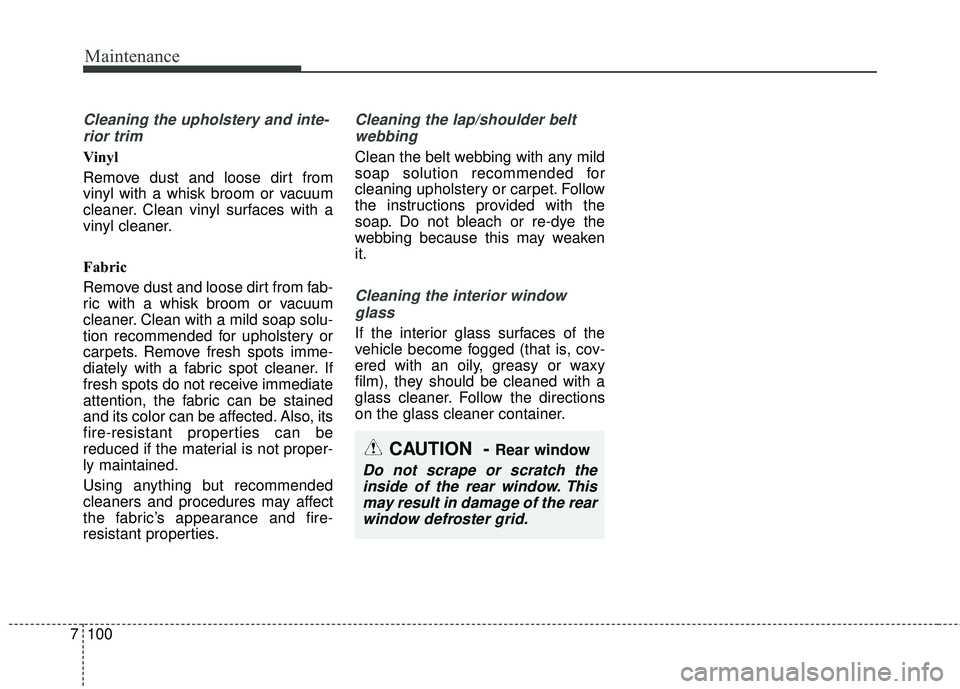
Cleaning the upholstery and inte-
rior trim
Vinyl
Remove dust and loose dirt from
vinyl with a whisk broom or vacuum
cleaner. Clean vinyl surfaces with a
vinyl cleaner.
Fabric
Remove dust and loose dirt from fab-
ric with a whisk broom or vacuum
cleaner. Clean with a mild soap solu-
tion recommended for upholstery or
carpets. Remove fresh spots imme-
diately with a fabric spot cleaner. If
fresh spots do not receive immediate
attention, the fabric can be stained
and its color can be affected. Also, its
fire-resistant properties can be
reduced if the material is not proper-
ly maintained.
Using anything but recommended
cleaners and procedures may affect
the fabric’s appearance and fire-
resistant properties.
Cleaning the lap/shoulder beltwebbing
Clean the belt webbing with any mild
soap solution recommended for
cleaning upholstery or carpet. Follow
the instructions provided with the
soap. Do not bleach or re-dye the
webbing because this may weaken
it.
Cleaning the interior windowglass
If the interior glass surfaces of the
vehicle become fogged (that is, cov-
ered with an oily, greasy or waxy
film), they should be cleaned with a
glass cleaner. Follow the directions
on the glass cleaner container.
CAUTION - Rear window
Do not scrape or scratch theinside of the rear window. Thismay result in damage of the rearwindow defroster grid.
Page 533 of 536
I7
Index
Heating and air conditioning . . . . . . . . . . . . . . . . . 4-131
System operation . . . . . . . . . . . . . . . . . . . . . . . . . . 4-137
Mirrors . . . . . . . . . . . . . . . . . . . . . . . . . . . . . . . . . . . . \
. 4-59 Inside rearview mirror . . . . . . . . . . . . . . . . . . . . . . . 4-59
Outside rearview mirror . . . . . . . . . . . . . . . . . . . . . . 4-69
Owner maintenance . . . . . . . . . . . . . . . . . . . . . . . . . . . . 7-8 Owner maintenance schedule. . . . . . . . . . . . . . . . . . . 7-8
Panoramic sunroof . . . . . . . . . . . . . . . . . . . . . . . . . . . . 4-49 Closing the sunroof . . . . . . . . . . . . . . . . . . . . . . . . . 4-54
Resetting the sunroof . . . . . . . . . . . . . . . . . . . . . . . . 4-54
Sliding the sunroof . . . . . . . . . . . . . . . . . . . . . . . . . 4-52
Sunroof open warning . . . . . . . . . . . . . . . . . . . . . . . 4-50
Sunshade. . . . . . . . . . . . . . . . . . . . . . . . . . . . . . . . . . 4-51\
Tilting the sunroof . . . . . . . . . . . . . . . . . . . . . . . . . . 4-53
Parking brake . . . . . . . . . . . . . . . . . . . . . . . . . . . . . . . . 7-40 Checking the parking brake . . . . . . . . . . . . . . . . . . . 7-40
Power liftgate . . . . . . . . . . . . . . . . . . . . . . . . . . . . . . . . 4-28 Closing the liftgate . . . . . . . . . . . . . . . . . . . . . . . . . . 4-30
Emergency liftgate safety release . . . . . . . . . . . . . . 4-38
Opening the liftgate . . . . . . . . . . . . . . . . . . . . . . . . . 4-29
Smart power liftgate . . . . . . . . . . . . . . . . . . . . . . . . . 4-34 Rear parking assist system . . . . . . . . . . . . . . . . . . . . . 4-109
Non-operational conditions of rearparking assist system . . . . . . . . . . . . . . . . . . . . . . 4-110
Operation of the rear parking assist system . . . . . . 4-109
Rear parking assist system precautions . . . . . . . . . 4-111
Self-diagnosis . . . . . . . . . . . . . . . . . . . . . . . . . . . . . 4-112
Rearview camera. . . . . . . . . . . . . . . . . . . . . . . . . . . . . 4-113
Recommended lubricants and capacities . . . . . . . . . . . . 8-7 Recommended SAE viscosity number. . . . . . . . . . . . 8-9
Road warning . . . . . . . . . . . . . . . . . . . . . . . . . . . . . . . . . 6-2 Hazard warning flasher . . . . . . . . . . . . . . . . . . . . . . . 6-2
Scheduled maintenance service . . . . . . . . . . . . . . . . . . 7-10
Seat belts . . . . . . . . . . . . . . . . . . . . . . . . . . . . . . . . . . . . \
3-25 Care of seat belts . . . . . . . . . . . . . . . . . . . . . . . . . . . 3-35
Pre-tensioner seat belt . . . . . . . . . . . . . . . . . . . . . . . 3-31
Seat belt precautions . . . . . . . . . . . . . . . . . . . . . . . . 3-33
Seat belt restraint system . . . . . . . . . . . . . . . . . . . . . 3-25
Seats . . . . . . . . . . . . . . . . . . . . . . . . . . . . . . . . . . . . \
. . . . 3-2 Driver position memory system (for power seat) . . . 3-9
Front seat adjustment - manual . . . . . . . . . . . . . . . . . 3-5
Front seat adjustment - power . . . . . . . . . . . . . . . . . . 3-6
Headrest (for front seat) . . . . . . . . . . . . . . . . . . . . . . 3-11
Headrest (for rear seat) . . . . . . . . . . . . . . . . . . . . . . 3-22
P
R
S
O