cooling system KIA SORENTO 2019 User Guide
[x] Cancel search | Manufacturer: KIA, Model Year: 2019, Model line: SORENTO, Model: KIA SORENTO 2019Pages: 573, PDF Size: 10.61 MB
Page 424 of 573
What to do in an emergency
86
IF THE ENGINE OVERHEATS
If your temperature gauge indicates
overheating, you experience a loss
of power, or hear loud pinging or
knocking, the engine will probably be
too hot. If this happens, you should:
1.Pull off the road and stop as soonas it is safe to do so.
2.Place the shift lever in P (Park) and set the parking brake. If the air con-
ditioning is on, turn it off.
3.If engine coolant is running out under the vehicle or steam is com-
ing out from underneath the hood,
stop the engine. Do not open the
hood until the coolant has stopped
running or the steaming has
stopped. If there is no visible loss
of engine coolant and no steam,
leave the engine running and
check to be sure the engine cool-
ing fan is operating. If the fan is not
running, turn the engine off. 4.Check to see if the water pump
drive belt is missing. If it is not
missing, check to see that it is
tight. If the drive belt seems to be
satisfactory, check for coolant leak-
ing from the radiator, hoses or
under the vehicle. (If the air condi-
tioning had been in use, it is nor-
mal for cold water to be draining
from it when you stop).
5.If the water pump drive belt is bro- ken or engine coolant is leaking
out, stop the engine immediately
and call the nearest authorized Kia
dealer for assistance. 6.If you cannot find the cause of the
overheating, wait until the engine
temperature has returned to nor-
mal. Then, if coolant has been lost,
carefully add coolant to the reser-
voir to bring the fluid level in the
reservoir up to the halfway mark.
7.Proceed with caution, keeping alert for further signs of overheat-
ing. If overheating happens again,
call an authorized Kia dealer for
assistance.
Serious loss of coolant indicates
there is a leak in the cooling system
and this should be checked as soon
as possible by an authorized Kia
dealer.
WARNING - Under the hood
While the engine is running,
keep hair, hands and clothing
away from moving parts such
as the fan and drive belts to pre-
vent injury.
WARNING - Radiator cap
Do not remove the radiator cap
when the engine is hot. This
may result in coolant being
blown out of the opening and
cause serious burns.
Page 455 of 573
Maintenance
12
7
Number of months or driving distance, whichever comes first
Months1224364860728496108120132144156168180
Miles×1,0007.51522.530 37.5 45 52.5 60 67.5 75 82.5 90 97.5 105 112.5
Km×1,00012 24 36 48 60 72 84 96 108 120 132 144 156 168 180
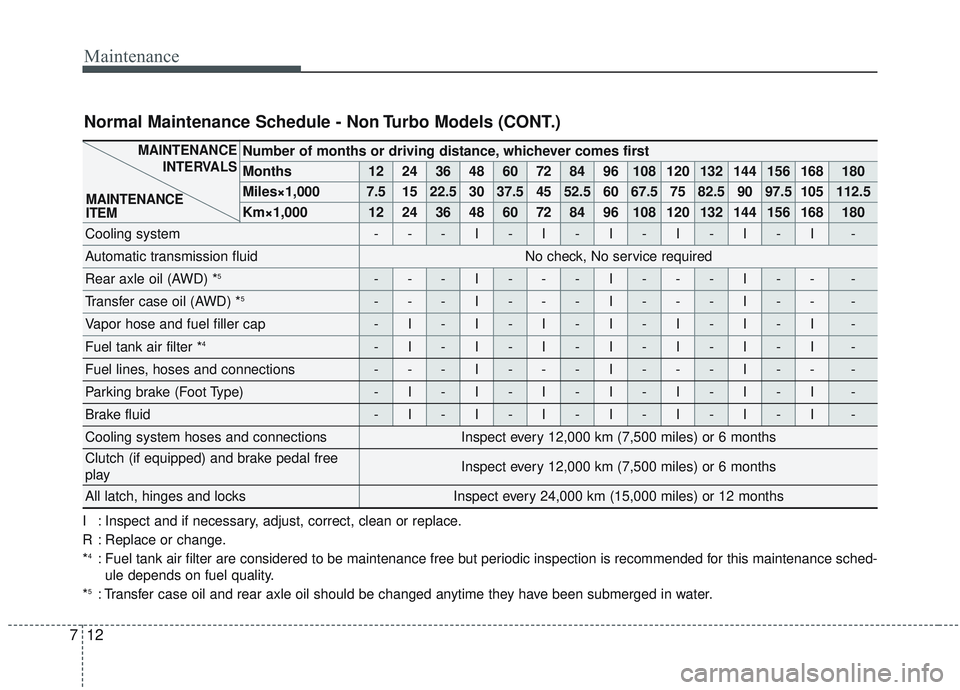
Cooling system---I-I-I-I-I-I-
Automatic transmission fluidNo check, No service required
Rear axle oil (AWD) *5---I---I---I---
Transfer case oil (AWD) *5---I---I---I---
Vapor hose and fuel filler cap-I-I-I-I-I-I-I-
Fuel tank air filter *4-I-I-I-I-I-I-I-
Fuel lines, hoses and connections---I---I---I---
Parking brake (Foot Type)-I-I-I-I-I-I-I-
Brake fluid-I-I-I-I-I-I-I-
Cooling system hoses and connectionsInspect every 12,000 km (7,500 miles) or 6 months
Clutch (if equipped) and brake pedal free
playInspect every 12,000 km (7,500 miles) or 6 months
All latch, hinges and locksInspect every 24,000 km (15,000 miles) or 12 months
MAINTENANCE
INTERVALS
MAINTENANCE
ITEM
Normal Maintenance Schedule - Non Turbo Models (CONT.)
I : Inspect and if necessary, adjust, correct, clean or replace.
R : Replace or change.
*
4: Fuel tank air filter are considered to be maintenance free but periodic inspection is recommended for this maintenance sched- ule depends on fuel quality.
*
5: Transfer case oil and rear axle oil should be changed anytime they have been submerged in water.
Page 459 of 573
Maintenance
16
7
Vacuum crankcase ventilation
hoses (if equipped)
Inspect the surface of hoses for evi-
dence of heat and/or mechanical
damage. Hard and brittle rubber,
cracking, tears, cuts, abrasions, and
excessive swelling indicate deterio-
ration. Particular attention should be
pay particular attention to the hose
surfaces nearest to high heat
sources, such as the exhaust mani-
fold.
Inspect the hose routing to assure
that the hoses do not come in con-
tact with any heat source, sharp
edges or moving components which
might cause heat damage or
mechanical wear. Inspect all hose
connections, such as clamps and
couplings, to make sure they are
secure, and that no leaks are pres-
ent. Hoses should be replaced
immediately if there is any evidence
of deterioration or damage.
Air cleaner filter
A Genuine Kia air cleaner filter is
recommended when the filter is
replaced.
Spark plugs
Make sure to install new spark plugs
of the correct heat range.
Valve clearance (if equipped)
Inspect for excessive valve noise
and/or engine vibration and adjust if
necessary. An authorized Kia dealer
should perform this procedure.
Cooling system
Check the cooling system compo-
nents, such as the radiator, coolant
reservoir, hoses and connections for
leakage and damage. Replace any
damaged parts.
Coolant
The coolant should be changed at
the intervals specified in the mainte-
nance schedule.
Automatic transmission fluid
Automatic transmission fluid should
not be checked under normal usage
conditions.
But in severe conditions, the fluid
should be changed at an authorized
Kia dealer in accordance to the
scheduled maintenance at the begin-
ning of this chapter.
Page 464 of 573
721
Maintenance
ENGINE COOLANT
The high-pressure cooling system
has a reservoir filled with year round
antifreeze coolant. The reservoir is
filled at the factory.
Check the antifreeze protection and
coolant level at least once a year: at
the beginning of the winter season,
and before traveling to a colder cli-
mate.Checking the coolant level Turn the engine off and wait until itcools down. Use extreme care
when removing the radiator cap.
Wrap a thick towel around it, and
turn it counterclockwise slowly to
the first stop. Step back while the
pressure is released from the cool-
ing system.
When you are sure all the pressure
has been released, press down on
the cap, using a thick towel, and
continue turning counterclockwise
to remove it.
Even if the engine is not operating, do not remove the radiator cap or
the drain plug while the engine and
radiator are hot. Hot coolant and
steam may still blow out under
pressure, causing serious injury.
WARNING
Removing radiator
cap
Never attempt to remove the
radiator cap while the engine is
operating or hot. Doing so
could result in serious personal
injury from escaping hot
coolant or steam.
CAUTION - Radiator cap
Never attempt to remove the radiator cap while the engine isoperating or hot. Doing somight lead to cooling systemand engine damage.
Page 465 of 573
Maintenance
22
7
Check the condition and connections
of all cooling system hoses and
heater hoses. Replace any swollen
or deteriorated hoses.
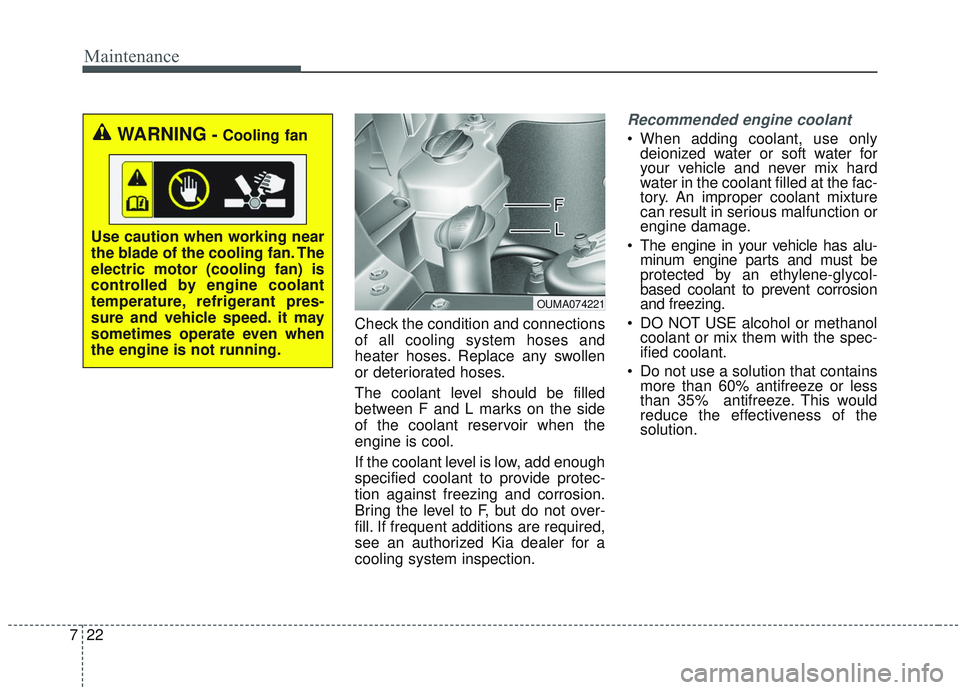
The coolant level should be filled
between F and L marks on the side
of the coolant reservoir when the
engine is cool.
If the coolant level is low, add enough
specified coolant to provide protec-
tion against freezing and corrosion.
Bring the level to F, but do not over-
fill. If frequent additions are required,
see an authorized Kia dealer for a
cooling system inspection.
Recommended engine coolant
When adding coolant, use only
deionized water or soft water for
your vehicle and never mix hard
water in the coolant filled at the fac-
tory. An improper coolant mixture
can result in serious malfunction or
engine damage.
The engine in your vehicle has alu- minum engine parts and must be
protected by an ethylene-glycol-
based coolant to prevent corrosion
and freezing.
DO NOT USE alcohol or methanol coolant or mix them with the spec-
ified coolant.
Do not use a solution that contains more than 60% antifreeze or less
than 35% antifreeze. This would
reduce the effectiveness of the
solution.
OUMA074221
WARNING- Cooling fan
Use caution when working near
the blade of the cooling fan. The
electric motor (cooling fan) is
controlled by engine coolant
temperature, refrigerant pres-
sure and vehicle speed. it may
sometimes operate even when
the engine is not running.
Page 561 of 573
Index
4I
Child restraint system . . . . . . . . . . . . . . . . . . . . . . . . . . 3-38Using a child restraint system . . . . . . . . . . . . . . . . . 3-39
Placing a passenger seat belt into the auto lock mode . . . . . . . . . . . . . . . . . . . . . . . . . . . . . . . . . . . . \
3-40
Securing a child restraint seat with tether anchor system. . . . . . . . . . . . . . . . . . . . . . . . . . . . . 3-43
Securing a child restraint seat with child seat lower anchor system. . . . . . . . . . . . . . . . . . . . . . . . . . . . . 3-44
Child-protector rear door lock . . . . . . . . . . . . . . . . . . . 4-25
Climate control air filter . . . . . . . . . . . . . . . . . . . . . . . . 7-29 Filter inspection . . . . . . . . . . . . . . . . . . . . . . . . . . . . 7-29
Closing the sunroof. . . . . . . . . . . . . . . . . . . . . . . . . . . . 4-55
Coat hook . . . . . . . . . . . . . . . . . . . . . . . . . . . . . . . . . . 4-18\
2
Combined instrument, see instrument cluster . . . . . . . 4-75
Consumer assistance . . . . . . . . . . . . . . . . . . . . . . . . . . . 8-12
Coolant . . . . . . . . . . . . . . . . . . . . . . . . . . . . . . . . . . . . \
. 7-21
Cooling fluid, see engine coolant . . . . . . . . . . . . . . . . . 7-21
Crankcase emission control system . . . . . . . . . . . . . . 7-100
Cruise control system . . . . . . . . . . . . . . . . . . . . . . . . . . 5-63 To set cruise control speed . . . . . . . . . . . . . . . . . . . . 5-63
To increase cruise control set speed. . . . . . . . . . . . . 5-64
To decrease the cruising speed. . . . . . . . . . . . . . . . . 5-65
To temporarily accelerate with the cruise control on5-65
To cancel cruise control . . . . . . . . . . . . . . . . . . . . . . 5-65
To resume cruising speed at more than approximately 30 km/h (20mph) . . . . . . . . . . . . . . . . . . . . . . . . . . 5-66
To turn cruise control off . . . . . . . . . . . . . . . . . . . . . 5-66 Cup holder . . . . . . . . . . . . . . . . . . . . . . . . . . . . . . . . . 4-172
Curtain air bag . . . . . . . . . . . . . . . . . . . . . . . . . . . . . . . 3-63
Dashboard illumination, see instrument panel
illumination . . . . . . . . . . . . . . . . . . . . . . . . . . . . . . 4-76
Dashboard, see instrument cluster . . . . . . . . . . . . . . . . 4-75
Day/Night rearview mirror . . . . . . . . . . . . . . . . . . . . . . 4-61
Daytime running light. . . . . . . . . . . . . . . . . . . . . . . . . 4-123
Defogging (Windshield) . . . . . . . . . . . . . . . . . . . . . . . 4-164
Defroster (Rear window) . . . . . . . . . . . . . . . . . . . . . . 4-140
Defrosting (Windshield) . . . . . . . . . . . . . . . . . . . . . . . 4-164
Digital speedometer . . . . . . . . . . . . . . . . . . . . . . . . . . . 4-86
Dimensions . . . . . . . . . . . . . . . . . . . . . . . . . . . . . . . . . . . 8-\
2
Display illumination, see instrument panel illumination . . . . . . . . . . . . . . . . . . . . . . . . . . . . . . . 4-76
Displays, see instrument cluster . . . . . . . . . . . . . . . . . . 4-75
Distance to empty . . . . . . . . . . . . . . . . . . . . . . . . . . . . . 4-89
Do not use methanol . . . . . . . . . . . . . . . . . . . . . . . . . . . . 1-4
Door lock button . . . . . . . . . . . . . . . . . . . . . . . . . . . . . . 4-23
Door locks. . . . . . . . . . . . . . . . . . . . . . . . . . . . . . . . . . . 4-\
22 From outside the vehicle . . . . . . . . . . . . . . . . . . . . . 4-22
From inside the vehicle . . . . . . . . . . . . . . . . . . . . . . 4-23
Door lock button . . . . . . . . . . . . . . . . . . . . . . . . . . . 4-23
Central door lock switch . . . . . . . . . . . . . . . . . . . . . 4-24
Child-protector rear door lock . . . . . . . . . . . . . . . . . 4-25
Drinks holders, see cup holders . . . . . . . . . . . . . . . . . 4-172
D
Page 563 of 573
Index
6I
Engine will not start . . . . . . . . . . . . . . . . . . . . . . . . . . . . 6-4
Evaporative emission control (including ORVR: Onboard Refueling Vapor Recovery) system . . . . 7-100
Exhaust emission control system . . . . . . . . . . . . . . . . 7-101
Explanation of scheduled maintenance items . . . . . . . 7-15 Engine oil and filter . . . . . . . . . . . . . . . . . . . . . . . . . 7-15
Drive belts . . . . . . . . . . . . . . . . . . . . . . . . . . . . . . . . 7-15
Fuel filter (for gasoline) . . . . . . . . . . . . . . . . . . . . . . 7-15
Fuel lines, fuel hoses and connections . . . . . . . . . . . 7-15
Vapor hose and fuel filler cap . . . . . . . . . . . . . . . . . 7-15
Vacuum crankcase ventilation hoses . . . . . . . . . . . . 7-16
Air cleaner filter . . . . . . . . . . . . . . . . . . . . . . . . . . . . 7-16
Spark plugs . . . . . . . . . . . . . . . . . . . . . . . . . . . . . . . . 7-16
Valve clearance. . . . . . . . . . . . . . . . . . . . . . . . . . . . . 7-16
Cooling system . . . . . . . . . . . . . . . . . . . . . . . . . . . . . 7-16
Coolant . . . . . . . . . . . . . . . . . . . . . . . . . . . . . . . . . . . 7-\
16
Automatic transmission fluid . . . . . . . . . . . . . . . . . . 7-16
Brake hoses and lines . . . . . . . . . . . . . . . . . . . . . . . . 7-17
Brake fluid . . . . . . . . . . . . . . . . . . . . . . . . . . . . . . . . 7-17
Parking brake . . . . . . . . . . . . . . . . . . . . . . . . . . . . . . 7-17
Brake discs, pads, calipers and rotors . . . . . . . . . . . 7-17
Exhaust pipe and muffler . . . . . . . . . . . . . . . . . . . . . 7-17
Suspension mounting bolts . . . . . . . . . . . . . . . . . . . 7-17
Steering gear box, linkage & boots/lower arm ball joint . . . . . . . . . . . . . . . . . . . . . . . . . . . . . . . . . 7-18
Drive shafts and boots . . . . . . . . . . . . . . . . . . . . . . . 7-18
Air conditioning refrigerant . . . . . . . . . . . . . . . . . . . 7-18
Exterior care . . . . . . . . . . . . . . . . . . . . . . . . . . . . . . . . . 7-96 Exterior features . . . . . . . . . . . . . . . . . . . . . . . . . . . . . 4-185
Roof rack . . . . . . . . . . . . . . . . . . . . . . . . . . . . . . . . 4-185
Exterior overview . . . . . . . . . . . . . . . . . . . . . . . . . . . . . . 2-2
Flat tire . . . . . . . . . . . . . . . . . . . . . . . . . . . . . . . . . . . . \
. 6-16 Jack and tools . . . . . . . . . . . . . . . . . . . . . . . . . . . . . . 6-16
Removing and storing the spare tire . . . . . . . . . . . . 6-17
Changing tires . . . . . . . . . . . . . . . . . . . . . . . . . . . . . 6-19
Floor mat anchor(s) . . . . . . . . . . . . . . . . . . . . . . . . . . 4-182
Fluid Brake fluid . . . . . . . . . . . . . . . . . . . . . . . . . . . . . . . . 7-24
Washer fluid . . . . . . . . . . . . . . . . . . . . . . . . . . . . . . . 7-25
Folding key . . . . . . . . . . . . . . . . . . . . . . . . . . . . . . . . . . . 4-\
5 Record your key number . . . . . . . . . . . . . . . . . . . . . . 4-5
Key operations . . . . . . . . . . . . . . . . . . . . . . . . . . . . . . 4-5
Transmitter precautions . . . . . . . . . . . . . . . . . . . . . . . 4-7
Battery replacement . . . . . . . . . . . . . . . . . . . . . . . . . . 4-8
Immobilizer system . . . . . . . . . . . . . . . . . . . . . . . . . . 4-9
Folding the outside rearview mirror . . . . . . . . . . . . . . . 4-71
Forward Collision-Avoidance assist (FCA) . . . . . . . . . 5-49 System setting and activation. . . . . . . . . . . . . . . . . . 5-49
FCA warning message and system control . . . . . . . 5-51
Brake operation . . . . . . . . . . . . . . . . . . . . . . . . . . . . 5-52
FCA front radar/camera sensor . . . . . . . . . . . . . . . . 5-53
System malfunction . . . . . . . . . . . . . . . . . . . . . . . . . 5-55
F