brakes KIA SORENTO 2019 Owner's Guide
[x] Cancel search | Manufacturer: KIA, Model Year: 2019, Model line: SORENTO, Model: KIA SORENTO 2019Pages: 573, PDF Size: 10.61 MB
Page 410 of 573
5133
Driving your vehicle
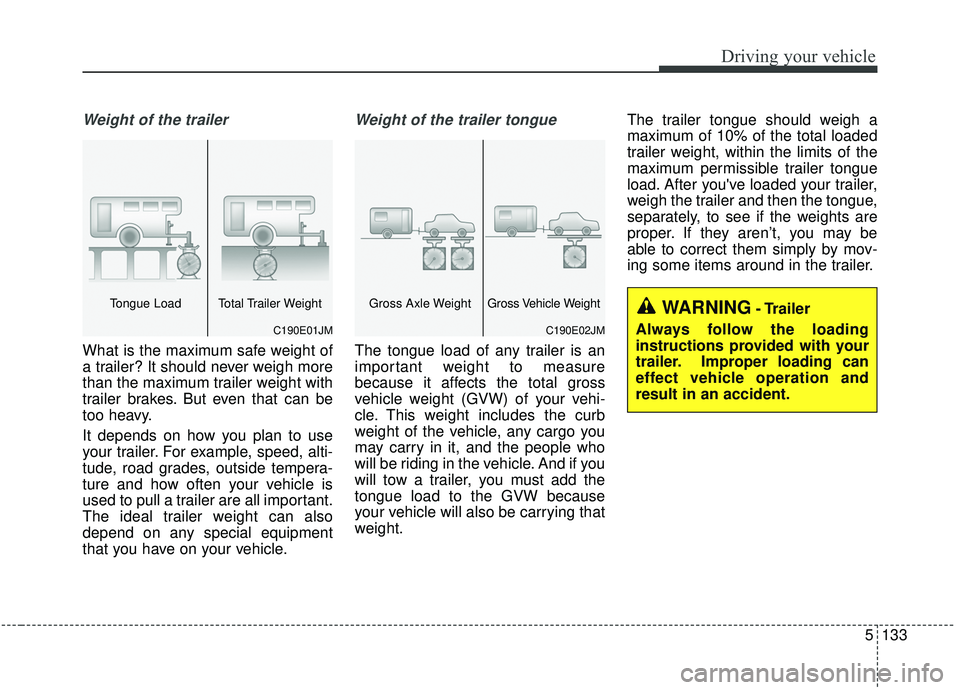
Weight of the trailer
What is the maximum safe weight of
a trailer? It should never weigh more
than the maximum trailer weight with
trailer brakes. But even that can be
too heavy.
It depends on how you plan to use
your trailer. For example, speed, alti-
tude, road grades, outside tempera-
ture and how often your vehicle is
used to pull a trailer are all important.
The ideal trailer weight can also
depend on any special equipment
that you have on your vehicle.
Weight of the trailer tongue
The tongue load of any trailer is an
important weight to measure
because it affects the total gross
vehicle weight (GVW) of your vehi-
cle. This weight includes the curb
weight of the vehicle, any cargo you
may carry in it, and the people who
will be riding in the vehicle. And if you
will tow a trailer, you must add the
tongue load to the GVW because
your vehicle will also be carrying that
weight.The trailer tongue should weigh a
maximum of 10% of the total loaded
trailer weight, within the limits of the
maximum permissible trailer tongue
load. After you've loaded your trailer,
weigh the trailer and then the tongue,
separately, to see if the weights are
proper. If they aren’t, you may be
able to correct them simply by mov-
ing some items around in the trailer.
C190E01JM
Tongue Load Total Trailer Weight
C190E02JM
Gross Axle WeightGross Vehicle WeightWARNING- Trailer
Always follow the loading
instructions provided with your
trailer. Improper loading can
effect vehicle operation and
result in an accident.
Page 412 of 573
5135
Driving your vehicle
Vehicle capacity weight:
5 persons : 420 kg (930 lbs.)
7 persons : 506 kg (1,120 lbs.)
Vehicle capacity weight is the maxi-
mum combined weight of occupants
and cargo. If your vehicle is equipped
with a trailer, the combined weight
includes the tongue load.
Seating capacity:
Total - 5 persons (Front seat : 2 persons,
Rear seat : 3 persons)
- 7 persons (Front seat : 2 persons,
Rear seat : 5 persons)
Seating capacity is the maximum
number of occupants including a
driver, your vehicle may carry.
However, the seating capacity may
be reduced based upon the weight of
all of the occupants, and the weight
of the cargo being carried or towed.
Do not overload the vehicle as there
is a limit to the total weight, or load
limit including occupants and cargo,
the vehicle can carry.
Towing capacity:
* 2.4L Engine
Without trailer brakes
: 750 kg (1,650 lbs)
With trailer brakes
: 907 kg (2,000 lbs)
With trailer package
: N/A
* 3.3L Engine
Without trailer brakes
: 750 kg (1,650 lbs)
With trailer brakes
: 907 kg (2,000 lbs)
With trailer package
: 2WD : 1,587 kg (3,500 lbs.) 4WD : 2,267 kg (5,000 lbs.)
Towing capacity is the maximum
trailer weight including its cargo
weight, your vehicle can tow.
Page 419 of 573
63
What to do in an emergency
If the engine stalls at a cross-
road or crossing
If the engine stalls at a crossroad or
crossing, set the shift lever in the N
(Neutral) position and then push the
vehicle to a safe place.
If you have a flat tire while
driving
If a tire goes flat while you are driv-
ing:
1. Take your foot off the acceleratorpedal and let the vehicle slow
down while driving straight ahead.
Do not apply the brakes immedi-
ately or attempt to pull off the road
as this may cause a loss of con-
trol. When the vehicle has slowed
to such a speed that it is safe to do
so, brake carefully and pull off the
road. Drive off the road as far as
possible and park on a firm level
ground. If you are on a divided
highway, do not park in the median
area between the two traffic lanes. 2. When the vehicle is stopped, turn
on your emergency hazard flash-
ers, set the parking brake and put
the transmission in P (Park).
3. Have all passengers get out of the vehicle. Be sure they all get out on
the side of the vehicle that is away
from traffic.
4. When changing a flat tire, follow the instruction provided later in
this section.
If the engine stalls while driv-
ing
1. Reduce your speed gradually,keeping a straight line. Move cau-
tiously off the road to a safe place.
2. Turn on your emergency flashers.
3. Try to start the engine again. If your vehicle will not start, contact
an authorized Kia dealer or seek
other qualified assistance.
✽ ✽NOTICE
If there was a check engine light and
loss of power or stall and if safe to do
so, wait at least 10 seconds to restart
the vehicle after it stalls. This may
reset the car so it will no longer run
at low power condition.
IN CASE OF AN EMERGENCY WHILE DRIVING
Page 430 of 573
What to do in an emergency
14
6
You may not be able to identify a low
tire by simply looking at it. Always
use a good quality tire pressure
gauge to measure the tire's inflation
pressure. Please note that a tire that
is hot (from being driven) will have a
higher pressure measurement than a
tire that is cold (from sitting station-
ary for at least 3 hours and driven
less than 1.6 km (1 mile) during that
3 hour period).
Allow the tire to cool before measur-
ing the inflation pressure. Always be
sure the tire is cold before inflating to
the recommended pressure.
A cold tire means the vehicle has
been sitting for 3 hours and driven for
less than 1.6 km (1 mile) in that 3
hour period.
Do not use any tire sealant if your
vehicle is equipped with a Tire
Pressure Monitoring System. The liq-
uid sealant can damage the tire
pressure sensors. The TPMS cannot alert you to
severe and sudden tire damage
caused by external factors such as
nails or road debris.
If you feel any vehicle instability, immediately take your foot off the
accelerator, apply the brakes grad-
ually and with light force, and slow-
ly move to a safe position off the
road.✽ ✽ NOTICE - Protecting TPMS
Tampering with, modifying, or dis-
abling the Tire Pressure Monitoring
System (TPMS) components may
interfere with the system's ability to
warn the driver of low tire pressure
conditions and/or TPMS malfunc-
tions. Tampering with, modifying,
or disabling the Tire Pressure
Monitoring System (TPMS) compo-
nents may void the warranty for
that portion of the vehicle.
Page 467 of 573
Maintenance
24
7
BRAKE FLUID
Checking the brake fluid level
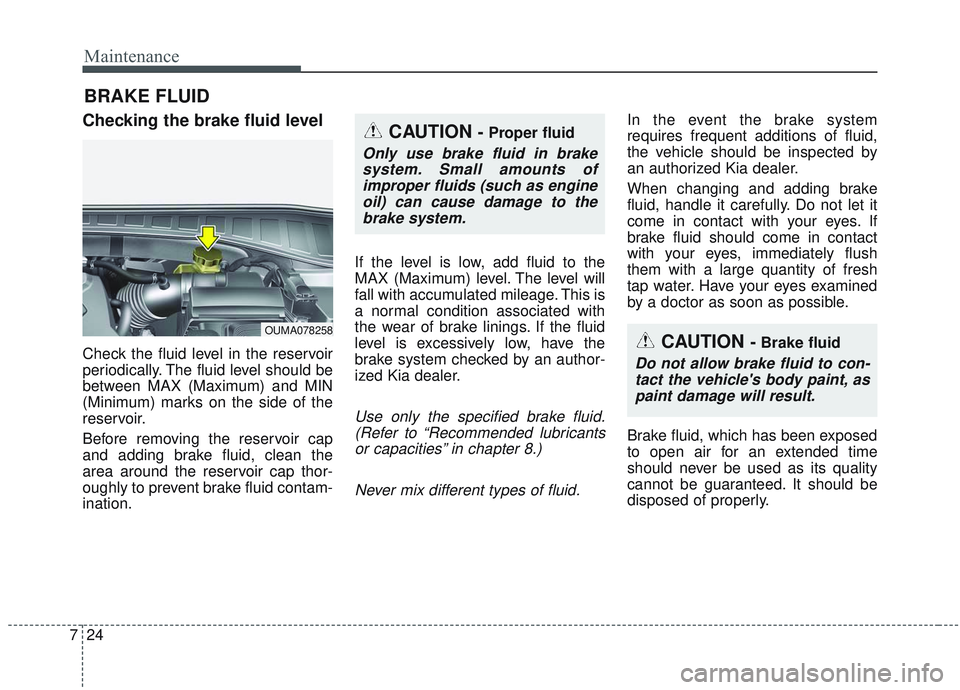
Check the fluid level in the reservoir
periodically. The fluid level should be
between MAX (Maximum) and MIN
(Minimum) marks on the side of the
reservoir.
Before removing the reservoir cap
and adding brake fluid, clean the
area around the reservoir cap thor-
oughly to prevent brake fluid contam-
ination. If the level is low, add fluid to the
MAX (Maximum) level. The level will
fall with accumulated mileage. This is
a normal condition associated with
the wear of brake linings. If the fluid
level is excessively low, have the
brake system checked by an author-
ized Kia dealer.
Use only the specified brake fluid.
(Refer to “Recommended lubricantsor capacities” in chapter 8.)
Never mix different types of fluid.
In the event the brake system
requires frequent additions of fluid,
the vehicle should be inspected by
an authorized Kia dealer.
When changing and adding brake
fluid, handle it carefully. Do not let it
come in contact with your eyes. If
brake fluid should come in contact
with your eyes, immediately flush
them with a large quantity of fresh
tap water. Have your eyes examined
by a doctor as soon as possible.
Brake fluid, which has been exposed
to open air for an extended time
should never be used as its quality
cannot be guaranteed. It should be
disposed of properly.CAUTION - Proper fluid
Only use brake fluid in brakesystem. Small amounts ofimproper fluids (such as engineoil) can cause damage to thebrake system.
CAUTION - Brake fluid
Do not allow brake fluid to con-tact the vehicle's body paint, aspaint damage will result.
OUMA078258
Page 491 of 573
Maintenance
48
7
Ply: A layer of rubber-coated parallel
cords
Pneumatic tire: A mechanical
device made of rubber, chemicals,
fabric and steel or other materials,
that, when mounted on an automo-
tive wheel, provides the traction and
contains the gas or fluid that sustains
the load.
Production options weight: The
combined weight of installed regular
production options weighing over 5
lb.(2.3 kg) in excess of the standard
items which they replace, not previ-
ously considered in curb weight or
accessory weight, including heavy
duty brakes, ride levelers, roof rack,
heavy duty battery, and special trim.
Recommended Inflation Pressure:
Vehicle manufacturer's recommend-
ed tire inflation pressure and shown
on the tire placard. Radial Ply Tire:
A pneumatic tire in
which the ply cords that extend to the
beads are laid at 90 degrees to the
centerline of the tread.
Rim: A metal support for a tire and
upon which the tire beads are seat-
ed.
Sidewall: The portion of a tire
between the tread and the bead.
Speed Rating: An alphanumeric
code assigned to a tire indicating the
maximum speed at which a tire can
operate.
Traction: The friction between the
tire and the road surface. The
amount of grip provided.
Tread: The portion of a tire that
comes into contact with the road.
Treadwear Indicators: Narrow
bands, sometimes called "wear
bars," that show across the tread of a
tire when only 1/16 inch of tread
remains. UTQGS:
Uniform Tire Quality
Grading Standards, a tire information
system that provides consumers with
ratings for a tire's traction, tempera-
ture and treadwear. Ratings are
determined by tire manufacturers
using government testing proce-
dures. The ratings are molded into
the sidewall of the tire.
Vehicle Capacity Weight: The num-
ber of designated seating positions
multiplied by 68 kg (150 lbs.) plus the
rated cargo and luggage load.
Vehicle Maximum Load on the
Tire: Load on an individual tire due
to curb and accessory weight plus
maximum occupant and cargo
weight.
Vehicle Normal Load on the Tire:
Load on an individual tire that is
determined by distributing to each
axle its share of the curb weight,
accessory weight, and normal occu-
pant weight and driving by 2.
Vehicle Placard: A label permanent-
ly attached to a vehicle showing the
original equipment tire size and rec-
ommended inflation pressure.
Page 534 of 573
791
Maintenance
APPEARANCE CARE
Exterior care
Exterior general caution
It is very important to follow the label
directions when using any chemical
cleaner or polish. Read all warning
and caution statements that appear
on the label.
Finish maintenance
Washing
To help protect your vehicle’s finish
from rust and deterioration, wash it
thoroughly and frequently at least
once a month with lukewarm or cold
water.
If you use your vehicle for off-road
driving, you should wash it after each
off-road trip. Pay special attention to
the removal of any accumulation of
salt, dirt, mud, and other foreign mate-
rials. Make sure the drain holes in the
lower edges of the doors and rocker
panels are kept clear and clean.
Insects, tar, tree sap, bird droppings,
industrial pollution and similar
deposits can damage your vehicle’s
finish if not removed immediately.
Even prompt washing with plain water
may not completely remove all these
deposits. A mild soap, safe for use on
painted surfaces, may be used.
After washing, rinse the vehicle thor-
oughly with lukewarm or cold water.
Do not allow soap to dry on the finish.After washing the vehicle, test the
brakes while driving slowly to see if
they have been affected by water. If
braking performance is impaired, dry
the brakes by applying them lightly
while maintaining a slow forward
speed.
CAUTION - Headlight Lens
To prevent damage, do not
clean headlight lens with chem-ical solvents or strong deter-gents.
Page 537 of 573
Maintenance
94
7
Use professional service techni-
cians or governmental inspection
stations to annually inspect for cor-
rosion.
Immediately seek an inspection of your vehicle if you become visually
aware of corrosion flaking or scal-
ing or if you become aware of a
change in vehicle performance,
such as soft or spongey brakes,
fluids leaking, impairment of direc-
tional control, suspension noises
or rattling metal straps.Aluminum wheel maintenance
The aluminum wheels are coated
with a clear protective finish.
Do not use any abrasive cleaner,polishing compound, solvent, or
wire brushes on aluminum wheels.
They may scratch the finish.
Clean the wheel when it has cooled.
Use only a mild soap or neutral detergent, and rinse thoroughly
with water. Also, be sure to clean
the wheels after driving on salted
roads. This helps prevent corro-
sion.
Avoid washing the wheels with highspeed vehicle wash brushes.
Do not use any alkaline or acid detergents It may damage and cor-
rode the aluminum wheels coated
with a clear protective finish.
Corrosion protection
Protecting your vehicle from corro-
sion
By using the most advanced design
and construction practices to combat
corrosion, we produce vehicles of
the highest quality. However, this is
only part of the job. To achieve the
long-term corrosion resistance your
vehicle can deliver, the owner's
cooperation and assistance is also
required.
Common causes of corrosion
The most common causes of corro-
sion on your vehicle are:
Road salt, dirt and moisture that isallowed to accumulate underneath
the vehicle.
coatings by stones, gravel, abra-
sion or minor scrapes and dents
which leave unprotected metal
exposed to corrosion.
Page 560 of 573
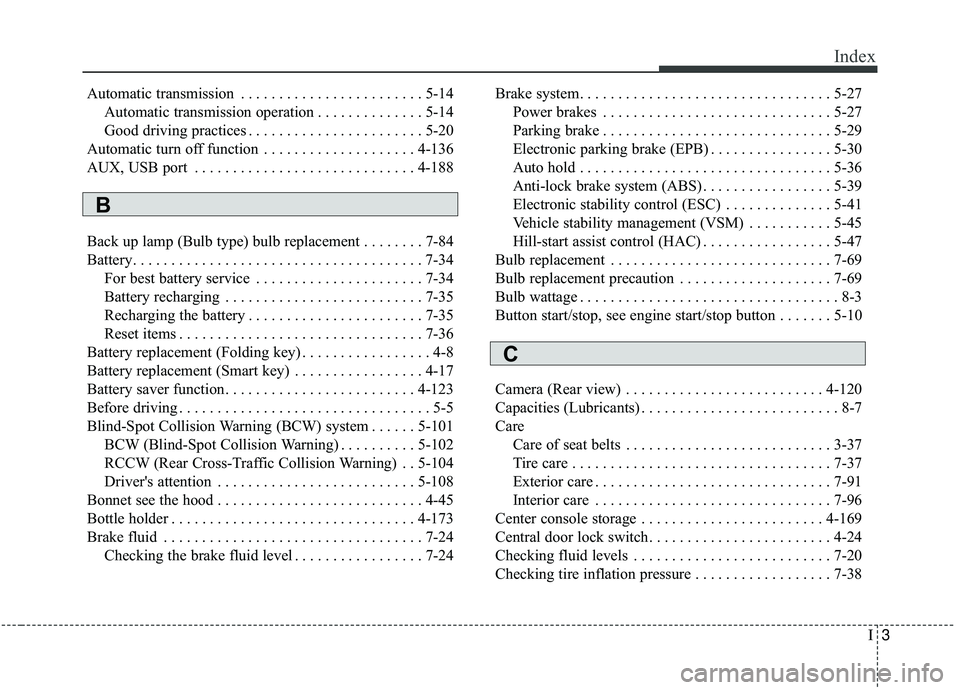
I3
Index
Automatic transmission . . . . . . . . . . . . . . . . . . . . . . . . 5-14Automatic transmission operation . . . . . . . . . . . . . . 5-14
Good driving practices . . . . . . . . . . . . . . . . . . . . . . . 5-20
Automatic turn off function . . . . . . . . . . . . . . . . . . . . 4-136
AUX, USB port . . . . . . . . . . . . . . . . . . . . . . . . . . . . . 4-188
Back up lamp (Bulb type) bulb replacement . . . . . . . . 7-84
Battery. . . . . . . . . . . . . . . . . . . . . . . . . . . . . . . . . . . . \
. . 7-34 For best battery service . . . . . . . . . . . . . . . . . . . . . . 7-34
Battery recharging . . . . . . . . . . . . . . . . . . . . . . . . . . 7-35
Recharging the battery . . . . . . . . . . . . . . . . . . . . . . . 7-35
Reset items . . . . . . . . . . . . . . . . . . . . . . . . . . . . . . . . 7-36
Battery replacement (Folding key) . . . . . . . . . . . . . . . . . 4-8
Battery replacement (Smart key) . . . . . . . . . . . . . . . . . 4-17
Battery saver function. . . . . . . . . . . . . . . . . . . . . . . . . 4-123
Before driving . . . . . . . . . . . . . . . . . . . . . . . . . . . . . . . . . 5-5
Blind-Spot Collision Warning (BCW) system . . . . . . 5-101 BCW (Blind-Spot Collision Warning) . . . . . . . . . . 5-102
RCCW (Rear Cross-Traffic Collision Warning) . . 5-104
Driver's attention . . . . . . . . . . . . . . . . . . . . . . . . . . 5-108
Bonnet see the hood . . . . . . . . . . . . . . . . . . . . . . . . . . . 4-45
Bottle holder . . . . . . . . . . . . . . . . . . . . . . . . . . . . . . . . 4-173
Brake fluid . . . . . . . . . . . . . . . . . . . . . . . . . . . . . . . . . . 7-24\
Checking the brake fluid level . . . . . . . . . . . . . . . . . 7-24 Brake system. . . . . . . . . . . . . . . . . . . . . . . . . . . . . . . . . 5-27
Power brakes . . . . . . . . . . . . . . . . . . . . . . . . . . . . . . 5-27
Parking brake . . . . . . . . . . . . . . . . . . . . . . . . . . . . . . 5-29
Electronic parking brake (EPB) . . . . . . . . . . . . . . . . 5-30
Auto hold . . . . . . . . . . . . . . . . . . . . . . . . . . . . . . . . . 5-36
Anti-lock brake system (ABS) . . . . . . . . . . . . . . . . . 5-39
Electronic stability control (ESC) . . . . . . . . . . . . . . 5-41
Vehicle stability management (VSM) . . . . . . . . . . . 5-45
Hill-start assist control (HAC) . . . . . . . . . . . . . . . . . 5-47
Bulb replacement . . . . . . . . . . . . . . . . . . . . . . . . . . . . . 7-69
Bulb replacement precaution . . . . . . . . . . . . . . . . . . . . 7-69
Bulb wattage . . . . . . . . . . . . . . . . . . . . . . . . . . . . . . . . . . 8-3
Button start/stop, see engine start/stop button . . . . . . . 5-10
Camera (Rear view) . . . . . . . . . . . . . . . . . . . . . . . . . . 4-120
Capacities (Lubricants) . . . . . . . . . . . . . . . . . . . . . . . . . . 8-7
Care Care of seat belts . . . . . . . . . . . . . . . . . . . . . . . . . . . 3-37
Tire care . . . . . . . . . . . . . . . . . . . . . . . . . . . . . . . . . . 7-37\
Exterior care . . . . . . . . . . . . . . . . . . . . . . . . . . . . . . . 7-91
Interior care . . . . . . . . . . . . . . . . . . . . . . . . . . . . . . . 7-96
Center console storage . . . . . . . . . . . . . . . . . . . . . . . . 4-169
Central door lock switch. . . . . . . . . . . . . . . . . . . . . . . . 4-24
Checking fluid levels . . . . . . . . . . . . . . . . . . . . . . . . . . 7-20
Checking tire inflation pressure . . . . . . . . . . . . . . . . . . 7-38
B
C
Page 569 of 573
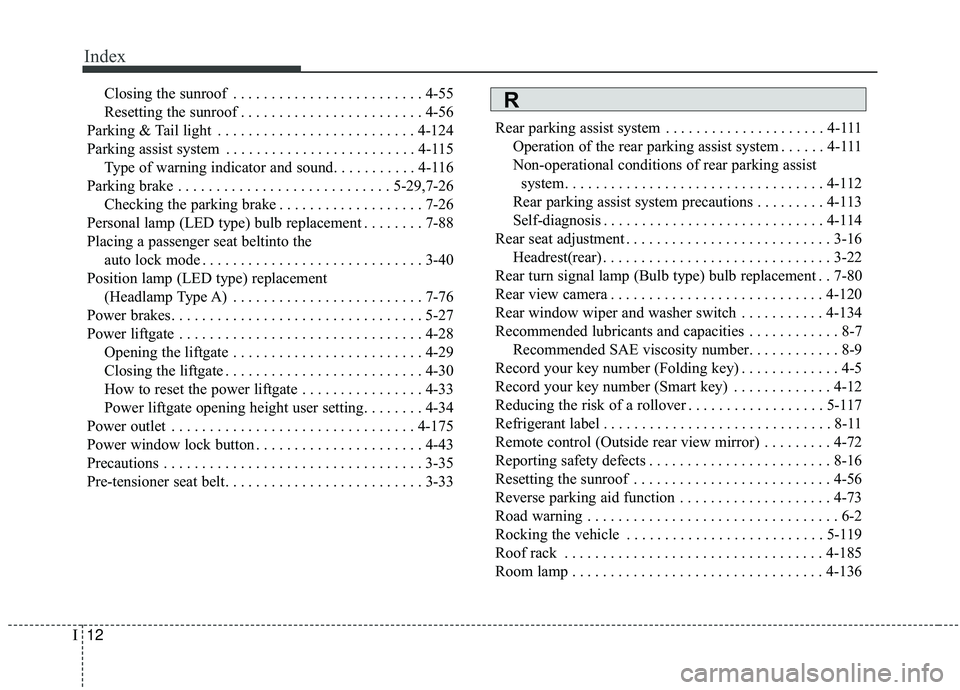
Index
12I
Closing the sunroof . . . . . . . . . . . . . . . . . . . . . . . . . 4-55
Resetting the sunroof . . . . . . . . . . . . . . . . . . . . . . . . 4-56
Parking & Tail light . . . . . . . . . . . . . . . . . . . . . . . . . . 4-124
Parking assist system . . . . . . . . . . . . . . . . . . . . . . . . . 4-115 Type of warning indicator and sound. . . . . . . . . . . 4-116
Parking brake . . . . . . . . . . . . . . . . . . . . . . . . . . . . 5-29,7-26 Checking the parking brake . . . . . . . . . . . . . . . . . . . 7-26
Personal lamp (LED type) bulb replacement . . . . . . . . 7-88
Placing a passenger seat beltinto the auto lock mode . . . . . . . . . . . . . . . . . . . . . . . . . . . . . 3-40
Position lamp (LED type) replacement (Headlamp Type A) . . . . . . . . . . . . . . . . . . . . . . . . . 7-76
Power brakes. . . . . . . . . . . . . . . . . . . . . . . . . . . . . . . . . 5-27
Power liftgate . . . . . . . . . . . . . . . . . . . . . . . . . . . . . . . . 4-28 Opening the liftgate . . . . . . . . . . . . . . . . . . . . . . . . . 4-29
Closing the liftgate . . . . . . . . . . . . . . . . . . . . . . . . . . 4-30
How to reset the power liftgate . . . . . . . . . . . . . . . . 4-33
Power liftgate opening height user setting. . . . . . . . 4-34
Power outlet . . . . . . . . . . . . . . . . . . . . . . . . . . . . . . . . 4-175
Power window lock button . . . . . . . . . . . . . . . . . . . . . . 4-43
Precautions . . . . . . . . . . . . . . . . . . . . . . . . . . . . . . . . . . 3-35\
Pre-tensioner seat belt. . . . . . . . . . . . . . . . . . . . . . . . . . 3-33 Rear parking assist system . . . . . . . . . . . . . . . . . . . . . 4-111
Operation of the rear parking assist system . . . . . . 4-111
Non-operational conditions of rear parking assist system . . . . . . . . . . . . . . . . . . . . . . . . . . . . . . . . . . 4-112
Rear parking assist system precautions . . . . . . . . . 4-113
Self-diagnosis . . . . . . . . . . . . . . . . . . . . . . . . . . . . . 4-114
Rear seat adjustment . . . . . . . . . . . . . . . . . . . . . . . . . . . 3-16 Headrest(rear) . . . . . . . . . . . . . . . . . . . . . . . . . . . . . . 3-22
Rear turn signal lamp (Bulb type) bulb replacement . . 7-80
Rear view camera . . . . . . . . . . . . . . . . . . . . . . . . . . . . 4-120
Rear window wiper and washer switch . . . . . . . . . . . 4-134
Recommended lubricants and capacities . . . . . . . . . . . . 8-7 Recommended SAE viscosity number. . . . . . . . . . . . 8-9
Record your key number (Folding key) . . . . . . . . . . . . . 4-5
Record your key number (Smart key) . . . . . . . . . . . . . 4-12
Reducing the risk of a rollover . . . . . . . . . . . . . . . . . . 5-117
Refrigerant label . . . . . . . . . . . . . . . . . . . . . . . . . . . . . . 8-11
Remote control (Outside rear view mirror) . . . . . . . . . 4-72
Reporting safety defects . . . . . . . . . . . . . . . . . . . . . . . . 8-16
Resetting the sunroof . . . . . . . . . . . . . . . . . . . . . . . . . . 4-56
Reverse parking aid function . . . . . . . . . . . . . . . . . . . . 4-73
Road warning . . . . . . . . . . . . . . . . . . . . . . . . . . . . . . . . . 6-2
Rocking the vehicle . . . . . . . . . . . . . . . . . . . . . . . . . . 5-119
Roof rack . . . . . . . . . . . . . . . . . . . . . . . . . . . . . . . . . . 4-18\
5
Room lamp . . . . . . . . . . . . . . . . . . . . . . . . . . . . . . . . . 4-136R