cover KIA SORENTO 2019 Manual Online
[x] Cancel search | Manufacturer: KIA, Model Year: 2019, Model line: SORENTO, Model: KIA SORENTO 2019Pages: 573, PDF Size: 10.61 MB
Page 532 of 573
789
Maintenance
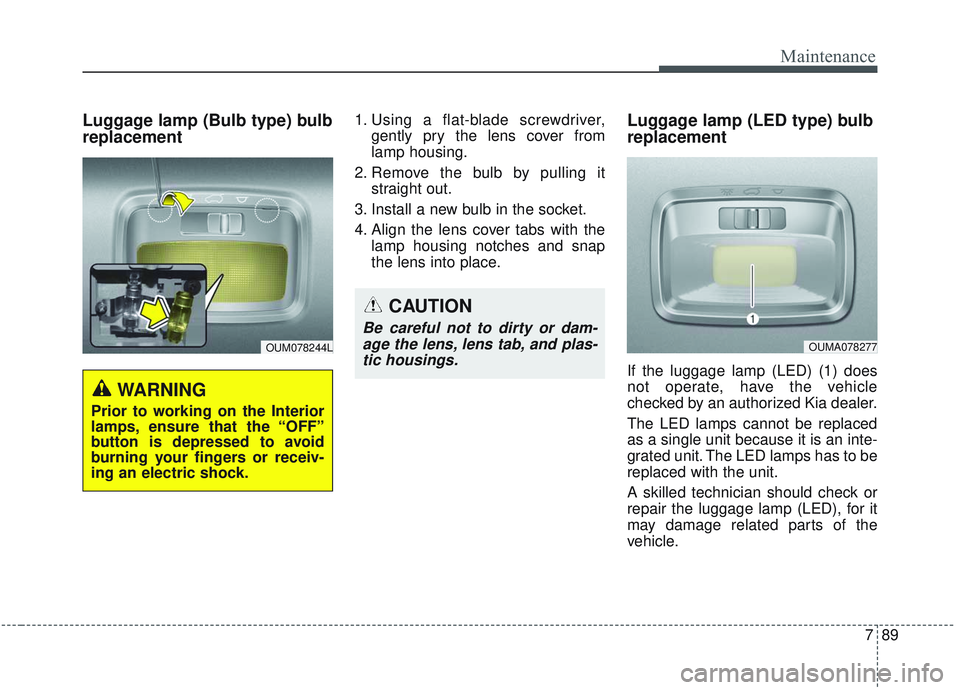
Luggage lamp (Bulb type) bulb
replacement1. Using a flat-blade screwdriver,gently pry the lens cover from
lamp housing.
2. Remove the bulb by pulling it straight out.
3. Install a new bulb in the socket.
4. Align the lens cover tabs with the lamp housing notches and snap
the lens into place.Luggage lamp (LED type) bulb
replacement
If the luggage lamp (LED) (1) does
not operate, have the vehicle
checked by an authorized Kia dealer.
The LED lamps cannot be replaced
as a single unit because it is an inte-
grated unit. The LED lamps has to be
replaced with the unit.
A skilled technician should check or
repair the luggage lamp (LED), for it
may damage related parts of the
vehicle.
WARNING
Prior to working on the Interior
lamps, ensure that the “OFF”
button is depressed to avoid
burning your fingers or receiv-
ing an electric shock.
OUM078244L
CAUTION
Be careful not to dirty or dam-age the lens, lens tab, and plas-tic housings.
OUMA078277
Page 535 of 573
Maintenance
92
7
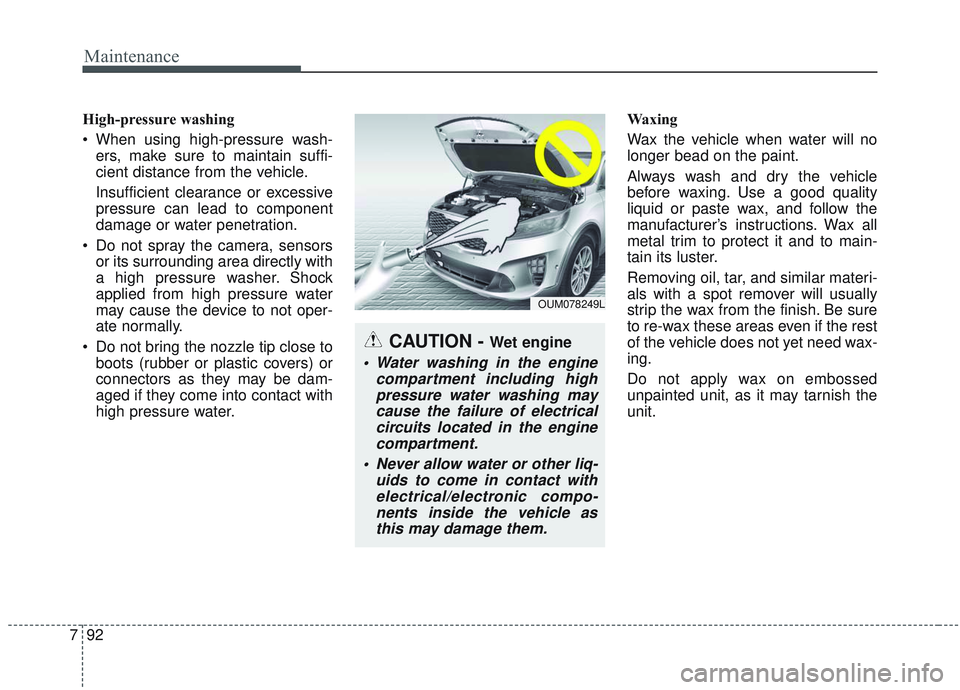
High-pressure washing
When using high-pressure wash-
ers, make sure to maintain suffi-
cient distance from the vehicle.
Insufficient clearance or excessive
pressure can lead to component
damage or water penetration.
Do not spray the camera, sensors or its surrounding area directly with
a high pressure washer. Shock
applied from high pressure water
may cause the device to not oper-
ate normally.
Do not bring the nozzle tip close to boots (rubber or plastic covers) or
connectors as they may be dam-
aged if they come into contact with
high pressure water. Waxing
Wax the vehicle when water will no
longer bead on the paint.
Always wash and dry the vehicle
before waxing. Use a good quality
liquid or paste wax, and follow the
manufacturer’s instructions. Wax all
metal trim to protect it and to main-
tain its luster.
Removing oil, tar, and similar materi-
als with a spot remover will usually
strip the wax from the finish. Be sure
to re-wax these areas even if the rest
of the vehicle does not yet need wax-
ing.
Do not apply wax on embossed
unpainted unit, as it may tarnish the
unit.
CAUTION - Wet engine
Water washing in the engine
compartment including highpressure water washing maycause the failure of electricalcircuits located in the enginecompartment.
Never allow water or other liq- uids to come in contact withelectrical/electronic compo-nents inside the vehicle asthis may damage them.
OUM078249L
Page 536 of 573
793
Maintenance
Finish damage repair
Deep scratches or stone chips in the
painted surface must be repaired
promptly. Exposed metal will quickly
rust and may develop into a major
repair expense.
If your vehicle is damaged and
requires any metal repair or replace-
ment, be sure the body shop applies
anti-corrosion materials to the parts
repaired or replaced.
Bright-metal maintenance
To remove road tar and insects,use a tar remover, not a scraper or
other sharp object.
To protect the surfaces of bright- metal parts from corrosion, apply a
coating of wax or chrome preser-
vative and rub to a high luster.
During winter weather or in coastal areas, cover the bright metal parts
with a heavier coating of wax or
preservative. If necessary, coat the
parts with non-corrosive petroleum
jelly or other protective compound.
Underbody maintenance
Road salt and other corrosive chem-
icals are used in cold weather states
to melt snow and prevent ice accu-
mulation. If these chemicals are not
regularly removed, they will corrode
the vehicle underbody and over time
damage fuel lines, the fuel tank
retention system, the vehicle sus-
pension, the exhaust system, and
even the body frame. The National
Highway Traffic Safety Administration
has warned all vehicle owners of all
brands of the need to take the follow-
ing steps:
Wash the undercarriage of yourvehicle regularly during the winter
and whenever your vehicle has
been exposed to such salts or
chemicals.
Do a thorough washing of the undercarriage at the end of the
winter.CAUTION - Drying vehicle
Wiping dust or dirt off the body with a dry cloth willscratch the finish.
Do not use steel wool, abra- sive cleaners, acid detergentsor strong detergents contain-ing high alkaline or causticagents on chrome-plated oranodized aluminum parts.This may result in damage tothe protective coating andcause discoloration or paintdeterioration.
Page 539 of 573
Maintenance
96
7
When cleaning lower door panels,
rocker panels and frame members,
be sure that drain holes are kept
open so that moisture can escape
and not be trapped inside to accel-
erate corrosion.
Keep your garage dry
Don't park your vehicle in a damp,
poorly ventilated garage. This cre-
ates a favorable environment for cor-
rosion. This is particularly true if you
wash your vehicle in the garage or
drive it into the garage when it is still
wet or covered with snow, ice or
mud. Even a heated garage can con-
tribute to corrosion unless it is well
ventilated so moisture is dispersed. Keep paint and trim in good condi-
tion
Scratches or chips in the finish
should be covered with "touch-up"
paint as soon as possible to reduce
the possibility of corrosion. If bare
metal is showing through, the atten-
tion of a qualified body and paint
shop is recommended.
Bird droppings : Bird droppings are
highly corrosive and may damage
painted surfaces in just a few hours.
Always remove bird droppings as
soon as possible.
Don't neglect the interior
Moisture can collect under the floor
mats and carpeting and cause corro-
sion. Check under the mats periodi-
cally to be sure the carpeting is dry.
Use particular care if you carry fertil-
izers, cleaning materials or chemi-
cals in the vehicle.
These should be carried only in prop-
er containers and any spills or leaks
should be cleaned up, flushed with
clean water and thoroughly dried.Interior care
Interior general precautions
Prevent chemicals such as perfume,
cosmetic oil, sun cream, hand clean-
er, and air freshener from contacting
the interior parts because they may
cause damage or discoloration. If
they do contact the interior parts,
wipe them off immediately. If neces-
sary, use a vinyl cleaner, see product
instructions for correct usage.
CAUTION - Electrical
components
Never allow water or other liq-
uids to come in contact withelectrical/electronic compo-nents inside the vehicle as thismay damage them.
Page 540 of 573
797
Maintenance
Taking care of leather seats
Vacuum the seat periodically toremove dust and sand on the seat.
It will prevent abrasion or damage of
the leather and maintain its quality.
Wipe the natural leather seat cover often with dry or soft cloth.
Sufficient use of a leather protec- tive may prevent abrasion of the
cover and helps maintain the color.
Be sure to read the instructions
and consult a specialist when
using leather coating or protective
agents.
Leather with bright colors(beige, cream beige) is easily contaminat-
ed and clear in appearance. Clean
the seats frequently.
Avoid wiping with wet cloth. It may cause the surface to crack.
Cleaning the leather seats
Remove all contaminates instantly.Refer to instructions below for
removal of each contaminant.
Cosmetic products(sunscreen, foundation, etc.)
- Apply cleansing cream on a clothand wipe the contaminated point.
Wipe off the cream with a wet
cloth and remove water with a dry
cloth.
Beverages(coffee, soft drink, etc.) - Apply a small amount of neutraldetergent and wipe until contami-
nations do not smear.
Oil - Remove oil instantly withabsorbable cloth and wipe with
stain remover for natural leather
only.
Chewing gum - Harden the gum with ice andremove gradually.CAUTION - Leather
When cleaning leather products(steering wheel, seats etc.), useneutral detergents or low alco-hol content solutions. If you usehigh alcohol content solutionsor acid/alkaline detergents, thecolor of the leather may fade orthe surface may get stripped off.
Page 541 of 573
Maintenance
98
7
Fabric seat cover using precau-
tions (If equipped)
Please clean the fabric seats regu-
larly with a vacuum cleaner in con-
sideration of fabric material charac-
teristics. If they are heavily soiled
with beverage stains, etc., use a suit-
able interior cleaner. To prevent dam-
age to seat covers, wipe off the seat
covers down to the seams with a
large wiping motion and moderate
pressure using a soft sponge or
microfiber cloth.
Velcro closures on clothing or sharp
objects may cause snagging or
scratches on the surface of the
seats. Make sure not to rub such
objects against the surface.
Cleaning the upholstery and inte-rior trim
Vinyl
Remove dust and loose dirt from
vinyl with a whisk broom or vacuum
cleaner. Clean vinyl surfaces with a
vinyl cleaner.
Fabric
Remove dust and loose dirt from fab-
ric with a whisk broom or vacuum
cleaner. Clean with a mild soap solu-
tion recommended for upholstery or
carpets. Remove fresh spots imme-
diately with a fabric spot cleaner. If
fresh spots do not receive immediate
attention, the fabric can be stained
and its color can be affected. Also, its
fire-resistant properties can be
reduced if the material is not proper-
ly maintained.
Using anything but recommended
cleaners and procedures may affect
the fabric’s appearance and fire-
resistant properties.
Cleaning the lap/shoulder beltwebbing
Clean the belt webbing with any mild
soap solution recommended for
cleaning upholstery or carpet. Follow
the instructions provided with the
soap. Do not bleach or re-dye the
webbing because this may weaken it.
Page 543 of 573
Maintenance
100
7
EMISSION CONTROL SYSTEM
The emission control system of your
vehicle is covered by a written limited
warranty. Please see the warranty
information contained in the
Warranty & Maintenance booklet in
your vehicle.
Your vehicle is equipped with an
emission control system to meet all
applicable emission regulations.
There are three emission control
systems, as follows.
(1) Crankcase emission control sys-
tem
(2) Evaporative emission control sys- tem
(3) Exhaust emission control system
In order to assure the proper function
of the emission control systems, it is
recommended that you have your
vehicle inspected and maintained by
an authorized Kia dealer in accor-
dance with the maintenance sched-
ule in this manual. Caution for the Inspection and
Maintenance Test (With Electronic
Stability Control (ESC) system)
To prevent the vehicle from mis-
firing during dynamometer test-
ing, turn the Electronic Stability
Control (ESC) system off by
pressing the ESC switch.
After dynamometer testing is completed, turn the ESC system
back on by pressing the ESC
switch again.1. Crankcase emission control system
The positive crankcase ventilation
system is employed to prevent air
pollution caused by blow-by gases
being emitted from the crankcase.
This system supplies fresh filtered air
to the crankcase through the air
intake hose. Inside the crankcase,
the fresh air mixes with blow-by
gases, which then pass through the
PCV valve into the induction system.
2. Evaporative emission con-trol (including ORVR:
Onboard Refueling Vapor
Recovery) system
The Evaporative Emission Control
System is designed to prevent fuel
vapors from escaping into the atmos-
phere.
(The ORVR system is designed to
allow the vapors from the fuel tank to
be loaded into a canister while refu-
eling at the gas station, preventing
the escape of fuel vapors into the
atmosphere.)
Page 544 of 573
7101
Maintenance
Canister
Fuel vapors generated inside the fuel
tank are absorbed and stored in the
onboard canister. When the engine is
running, the fuel vapors absorbed in
the canister are drawn into the surge
tank through the purge control sole-
noid valve.
Purge Control Solenoid Valve(PCSV)
The purge control solenoid valve is
controlled by the Engine Control
Module (ECM); when the engine
coolant temperature is low during
idling, the PCSV closes so that evap-
orated fuel is not taken into the
engine. After the engine warms up
during ordinary driving, the PCSV
opens to introduce evaporated fuel to
the engine.
3. Exhaust emission control system
The Exhaust Emission Control
System is a highly effective system
which controls exhaust emissions
while maintaining good vehicle per-
formance.
Vehicle modifications
This vehicle should not be modified.
Modification of your vehicle could
affect its performance, safety or
durability and may even violate gov-
ernmental safety and emissions reg-
ulations.
In addition, damage or performance
problems resulting from any modifi-
cation may not be covered under
warranty.
If you use unauthorized electronic
devices, it may cause the vehicle to
operate abnormally, wire damage,
battery discharge and fire. For your
safety, do not use unauthorized
electronic devices.
Engine exhaust gas precautions
(carbon monoxide)
Carbon monoxide can be present with other exhaust fumes.
Therefore, if you smell exhaust
fumes of any kind inside your vehi-
cle, have it inspected and repaired
immediately. If you ever suspect
exhaust fumes are coming into
your vehicle, drive it only with all
the windows fully open. Have your
vehicle checked and repaired
immediately.
WARNING - Exhaust
Engine exhaust gases contain
carbon monoxide (CO). Though
colorless and odorless, it is
dangerous and could be lethal if
inhaled. Follow the instructions
on this page to avoid CO poi-
soning.
Page 562 of 573
I5
Index
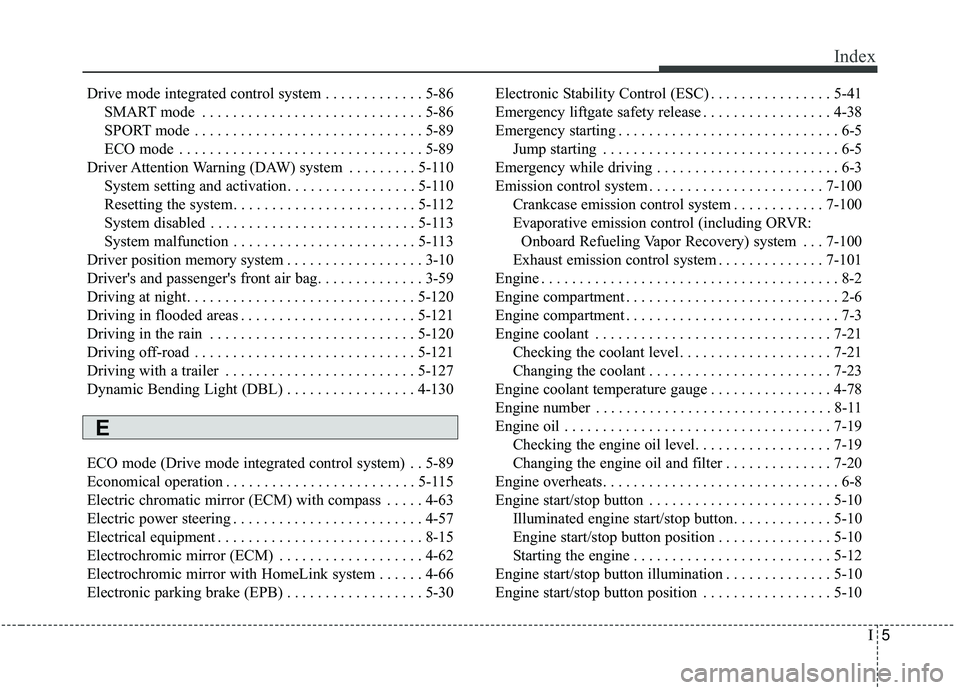
Drive mode integrated control system . . . . . . . . . . . . . 5-86SMART mode . . . . . . . . . . . . . . . . . . . . . . . . . . . . . 5-86
SPORT mode . . . . . . . . . . . . . . . . . . . . . . . . . . . . . . 5-89
ECO mode . . . . . . . . . . . . . . . . . . . . . . . . . . . . . . . . 5-89
Driver Attention Warning (DAW) system . . . . . . . . . 5-110 System setting and activation . . . . . . . . . . . . . . . . . 5-110
Resetting the system . . . . . . . . . . . . . . . . . . . . . . . . 5-112
System disabled . . . . . . . . . . . . . . . . . . . . . . . . . . . 5-113
System malfunction . . . . . . . . . . . . . . . . . . . . . . . . 5-113
Driver position memory system . . . . . . . . . . . . . . . . . . 3-10
Driver's and passenger's front air bag. . . . . . . . . . . . . . 3-59
Driving at night. . . . . . . . . . . . . . . . . . . . . . . . . . . . . . 5-120
Driving in flooded areas . . . . . . . . . . . . . . . . . . . . . . . 5-121
Driving in the rain . . . . . . . . . . . . . . . . . . . . . . . . . . . 5-120
Driving off-road . . . . . . . . . . . . . . . . . . . . . . . . . . . . . 5-121
Driving with a trailer . . . . . . . . . . . . . . . . . . . . . . . . . 5-127
Dynamic Bending Light (DBL) . . . . . . . . . . . . . . . . . 4-130
ECO mode (Drive mode integrated control system) . . 5-89
Economical operation . . . . . . . . . . . . . . . . . . . . . . . . . 5-115
Electric chromatic mirror (ECM) with compass . . . . . 4-63
Electric power steering . . . . . . . . . . . . . . . . . . . . . . . . . 4-57
Electrical equipment . . . . . . . . . . . . . . . . . . . . . . . . . . . 8-15
Electrochromic mirror (ECM) . . . . . . . . . . . . . . . . . . . 4-62
Electrochromic mirror with HomeLink system . . . . . . 4-66
Electronic parking brake (EPB) . . . . . . . . . . . . . . . . . . 5-30 Electronic Stability Control (ESC) . . . . . . . . . . . . . . . . 5-41
Emergency liftgate safety release . . . . . . . . . . . . . . . . . 4-38
Emergency starting . . . . . . . . . . . . . . . . . . . . . . . . . . . . . 6-5
Jump starting . . . . . . . . . . . . . . . . . . . . . . . . . . . . . . . 6-5
Emergency while driving . . . . . . . . . . . . . . . . . . . . . . . . 6-3
Emission control system . . . . . . . . . . . . . . . . . . . . . . . 7-100 Crankcase emission control system . . . . . . . . . . . . 7-100
Evaporative emission control (including ORVR: Onboard Refueling Vapor Recovery) system . . . 7-100
Exhaust emission control system . . . . . . . . . . . . . . 7-101
Engine . . . . . . . . . . . . . . . . . . . . . . . . . . . . . . . . . . . . \
. . . 8-2
Engine compartment . . . . . . . . . . . . . . . . . . . . . . . . . . . . 2-6
Engine compartment . . . . . . . . . . . . . . . . . . . . . . . . . . . . 7-3
Engine coolant . . . . . . . . . . . . . . . . . . . . . . . . . . . . . . . 7-21 Checking the coolant level . . . . . . . . . . . . . . . . . . . . 7-21
Changing the coolant . . . . . . . . . . . . . . . . . . . . . . . . 7-23
Engine coolant temperature gauge . . . . . . . . . . . . . . . . 4-78
Engine number . . . . . . . . . . . . . . . . . . . . . . . . . . . . . . . 8-11
Engine oil . . . . . . . . . . . . . . . . . . . . . . . . . . . . . . . . . . . 7-\
19 Checking the engine oil level. . . . . . . . . . . . . . . . . . 7-19
Changing the engine oil and filter . . . . . . . . . . . . . . 7-20
Engine overheats. . . . . . . . . . . . . . . . . . . . . . . . . . . . . . . 6-8
Engine start/stop button . . . . . . . . . . . . . . . . . . . . . . . . 5-10 Illuminated engine start/stop button. . . . . . . . . . . . . 5-10
Engine start/stop button position . . . . . . . . . . . . . . . 5-10
Starting the engine . . . . . . . . . . . . . . . . . . . . . . . . . . 5-12
Engine start/stop button illumination . . . . . . . . . . . . . . 5-10
Engine start/stop button position . . . . . . . . . . . . . . . . . 5-10
E
Page 563 of 573
Index
6I
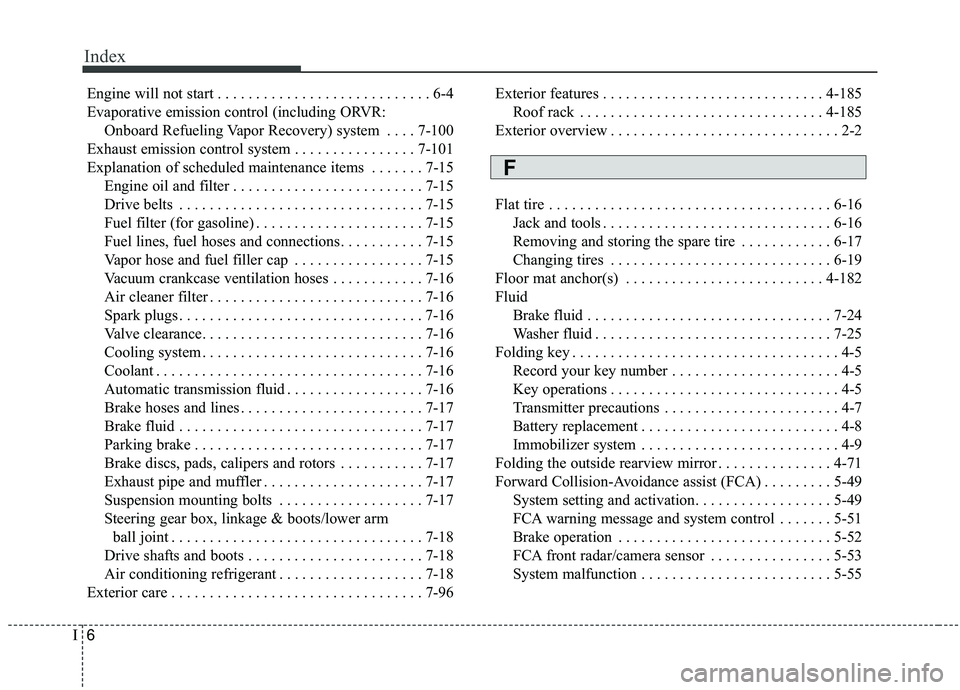
Engine will not start . . . . . . . . . . . . . . . . . . . . . . . . . . . . 6-4
Evaporative emission control (including ORVR: Onboard Refueling Vapor Recovery) system . . . . 7-100
Exhaust emission control system . . . . . . . . . . . . . . . . 7-101
Explanation of scheduled maintenance items . . . . . . . 7-15 Engine oil and filter . . . . . . . . . . . . . . . . . . . . . . . . . 7-15
Drive belts . . . . . . . . . . . . . . . . . . . . . . . . . . . . . . . . 7-15
Fuel filter (for gasoline) . . . . . . . . . . . . . . . . . . . . . . 7-15
Fuel lines, fuel hoses and connections . . . . . . . . . . . 7-15
Vapor hose and fuel filler cap . . . . . . . . . . . . . . . . . 7-15
Vacuum crankcase ventilation hoses . . . . . . . . . . . . 7-16
Air cleaner filter . . . . . . . . . . . . . . . . . . . . . . . . . . . . 7-16
Spark plugs . . . . . . . . . . . . . . . . . . . . . . . . . . . . . . . . 7-16
Valve clearance. . . . . . . . . . . . . . . . . . . . . . . . . . . . . 7-16
Cooling system . . . . . . . . . . . . . . . . . . . . . . . . . . . . . 7-16
Coolant . . . . . . . . . . . . . . . . . . . . . . . . . . . . . . . . . . . 7-\
16
Automatic transmission fluid . . . . . . . . . . . . . . . . . . 7-16
Brake hoses and lines . . . . . . . . . . . . . . . . . . . . . . . . 7-17
Brake fluid . . . . . . . . . . . . . . . . . . . . . . . . . . . . . . . . 7-17
Parking brake . . . . . . . . . . . . . . . . . . . . . . . . . . . . . . 7-17
Brake discs, pads, calipers and rotors . . . . . . . . . . . 7-17
Exhaust pipe and muffler . . . . . . . . . . . . . . . . . . . . . 7-17
Suspension mounting bolts . . . . . . . . . . . . . . . . . . . 7-17
Steering gear box, linkage & boots/lower arm ball joint . . . . . . . . . . . . . . . . . . . . . . . . . . . . . . . . . 7-18
Drive shafts and boots . . . . . . . . . . . . . . . . . . . . . . . 7-18
Air conditioning refrigerant . . . . . . . . . . . . . . . . . . . 7-18
Exterior care . . . . . . . . . . . . . . . . . . . . . . . . . . . . . . . . . 7-96 Exterior features . . . . . . . . . . . . . . . . . . . . . . . . . . . . . 4-185
Roof rack . . . . . . . . . . . . . . . . . . . . . . . . . . . . . . . . 4-185
Exterior overview . . . . . . . . . . . . . . . . . . . . . . . . . . . . . . 2-2
Flat tire . . . . . . . . . . . . . . . . . . . . . . . . . . . . . . . . . . . . \
. 6-16 Jack and tools . . . . . . . . . . . . . . . . . . . . . . . . . . . . . . 6-16
Removing and storing the spare tire . . . . . . . . . . . . 6-17
Changing tires . . . . . . . . . . . . . . . . . . . . . . . . . . . . . 6-19
Floor mat anchor(s) . . . . . . . . . . . . . . . . . . . . . . . . . . 4-182
Fluid Brake fluid . . . . . . . . . . . . . . . . . . . . . . . . . . . . . . . . 7-24
Washer fluid . . . . . . . . . . . . . . . . . . . . . . . . . . . . . . . 7-25
Folding key . . . . . . . . . . . . . . . . . . . . . . . . . . . . . . . . . . . 4-\
5 Record your key number . . . . . . . . . . . . . . . . . . . . . . 4-5
Key operations . . . . . . . . . . . . . . . . . . . . . . . . . . . . . . 4-5
Transmitter precautions . . . . . . . . . . . . . . . . . . . . . . . 4-7
Battery replacement . . . . . . . . . . . . . . . . . . . . . . . . . . 4-8
Immobilizer system . . . . . . . . . . . . . . . . . . . . . . . . . . 4-9
Folding the outside rearview mirror . . . . . . . . . . . . . . . 4-71
Forward Collision-Avoidance assist (FCA) . . . . . . . . . 5-49 System setting and activation. . . . . . . . . . . . . . . . . . 5-49
FCA warning message and system control . . . . . . . 5-51
Brake operation . . . . . . . . . . . . . . . . . . . . . . . . . . . . 5-52
FCA front radar/camera sensor . . . . . . . . . . . . . . . . 5-53
System malfunction . . . . . . . . . . . . . . . . . . . . . . . . . 5-55
F