fuel cap KIA SOUL 2009 User Guide
[x] Cancel search | Manufacturer: KIA, Model Year: 2009, Model line: SOUL, Model: KIA SOUL 2009Pages: 328, PDF Size: 29.57 MB
Page 263 of 328
Maintenance
22
7
G050500AUN Timing belt (if equipped)
Inspect all parts related to the timing belt
for damage and deformation. Replace
any damaged parts immediately.
G050600AUN
Vapor hose and fuel filler cap
The vapor hose and fuel filler cap should
be inspected at those intervals specified
in the maintenance schedule. Make sure
that a new vapor hose or fuel filler cap iscorrectly replaced. G050700AUN
Vacuum crankcase ventilation hoses (if equipped)
Inspect the surface of hoses for evidence
of heat and/or mechanical damage. Hard
and brittle rubber, cracking, tears, cuts,
abrasions, and excessive swelling indi-
cate deterioration. Particular attention
should be paid to examine those hose
surfaces nearest to high heat sources,
such as the exhaust manifold. Inspect the hose routing to assure that the hoses do not come in contact with
any heat source, sharp edges or movingcomponent which might cause heat dam-
age or mechanical wear. Inspect all hose
connections, such as clamps and cou-
plings, to make sure they are secure, and
that no leaks are present. Hoses should
be replaced immediately if there is any
evidence of deterioration or damage.G050800AUN
Air cleaner filter
A Genuine KIA air cleaner filter is recom- mended when the filter is replaced.
G050900AUN
Spark plugs (for gasoline engine)
Make sure to install new spark plugs of
the correct heat range.
G051000AU-U1
Valve clearance (if equipped)
Inspect for excessive valve noise and/or
engine vibration and adjust if necessary.
An authorized KIA dealer should perform
the operation.
Page 315 of 328
Maintenance
74
7
EMISSION CONTROL SYSTEM
G270000AUN
The emission control system of your
vehicle is covered by a written limited
warranty. Please see the warranty infor-
mation contained in the Warranty &
Maintenance booklet in your vehicle.
Your vehicle is equipped with an emis- sion control system to meet all emission
regulations. There are three emission control sys-
tems which are as follows.
(1) Crankcase emission control system
(2) Evaporative emission control system(3) Exhaust emission control system In order to assure the proper function of
the emission control systems, it is rec-
ommended that you have your vehicle
inspected and maintained by an author-
ized KIA dealer in accordance with the
maintenance schedule in this manual. Caution for the Inspection and
Maintenance Test (With Electronic
Stability Program (ESP) system)
To prevent the vehicle from misfir-
ing during dynamometer testing,
turn the Electronic Stability
Program (ESP) system off by press-
ing the ESP switch.
After dynamometer testing is com- pleted, turn the ESP system back on
by pressing the ESP switch again. G270100AUN
1. Crankcase emission control
system
The positive crankcase ventilation sys-
tem is employed to prevent air pollution
caused by blow-by gases being emitted
from the crankcase. This system supplies
fresh filtered air to the crankcase through
the air intake hose. Inside the crankcase,
the fresh air mixes with blow-by gases,
which then pass through the PCV valveinto the induction system.
G270200AUN-C1
2. Evaporative emission control system
The Evaporative Emission Control
System is designed to prevent fuel
vapors from escaping into the atmos-
phere.
Page 321 of 328
Specifications & Consumer information
4
8
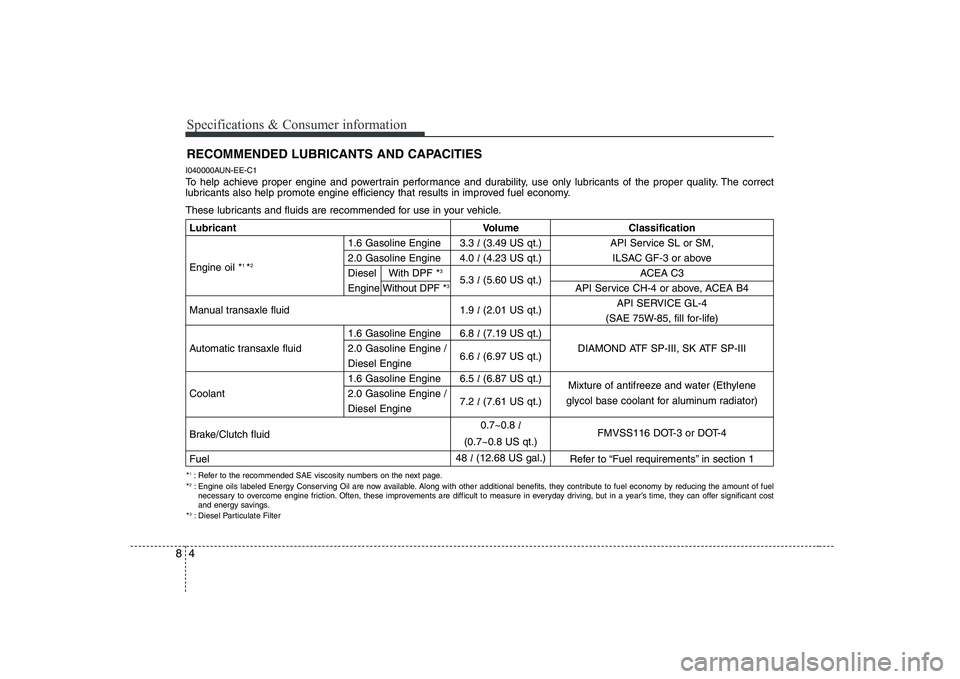
RECOMMENDED LUBRICANTS AND CAPACITIES
I040000AUN-EE-C1
To help achieve proper engine and powertrain performance and durability, use only lubricants of the proper quality. The correct
lubricants also help promote engine efficiency that results in improved fuel economy.
These lubricants and fluids are recommended for use in your vehicle.
* 1
: Refer to the recommended SAE viscosity numbers on the next page.
* 2
: Engine oils labeled Energy Conserving Oil are now available. Along with other additional benefits, they contribute to fuel economy by reducing the amount of fuel
necessary to overcome engine friction. Often, these improvements are difficult to measure in everyday driving, but in a year’s time, they can offer significant cost
and energy savings.
* 3
: Diesel Particulate Filter
Lubricant Volume Classification
1.6 Gasoline Engine 3.3 l(3.49 US qt.) API Service SL or SM,
2.0 Gasoline Engine 4.0 l(4.23 US qt.) ILSAC GF-3 or above
Engine oil * 1
*2
Diesel With DPF *3
5.3 l(5.60 US qt.) ACEA C3
Engine Without DPF * 3
API Service CH-4 or above, ACEA B4
Manual transaxle fluid 1.9 l(2.01 US qt.) API SERVICE GL-4
(SAE 75W-85, fill for-life)
1.6 Gasoline Engine 6.8 l(7.19 US qt.)
Automatic transaxle fluid 2.0 Gasoline Engine / 6.6 l(6.97 US qt.) DIAMOND ATF SP-III, SK ATF SP-III
Diesel Engine
1.6 Gasoline Engine 6.5 l(6.87 US qt.)
Mixture of antifreeze and water (Ethylene
Coolant 2.0 Gasoline Engine / 7.2 l(7.61 US qt.)
Diesel Engine glycol base coolant for aluminum radiator)
Brake/Clutch fluid 0.7~0.8
l
FMVSS116 DOT-3 or DOT-4
(0.7~0.8 US qt.)
Fuel 48
l(12.68 US gal.)
Refer to “Fuel requirements” in section 1