flat tire KIA SOUL 2009 Owner's Manual
[x] Cancel search | Manufacturer: KIA, Model Year: 2009, Model line: SOUL, Model: KIA SOUL 2009Pages: 328, PDF Size: 29.57 MB
Page 284 of 328
743
Maintenance
Remove the valve cap from the tire
valve stem. Press the tire gage firm-
ly onto the valve to get a pressure
measurement. If the cold tire inflationpressure matches the recommendedpressure on the tire and loading
information label, no further adjust-
ment is necessary. If the pressure is
low, add air until you reach the rec-ommended amount.
If you overfill the tire, release air by pushing on the metal stem in the
center of the tire valve. Recheck the
tire pressure with the tire gage. Be
sure to put the valve caps back on
the valve stems. They help prevent
leaks by keeping out dirt and mois-
ture.G200400AUN
Tire rotation
To equalize tread wear, it is recom- mended that the tires be rotated
every 12,000 km (7,500 miles) or
sooner if irregular wear develops.
During rotation, check the tires for
correct balance.
When rotating tires, check for uneven
wear and damage. Abnormal wear is
usually caused by incorrect tire pres-
sure, improper wheel alignment, out-
of-balance wheels, severe braking or
severe cornering. Look for bumps or
bulges in the tread or side of tire.
Replace the tire if you find either of
these conditions. Replace the tire if
fabric or cord is visible. After rotation,
be sure to bring the front and rear tire
pressures to specification and check
lug nut tightness.
Refer to “Tire and wheels” in section 8.
WARNING
Inspect your tires frequently for proper inflation as well as
wear and damage. Always use
a tire pressure gauge.
Tires with too much or too little pressure wear unevenly caus-
ing poor handling, loss of vehi-
cle control, and sudden tirefailure leading to accidents,
injuries, and even death. Therecommended cold tire pres-
sure for your vehicle can be
found in this manual and onthe tire label located on the dri-
ver's side center pillar.
Worn tires can cause acci- dents. Replace tires that are
worn, show uneven wear, or
are damaged.
Remember to check the pres- sure of your spare tire. KIA
recommends that you check
the spare every time you
check the pressure of the
other tires on your vehicle.
Page 287 of 328
Maintenance
46
7
G200601AUN
Compact spare tire replacement (if
equipped)
A compact spare tire has a shorter
tread life than a regular size tire.
Replace it when you can see the
tread wear indicator bars on the tire.The replacement compact spare tire
should be the same size and design
tire as the one provided with your
new vehicle and should be mountedon the same compact spare tire
wheel. The compact spare tire is notdesigned to be mounted on a regular
size wheel, and the compact spare
tire wheel is not designed for mount-
ing a regular size tire. G200700BUN Wheel replacement
When replacing the metal wheels for
any reason, make sure the new
wheels are equivalent to the original
factory units in diameter, rim widthand offset.
G200800AUN-U1 Tire traction
Tire traction can be reduced if you
drive on worn tires, tires that are
improperly inflated or on slippery
road surfaces. Tires should be
replaced when tread wear indicators
appear. Slow down whenever there
is rain, snow or ice on the road, toreduce the possibility of losing con-
trol of the vehicle. G200900ASA Tire maintenance In addition to proper inflation, correct wheel alignment helps decrease tire
wear. If you find a tire worn unevenly,
have your dealer check the wheelalignment.
When you have new tires installed,
make sure they are balanced. This
will increase vehicle ride comfort and
tire life. Additionally, a tire should
always be rebalanced if it is removedfrom the wheel.
WARNING
A wheel that is not the correct
size may adversely affect wheel
and bearing life, braking and
stopping abilities, handling
characteristics, ground clear-
ance, body-to-tire clearance,
snow chain clearance,speedometer and odometer cal-
ibration, headlight aim and
bumper height.
Page 290 of 328
749
Maintenance
G201005AUN
5. Maximum permissible inflationpressure
This number is the greatest amount of air pressure that should be put in
the tire. Do not exceed the maximum
permissible inflation pressure. Refer
to the Tire and Loading Information
label for recommended inflation
pressure.
G201006AUN
6. Maximum load rating
This number indicates the maximum
load in kilograms and pounds that
can be carried by the tire. When
replacing the tires on the vehicle,
always use a tire that has the same
load rating as the factory installed
tire. G2010007AEN
7. Uniform tire quality grading
Quality grades can be found where
applicable on the tire sidewall
between tread shoulder and maxi-
mum section width.
For example:
TREAD wear 200
TRACTION AA
TEMPERATUE A
Tread wear
The tread wear grade is a compara-
tive rating based on the wear rate ofthe tire when tested under controlled
conditions on a specified govern-
ment test course. For example, a tire
graded 150 would wear one-and-a-
half times (1½) as well on the gov-
ernment course as a tire graded 100.
The relative performance of tires depends upon the actual conditions
of their use, however, and may
depart significantly from the norm
due to variations in driving habits,
service practices and differences in
road characteristics and climate.These grades are molded on the
side-walls of passenger vehicle tires.
The tires available as standard or
optional equipment on your vehicle
may vary with respect to grade.
Traction - AA, A, B & C
The traction grades, from highest to
lowest, are AA, A, B and C. Those
grades represent the tire’s ability to
stop on wet pavement measuredunder controlled conditions on spec-
ified government test surfaces of
asphalt and concrete. A tire marked
C may have poor traction perform-
ance.
WARNING
The traction grade assigned to this tire is based on straight-ahead braking traction tests,
and does not include accelera-
tion, cornering, hydroplaning,
or peak traction characteristics.
Page 291 of 328
Maintenance
50
7
Temperature -A, B & C
The temperature grades are A (the
highest), B, and C, representing the
tire’s resistance to the generation ofheat and its ability to dissipate heatwhen tested under controlled condi-
tions on a specified indoor laboratorytest wheel.
Sustained high temperature can
cause the material of the tire to
degenerate and reduce tire life, and
excessive temperature can lead to
sudden tire failure. Grades B and A
represent higher levels of perform-
ance on the laboratory test wheel
than the minimum required by law.
WARNING - Tire
temperature
The temperature grade for this
tire is established for a tire that
is properly inflated and not
overloaded. Excessive speed,
underinflation, or excessive
loading, either separately or in
combination, can cause heat
build-up and sudden tire failure.
This can cause loss of vehicle
control and serious injury ordeath.
Page 320 of 328
83
Specifications & Consumer information
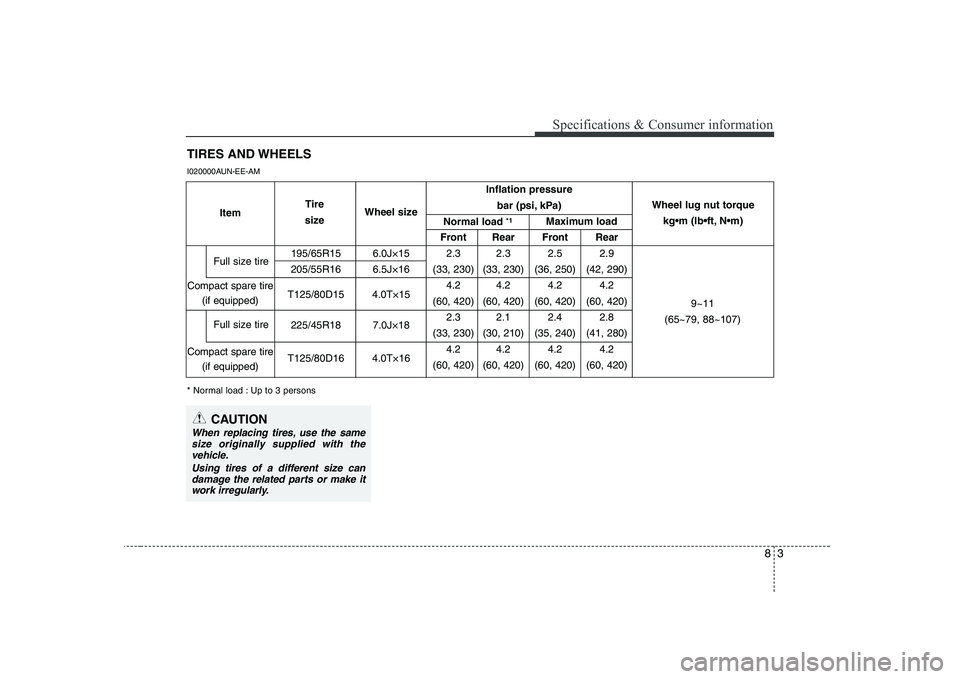
TIRES AND WHEELS
* Normal load : Up to 3 persons
I020000AUN-EE-AM
Inflation pressure
bar (psi, kPa)
Front Rear Front Rear
195/65R15 6.0J×15 2.3 2.3 2.5 2.9
205/55R16 6.5J×16 (33, 230) (33, 230) (36, 250) (42, 290) 4.2 4.2 4.2 4.2
T125/80D15 4.0T×15 (60, 420) (60, 420) (60, 420) (60, 420)
225/45R18 7.0J×18 2.3 2.1 2.4 2.8
(33, 230) (30, 210) (35, 240) (41, 280) 4.2 4.2 4.2 4.2
T125/80D16 4.0T×16 (60, 420) (60, 420) (60, 420) (60, 420)
Full size tire
Compact spare tire (if equipped)
Compact spare tire (if equipped) Wheel lug nut torque
9~11
(65~79, 88~107)
Item
Tire
size Wheel size
Normal load *1
Maximum load
CAUTION
When replacing tires, use the same
size originally supplied with thevehicle.
Using tires of a different size candamage the related parts or make it
work irregularly.
Full size tire
Page 327 of 328
I3
Index
If the engine overheats·····················································6-6
If the engine will not start ···············································6-3
If you have a flat tire (with spare tire) ····························6-7
In case of an emergency while driving····························6-2
Indicator symbols on the instrument cluster ···················1-6
Instrument cluster ··························································4-31
Instrument panel overview ··············································2-3
Interior features······························································4-72
Interior light ···································································4-57
Interior overview ·····························································2-2
Key positions ···································································5-4
Keys ·················································································4-2
Light bulbs ·····································································7-60
Lighting··········································································4-49
Maintenance services ·······················································7-4
Manual climate control system······································4-59 Manual transaxle······························································5-7
Mirrors ···········································································4-27
Owner maintenance ·························································7-6
Parking brake ································································7-32
Rear parking assist system·············································4-45
Rearview camera ···························································4-48
Recommended lubricants and capacities ·························8-4
Remote keyless entry ·······················································4-4
Road warning ···································································6-2
Scheduled maintenance service ·······································7-8
Seat belts ········································································3-13
Seats ·················································································3-2
Special driving conditions ·············································5-31
Starting the engine ···························································5-5
Steering wheel································································4-25
I
K
L
M
O
P
R
S