ECU KIA Soul 2014 2.G User Guide
[x] Cancel search | Manufacturer: KIA, Model Year: 2014, Model line: Soul, Model: KIA Soul 2014 2.GPages: 500, PDF Size: 13.89 MB
Page 49 of 500
333
Safety features of your vehicle
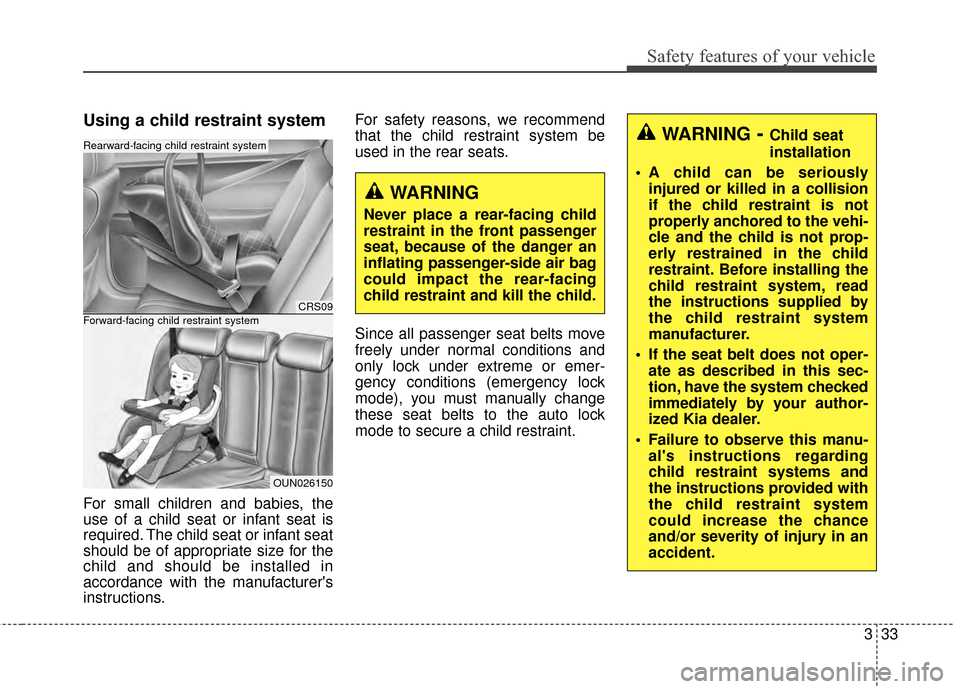
Using a child restraint system
For small children and babies, the
use of a child seat or infant seat is
required. The child seat or infant seat
should be of appropriate size for the
child and should be installed in
accordance with the manufacturer's
instructions.For safety reasons, we recommend
that the child restraint system be
used in the rear seats.
Since all passenger seat belts move
freely under normal conditions and
only lock under extreme or emer-
gency conditions (emergency lock
mode), you must manually change
these seat belts to the auto lock
mode to secure a child restraint.
CRS09
OUN026150
Forward-facing child restraint system
Rearward-facing child restraint system
WARNING
Never place a rear-facing child
restraint in the front passenger
seat, because of the danger an
inflating passenger-side air bag
could impact the rear-facing
child restraint and kill the child.
WARNING- Child seat
installation
A child can be seriously injured or killed in a collision
if the child restraint is not
properly anchored to the vehi-
cle and the child is not prop-
erly restrained in the child
restraint. Before installing the
child restraint system, read
the instructions supplied by
the child restraint system
manufacturer.
If the seat belt does not oper- ate as described in this sec-
tion, have the system checked
immediately by your author-
ized Kia dealer.
Failure to observe this manu- al's instructions regarding
child restraint systems and
the instructions provided with
the child restraint system
could increase the chance
and/or severity of injury in an
accident.
Page 50 of 500
Safety features of your vehicle
34
3
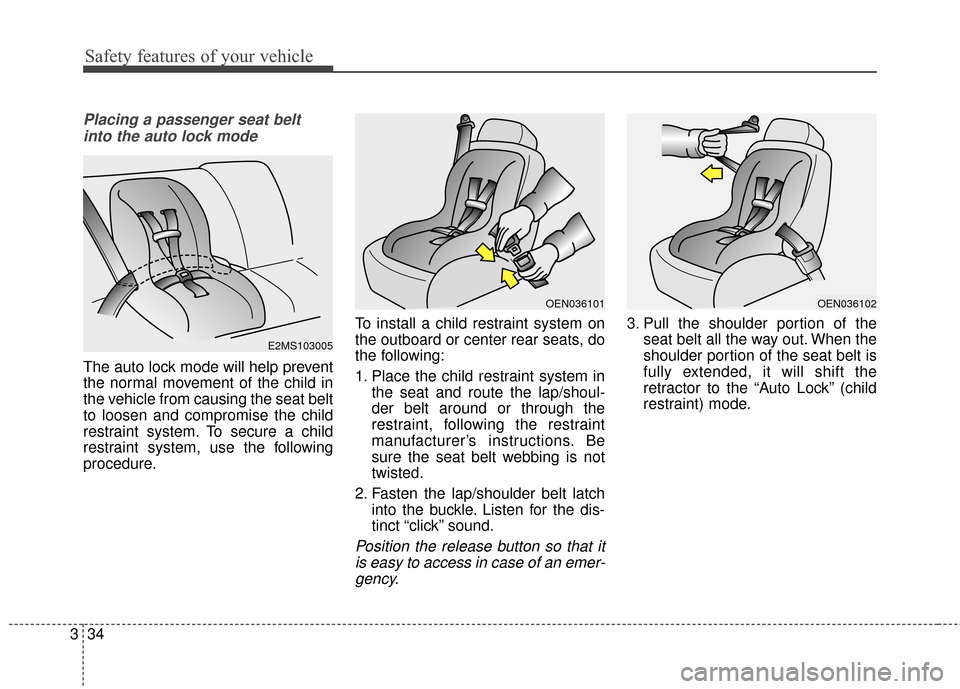
Placing a passenger seat belt
into the auto lock mode
The auto lock mode will help prevent
the normal movement of the child in
the vehicle from causing the seat belt
to loosen and compromise the child
restraint system. To secure a child
restraint system, use the following
procedure. To install a child restraint system on
the outboard or center rear seats, do
the following:
1. Place the child restraint system in
the seat and route the lap/shoul-
der belt around or through the
restraint, following the restraint
manufacturer’s instructions. Be
sure the seat belt webbing is not
twisted.
2. Fasten the lap/shoulder belt latch into the buckle. Listen for the dis-
tinct “click” sound.
Position the release button so that itis easy to access in case of an emer-gency.
3. Pull the shoulder portion of the seat belt all the way out. When the
shoulder portion of the seat belt is
fully extended, it will shift the
retractor to the “Auto Lock” (child
restraint) mode.
E2MS103005
OEN036101OEN036102
Page 52 of 500
Safety features of your vehicle
36
3
When the seat belt is allowed to
retract to its fully stowed position,
the retractor will automatically
switch from the “Auto Lock” mode
to the emergency lock mode for
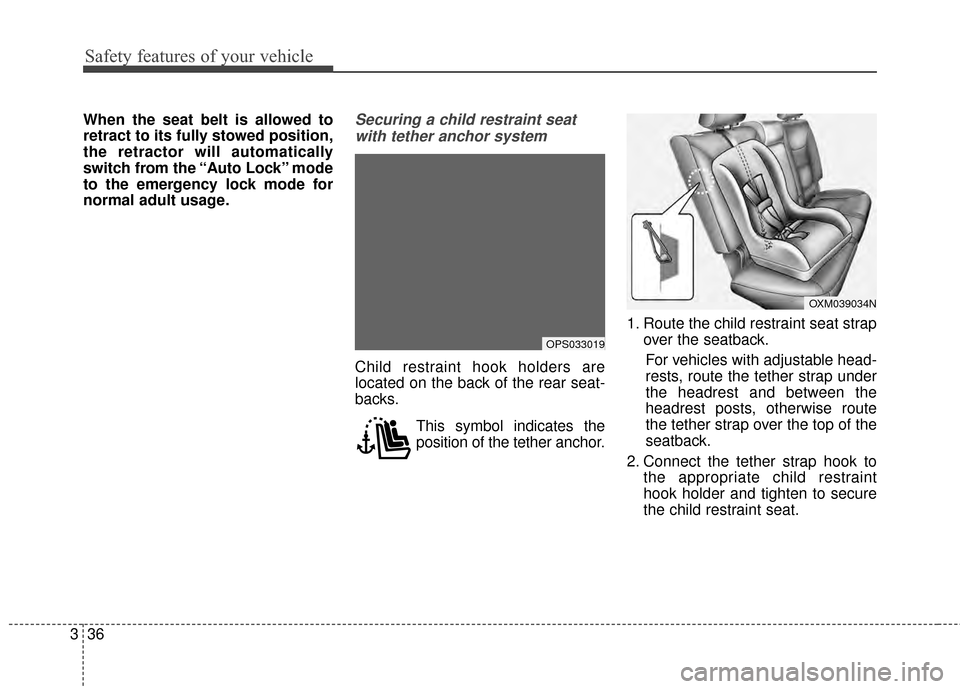
normal adult usage.Securing a child restraint seat
with tether anchor system
Child restraint hook holders are
located on the back of the rear seat-
backs.
This symbol indicates the
position of the tether anchor. 1. Route the child restraint seat strap
over the seatback.
For vehicles with adjustable head-
rests, route the tether strap under
the headrest and between the
headrest posts, otherwise route
the tether strap over the top of the
seatback.
2. Connect the tether strap hook to the appropriate child restraint
hook holder and tighten to secure
the child restraint seat.
OXM039034N
OPS033019
Page 53 of 500
337
Safety features of your vehicle
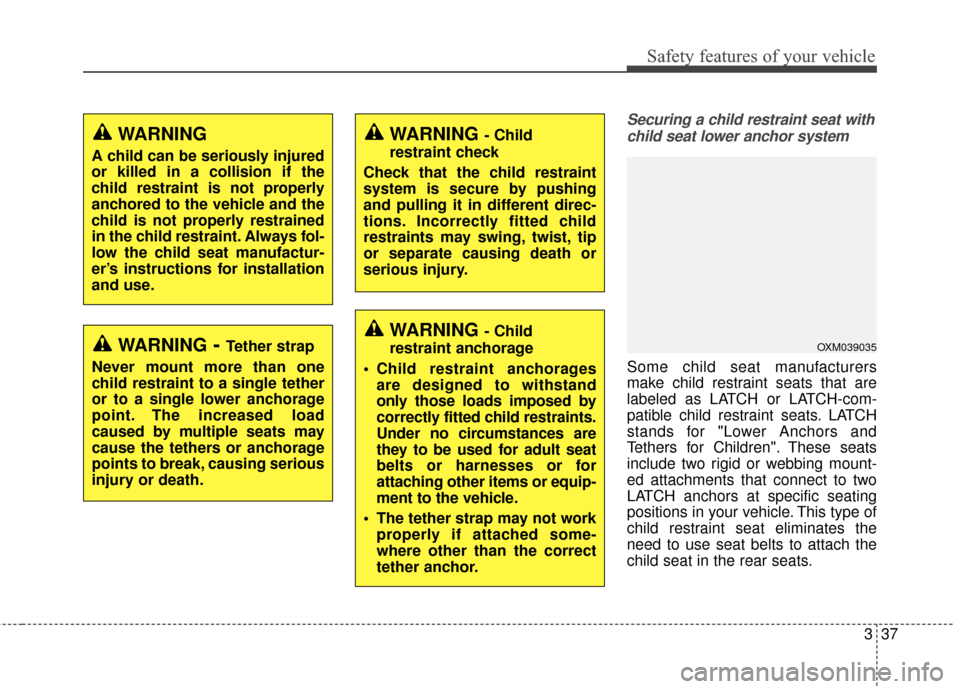
Securing a child restraint seat withchild seat lower anchor system
Some child seat manufacturers
make child restraint seats that are
labeled as LATCH or LATCH-com-
patible child restraint seats. LATCH
stands for "Lower Anchors and
Tethers for Children". These seats
include two rigid or webbing mount-
ed attachments that connect to two
LATCH anchors at specific seating
positions in your vehicle. This type of
child restraint seat eliminates the
need to use seat belts to attach the
child seat in the rear seats.
WARNING - Child
restraint check
Check that the child restraint
system is secure by pushing
and pulling it in different direc-
tions. Incorrectly fitted child
restraints may swing, twist, tip
or separate causing death or
serious injury.
WARNING - Child
restraint anchorage
Child restraint anchorages are designed to withstand
only those loads imposed by
correctly fitted child restraints.
Under no circumstances are
they to be used for adult seat
belts or harnesses or for
attaching other items or equip-
ment to the vehicle.
The tether strap may not work properly if attached some-
where other than the correct
tether anchor.OXM039035WARNING- Tether strap
Never mount more than one
child restraint to a single tether
or to a single lower anchorage
point. The increased load
caused by multiple seats may
cause the tethers or anchorage
points to break, causing serious
injury or death.
WARNING
A child can be seriously injured
or killed in a collision if the
child restraint is not properly
anchored to the vehicle and the
child is not properly restrained
in the child restraint. Always fol-
low the child seat manufactur-
er’s instructions for installation
and use.
Page 54 of 500
Safety features of your vehicle
38
3
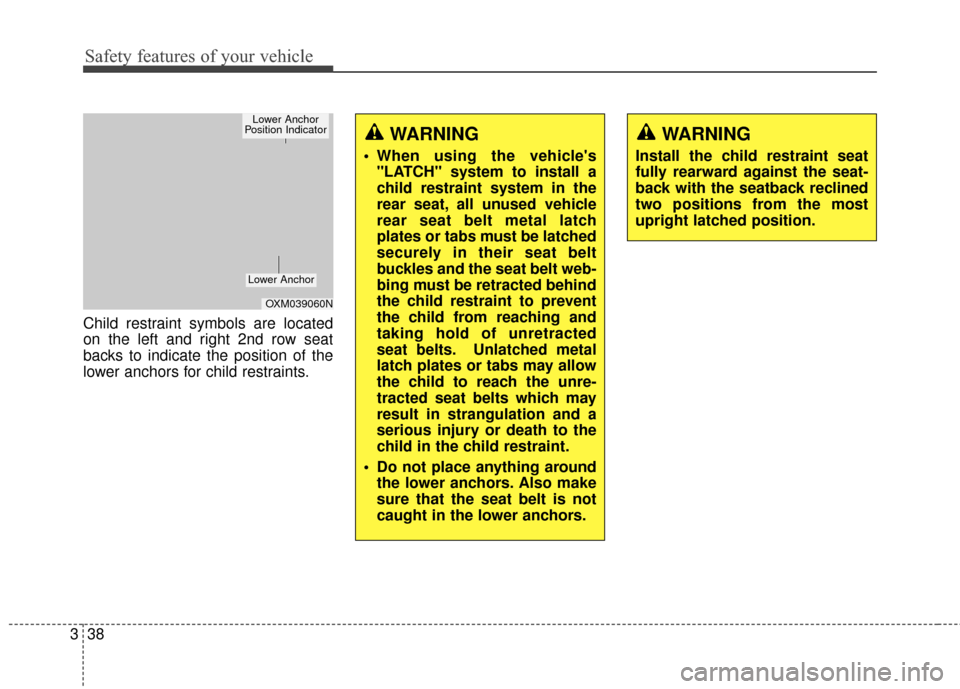
Child restraint symbols are located
on the left and right 2nd row seat
backs to indicate the position of the
lower anchors for child restraints.
OXM039060N
Lower Anchor
Lower Anchor
Position Indicator
WARNING
When using the vehicle's
"LATCH" system to install a
child restraint system in the
rear seat, all unused vehicle
rear seat belt metal latch
plates or tabs must be latched
securely in their seat belt
buckles and the seat belt web-
bing must be retracted behind
the child restraint to prevent
the child from reaching and
taking hold of unretracted
seat belts. Unlatched metal
latch plates or tabs may allow
the child to reach the unre-
tracted seat belts which may
result in strangulation and a
serious injury or death to the
child in the child restraint.
Do not place anything around the lower anchors. Also make
sure that the seat belt is not
caught in the lower anchors.
WARNING
Install the child restraint seat
fully rearward against the seat-
back with the seatback reclined
two positions from the most
upright latched position.
Page 59 of 500
343
Safety features of your vehicle
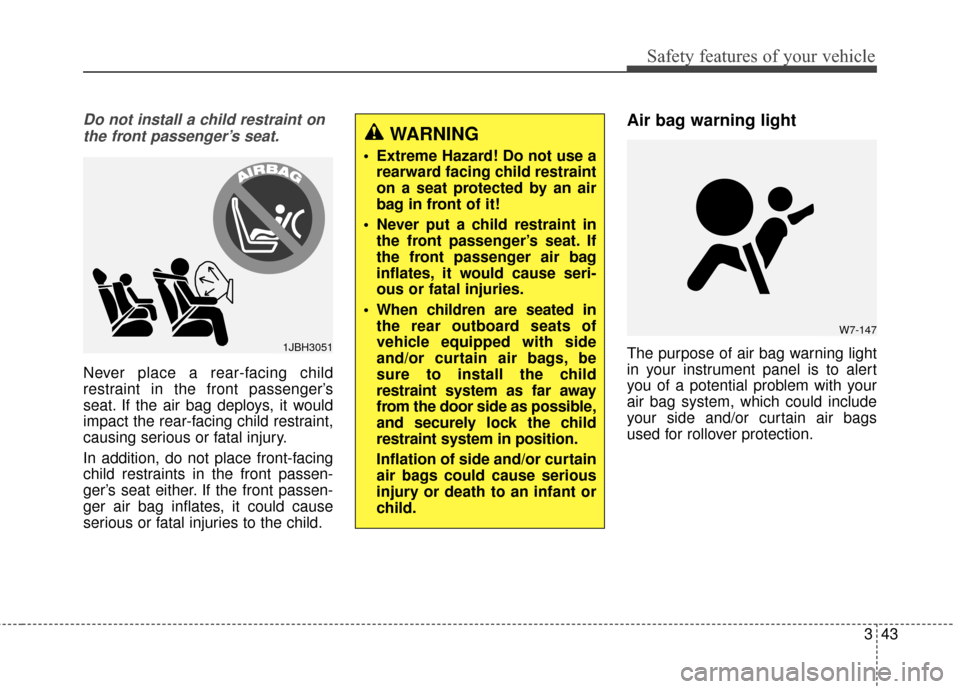
Do not install a child restraint onthe front passenger’s seat.
Never place a rear-facing child
restraint in the front passenger’s
seat. If the air bag deploys, it would
impact the rear-facing child restraint,
causing serious or fatal injury.
In addition, do not place front-facing
child restraints in the front passen-
ger’s seat either. If the front passen-
ger air bag inflates, it could cause
serious or fatal injuries to the child.
Air bag warning light
The purpose of air bag warning light
in your instrument panel is to alert
you of a potential problem with your
air bag system, which could include
your side and/or curtain air bags
used for rollover protection.1JBH3051
WARNING
Extreme Hazard! Do not use a rearward facing child restraint
on a seat protected by an air
bag in front of it!
Never put a child restraint in the front passenger’s seat. If
the front passenger air bag
inflates, it would cause seri-
ous or fatal injuries.
When children are seated in the rear outboard seats of
vehicle equipped with side
and/or curtain air bags, be
sure to install the child
restraint system as far away
from the door side as possible,
and securely lock the child
restraint system in position.
Inflation of side and/or curtain
air bags could cause serious
injury or death to an infant or
child.
W7-147
Page 68 of 500
Safety features of your vehicle
52
3
WARNING
Even though your vehicle is
equipped with the occupant
detection system, never install a
child restraint system in the
front passenger's seat. A
deploying air bag can forcefully
strike a child resulting in seri-
ous injuries or death. Any child
age 12 and under should ride in
the rear seat. Children too large
for child restraints should use
the available lap/shoulder belts.
No matter what type of crash,
children of all ages are safer
when restrained in the rear seat.
If the PASSENGER AIR BAG “OFF” indicator is illuminated
when the front passenger's seat
is occupied by an adult and
he/she sits properly (sitting
upright with the seatback in an
upright position, centered on
the seat cushion with their seat
belt on, legs comfortably
extended and their feet on the
floor), have that person sit in the
rear seat.
(Continued)
(Continued)
Accident statistics show thatchildren are safer if they are
restrained in the rear, as
opposed to the front seat. It is
recommended that child
restraints be secured in a rear
seat, including an infant riding
in a rear-facing infant seat, a
child riding in a forward-facing
child seat and an older child
riding in a booster seat.
Air bags can only be used once – have an authorized Kia
dealer replace the air bag
immediately after deployment.
The occupant detection sys- tem may not work properly if
water, coffee or any other liq-
uid including rain gets on the
seat. Keep the front seat dry
at all times.
(Continued)(Continued)
If the front passenger seat isoccupied by a child who is not
in a CRS, the "PASSENGER
AIR BAG OFF" indicator may
or may not be on and the pas-
senger air bag may or may not
deploy in a collision. Have the
child move to a rear seat to
increase their safety.
Do not modify or replace the front passenger seat. Don't
place anything on or attach
anything such as a blanket or
seat heater to the front pas-
senger seat. This can adverse-
ly affect the occupant detec-
tion system.
Do not place sharp objects on the front passenger seat.
These may damage the occu-
pant detection system, if they
puncture the seat cushion.
Do not use accessory seat covers on the front seats.
(Continued)
Page 77 of 500
361
Safety features of your vehicle
They are designed to help protect
occupants in certain side impacts
and to help prevent them from eject-
ing out of the vehicle as a result of a
rollover, especially when the seat-
belts are also in use.
to deploy during certain side
impact collisions, depending on the
crash severity, angle, speed and
point of impact.
The side and/or curtain air bags do not only deploy on the side of
the impact but also on the opposite
side.
Also, the curtain air bags on both sides of the vehicle will deploy in
certain rollover situations.
The curtain air bags are not designed to deploy in all side
impact or rollover situations.
WARNING
In order for side and curtainair bags to provide the best
protection, front seat occu-
pants and outboard rear occu-
pants should sit in an upright
position with the seat belts
properly fastened.
Importantly, children should
sit in a proper child restraint
system in the rear seat.
When children are seated in the rear outboard seats, they
must be seated in the proper
child restraint system. Make
sure to position the child
restraint system as far away
from the door side as possi-
ble, and secure the child
restraint system in a locked
position.
(Continued)
(Continued)
Do not allow the passengersto lean their heads or bodies
against the doors, put their
arms on the doors, stretch
their arms out of the window
or place objects between the
doors and passengers when
they are seated on seats
equipped with side impact
and/or curtain air bags.
Never try to open or repair any components of the side and
curtain air bag system. This
should only be done by an
authorized Kia dealer.
Failure to follow the above men-
tioned instructions can result in
injury or death to the vehicle
occupants in an accident.
Page 105 of 500
419
Features of your vehicle
DOOR LOCKS
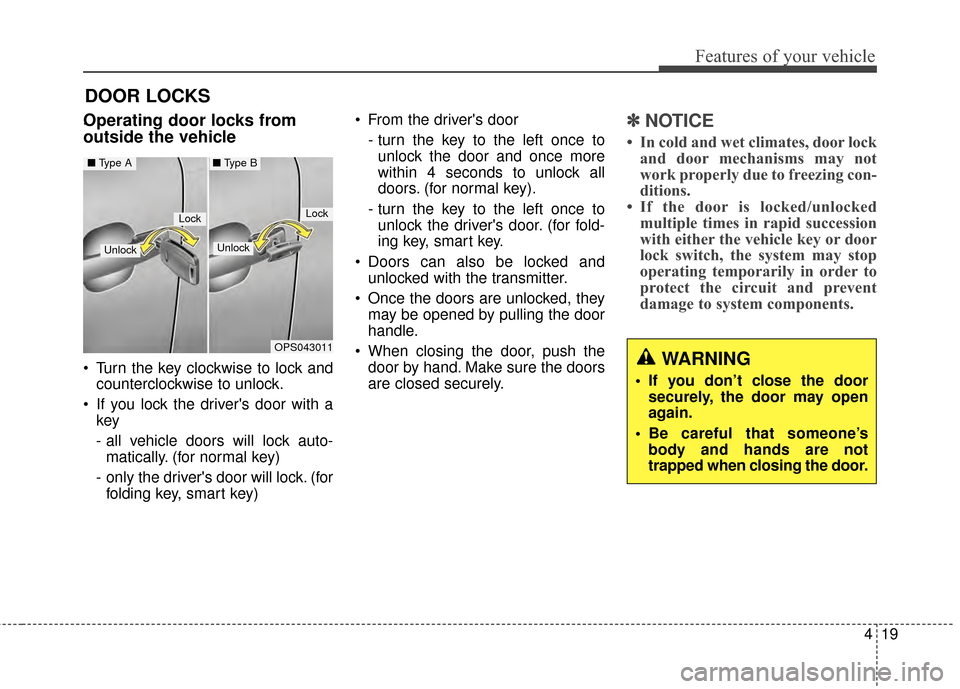
.Operating door locks from
outside the vehicle
Turn the key clockwise to lock andcounterclockwise to unlock.
If you lock the driver's door with a key
- all vehicle doors will lock auto-
matically. (for normal key)
- only the driver's door will lock. (for folding key, smart key) From the driver's door
- turn the key to the left once tounlock the door and once more
within 4 seconds to unlock all
doors. (for normal key).
- turn the key to the left once to unlock the driver's door. (for fold-
ing key, smart key.
Doors can also be locked and unlocked with the transmitter.
Once the doors are unlocked, they may be opened by pulling the door
handle.
When closing the door, push the door by hand. Make sure the doors
are closed securely.
✽ ✽ NOTICE
• In cold and wet climates, door lock
and door mechanisms may not
work properly due to freezing con-
ditions.
• If the door is locked/unlocked multiple times in rapid succession
with either the vehicle key or door
lock switch, the system may stop
operating temporarily in order to
protect the circuit and prevent
damage to system components.
OPS043011
LockLock
Unlock
■ Type A■ Type B
Unlock
WARNING
If you don’t close the door
securely, the door may open
again.
Be careful that someone’s body and hands are not
trapped when closing the door.
Page 110 of 500
Features of your vehicle
24
4
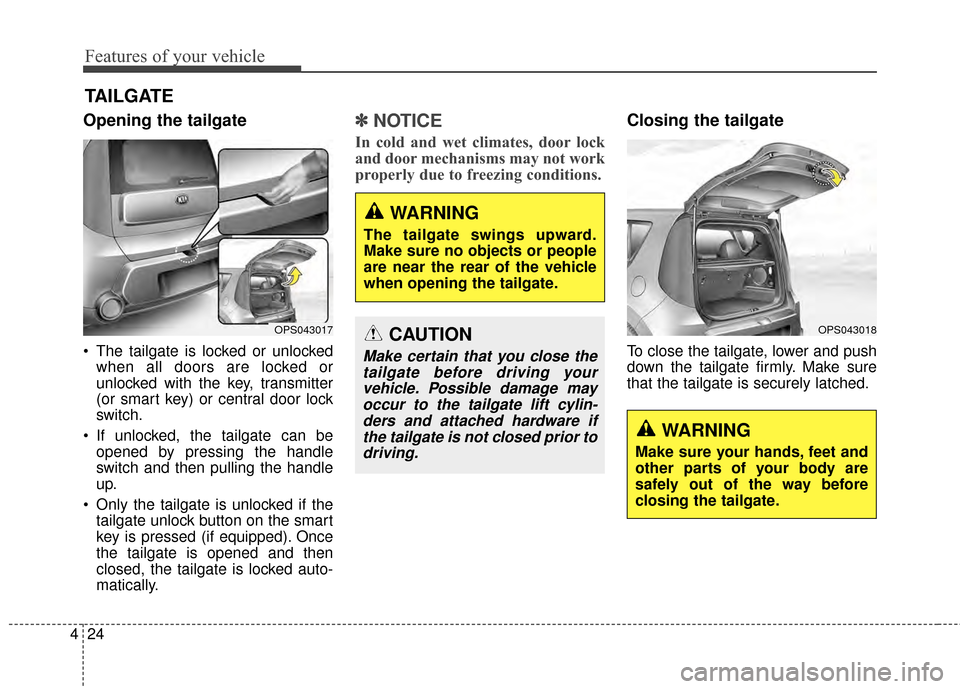
Opening the tailgate
The tailgate is locked or unlocked
when all doors are locked or
unlocked with the key, transmitter
(or smart key) or central door lock
switch.
If unlocked, the tailgate can be opened by pressing the handle
switch and then pulling the handle
up.
Only the tailgate is unlocked if the tailgate unlock button on the smart
key is pressed (if equipped). Once
the tailgate is opened and then
closed, the tailgate is locked auto-
matically.
✽ ✽ NOTICE
In cold and wet climates, door lock
and door mechanisms may not work
properly due to freezing conditions.
Closing the tailgate
To close the tailgate, lower and push
down the tailgate firmly. Make sure
that the tailgate is securely latched.
TAILGATE
WARNING
The tailgate swings upward.
Make sure no objects or people
are near the rear of the vehicle
when opening the tailgate.
CAUTION
Make certain that you close the
tailgate before driving yourvehicle. Possible damage mayoccur to the tailgate lift cylin-ders and attached hardware ifthe tailgate is not closed prior todriving.
OPS043017OPS043018
WARNING
Make sure your hands, feet and
other parts of your body are
safely out of the way before
closing the tailgate.