engine KIA Soul 2014 2.G User Guide
[x] Cancel search | Manufacturer: KIA, Model Year: 2014, Model line: Soul, Model: KIA Soul 2014 2.GPages: 500, PDF Size: 13.89 MB
Page 63 of 500
347
Safety features of your vehicle
Occupant Detection System
(ODS)
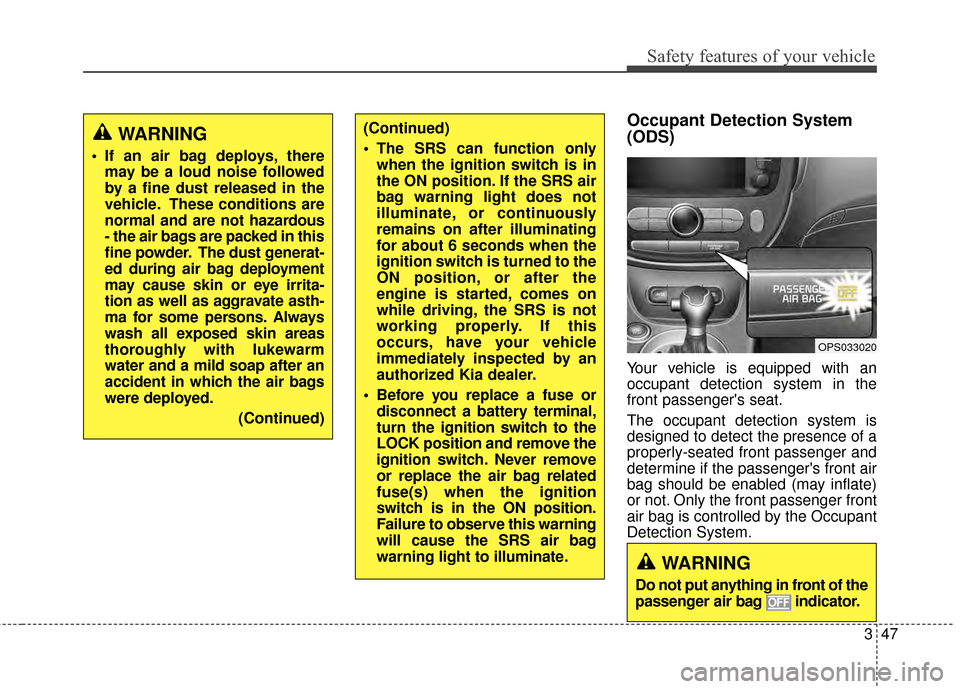
Your vehicle is equipped with an
occupant detection system in the
front passenger's seat.
The occupant detection system is
designed to detect the presence of a
properly-seated front passenger and
determine if the passenger's front air
bag should be enabled (may inflate)
or not. Only the front passenger front
air bag is controlled by the Occupant
Detection System.
WARNING
If an air bag deploys, theremay be a loud noise followed
by a fine dust released in the
vehicle. These conditions are
normal and are not hazardous
- the air bags are packed in this
fine powder. The dust generat-
ed during air bag deployment
may cause skin or eye irrita-
tion as well as aggravate asth-
ma for some persons. Always
wash all exposed skin areas
thoroughly with lukewarm
water and a mild soap after an
accident in which the air bags
were deployed.
(Continued)
(Continued)
The SRS can function onlywhen the ignition switch is in
the ON position. If the SRS air
bag warning light does not
illuminate, or continuously
remains on after illuminating
for about 6 seconds when the
ignition switch is turned to the
ON position, or after the
engine is started, comes on
while driving, the SRS is not
working properly. If this
occurs, have your vehicle
immediately inspected by an
authorized Kia dealer.
Before you replace a fuse or disconnect a battery terminal,
turn the ignition switch to the
LOCK position and remove the
ignition switch. Never remove
or replace the air bag related
fuse(s) when the ignition
switch is in the ON position.
Failure to observe this warning
will cause the SRS air bag
warning light to illuminate.
OPS033020
WARNING
Do not put anything in front of the
passenger air bag indicator.
Page 67 of 500
351
Safety features of your vehicle
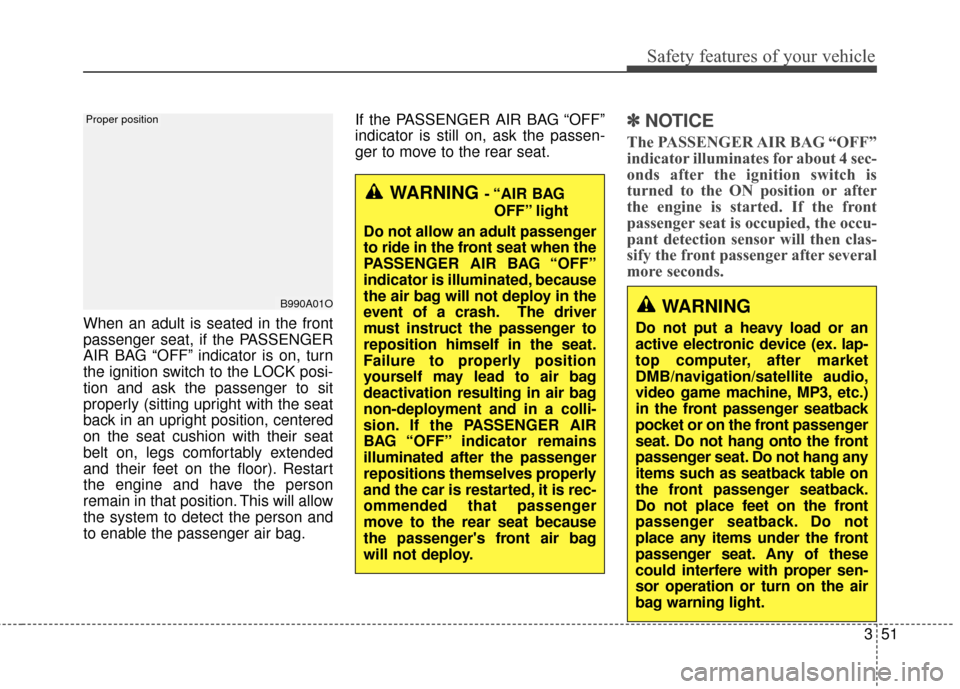
When an adult is seated in the front
passenger seat, if the PASSENGER
AIR BAG “OFF” indicator is on, turn
the ignition switch to the LOCK posi-
tion and ask the passenger to sit
properly (sitting upright with the seat
back in an upright position, centered
on the seat cushion with their seat
belt on, legs comfortably extended
and their feet on the floor). Restart
the engine and have the person
remain in that position. This will allow
the system to detect the person and
to enable the passenger air bag.If the PASSENGER AIR BAG “OFF”
indicator is still on, ask the passen-
ger to move to the rear seat.
✽ ✽
NOTICE
The PASSENGER AIR BAG “OFF”
indicator illuminates for about 4 sec-
onds after the ignition switch is
turned to the ON position or after
the engine is started. If the front
passenger seat is occupied, the occu-
pant detection sensor will then clas-
sify the front passenger after several
more seconds.
B990A01OWARNING
Do not put a heavy load or an
active electronic device (ex. lap-
top computer, after market
DMB/navigation/satellite audio,
video game machine, MP3, etc.)
in the front passenger seatback
pocket or on the front passenger
seat. Do not hang onto the front
passenger seat. Do not hang any
items such as seatback table on
the front passenger seatback.
Do not place feet on the front
passenger seatback. Do not
place any items under the front
passenger seat. Any of these
could interfere with proper sen-
sor operation or turn on the air
bag warning light.
Proper position
WARNING - “AIR BAG
OFF” light
Do not allow an adult passenger
to ride in the front seat when the
PASSENGER AIR BAG “OFF”
indicator is illuminated, because
the air bag will not deploy in the
event of a crash. The driver
must instruct the passenger to
reposition himself in the seat.
Failure to properly position
yourself may lead to air bag
deactivation resulting in air bag
non-deployment and in a colli-
sion. If the PASSENGER AIR
BAG “OFF” indicator remains
illuminated after the passenger
repositions themselves properly
and the car is restarted, it is rec-
ommended that passenger
move to the rear seat because
the passenger's front air bag
will not deploy.
Page 74 of 500
Safety features of your vehicle
58
3
(Continued)
For maximum safety protection
in all types of crashes, all occu-
pants including the driver
should always wear their seat
belts whether or not an air bag
is also provided at their seating
position to minimize the risk of
severe injury or death in the
event of a crash. Do not sit or
lean unnecessarily close to the
air bag while the vehicle is in
motion.
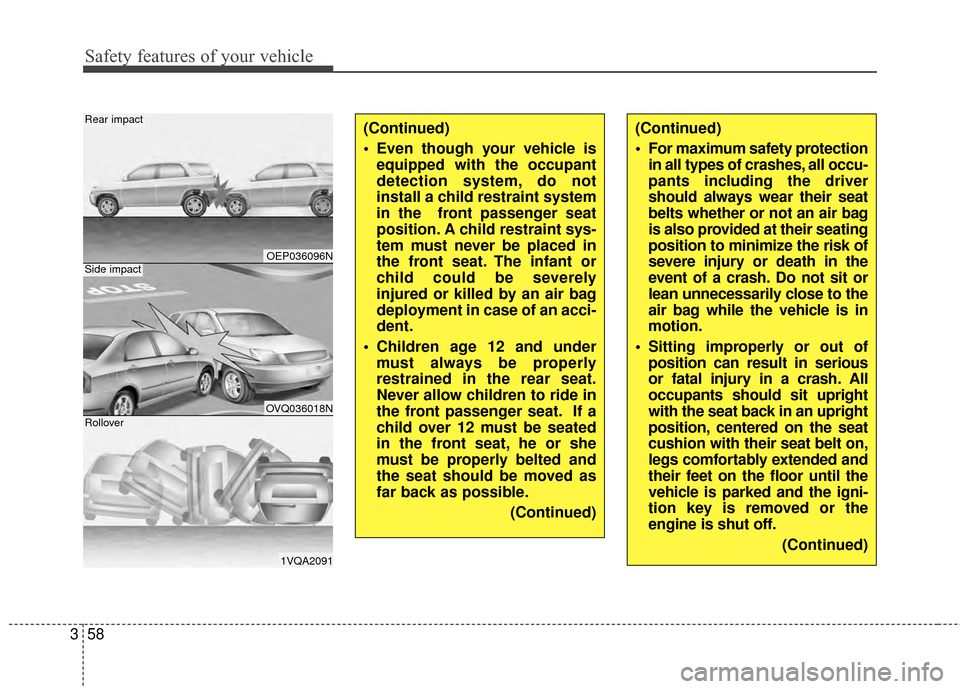
Sitting improperly or out of position can result in serious
or fatal injury in a crash. All
occupants should sit upright
with the seat back in an upright
position, centered on the seat
cushion with their seat belt on,
legs comfortably extended and
their feet on the floor until the
vehicle is parked and the igni-
tion key is removed or the
engine is shut off.
(Continued)(Continued)
Even though your vehicle isequipped with the occupant
detection system, do not
install a child restraint system
in the front passenger seat
position. A child restraint sys-
tem must never be placed in
the front seat. The infant or
child could be severely
injured or killed by an air bag
deployment in case of an acci-
dent.
Children age 12 and under must always be properly
restrained in the rear seat.
Never allow children to ride in
the front passenger seat. If a
child over 12 must be seated
in the front seat, he or she
must be properly belted and
the seat should be moved as
far back as possible.
(Continued)
OEP036096N
OVQ036018N
1VQA2091
Rear impact
Side impact
Rollover
Page 84 of 500
Safety features of your vehicle
68
3
Additional safety precautions
Never let passengers ride in the
cargo area or on top of a folded-
down back seat. All occupants
should sit upright, fully back in their
seats with their seat belts on and
their feet on the floor.
Passengers should not move
out of or change seats while the
vehicle is moving. A passenger
who is not wearing a seat belt dur-
ing a crash or emergency stop can
be thrown against the inside of the
vehicle, against other occupants,
or out of the vehicle.
Each seat belt is designed to
restrain one occupant. If more
than one person uses the same
seat belt, they could be seriously
injured or killed in a collision.
Do not use any accessories on
seat belts. Devices claiming to
improve occupant comfort or repo-
sition the seat belt can reduce the
protection provided by the seat belt
and increase the chance of serious
injury in a crash.
Passengers should not place
hard or sharp objects between
themselves and the air bags.
Carrying hard or sharp objects on
your lap or in your mouth can result
in injuries if an air bag inflates.
Keep occupants away from the
air bag covers. All occupants
should sit upright, fully back in their
seats with their seat belts on and
their feet on the floor. If occupants
are too close to the air bag covers,
they could be injured if the air bags
inflate.
Do not attach or place objects
on or near the air bag covers.
Any object attached to or placed
on the front or side air bag covers
could interfere with the proper
operation of the air bags.
Do not modify the front seats.
Modification of the front seats
could interfere with the operation of
the supplemental restraint system
sensing components or side air
bags.(Continued)
If the air bags inflate, they
must be replaced by an
authorized Kia dealer.
Do not tamper with or discon- nect SRS wiring, or other
components of the SRS sys-
tem. Doing so could result in
injury, due to accidental infla-
tion of the air bags or by ren-
dering the SRS inoperative.
If components of the air bag system must be discarded, or
if the vehicle must be
scrapped, certain safety pre-
cautions must be observed.
An authorized Kia dealer
knows these precautions and
can give you the necessary
information. Failure to follow
these precautions and proce-
dures could increase the risk
of personal injury.
If your vehicle was flooded and has soaked carpeting or
water on flooring, you should-
n't try to start the engine;
have the vehicle towed to an
authorized Kia dealer.
Page 90 of 500
Features of your vehicle
44
Record your key number
The key code num-
ber is stamped on
the key code tag
attached to the key
set. Should you
lose your keys, this number will
enable an authorized Kia dealer to
duplicate the keys easily. Remove
the key code tag and store it in a safe
place. Also, record the key code
number and keep it in a safe and
handy place, but not in the vehicle.
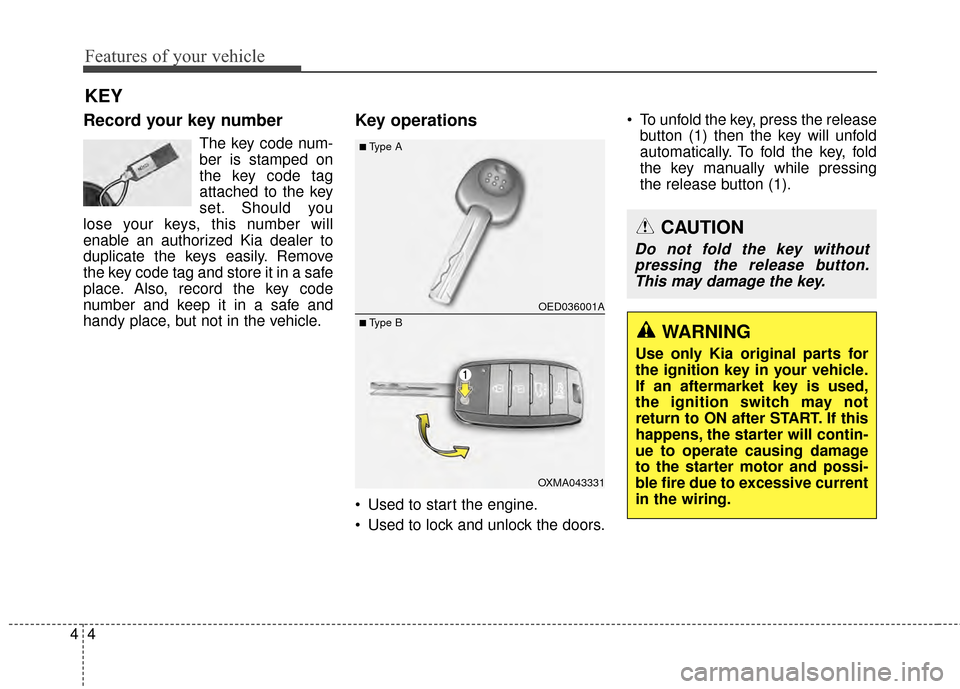
Key operations
• Used to start the engine.
Used to lock and unlock the doors. To unfold the key, press the release
button (1) then the key will unfold
automatically. To fold the key, fold
the key manually while pressing
the release button (1).
KEY
CAUTION
Do not fold the key withoutpressing the release button.This may damage the key.
WARNING
Use only Kia original parts for
the ignition key in your vehicle.
If an aftermarket key is used,
the ignition switch may not
return to ON after START. If this
happens, the starter will contin-
ue to operate causing damage
to the starter motor and possi-
ble fire due to excessive current
in the wiring.
OED036001A
OXMA043331
■Type A
■ Type B
Page 91 of 500
45
Features of your vehicle
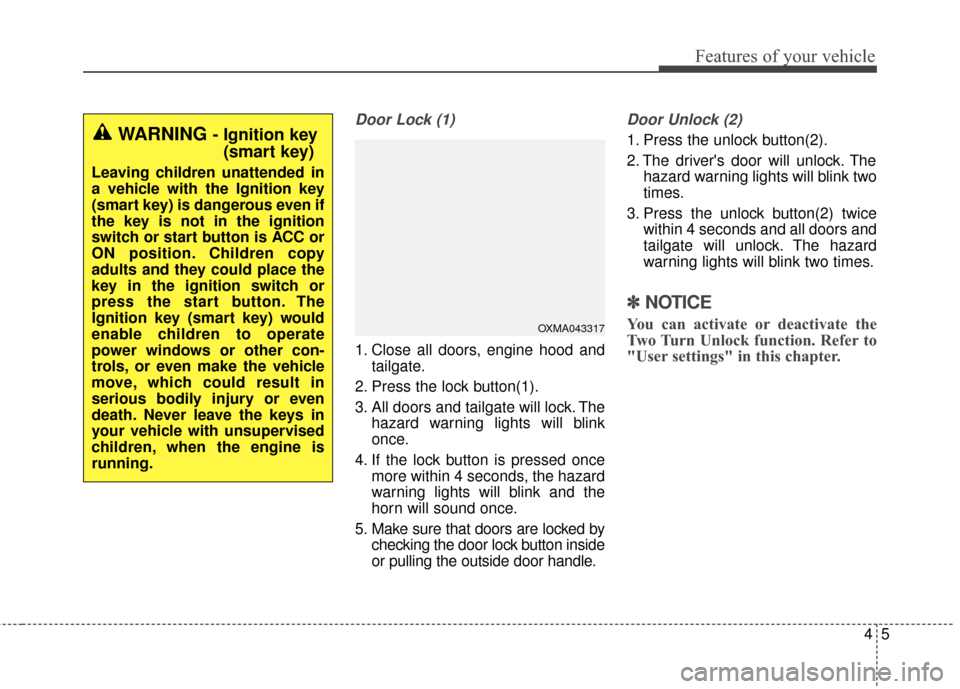
Door Lock (1)
1. Close all doors, engine hood andtailgate.
2. Press the lock button(1).
3. All doors and tailgate will lock. The hazard warning lights will blink
once.
4. If the lock button is pressed once more within 4 seconds, the hazard
warning lights will blink and the
horn will sound once.
5. Make sure that doors are locked by checking the door lock button inside
or pulling the outside door handle.
Door Unlock (2)
1. Press the unlock button(2).
2. The driver's door will unlock. Thehazard warning lights will blink two
times.
3. Press the unlock button(2) twice within 4 seconds and all doors and
tailgate will unlock. The hazard
warning lights will blink two times.
✽ ✽NOTICE
You can activate or deactivate the
Two Turn Unlock function. Refer to
"User settings" in this chapter.
WARNING - Ignition key
(smart key)
Leaving children unattended in
a vehicle with the Ignition key
(smart key) is dangerous even if
the key is not in the ignition
switch or start button is ACC or
ON position. Children copy
adults and they could place the
key in the ignition switch or
press the start button. The
Ignition key (smart key) would
enable children to operate
power windows or other con-
trols, or even make the vehicle
move, which could result in
serious bodily injury or even
death. Never leave the keys in
your vehicle with unsupervised
children, when the engine is
running.
OXMA043317
Page 94 of 500
Features of your vehicle
84
Immobilizer system
Your vehicle is equipped with an
electronic engine immobilizer system
to reduce the risk of unauthorized
vehicle use.
Your immobilizer system is com-
prised of a small transponder in the
ignition key and electronic devices
inside the vehicle.
With the immobilizer system, when-
ever you insert your ignition key into
the ignition switch and turn it to ON,
it checks and determines and verifies
if the ignition key is valid.
If the key is determined to be valid,
the engine will start.
If the key is determined to be invalid,
the engine will not start.
To activate the immobilizer sys-tem:
Turn the ignition key to the OFF posi-
tion. The immobilizer system acti-
vates automatically. Without a valid
ignition key for your vehicle, the
engine will not start.
To deactivate the immobilizersystem:
Insert the ignition key into the key
cylinder and turn it to the ON position.
✽ ✽ NOTICE
When starting the engine, do not use
the key with other immobilizer keys
around. Otherwise the engine may
not start or may stop soon after it
starts. Keep each key separate in
order to avoid a starting malfunction.
✽ ✽NOTICE
If you need additional keys or lose
your keys, contact an authorized
Kia dealer.
WARNING
In order to prevent theft of your
vehicle, do not leave spare keys
anywhere in your vehicle. Your
Immobilizer password is a cus-
tomer unique password and
should be kept confidential. Do
not leave this number anywhere
in your vehicle.
CAUTION
Do not put metal accessories
near the ignition switch.
Metal accessories may interruptthe transponder signal and mayprevent the engine from beingstarted.
Page 95 of 500
49
Features of your vehicle
This device complies with Industry
Canada Standard RSS-210.
Operation is subject to the following
two conditions:
1. This device may not cause harm-ful interference, and
2. This device must accept any inter- ference received, including inter-
ference that may cause undesired
operation.Limp home (override) proce-
dure
When you turn the ignition switch to
the ON position, if the immobilizer
indicator ( ) goes off after blink-
ing 5 times, your transponder
equipped in the ignition key is out of
order. You cannot start the engine
without the limp home procedure. To
start the engine, you have to input
your password by using the ignition
switch. Your password is only avail-
able from an authorized Kia dealer-
ship. Contact an authorized dealer
for more information.
The following procedure is how to
input your password of “2345” as an
example.
1. Turn the ignition s witch to the ON
position. The immobilizer indicator
( ) will blink 5 times and go off
indicating the beginning of the limp
home procedure.
2. Turn the ignition switch to the ACC position.
CAUTION
The transponder in your ignitionkey is an important part of theimmobilizer system. It isdesigned to give years of trou-ble-free service, however youshould avoid exposure to mois-ture, static electricity and roughhandling. Immobilizer systemmalfunction could occur.
CAUTION
Do not change, alter or adjustthe immobilizer system becauseit could cause the immobilizersystem to malfunction andshould only be serviced by anauthorized Kia dealer.
Malfunctions caused by improp-er alterations, adjustments ormodifications to the immobilizersystem are not covered by yourvehicle manufacturer warranty.
CAUTION
Changes or modifications notexpressly approved by the partyresponsible for compliancecould void the user’s authorityto operate the equipment. If thekeyless entry system is inopera-tive due to changes or modifica-tions not approved by the partyresponsible for compliance, itwill not be covered by your man-ufacturer’s vehicle warranty.
Page 96 of 500
Features of your vehicle
10
4
3. To enter the first digit (in this
example “2”), turn the ignition
switch to the ON and ACC position
twice. Perform the same proce-
dure for the next digits between 3
seconds and 10 seconds (for
example, for “3”, turn the ignition
ON and ACC 3 times).
4. If all of the digits have been input successfully, you have to start the
engine within 30 seconds. If you
attempt to start the engine after 30
seconds, the engine will not start
and you will have to input your
password again.
After performing the limp home pro-
cedure, you have to see an author-
ized Kia dealer immediately to
inspect and repair your ignition key
or immobilizer system.
Page 97 of 500
411
Features of your vehicle
Record your key number
The key code num-
ber is stamped on
the key code tag
attached to the key
set. Should you
lose your keys, this number will
enable an authorized Kia dealer to
duplicate the keys easily. Remove
the key code tag and store it in a safe
place. Also, record the key code
number and keep it in a safe and
handy place, but not in the vehicle.
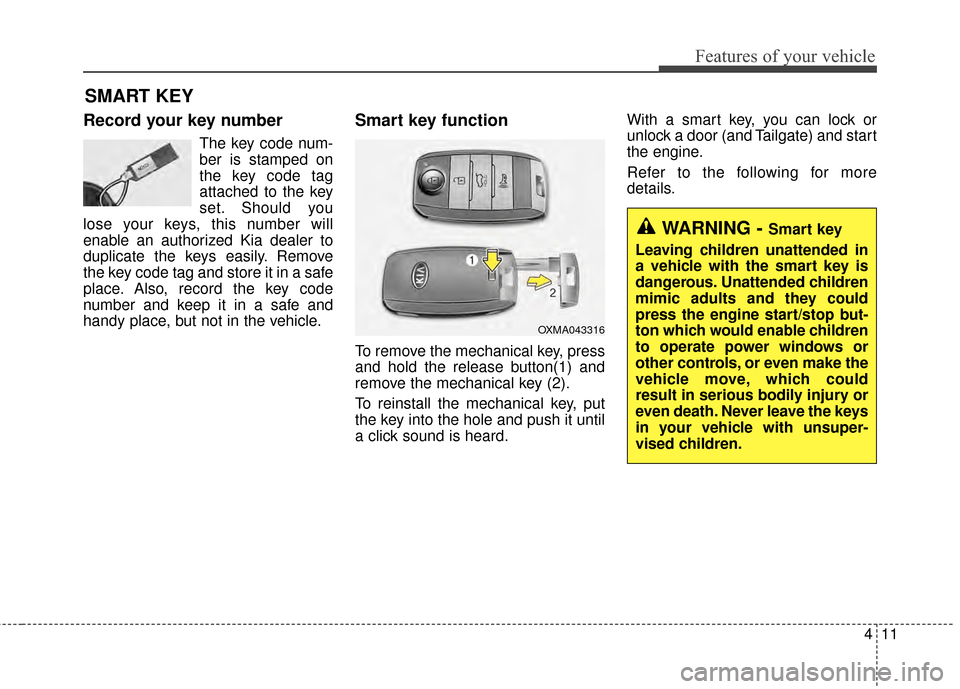
Smart key function
To remove the mechanical key, press
and hold the release button(1) and
remove the mechanical key (2).
To reinstall the mechanical key, put
the key into the hole and push it until
a click sound is heard. With a smart key, you can lock or
unlock a door (and Tailgate) and start
the engine.
Refer to the following for more
details.
SMART KEY
OXMA043316
WARNING - Smart key
Leaving children unattended in
a vehicle with the smart key is
dangerous. Unattended children
mimic adults and they could
press the engine start/stop but-
ton which would enable children
to operate power windows or
other controls, or even make the
vehicle move, which could
result in serious bodily injury or
even death. Never leave the keys
in your vehicle with unsuper-
vised children.