Button A KIA Soul 2014 2.G Owner's Manual
[x] Cancel search | Manufacturer: KIA, Model Year: 2014, Model line: Soul, Model: KIA Soul 2014 2.GPages: 500, PDF Size: 13.89 MB
Page 3 of 500

ii
1
2
3
4
5
6
7
8I
IntroductionHow to use this manual / Fuel requirements / Vehicle break-in process
Your vehicle at a glance
Exterior overview / Interior overview / Instrument panel overview / Engi\
ne compartment
Safety features of your vehicle
Seats / Seat belts / Child restraint system / Air bag
Features of your vehicleKeys / Door locks / Tailgate / Windows / Hood / Fuel filler lid / Panoramic sunroof / Steering wheel / Mirrors/ Instrument cluster / Lighting / Wipers & Washers / Climate control system / Audio system / Etc.
Driving your vehicleBefore driving / Engine start/stop button / Transaxle / Brake system / Cruise control system /
Active ECO system / Winter driving / Vehicle load limit / Etc.
What to do in an emergencyRoad warning / Emergency while driving / Emergency starting / Engine overheat / Flat tire / Towing / Etc.
MaintenanceEngine compartment / Maintenance service / Engine oil / Engine coolant /\
Brake fluid / Washer fluid /
Parking brake / Air cleaner / Wiper blades / Battery / Tire and wheels / Fuses / Etc.
Specifications & Consumer information
Index
table of contents
Page 13 of 500
Your vehicle at a glance
42
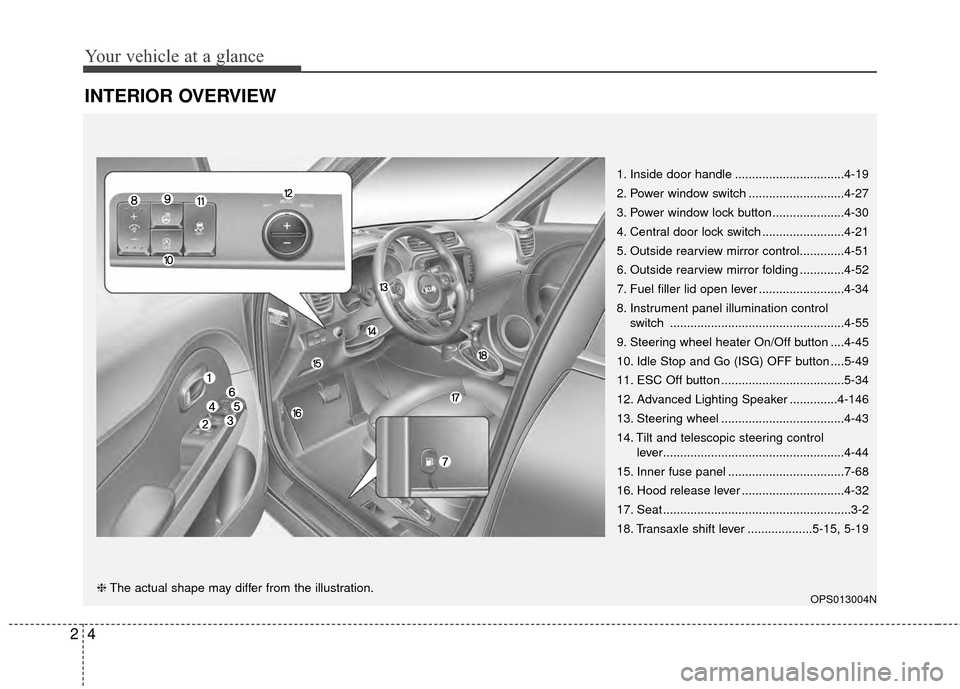
INTERIOR OVERVIEW
1. Inside door handle ................................4-19
2. Power window switch ............................4-27
3. Power window lock button .....................4-30
4. Central door lock switch ........................4-21
5. Outside rearview mirror control.............4-51
6. Outside rearview mirror folding .............4-52
7. Fuel filler lid open lever .........................4-34
8. Instrument panel illumination controlswitch ...................................................4-55
9. Steering wheel heater On/Off button ....4-45
10. Idle Stop and Go (ISG) OFF button ....5-49
11. ESC Off button ....................................5-34
12. Advanced Lighting Speaker ..............4-146
13. Steering wheel ....................................4-43
14. Tilt and telescopic steering control lever.....................................................4-44
15. Inner fuse panel ..................................7-68
16. Hood release lever ..............................4-32
17. Seat .......................................................3-2
18. Transaxle shift lever ...................5-15, 5-19
OPS013004N❈ The actual shape may differ from the illustration.
Page 14 of 500
25
Your vehicle at a glance
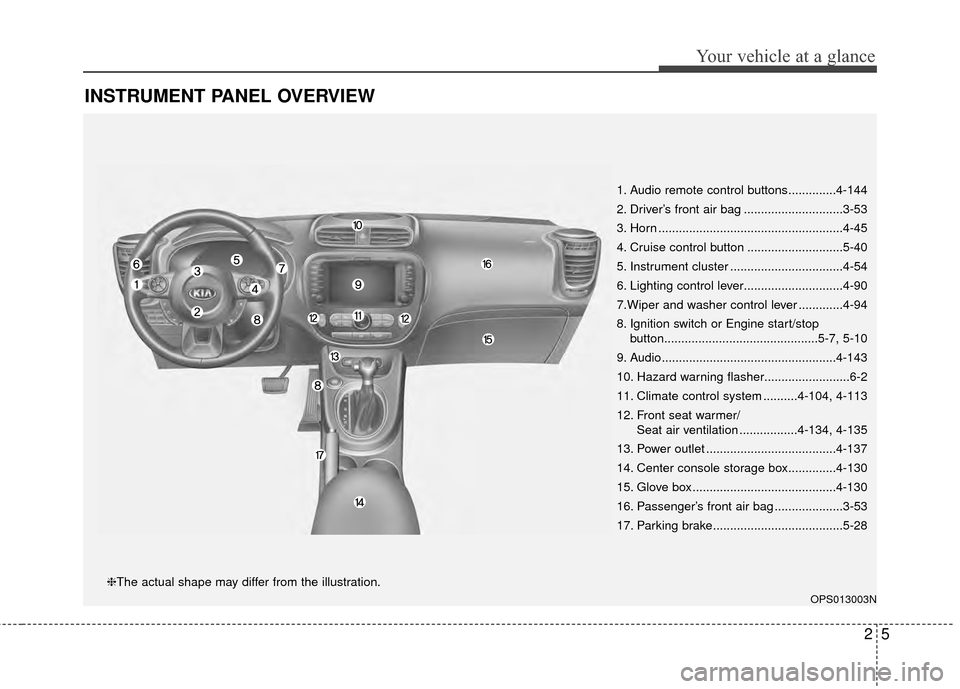
INSTRUMENT PANEL OVERVIEW
1. Audio remote control buttons..............4-144
2. Driver’s front air bag .............................3-53
3. Horn ......................................................4-45
4. Cruise control button ............................5-40
5. Instrument cluster .................................4-54
6. Lighting control lever.............................4-90
7.Wiper and washer control lever .............4-94
8. Ignition switch or Engine start/stopbutton.............................................5-7, 5-10
9. Audio...................................................4-143
10. Hazard warning flasher.........................6-2
11. Climate control system ..........4-104, 4-113
12. Front seat warmer/ Seat air ventilation .................4-134, 4-135
13. Power outlet ......................................4-137
14. Center console storage box..............4-130
15. Glove box ..........................................4-130
16. Passenger’s front air bag ....................3-53
17. Parking brake......................................5-28
OPS013003N
❈The actual shape may differ from the illustration.
Page 24 of 500
Safety features of your vehicle
83
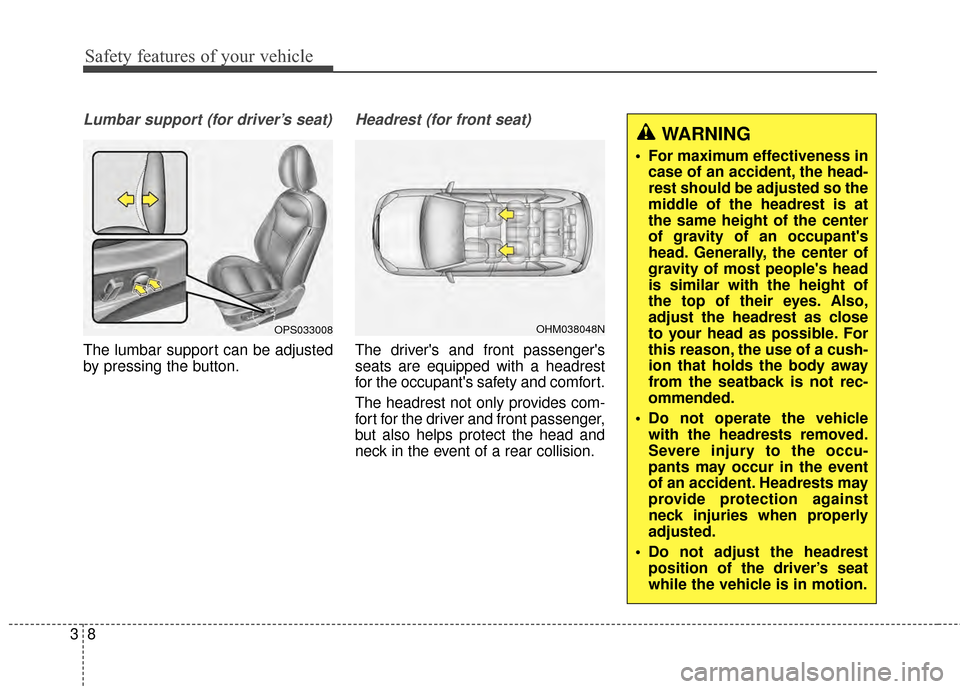
Lumbar support (for driver’s seat)
The lumbar support can be adjusted
by pressing the button.
Headrest (for front seat)
The driver's and front passenger's
seats are equipped with a headrest
for the occupant's safety and comfort.
The headrest not only provides com-
fort for the driver and front passenger,
but also helps protect the head and
neck in the event of a rear collision.
OPS033008OHM038048N
WARNING
For maximum effectiveness incase of an accident, the head-
rest should be adjusted so the
middle of the headrest is at
the same height of the center
of gravity of an occupant's
head. Generally, the center of
gravity of most people's head
is similar with the height of
the top of their eyes. Also,
adjust the headrest as close
to your head as possible. For
this reason, the use of a cush-
ion that holds the body away
from the seatback is not rec-
ommended.
Do not operate the vehicle with the headrests removed.
Severe injury to the occu-
pants may occur in the event
of an accident. Headrests may
provide protection against
neck injuries when properly
adjusted.
Do not adjust the headrest position of the driver’s seat
while the vehicle is in motion.
Page 25 of 500
39
Safety features of your vehicle
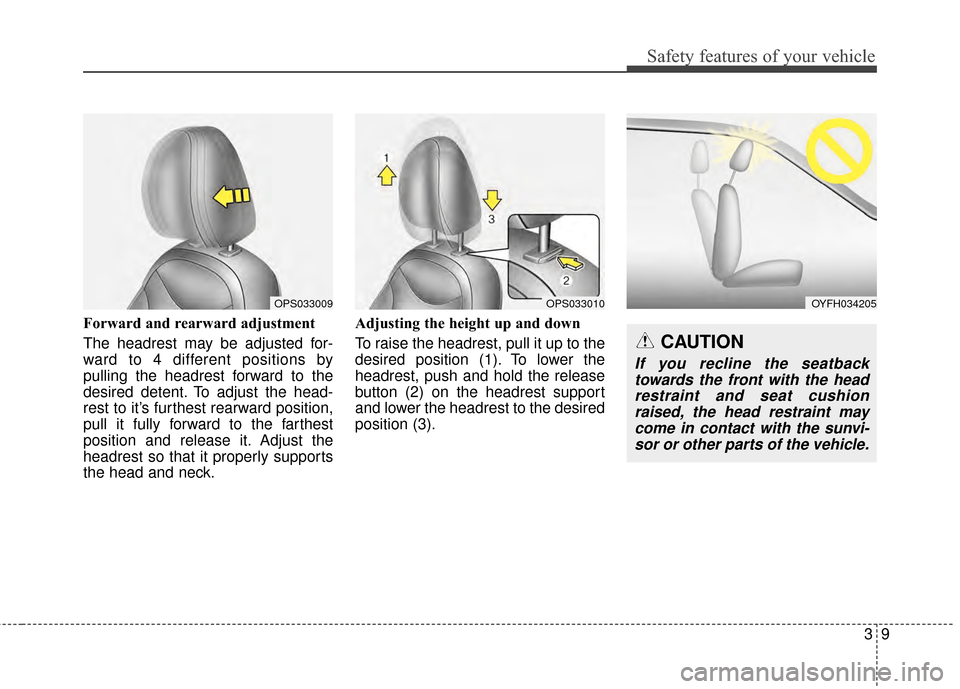
Forward and rearward adjustment
The headrest may be adjusted for-
ward to 4 different positions by
pulling the headrest forward to the
desired detent. To adjust the head-
rest to it’s furthest rearward position,
pull it fully forward to the farthest
position and release it. Adjust the
headrest so that it properly supports
the head and neck.Adjusting the height up and down
To raise the headrest, pull it up to the
desired position (1). To lower the
headrest, push and hold the release
button (2) on the headrest support
and lower the headrest to the desired
position (3).
OPS033009OPS033010
CAUTION
If you recline the seatback
towards the front with the headrestraint and seat cushionraised, the head restraint maycome in contact with the sunvi-sor or other parts of the vehicle.
OYFH034205
Page 26 of 500
Safety features of your vehicle
10
3
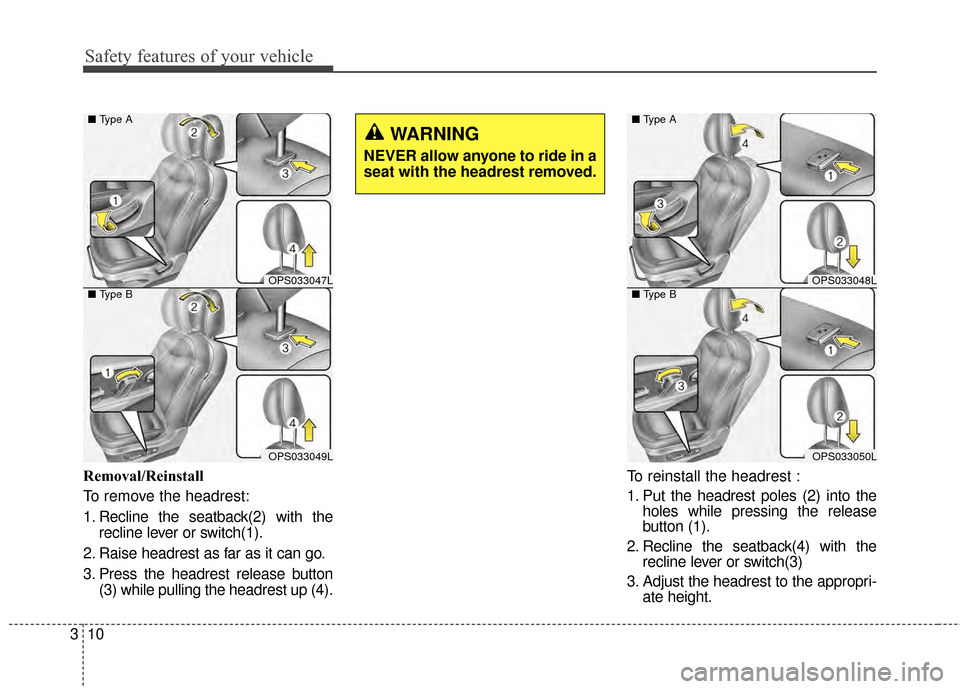
Removal/Reinstall
To remove the headrest:
1. Recline the seatback(2) with the
recline lever or switch(1).
2. Raise headrest as far as it can go.
3. Press the headrest release button (3) while pulling the headrest up (4). To reinstall the headrest :
1. Put the headrest poles (2) into the
holes while pressing the release
button (1).
2. Recline the seatback(4) with the recline lever or switch(3)
3. Adjust the headrest to the appropri- ate height.
WARNING
NEVER allow anyone to ride in a
seat with the headrest removed.
OPS033048L
OPS033050L
■ Type A
■ Type BOPS033047L
OPS033049L
■ Type A
■ Type B
Page 30 of 500
Safety features of your vehicle
14
3
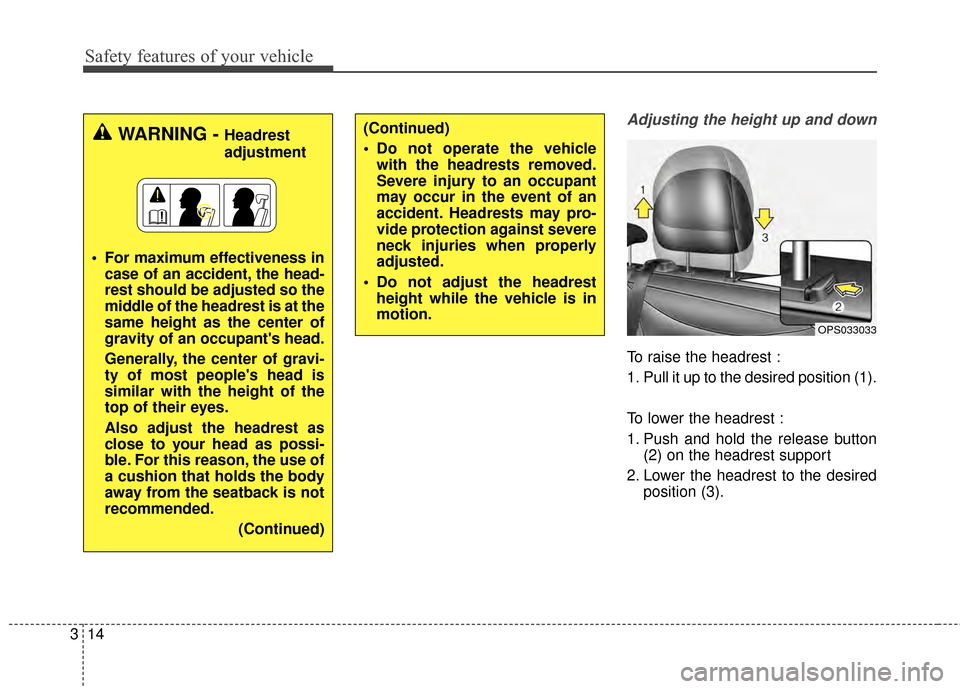
Adjusting the height up and down
To raise the headrest :
1. Pull it up to the desired position (1).
To lower the headrest :
1. Push and hold the release button
(2) on the headrest support
2. Lower the headrest to the desired position (3).
WARNING - Headrest
adjustment
For maximum effectiveness in case of an accident, the head-
rest should be adjusted so the
middle of the headrest is at the
same height as the center of
gravity of an occupant's head.
Generally, the center of gravi-
ty of most people's head is
similar with the height of the
top of their eyes.
Also adjust the headrest as
close to your head as possi-
ble. For this reason, the use of
a cushion that holds the body
away from the seatback is not
recommended.
(Continued)(Continued)
Do not operate the vehiclewith the headrests removed.
Severe injury to an occupant
may occur in the event of an
accident. Headrests may pro-
vide protection against severe
neck injuries when properly
adjusted.
Do not adjust the headrest height while the vehicle is in
motion.
OPS033033
Page 31 of 500
315
Safety features of your vehicle
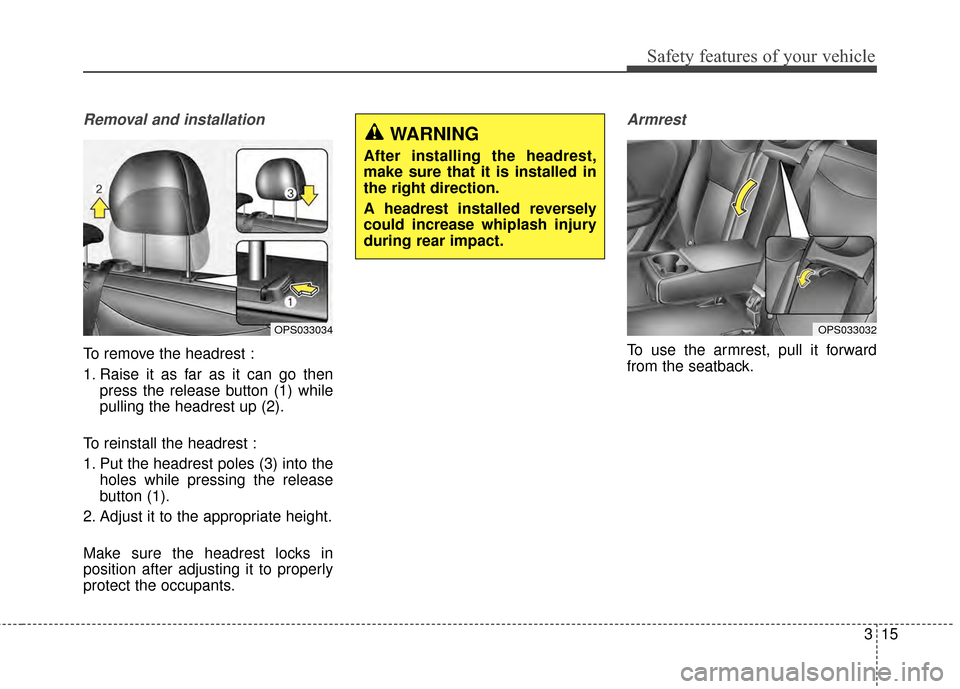
Removal and installation
To remove the headrest :
1. Raise it as far as it can go thenpress the release button (1) while
pulling the headrest up (2).
To reinstall the headrest :
1. Put the headrest poles (3) into the holes while pressing the release
button (1).
2. Adjust it to the appropriate height.
Make sure the headrest locks in
position after adjusting it to properly
protect the occupants.
Armrest
To use the armrest, pull it forward
from the seatback.
OPS033034OPS033032
WARNING
After installing the headrest,
make sure that it is installed in
the right direction.
A headrest installed reversely
could increase whiplash injury
during rear impact.
Page 35 of 500
319
Safety features of your vehicle
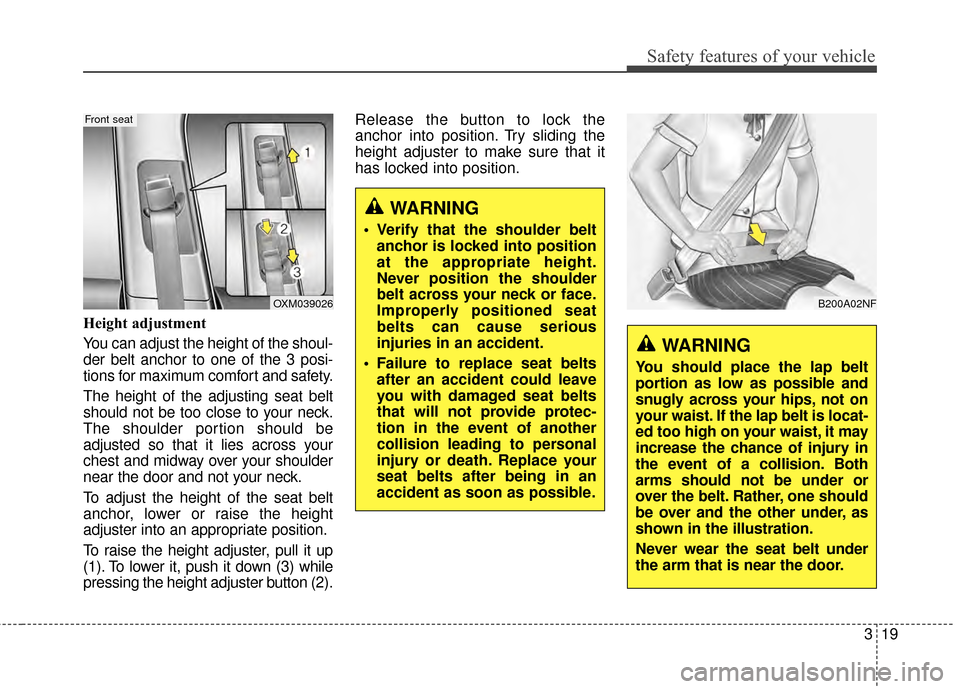
Height adjustment
You can adjust the height of the shoul-
der belt anchor to one of the 3 posi-
tions for maximum comfort and safety.
The height of the adjusting seat belt
should not be too close to your neck.
The shoulder portion should be
adjusted so that it lies across your
chest and midway over your shoulder
near the door and not your neck.
To adjust the height of the seat belt
anchor, lower or raise the height
adjuster into an appropriate position.
To raise the height adjuster, pull it up
(1). To lower it, push it down (3) while
pressing the height adjuster button (2).Release the button to lock the
anchor into position. Try sliding the
height adjuster to make sure that it
has locked into position.
B200A02NF
WARNING
You should place the lap belt
portion as low as possible and
snugly across your hips, not on
your waist. If the lap belt is locat-
ed too high on your waist, it may
increase the chance of injury in
the event of a collision. Both
arms should not be under or
over the belt. Rather, one should
be over and the other under, as
shown in the illustration.
Never wear the seat belt under
the arm that is near the door.
WARNING
Verify that the shoulder belt
anchor is locked into position
at the appropriate height.
Never position the shoulder
belt across your neck or face.
Improperly positioned seat
belts can cause serious
injuries in an accident.
Failure to replace seat belts after an accident could leave
you with damaged seat belts
that will not provide protec-
tion in the event of another
collision leading to personal
injury or death. Replace your
seat belts after being in an
accident as soon as possible.
OXM039026
Front seat
Page 37 of 500
321
Safety features of your vehicle
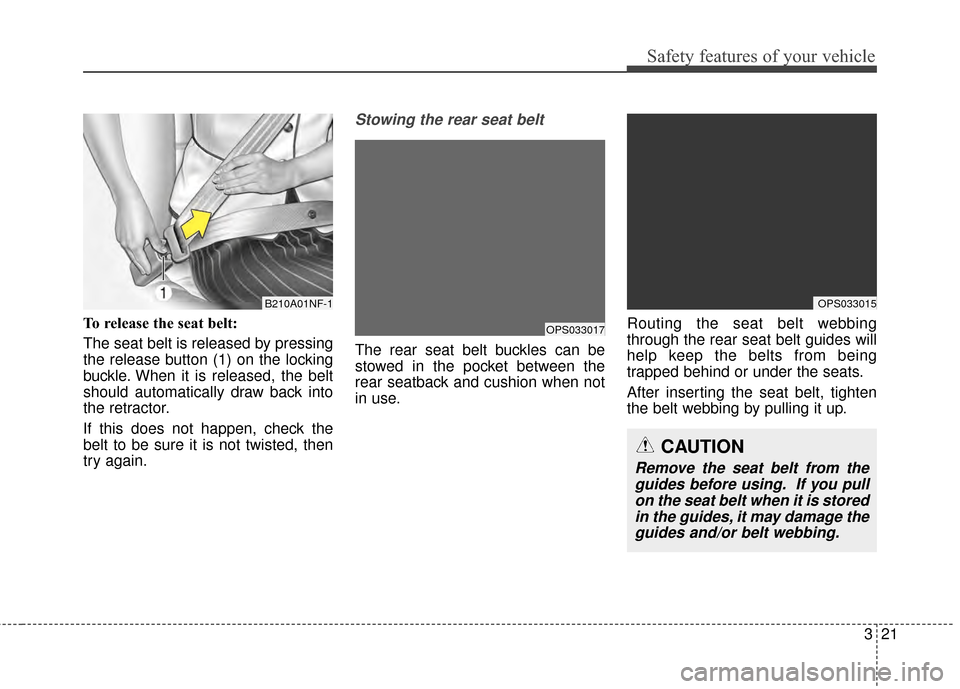
To release the seat belt:
The seat belt is released by pressing
the release button (1) on the locking
buckle. When it is released, the belt
should automatically draw back into
the retractor.
If this does not happen, check the
belt to be sure it is not twisted, then
try again.
Stowing the rear seat belt
The rear seat belt buckles can be
stowed in the pocket between the
rear seatback and cushion when not
in use.Routing the seat belt webbing
through the rear seat belt guides will
help keep the belts from being
trapped behind or under the seats.
After inserting the seat belt, tighten
the belt webbing by pulling it up.
CAUTION
Remove the seat belt from the
guides before using. If you pullon the seat belt when it is storedin the guides, it may damage theguides and/or belt webbing.
B210A01NF-1
OPS033017
OPS033015